The final lecture will briefly review the course aims and contents,
then conclude with a forward-looking discussion of possible future
directions in which the network might evolve.
The final lecture reviews how the Internet is changing,
to reduce latency, improve security, and avoid protocol ossification,
and discusses some of longer-term research work driving the evolution
of the network.

00:00:00.466
In this final lecture, I want to
00:00:02.300
talk about some possible future directions for
00:00:04.666
the development of the network.
00:00:07.900
So this course has focused on how
00:00:12.200
the Internet can change and evolve to address
00:00:14.966
some coming challenges.
00:00:18.233
It’s focused on the issues of how we establish
00:00:21.200
connections in an increasingly fragmented network,
00:00:24.466
thinking about the issues with network address
00:00:28.266
translation, the issues with the rise of
00:00:32.900
IPv6 and dual-stack hosts,
00:00:35.633
and I’ve spoken in some detail about
00:00:38.700
the challenges in establishing connections when the
00:00:42.133
machines are not necessarily in a common
00:00:44.166
addressing realm, and when there are multiple
00:00:46.866
different ways of potentially reaching a machine.
00:00:49.666
And this is techniques such as
00:00:51.966
the ICE algorithm for NAT traversal, the
00:00:54.633
Happy Eyeballs technique for connection racing for IPv6.
00:01:00.366
I’ve spoken about some of the issues with encryption, and
00:01:04.733
protecting against pervasive network monitoring,
00:01:08.433
and protecting against, and preventing,
00:01:12.033
transport ossification.
00:01:13.966
And this led to some of the
00:01:15.966
design of QUIC, with the entire protocol,
00:01:19.333
including the overwhelming majority of the transport
00:01:22.566
layer headers, being encrypted, and those which
00:01:24.900
are not encrypted being greased in order
00:01:27.533
to allow evolution.
00:01:29.566
And that's partly a security measure,
00:01:31.866
and it's partly an evolvability and
00:01:33.533
anti-ossification measure.
00:01:35.333
It’s looking at ways in which
00:01:37.666
we can keep changing the protocols by
00:01:39.833
deploying encryption to prevent middleboxes
00:01:42.333
interfering with our communications.
00:01:46.033
And I’ve spent a fair amount of
00:01:47.366
time talking about how we can reduce
00:01:49.166
latency, and support real-time and interactive content.
00:01:53.800
And, partly, this comes in, again,
00:01:55.800
in the design of protocols like QUIC,
00:01:58.133
in the design of TLS 1.3 with
00:02:01.400
reducing the number of round trips needed
00:02:03.166
to set up a connection.
00:02:06.066
It comes in, in
00:02:08.300
systems like content distribution networks that move
00:02:11.300
content nearer the edges, near the customers,
00:02:14.300
to reduce latency.
00:02:16.633
And it comes in, in the design
00:02:18.166
of real-time applications and protocols like RTP.
00:02:22.766
And I spoke about some of the
00:02:24.166
issues with congestion control, wireless networks,
00:02:27.366
and content distribution, and congestion control,
00:02:30.866
and how to make much more adaptive applications.
00:02:38.000
We’ve considered some of the challenges in
00:02:41.466
identifying content,
00:02:43.766
content distribution networks and naming, and how
00:02:48.600
you can securely
00:02:50.833
find the names for a piece of
00:02:53.233
content on the Internet that you want
00:02:54.866
to access, and how to do that
00:02:56.633
without being subject to phishing attacks.
00:02:59.366
And some of the challenges, and the
00:03:02.300
tussle for control of the DNS and naming,
00:03:05.666
and how those relate to censorship and
00:03:08.300
filtering, but also how the DNS can
00:03:11.200
be used to support content distribution networks.
00:03:15.100
And we've spoken about routing, and efficient
00:03:19.066
content delivery, in the last lecture.
00:03:22.766
And some of this leads into discussions
00:03:25.233
about decentralisation of the network, and the
00:03:28.533
rise of hyper-giants and content distribution networks,
00:03:31.866
that centralise content onto
00:03:35.533
a small number of providers.
00:03:41.000
As we've seen, there’s a large number of challenges.
00:03:45.700
And as a result of that,
00:03:47.000
the Internet is actually in the middle
00:03:48.700
of one of its most significant periods
00:03:50.933
of change, that certainly I’ve seen in
00:03:54.933
the time I’ve been involved in networking.
00:03:58.333
We're seeing IPv6 beginning to be significantly deployed.
00:04:04.600
And, partly, this is providing for increased address space,
00:04:09.700
and increasing numbers of devices on the network.
00:04:12.900
But it is also flexible enough,
00:04:15.533
because of the size of that address
00:04:17.300
space, that people are starting to look
00:04:19.766
at what they can do with IPv6
00:04:22.200
to evolve the way the network is being developed.
00:04:26.266
It's flexible, in that it’s got enough
00:04:28.733
bits in the address, that semantics can
00:04:31.733
be assigned to the addresses. So bits
00:04:34.433
can have meaning other than, perhaps,
00:04:36.233
just the location of a device on the network.
00:04:39.400
And it's got a very flexible header
00:04:41.533
extension mechanism that can be used to
00:04:44.400
layer-in features,
00:04:46.733
provide extra semantics,
00:04:51.433
and provide application semantics, as part of
00:04:53.966
the packet headers, to allow special processing.
00:04:56.500
And people are starting to explore the
00:04:58.566
things you can do with IPv6 as
00:05:00.766
it gets more widely deployed.
00:05:04.733
We've seen TLS 1.3 be rolled-out,
00:05:07.966
and massively improve and simplify security.
00:05:11.566
And we've seen it be incorporated into
00:05:13.633
the QUIC protocol, as the basis for
00:05:16.200
future transport evolution.
00:05:19.233
And, I've described QUIC as essentially a
00:05:22.133
better version of TCP, or as an
00:05:25.000
encrypted version of TCP, which combines the
00:05:28.100
goals TCP and TLS, and also adds
00:05:31.166
this idea of multi-streaming.
00:05:33.533
But I think QUIC is actually going
00:05:35.133
to be the basis for a lot
00:05:37.000
more developments, and a lot more evolution.
00:05:40.366
We’re already seeing this, to some extent.
00:05:44.633
There is already a datagram extension to
00:05:47.533
QUIC going through the standards process,
00:05:50.233
to start supporting real-time applications effectively over
00:05:55.100
QUIC, and it's pretty clear that we're
00:05:57.233
going to see a lot more evolution
00:05:58.833
and development in that space, with people using QUIC
00:06:02.166
as the basis for future transport protocols,
00:06:05.100
for real-time and interactive applications, and so on.
00:06:10.733
And this has led to the coming,
00:06:13.700
I think, adoption of HTTP/3 as the
00:06:15.733
basis for evolving the web,
00:06:18.900
and HTTP growing beyond web documents to
00:06:21.966
include a much richer set of real-time
00:06:25.733
and interactive services.
00:06:30.866
And, in parallel to this, I think
00:06:32.733
we've seen the rise of changes to
00:06:35.100
the DNS, many ways of running DNS
00:06:38.266
over encryption, whether it's a DNS over
00:06:40.666
HTTPS, or over TLS, or over QUIC,
00:06:44.833
in order to get secure name resolution.
00:06:49.300
And to avoid some of the control
00:06:51.200
points. And we’re seeing CDNs and overlays
00:06:55.033
increasingly making use of DNS
00:06:58.100
for directing hosts of the content.
00:07:04.466
And I think we're seeing an increasing
00:07:06.900
tussle for control, between the different industries
00:07:11.300
and the different providers.
00:07:14.133
On the one hand we've got
00:07:17.100
the model I’m describing, with QUIC,
00:07:20.100
and TLS, and HTTP/3, and encrypted DNS
00:07:25.066
to allow the application providers, and their
00:07:28.133
customers, and the end-users, to talk directly,
00:07:33.133
and to limit the visibility of the
00:07:35.033
network into that communication.
00:07:38.200
And, on the other hand, we have
00:07:40.066
operators trying to build application awareness into
00:07:43.300
their networks, trying to increase the communication
00:07:47.533
between the network and the endpoints,
00:07:49.433
to improve performance, and to sell enhanced services.
00:07:53.800
And there’s a tussle, where it’s not
00:07:55.266
clear how it's going to play out.
00:08:01.566
So that's the current set of developments
00:08:06.300
in the network. And that's the areas
00:08:08.433
where I've been trying to focus on
00:08:10.333
in this course, describing how the network
00:08:12.666
is currently changing.
00:08:16.400
In this last part, I’d like to
00:08:17.866
talk a little bit about some of
00:08:19.166
the longer-term challenges, some of the longer
00:08:21.533
term directions for the network, and think
00:08:24.166
about where the network might be going,
00:08:26.566
not in the next five years but
00:08:29.300
in the next 10 to 20 years.
00:08:35.633
And what might be the long-term future
00:08:37.900
developments of the Internet.
00:08:40.633
And, to be clear, what's coming in
00:08:43.233
the remainder of this part is speculative.
00:08:45.833
It’s my biased opinion of where I
00:08:48.766
see the network going, based on my
00:08:50.466
interests, based on the research that I
00:08:53.000
have seen happening.
00:08:55.433
But it's very much speculative. It may not come true.
00:09:02.133
But it's pointing to areas which I think
00:09:04.933
are interesting developments.
00:09:07.000
And nothing in this section is going to be assessed.
00:09:13.766
So where's the network going in the long term?
00:09:17.666
Well, I think, to get some understanding of
00:09:20.833
that, we need to look at the process by which
00:09:23.900
new ideas, new research, get incorporated into the network.
00:09:30.800
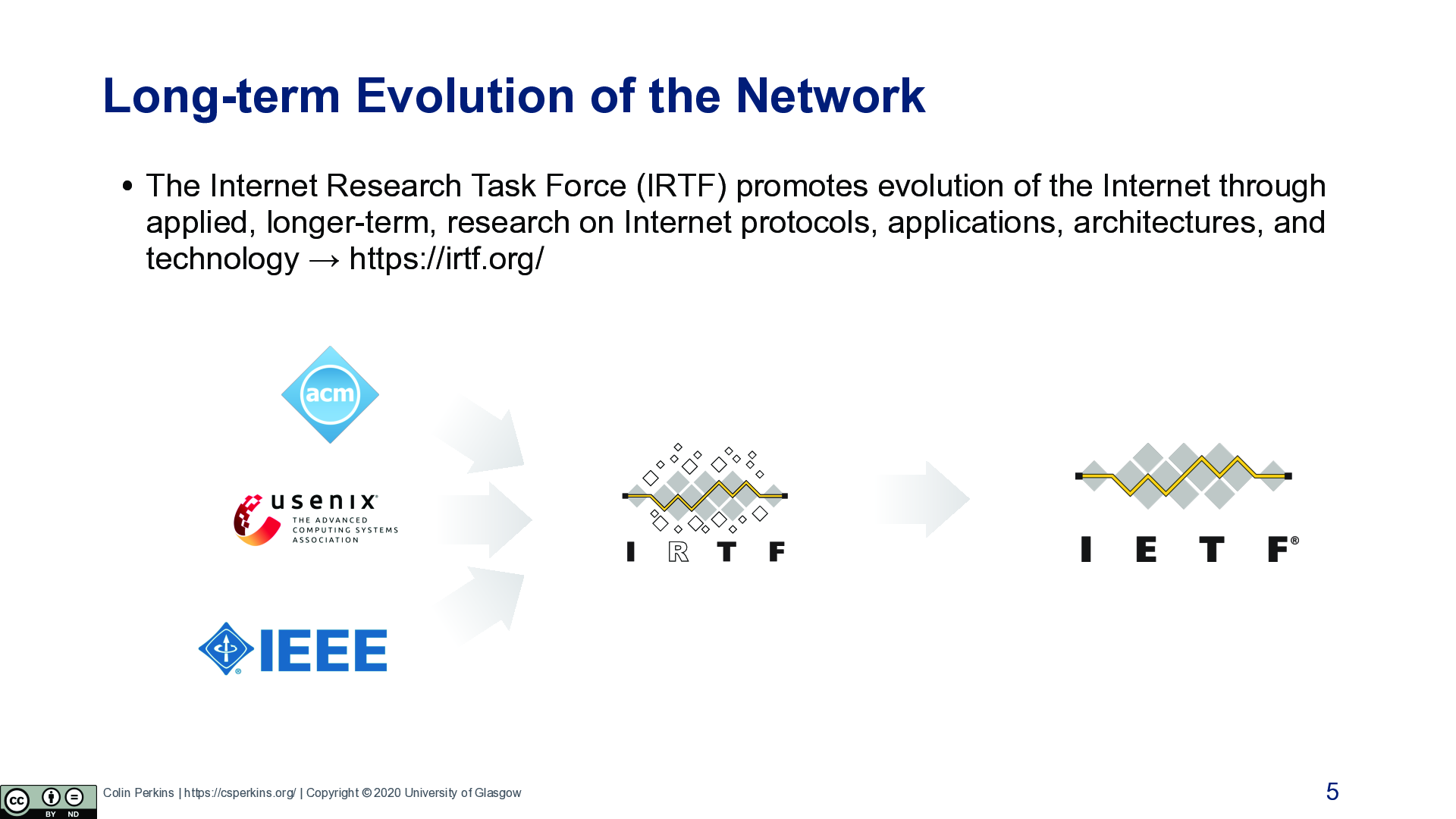
And, on the one hand, what we
00:09:32.466
see on the left of this slide, we have
00:09:34.266
the organisations that promote research
00:09:38.266
into computer networks.
00:09:40.166
The Association for Computing Machinery,
00:09:43.166
the USENIX Association, and the IEEE,
00:09:46.533
all of whom sponsor
00:09:50.100
both industrial and academic research in this
00:09:53.033
area, all of whom publish research in this area.
00:09:58.433
And this is the pure research side
00:10:01.666
of network development. This is people speculatively
00:10:05.533
trying to understand how the network could change.
00:10:08.900
In the middle, you have organisations like
00:10:12.166
the IRTF, the Internet Research Task Force,
00:10:15.500
which try to form the bridge between
00:10:19.200
these research organisations
00:10:20.666
and the standards organisations,
00:10:22.333
such as the IETF, which develop the
00:10:25.533
standards which we actually deploy.
00:10:29.000
And one of the other activities I have,
00:10:31.433
is that I chair the IRTF.
00:10:34.433
And the IRTF is a body which
00:10:38.100
promotes the evolution of the Internet.
00:10:40.433
It’s promoting the longer-term research and development
00:10:44.233
of the Internet protocols, and, as I say,
00:10:45.933
it's trying to bridge these organisations together.
00:10:49.400
And so by looking at some of
00:10:51.033
the work that's happening in the IRTF,
00:10:53.100
we can perhaps get an idea of
00:10:54.433
how the network might evolve, and what's
00:10:56.500
coming down the pipeline towards standardisation.

00:11:02.800
So the IRTF is organised as a
00:11:06.033
set of research groups, which focus on
00:11:08.366
longer-term development of ideas and protocols.
00:11:13.033
And it's organised to provide a forum where
00:11:15.633
the researchers and the engineers can
00:11:17.433
explore the feasibility of different research ideas.
00:11:20.766
And where the researchers,
00:11:23.833
developing ideas for the future of the
00:11:26.166
network, can learn from the engineers,
00:11:28.766
and the operators, who actually build and
00:11:30.500
operate the Internet.
00:11:32.166
But, equally, where the standards developers,
00:11:34.866
the engineers, the operations community, the implementors,
00:11:37.966
can learn from the research community.
00:11:40.566
Where the two can come together.
00:11:44.233
As I say, it’s organised as a
00:11:45.533
set of research groups. There’s currently 14
00:11:49.033
research groups that are listed on the
00:11:51.966
slide, I’ll talk about these in a
00:11:54.500
little more detail in a minute.
00:11:56.766
And as we can see, they’re covering a wide range of topics.
00:12:00.366
And there’s also an annual workshop we
00:12:03.433
organise, to help bring the communities together.

00:12:10.333
So what do the research groups do?
00:12:14.700
Well, they’re focused on several different topic areas.
00:12:19.766
One of which is the
00:12:22.866
space around security, and privacy, and human rights.
00:12:30.333
The cryptographic forum research group, the CFRG,
00:12:35.433
focuses on long-term development
00:12:38.566
of cryptographic primitives, and cryptographic techniques,
00:12:41.966
and guidance for using those techniques.
00:12:44.733
This is a research group looking at
00:12:47.700
new cryptographic algorithms, replacements for AES,
00:12:53.266
replacements for elliptic curve cryptography,
00:12:56.800
new elliptic curve algorithms, and the like.
00:13:01.700
And this is focused, very much, on
00:13:06.000
techniques, cryptographic techniques,
00:13:08.966
which support various privacy-enhancing
00:13:11.900
technologies. And it's beginning to focus on
00:13:15.166
post quantum cryptography, and cryptographic techniques that
00:13:19.566
can work in a world with working
00:13:22.500
quantum computers.
00:13:25.466
We have a privacy-enhancing technologies group,
00:13:29.633
which is focused on
00:13:32.933
the challenges of metadata in the network,
00:13:36.533
focusing on the challenges
00:13:39.833
of building a network that doesn't use
00:13:42.300
addresses, or that hides IP addresses,
00:13:45.266
in a way that prevents tracking.
00:13:47.466
And ways of providing privacy-enhancing logins,
00:13:53.166
and authentication tokens, and the like,
00:13:55.600
that can avoid tracking.
00:13:58.500
And we have a human rights protocol
00:14:00.966
considerations group, which is beginning to look
00:14:04.466
at, and understand, how Internet protocols and
00:14:07.066
standards affects human rights and privacy at
00:14:10.100
the Internet infrastructure level.
00:14:12.766
And it's looking at the
00:14:17.833
right of freedom of association on the
00:14:20.266
Internet, for example, and how that's affected
00:14:23.533
by protocol design.
00:14:25.866
It’s looking at
00:14:29.766
how protocols affect inclusivity and access,
00:14:34.733
and so on, and it's looking at
00:14:36.700
the politics of protocols.
00:14:39.866
And these three groups, are looking at
00:14:41.533
the interplay between security, privacy, and human rights,
00:14:44.300
and trying to raise awareness of
00:14:46.233
the broader societal and policy issues in
00:14:49.000
the standards community.
00:14:55.200
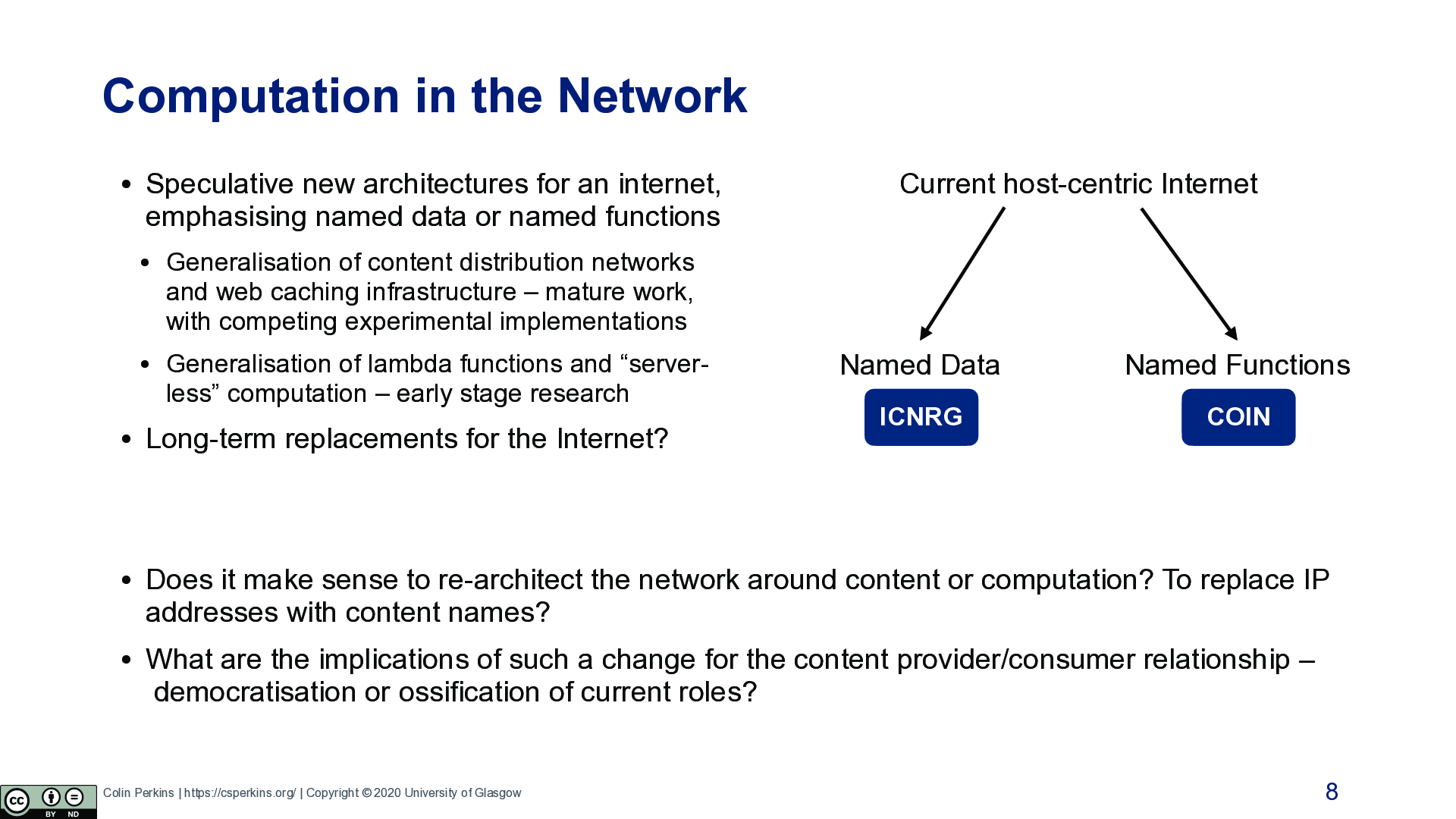
There's an interesting, I think, thread of
00:14:58.366
technical development, looking at the combination of
00:15:02.866
networks and distributed systems.
00:15:05.966
Looking at speculative new architectures for the internet,
00:15:09.700
which either emphasise data or emphasise computation.
00:15:15.366
If you think about the current network,
00:15:18.500
IP addresses identify devices, they identify attachment
00:15:22.233
points for devices in the network.
00:15:25.033
And these groups are looking at
00:15:28.066
the generalisation of content distribution networks,
00:15:31.566
and web caching infrastructure, and thinking about
00:15:34.266
what would happen if we replaced IP
00:15:36.366
addresses with content identifiers?
00:15:38.866
So the network would route towards particular
00:15:41.766
items of content, rather than routing packets
00:15:44.700
towards particular locations.
00:15:47.166
Or they’re looking at
00:15:50.100
generalising the network so it routes towards
00:15:54.300
addresses, and routes toward was named functions,
00:15:57.600
which are generalising the idea of serverless computation.
00:16:02.833
And the idea of both of these
00:16:04.000
groups is to think about what might
00:16:05.933
happen if you rearchitect the network around
00:16:08.333
either content, or computation, or both.
00:16:11.666
And think about the merger of communication,
00:16:16.066
data centres, computation, and data warehouses,
00:16:20.066
to form one large distributed system,
00:16:23.266
rather than an interconnection network which connects
00:16:26.933
compute devices, data stores, at the edges.
00:16:30.933
And thinking about what are the implications
00:16:34.000
for this change, towards a network with
00:16:36.333
ubiquitous data, or ubiquitous computation, for the
00:16:40.600
content provider/consumer relationship.
00:16:43.400
Thinking about will this help democratise the
00:16:46.500
network, will it help ensure a more
00:16:48.333
decentralised network.
00:16:50.966
will it help with hosting content throughout
00:16:54.233
the network in a way which empowers consumers,
00:16:56.866
or will it simply ossify the current
00:16:59.400
roles, and the current content distribution networks,
00:17:02.466
and large scale cloud providers.
00:17:04.400
And it’s looking at alternative architectures,
00:17:07.066
and how it can influence the way forward.
00:17:11.366
And all this leads to networks which
00:17:13.333
no longer have IP addresses as their
00:17:15.666
core, that no longer have the Internet
00:17:17.400
Protocol as their core, but are much
00:17:19.466
more about distributed computation and data.
00:17:27.000
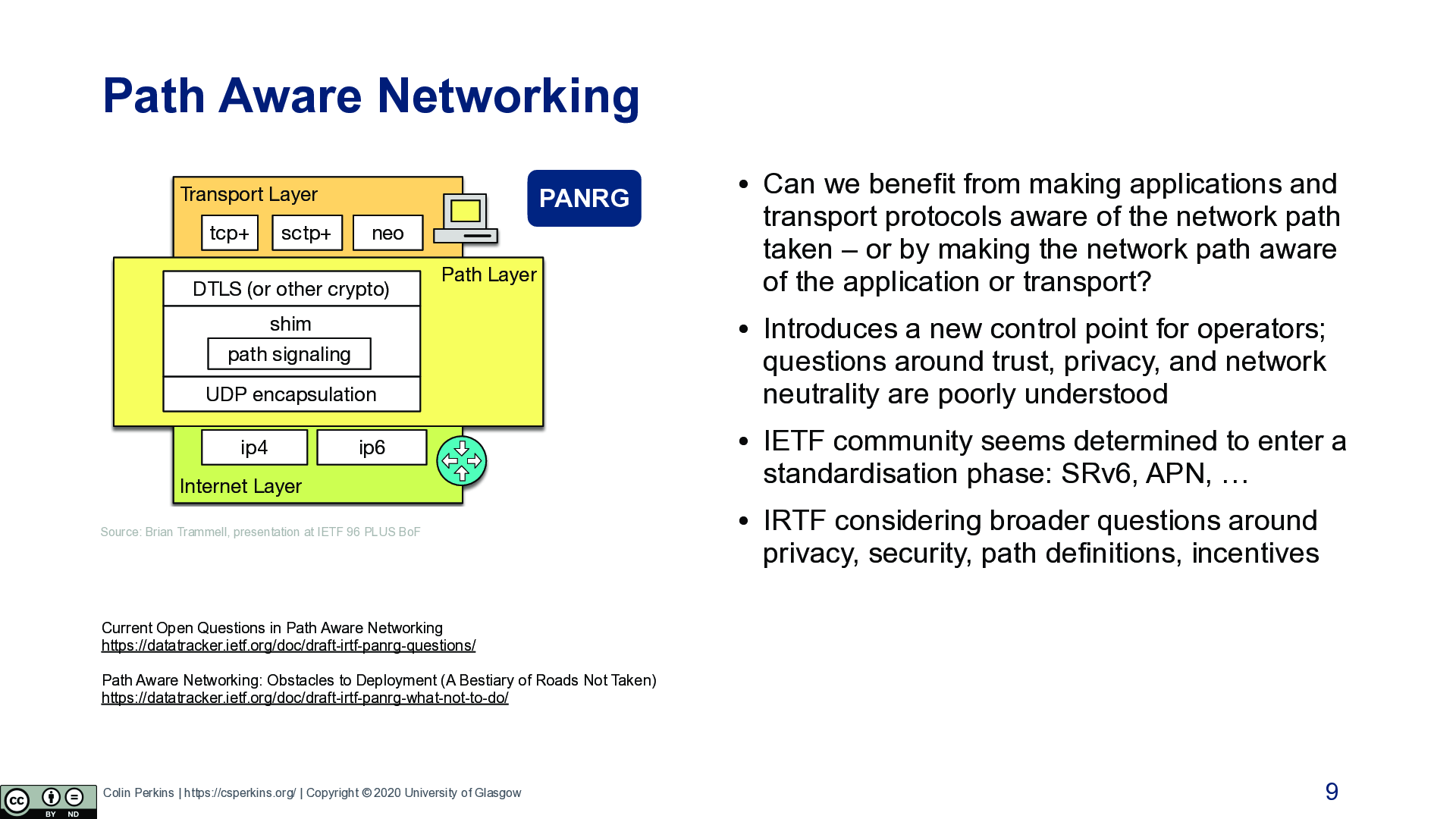
There's a research group looking into a
00:17:29.833
technique, known as path aware networking.
00:17:33.866
And this is the idea of trying
00:17:35.566
to explore what can happen if we
00:17:38.166
make the applications, and the transport protocols,
00:17:41.500
much more aware of the network path,
00:17:44.300
and the characteristics of the network path.
00:17:47.233
Or, similarly, if we make the network
00:17:49.433
much more aware of the applications and
00:17:51.300
the transports that are running on it.
00:17:55.400
And this potentially has benefits, it potentially
00:17:58.133
has benefits for improving the quality of
00:18:00.800
service, for allowing applications to request special
00:18:04.800
handling in the network to improve performance,
00:18:08.700
and to maybe request low-latency service,
00:18:13.133
or specialised in network processing.
00:18:18.633
But, equally, it has potential challenges,
00:18:21.600
because it introduces a control point.
00:18:23.600
It introduces a way for the operators
00:18:26.333
to control the types of applications that
00:18:28.333
can run on the network.
00:18:30.866
And there are some significant questions around
00:18:33.066
trust, and privacy, and network neutrality,
00:18:36.266
which are relatively poorly understood.
00:18:40.600
And this is an area where we
00:18:41.933
see the IETF community currently seems determined
00:18:45.466
to enter a standardisation phase.
00:18:48.233
There's a technique called segment routing,
00:18:51.266
and segment routing in IPv6, SRv6,
00:18:54.733
which is starting to
00:18:57.500
work its way through the standardisation process,
00:19:00.300
and it's starting to get some traction,
00:19:02.433
which is building some of this application
00:19:04.933
awareness into the network infrastructure.
00:19:07.833
And there’s technique called APN,
00:19:10.266
which is an application-aware networking scheme,
00:19:12.600
that’s going in the same direction.
00:19:15.400
And, a number of
00:19:18.300
large Internet companies are pushing in the space.
00:19:24.733
In the IRTF, the research groups,
00:19:27.466
I think, they’re looking at some of
00:19:29.033
the more broad questions, trying to
00:19:31.333
understand what are the privacy implications,
00:19:33.466
what are the security implications, and what
00:19:37.200
are the incentives for both the endpoints to deploy
00:19:40.666
these features, for the applications to deploy
00:19:43.333
these path-aware features, and for the operators
00:19:46.266
to enable them. And how does it
00:19:50.100
shift the balance of control between the
00:19:52.166
applications, and the end-users, and the network operators.
00:19:56.633
And I think there's some interesting unsolved
00:19:58.466
questions in that space.

00:20:04.100
In the longer term, we have a
00:20:06.166
group looking at designing the quantum Internet.
00:20:11.233
And the idea, here, is that it
00:20:14.366
seems likely that people will
00:20:17.400
manage to build working, large-scale, quantum computers
00:20:22.166
in the next few years.
00:20:25.933
And if they do that, they will
00:20:27.466
want to network and interconnect those computers.
00:20:30.600
The quantum Internet group is looking at
00:20:34.700
how we can architect a network that
00:20:36.766
provides quantum entanglement as a service.
00:20:40.133
It’s looking at how to build global-scale
00:20:43.700
distributed quantum computers.
00:20:47.700
And this is very much the exchange
00:20:50.533
of Bell Pairs; it’s the exchange of
00:20:52.800
quantum entangled state.
00:20:57.166
And it’s leading to a surprisingly traditional
00:21:01.566
network architecture. A control plane that looks
00:21:05.100
like the control plane used in a
00:21:07.733
lot of Internet service provider networks for
00:21:10.433
traffic engineering.
00:21:11.766
But rather than managing circuits and traffic
00:21:14.800
flows, it manages the setup of optically
00:21:18.166
clear paths, which can be used to
00:21:20.933
transmit entangled photons,
00:21:23.300
to manage entangled quantum state.
00:21:27.266
And this group’s coming to the conclusion
00:21:31.133
of its architecture development phase, and is
00:21:34.300
starting to build experiments, starting to prototype
00:21:38.166
these systems, and see if they actually work.
00:21:41.566
And people are actually starting to build
00:21:43.800
the initial versions of the quantum Internet,
00:21:47.600
and do at least small-scale experiments with
00:21:50.500
networked quantum computers and quantum entanglement.
00:21:59.300
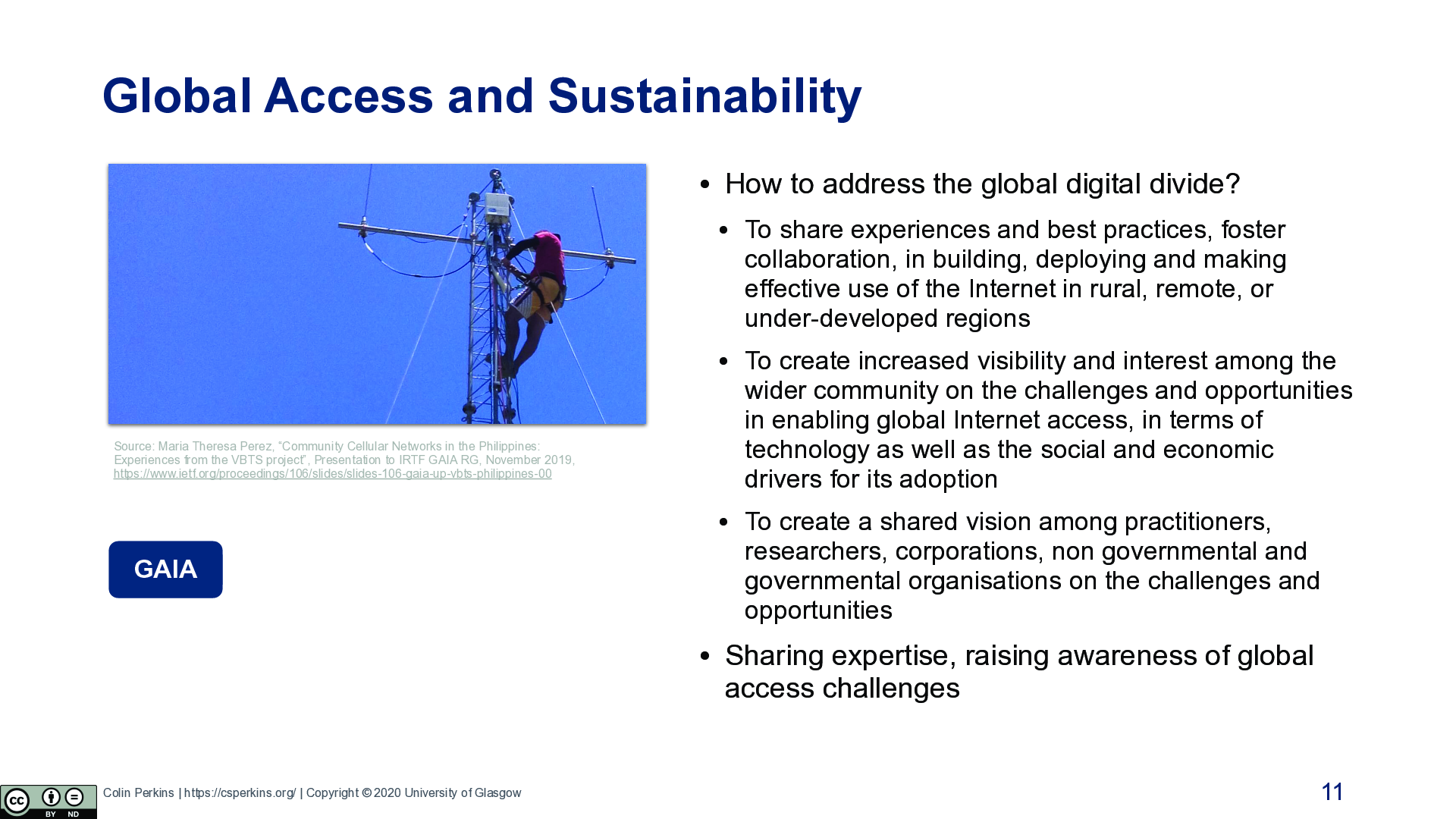
And, perhaps more pressingly,
00:22:02.533
we have a group, the Global Access
00:22:04.766
to the Internet for All group,
00:22:06.366
which is looking at global access and
00:22:07.966
sustainability. And it's looking about how to
00:22:10.466
address the global digital divide.
00:22:14.500
It's trying to share experiences and best
00:22:18.733
practices, foster collaboration in helping build,
00:22:22.866
and develop, and make effective use of
00:22:25.200
the Internet in rural, and remote,
00:22:27.733
and under-developed regions. And there’s a lot
00:22:30.966
of interest, a push towards community run,
00:22:34.833
community led, networks
00:22:38.133
to provide a more sustainable, more locally
00:22:42.100
run network, which reflects the needs of
00:22:45.733
the local communities, rather than the mega-corporations.
00:22:49.900
And it's trying to develop a shared
00:22:52.066
vision towards building a sustainable global network.
00:22:57.066
And, most of the focus here is
00:22:58.866
on developing countries, and on
00:23:01.866
building a fairer, more sustainable, network in
00:23:05.966
those parts of the world. But it's
00:23:08.266
also looking at access for less developed,
00:23:13.466
perhaps more rural regions, of
00:23:17.566
the world. And there's been some interesting
00:23:21.233
work trying to build community networks in
00:23:24.700
the Scottish Highlands and Islands, for example,
00:23:28.166
where there’s more constrained infrastructure.
00:23:32.033
But it's also talking about energy efficiency,
00:23:35.900
and renewable power, and building networks which
00:23:40.666
work much more sustainably.
00:23:46.066
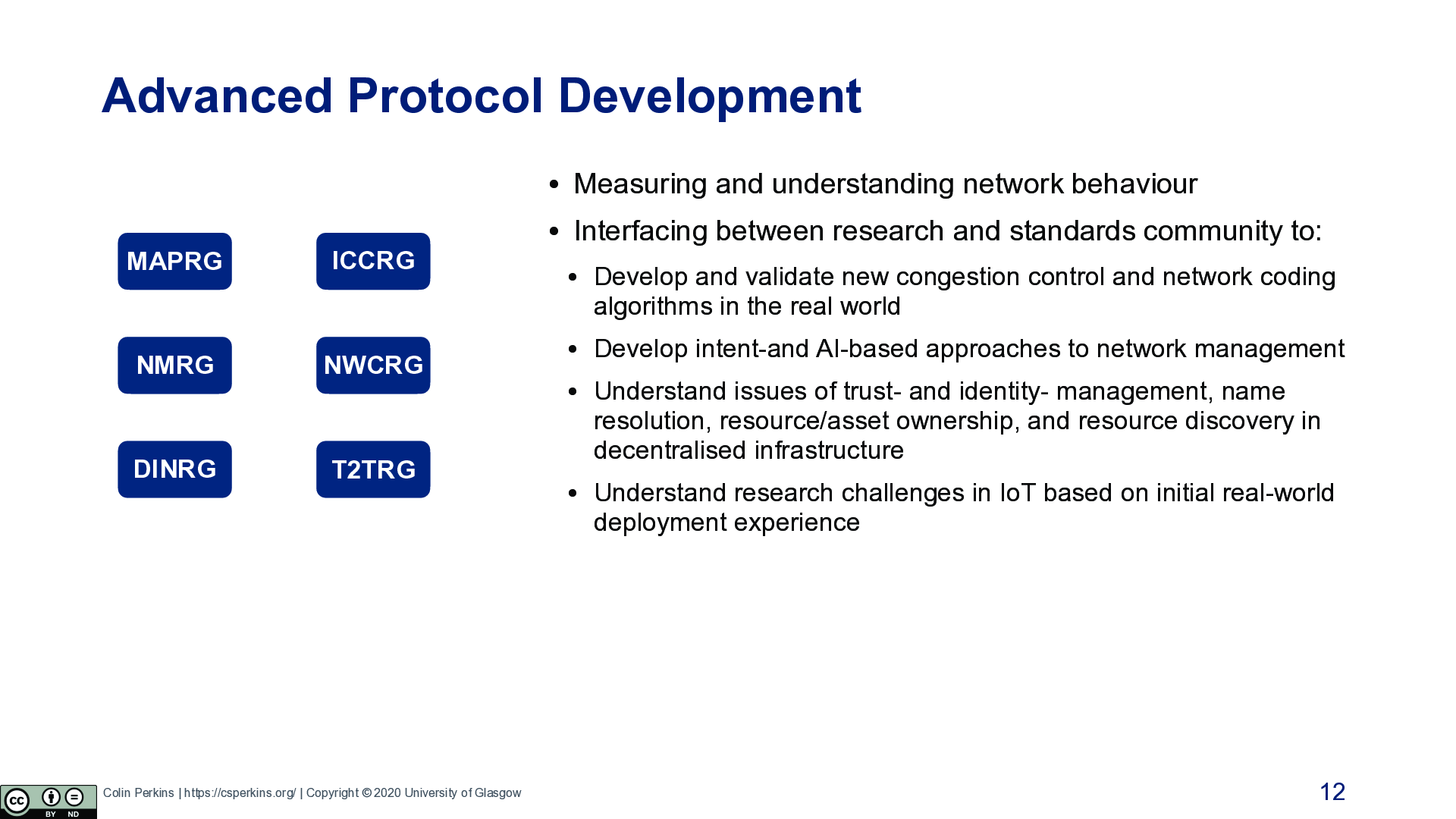
And there are other groups, which I
00:23:48.466
don't have time to talk about in
00:23:49.866
detail, looking at measuring and understanding network
00:23:55.100
behaviour, in the measurement and analysis protocols group.
00:23:59.666
Looking at developing new congestion control,
00:24:04.666
network coding algorithms to improve performance and
00:24:08.133
make applications more adaptive.
00:24:10.733
Looking at intent- and
00:24:13.400
artificial intelligence-based approaches
00:24:15.833
to managing and operating networks.
00:24:19.200
Understanding the issues of trust, and identity
00:24:22.600
management, and name resolution, and resource ownership,
00:24:25.966
and discovery, in decentralised infrastructure networks.
00:24:29.966
And looking at some of the challenges,
00:24:32.800
the research challenges, from initial, broad,
00:24:35.833
real-world deployments of Internet-of-Things devices,
00:24:38.933
and how we can make those devices more sustainable,
00:24:42.066
more programmable, and more secure.

00:24:49.466
The key thing I want to get
00:24:52.100
across is that the network, the Internet, is not finished.
00:24:58.266
The protocols and fundamental design are still
00:25:01.400
evolving, they're still changing.
00:25:05.933
There's a,
00:25:08.200
perhaps, a view of networking you get
00:25:11.566
from reading various textbooks that
00:25:15.366
the Internet is IPv4, and TCP, and the web.
00:25:21.700
And it's always been that, and it always will be that.
00:25:25.833
But nothing could be further from the truth.
00:25:29.400
The fundamental infrastructure has
00:25:32.566
massively shifted over the last few years.
00:25:35.400
And I think we're in the middle of this enormous
00:25:37.433
transition, and we are getting rid of
00:25:40.133
IPv4, and we are getting rid of
00:25:42.833
TCP, and we're getting rid of HTTP/1.1
00:25:46.400
and the traditional web infrastructure.
00:25:49.066
With IPv6 and QUIC, we're seeing a
00:25:52.800
radical restructuring of both the network infrastructure
00:25:56.200
layer, the IP layer, to support more
00:25:59.566
addresses, and to support more programability,
00:26:02.433
to support more application semantics.
00:26:05.600
But also the transport and the web layers,
00:26:09.033
to replace TCP, and better support real-time
00:26:12.700
and multimedia transport, and to be more
00:26:14.533
secure and more evolvable.
00:26:17.100
And the network is in the middle
00:26:18.866
of this enormous shift.
00:26:22.333
And, looking forward, I think there are
00:26:23.933
potentially even more significant changes to come,
00:26:26.833
with a merger of computation and communication
00:26:31.233
and data centres as one
00:26:33.700
global-scale distributed system.
00:26:36.366
With some of the ideas around path awareness,
00:26:39.766
the quantum Internet,
00:26:40.800
some of the security and sustainability challenges.
00:26:44.366
The network is not finished.
00:26:46.233
The network is keeping changing.
00:26:48.266
There’s still some exciting developments to come.

00:26:56.100
And that’s, essentially, all I have for this course.
00:27:02.466
To wrap up.
00:27:05.633
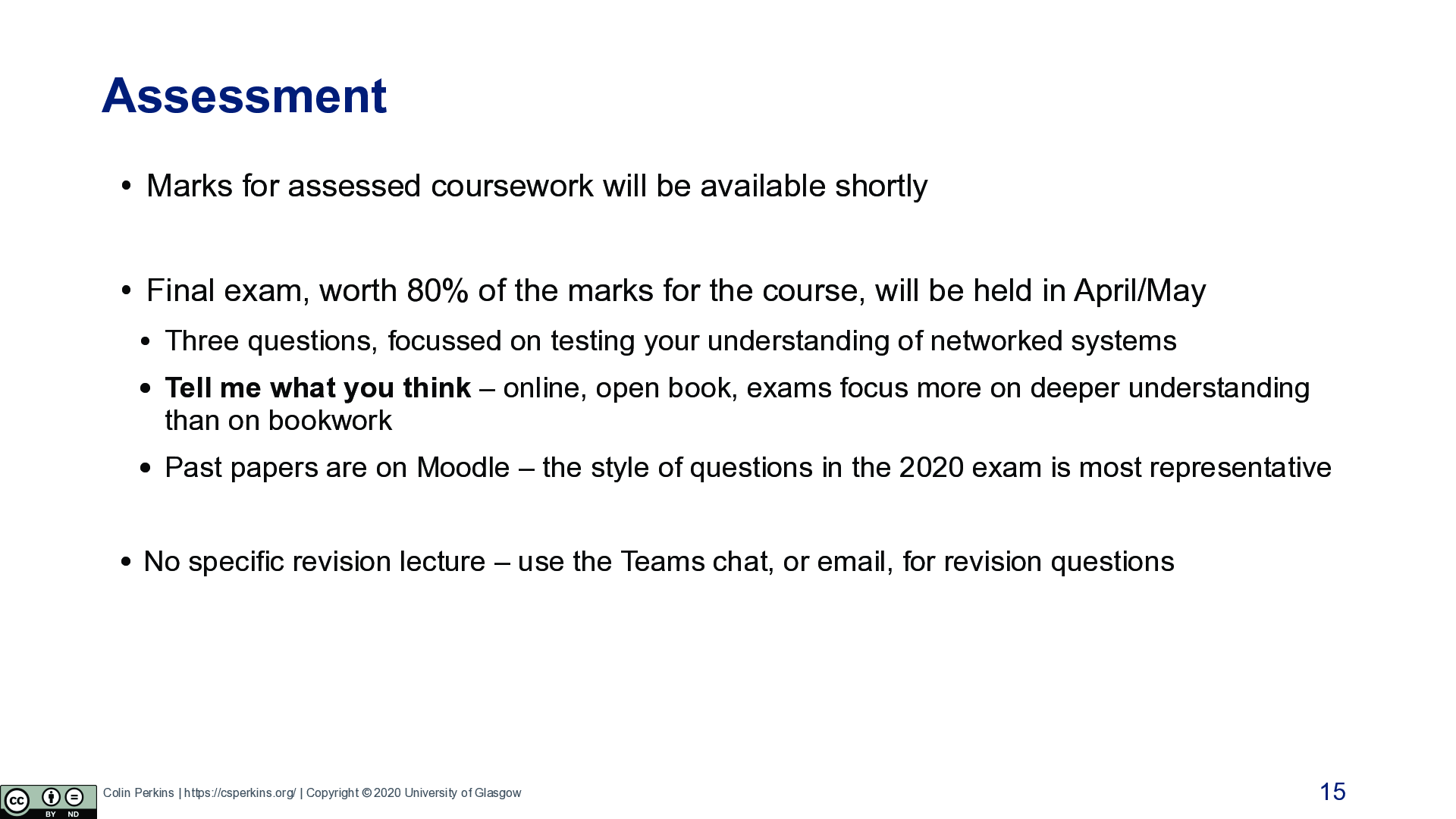
There will, of course, be an assessment at the end.
00:27:10.933
There'll be a final exam, and it
00:27:14.566
will be worth the usual 80%,
00:27:17.666
and will be held in the April/May
00:27:19.200
time frame as expected.
00:27:23.800
The exam is structured as a set
00:27:26.066
of three questions. It’s an "answer all
00:27:29.500
three questions” rubric.
00:27:31.566
And it will be focused on testing
00:27:33.233
your understanding of networked systems.
00:27:38.033
When answering the exam questions, tell me
00:27:41.633
what you think, and justify your answers.
00:27:48.066
The type of online, open book,
00:27:51.366
exams that we are forced to do
00:27:54.866
these days, focus much more on deeper
00:27:59.200
understanding of material, and much less on
00:28:02.533
book-work and memorisation.
00:28:06.233
There's little point asking an exam question which
00:28:13.100
tests your memory, when you're doing this,
00:28:16.666
when you're doing the exam online from
00:28:19.633
home, and you have Google next to you.
00:28:22.966
So the questions will be focussed more
00:28:24.966
on testing your understanding, than on your
00:28:27.600
testing your recall.
00:28:30.466
There are past exam papers on moodle.
00:28:33.233
The past exam papers go back some number of years.
00:28:37.200
As you may perhaps expect, the exam
00:28:39.866
questions from 2020 are probably more representative
00:28:43.933
of the style of this year's exam
00:28:46.000
than the older papers, although there are
00:28:48.866
certainly questions in this style going back
00:28:51.933
for many years.
00:28:55.900
The assessed coursework, the marks will be
00:28:59.233
available shortly, and
00:29:02.733
I apologise that it's taken a little
00:29:05.333
while to talk to mark some of that.
00:29:08.333
There's no specific revision lecture, but we
00:29:11.566
have the Teams chat, and we have
00:29:13.200
email, so please get in touch if
00:29:15.033
you have questions about the material.
00:29:19.066
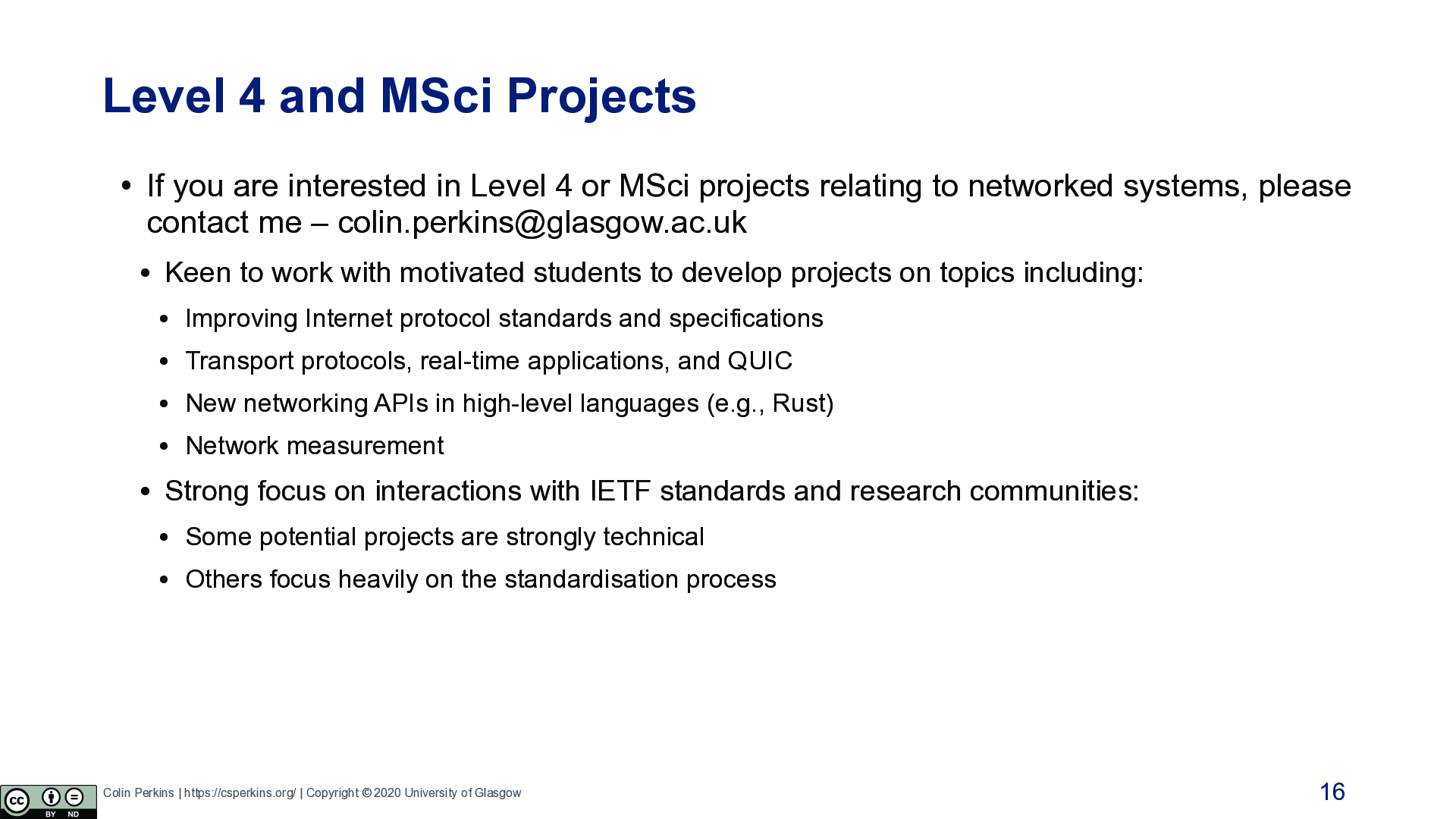
And, looking forward to next year,
00:29:21.566
if you're interested in doing Level 4
00:29:24.933
or MSci projects relating to networked systems,
00:29:27.966
then please get in touch with me,
00:29:29.900
send me email on the address.
00:29:32.566
I’m always very keen to work with
00:29:34.900
motivated students to develop projects.
00:29:38.633
My particular interests, I think, are around
00:29:42.900
improving Internet Protocol standards and specifications,
00:29:47.666
and working with the IETF and IRTF
00:29:50.600
communities to improve the way we build standards.
00:29:54.600
They’re about improving transport protocols,
00:29:57.200
real-time applications, and QUIC.
00:30:01.133
They’re about building alternative networking APIs,
00:30:05.466
and thinking about how we can use
00:30:07.566
modern, high-level, languages like Rust to change
00:30:11.600
the way we program networks, make network
00:30:14.300
programming easier, more flexible, and higher performance.
00:30:17.600
And they’re about measuring and understanding the network.
00:30:21.433
So if you have any interest in
00:30:23.266
any of those topics, please come and talk to me.
00:30:27.966
I tend to try and set projects,
00:30:30.700
do research, which has a strong focus
00:30:33.300
on interaction with the research communities,
00:30:36.800
interaction with the IETF standards.
00:30:39.333
And I have a range of project ideas,
00:30:42.633
and projects can go in a
00:30:43.866
range of different ways, some of which
00:30:45.833
are very strongly technical, some of which
00:30:48.333
focus much more heavily on the standardisation process,
00:30:52.100
and the way in which standards,
00:30:56.266
and protocols, are developed, and are looking
00:30:59.033
at the social and political aspects of
00:31:01.666
the way the Internet is developing.
00:31:04.033
So, as I say, if you have
00:31:05.333
an interest in any of these topics,
00:31:08.433
please come talk to me.

00:31:13.166
And that's all we have.
00:31:15.200
That's what I want to say about networks.
00:31:17.666
Thank you for your attention over the past few weeks.
00:31:22.600
I hope you have found some of the material interesting,
00:31:25.733
and if you have questions or comments
00:31:28.000
or things you'd like to discuss further,
00:31:29.666
please do get in touch. Thank you.