Lecture 7: Concurrency
Lecture 7 discusses concurrency. It talks about how multicore systems
are driving increasingly concurrent programming, and hot the commonly
used approach to concurrent code, using threads, locks, and shared
mutable state, is problematic. It introduces transaction-based and
message passing models as possible alternatives that might make
concurrent programming simpler in future.
Part 1: Implications of Multicore
The first part of the lecture talks about the implications of multicore
systems on programming. It outlines the need for modern programming
languages to have a well-defined memory model, and outline the memory
model adopted by Java. It talks about the common concurrency model of
threads and shared mutable state protected by locks, and discusses the
limitations and problems inherent in this model. And it starts to
introduce alternative concurrency models that will form the basis for
the discussion in later parts of the lecture.
00:00:00.700
In this lecture, I’d like to move
00:00:02.566
on from discussing memory management and garbage
00:00:04.900
collection, and talk instead about concurrency.
00:00:09.233
In this part, I’ll talk about some
00:00:11.466
implications of multicore hardware on the way
00:00:13.966
we write concurrent programs. In particular,
00:00:16.433
I’ll discuss how memory is arranged in
00:00:18.566
multicore systems and how this affects the
00:00:20.800
threading model for software running on those systems.
00:00:24.033
Then, in the following parts of the
00:00:26.066
lecture, I’ll talk about two alternative approaches
00:00:28.633
to concurrency, using transactions and message passing.
00:00:32.866
And, finally, I’ll talk about the impact
00:00:35.466
of race conditions on concurrent systems.
00:00:39.500
I’d like to begin, though, by talking
00:00:41.933
about some implications of multicore hardware.
00:00:46.000
As we discussed back in Lecture 2,
00:00:48.133
computing systems are increasingly
00:00:49.900
providing multicore support.
00:00:52.466
It’s now difficult to buy uniprocessor systems,
00:00:55.666
and systems with four or eight cores
00:00:57.933
are now mainstream. And systems with up
00:01:00.366
to 64 processor cores, and perhaps more,
00:01:03.133
are readily available.
00:01:05.766
The obvious consequence of this is that
00:01:07.800
parallel computation is now the norm.
00:01:10.733
Perhaps less obvious, though, is that distributed
00:01:13.433
memory is now also commonplace.
00:01:17.000
Each processor core has its own private
00:01:19.066
cache, that is not shared with other
00:01:21.166
cores. And as a result, each processor
00:01:24.400
has its own distinct view of memory.
00:01:27.266
And memory is not always equally accessible
00:01:29.333
to all the processor cores.
00:01:32.466
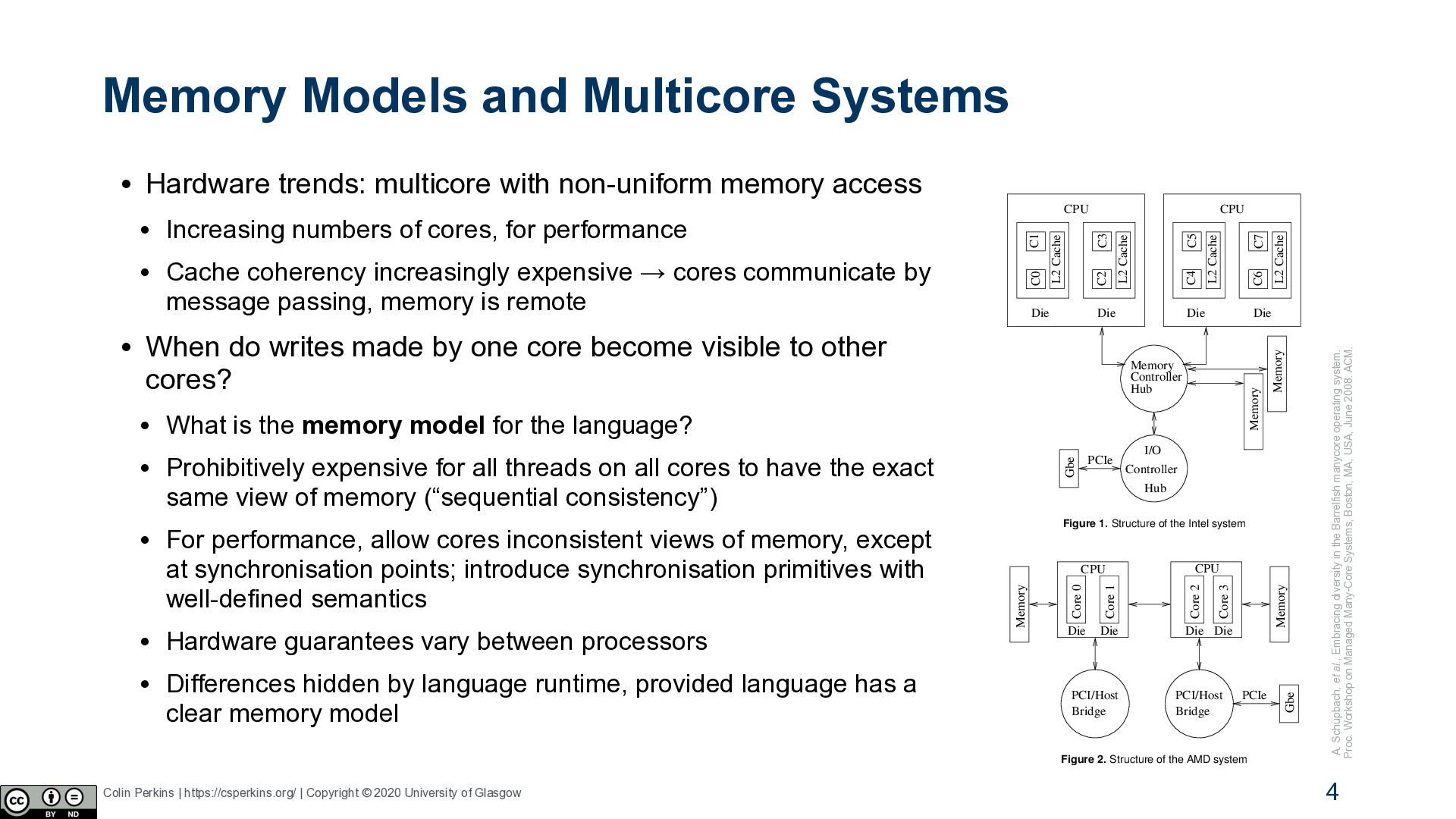
The figure at the top right of
00:01:33.733
the slide shows an eight core system
00:01:35.966
where each core has its own level
00:01:37.866
1 cache, but pairs of cores share
00:01:40.133
a level 2 cache. And where memory
00:01:42.966
is connected to all of the cores
00:01:44.333
via a shared memory controller hub.
00:01:48.200
The figure at the bottom right,
00:01:49.733
in contrast, shows a system where the
00:01:52.000
cores don’t share cache, and where the
00:01:54.400
memory is physically attached to certain processors.
00:01:58.533
In this case processor cores have direct
00:02:00.900
access to the memory attached to the
00:02:02.700
processor of which they are a part,
00:02:04.900
but can’t directly access other memory.
00:02:08.500
These processors communicate via a hardware message
00:02:11.033
passing layer, if they need to access
00:02:13.033
remote memory, asking the other processor to
00:02:15.966
read from its memory and pass the result back to them.
00:02:20.000
Now, these are examples of the way
00:02:22.000
systems are built. And there are many other examples.
00:02:27.000
What’s important is that memory access is no longer uniform.
00:02:32.166
The different processor cores each have a
00:02:34.366
different view of the contents of memory,
00:02:36.400
due to caching. And the speed at
00:02:38.833
which each core can access a particular
00:02:40.700
value in memory will depend on cache
00:02:42.500
occupancy, and on where in memory that
00:02:45.566
value is physically located. And this can
00:02:48.800
lead to a several-thousand times variation in
00:02:50.933
memory access latency for different values.
00:02:55.000
It’s prohibitively expensive to ensure that all
00:02:57.900
threads, on all cores, see the same
00:03:00.033
view of memory.
00:03:02.600
Rather, to ensure good performance, modern systems
00:03:05.933
allow different processor cores to see inconsistent
00:03:08.600
views of memory. What you see when
00:03:11.833
you read memory will depend what core
00:03:13.633
your program is executing on.
00:03:16.666
And they introduce explicit synchronisation points.
00:03:20.033
Explicit operations that force synchronisation of the
00:03:22.900
view of memory between processors, with each
00:03:25.966
processor providing slightly different
00:03:27.833
primitives to do this.
00:03:30.333
To ensure that programs work portably across
00:03:32.966
the different types of processor, programming languages
00:03:35.500
define their memory model.
00:03:38.000
They need to define what guarantees the
00:03:40.066
language provides around concurrent memory accesses.
00:03:43.700
And the compiler can then turn this
00:03:45.466
into machine code, using the synchronisation primitives
00:03:48.566
provided by the underlying hardware, to ensure
00:03:51.266
consistent behaviour.

00:03:55.800
So what do these memory models look like?
00:03:59.600
Well, the first mainstream language to define
00:04:02.966
an explicit memory model was Java.
00:04:06.500
The Java virtual machine guarantees that changes
00:04:09.300
made to a particular field in an
00:04:11.000
object appear in program order to the
00:04:13.433
thread that made the change.
00:04:16.000
That is, if a single thread writes
00:04:18.233
a value to memory, and then later
00:04:21.000
reads it back, and provided no other
00:04:23.500
threads wrote to the same location,
00:04:25.633
then the value the thread reads will
00:04:27.433
be that which it wrote.
00:04:29.533
And this is what you’d expect.
00:04:33.000
However, if multiple threads read and write
00:04:36.600
to a single field, then Java only
00:04:39.233
guarantees that changes made by one thread
00:04:41.400
become visible to other threads in certain cases.
00:04:45.633
If a thread changes a field that’s
00:04:47.733
marked as volatile, for example, then that
00:04:50.600
change is made atomically, and immediately becomes
00:04:53.033
visible to other threads.
00:04:56.000
But, if a thread changes a field
00:04:57.666
that’s not marked as volatile, then when
00:05:00.266
that changes becomes visible to other threads
00:05:02.266
depends on what locks were held,
00:05:04.233
and when the threads were created and destroyed.
00:05:08.433
There are three different cases.
00:05:11.733
Firstly, if a thread changes the value
00:05:14.966
of a non-volatile field, while holding a
00:05:17.466
lock, then releases that lock, and then
00:05:21.333
some other thread acquires the lock,
00:05:23.466
then the thread that acquires the lock
00:05:25.733
is guaranteed to see the written value.
00:05:29.500
Secondly, if a new thread is created,
00:05:32.133
it sees the state of the system
00:05:33.933
as if it had just acquired a
00:05:35.700
lock that had just been released by the creating thread.
00:05:40.000
And, thirdly, if a thread terminates,
00:05:42.600
then the changes it made become visible to other threads.
00:05:46.833
Outside of these three cases however,
00:05:49.366
there are no guarantees.
00:05:52.033
If two threads concurrently access a variable
00:05:54.766
without proper locking, then the changes made
00:05:57.200
by one thread might be visible to the other.
00:06:01.000
Or they might not.
00:06:03.500
It depends on hardware, and on the
00:06:05.866
exact details of the thread scheduling,
00:06:07.833
and it isn’t predictable to the programmer.
00:06:11.766
The only other guarantee made is that
00:06:14.300
accesses to 32-bit fields, such as integer
00:06:17.266
and floating point values, is atomic.
00:06:19.733
The system will never observe a half-completed
00:06:22.400
write to an int or a float,
00:06:24.166
even if it’s incorrectly synchronised.
00:06:27.366
But this guarantee doesn’t hold for 64-bit
00:06:29.800
fields, such as long or double values,
00:06:32.800
where corrupted and half-written, values can be
00:06:35.533
observed if the system isn’t correctly locked.
00:06:40.133
This memory model allows flexibility for the hardware.
00:06:44.333
It allows that each processor core can
00:06:46.633
see a different view of the memory,
00:06:48.533
and that the views of the memory can diverge
00:06:50.333
between different threads. And only
00:06:53.100
the explicit use of locks requires
00:06:55.100
synchronisation between cores.
00:06:57.933
This lets us write portable code,
00:07:00.800
if we pay attention to locking concurrent
00:07:02.900
accesses, whilst allowing good performance.
00:07:09.000
It’s increasingly clear that all languages need
00:07:11.833
to define their memory model.
00:07:14.533
If the language definition isn’t explicit about
00:07:16.866
when concurrent accesses become visible, it runs
00:07:20.300
the risk that different processors will behave
00:07:22.166
differently, and these differences will be visible
00:07:25.033
to the programmer.
00:07:27.300
So, to have any hope of correctness,
00:07:29.233
the language has to be clear what
00:07:30.800
behaviour the programmer can rely on.
00:07:34.300
Unfortunately, Java is unusual in having such
00:07:37.566
a clearly-specified memory model.
00:07:40.833
C and C++ have historically had very
00:07:43.766
poorly specified memory models. The recent versions
00:07:47.733
of both standards have now fixed this,
00:07:50.533
leaning very heavily on the work done
00:07:52.233
for Java, but it’s taking a long
00:07:54.666
time for compilers to implement those standards,
00:07:57.666
and to become available.
00:08:01.300
And Rust also does not yet have
00:08:03.066
a fully specified memory model, although one
00:08:05.333
is under development. Specifying a memory model
00:08:08.766
for Rust is complicated compared to C
00:08:11.400
or C++ or Java, because Rust has
00:08:13.900
several different reference types and ownership rules,
00:08:17.333
and because of the distinction between safe
00:08:19.233
and unsafe code.
00:08:21.566
This is one of the current limitations of Rust.
00:08:27.833
As we’ve seen, the memory model of
00:08:29.733
a language is explicitly tied into the
00:08:31.566
way it manages locking and communication between threads.
00:08:35.700
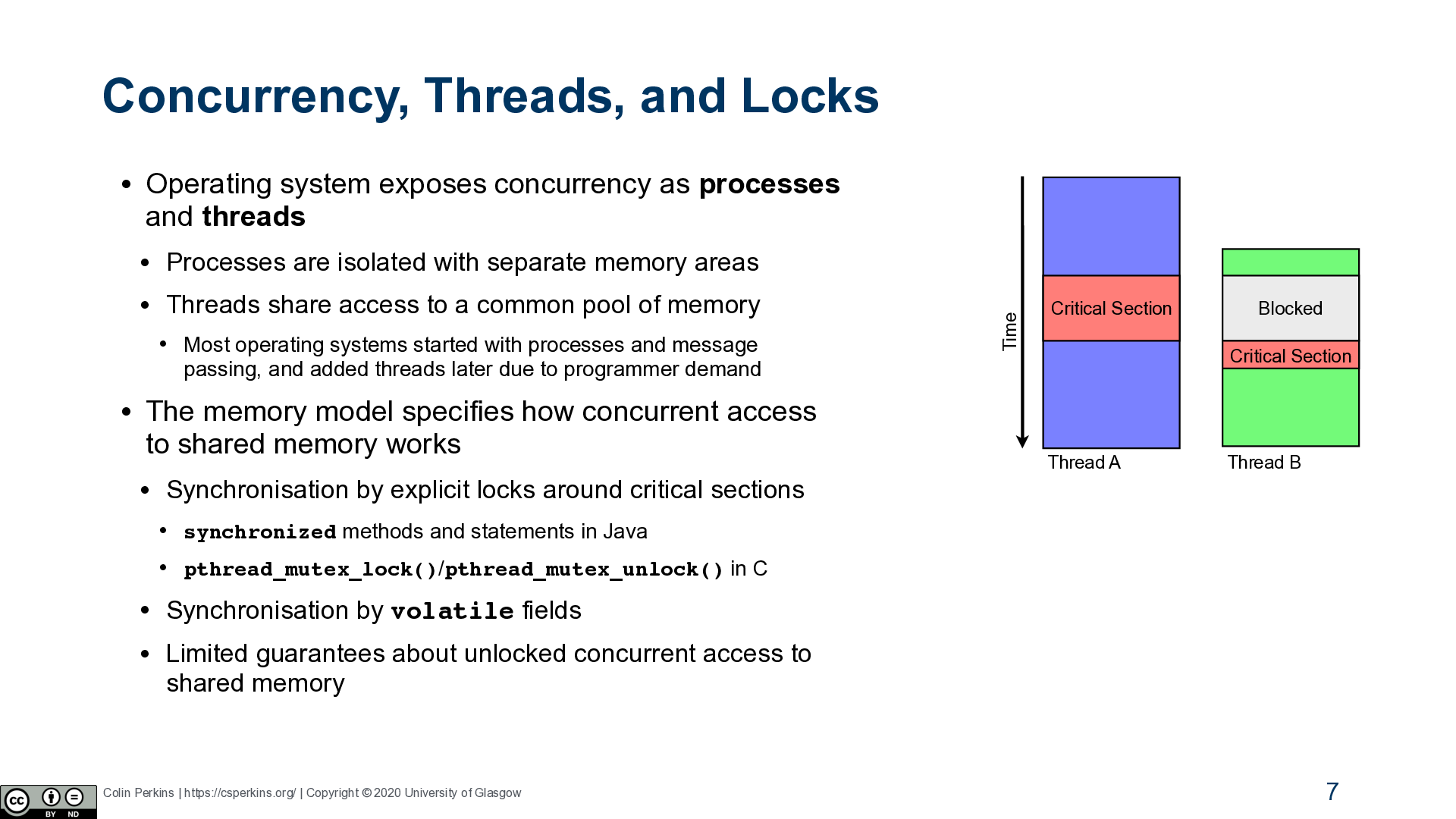
Most operating systems expose concurrency to applications
00:08:39.333
in the form of multiple processes,
00:08:41.433
each potentially containing multiple threads of execution.
00:08:45.000
And processes are isolated from each other,
00:08:47.566
and don’t share memory.
00:08:50.166
Threads within a process, though, share access
00:08:52.766
to a common pool of memory,
00:08:54.533
and make use of synchronisation to manage
00:08:56.533
access to that shared memory.
00:08:59.533
They require explicit locks around critical sections
00:09:02.533
where shared resources are accessed.
00:09:05.733
How this is done depends on the
00:09:07.600
language. In Java, for example, the locks
00:09:11.133
are provided by the implementation of synchronised
00:09:13.266
methods and synchronised blocks. In C,
00:09:17.166
they’re provided by the pthreads library,
00:09:19.466
in the form of pthread_mutex_lock()
00:09:21.666
and pthread_mutex_unlock(),
00:09:24.300
in C++ by the std::thread class.
00:09:29.000
And these provide the synchronisation primitives,
00:09:31.500
and ensure access to shared data follows
00:09:33.733
the memory model of the language.
00:09:36.533
And, outside of such protected, such locked,
00:09:39.233
regions, there are very few guarantees about
00:09:41.166
concurrent accesses to shared memory.
00:09:46.533
The approach of providing multiple threads,
00:09:48.900
and using locks to protect access to
00:09:50.666
shared memory, is extremely common.
00:09:54.233
But it’s also really problematic.
00:09:57.466
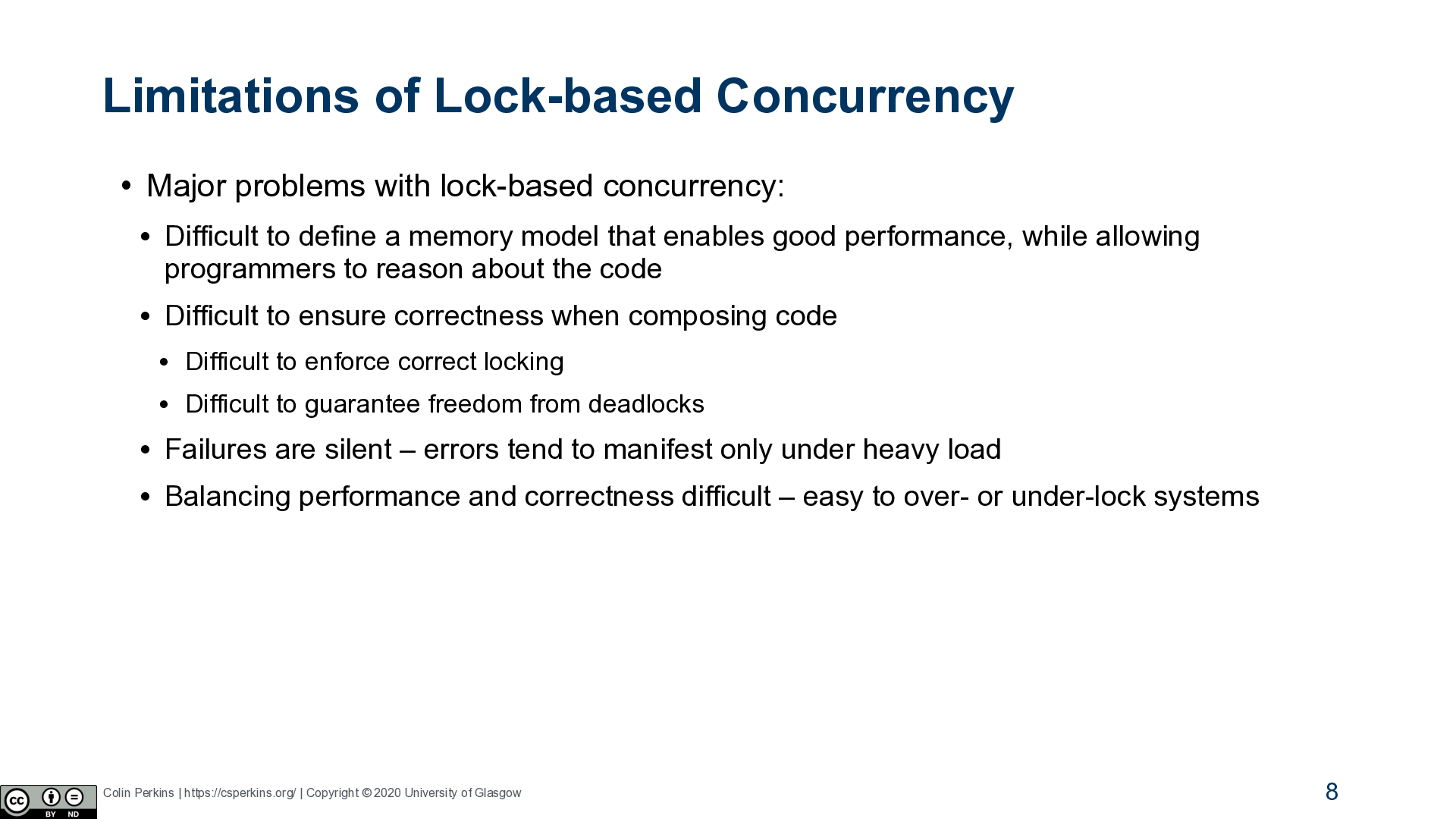
It’s proven difficult to define a memory
00:09:59.700
model for a languages that provides good
00:10:01.766
performance, whilst also allowing programmers to reason
00:10:04.800
about the code.
00:10:07.000
It’s difficult to know when the locking
00:10:08.900
is done correctly. Failures are silent.
00:10:12.266
Incorrectly locked code tends to compile just
00:10:14.833
fine, but errors tend to manifest themselves
00:10:17.800
under heavy load. This make such code
00:10:21.633
hard to write, and hard to debug.
00:10:24.966
Balancing performance and correctness is difficult.
00:10:28.133
It’s easy to over- or under-lock programs.
00:10:31.866
To add too many, or too few
00:10:34.133
locks. And if you lock too much,
00:10:37.000
or for too long, then the performance
00:10:38.900
is bad. But lock too little,
00:10:41.700
and the code occasionally and unpredictably fails.
00:10:45.366
It’s difficult to enforce correct locking,
00:10:47.900
and difficult to guarantee freedom from deadlocks.
00:10:52.866
And it’s difficult to compose code that uses locks.
00:10:56.866
And this, I think, is the real
00:10:58.600
argument against locks as synchronisation mechanism.
00:11:03.366
In principle, at least, it’s possible to
00:11:05.900
write small-scale code correctly using locks to
00:11:08.666
control access to shared data. It’s not
00:11:12.000
easy, and most people get it wrong,
00:11:13.933
but in principle it’s possible.
00:11:17.566
The problem is, though, is that lock-based
00:11:19.566
code doesn’t compose.
00:11:22.500
If you have two functions that each
00:11:25.166
use locking correctly, then the result of
00:11:28.533
combining them may not be correct.
00:11:32.166
The example everyone uses to illustrate this
00:11:34.366
is a banking system.
00:11:37.000
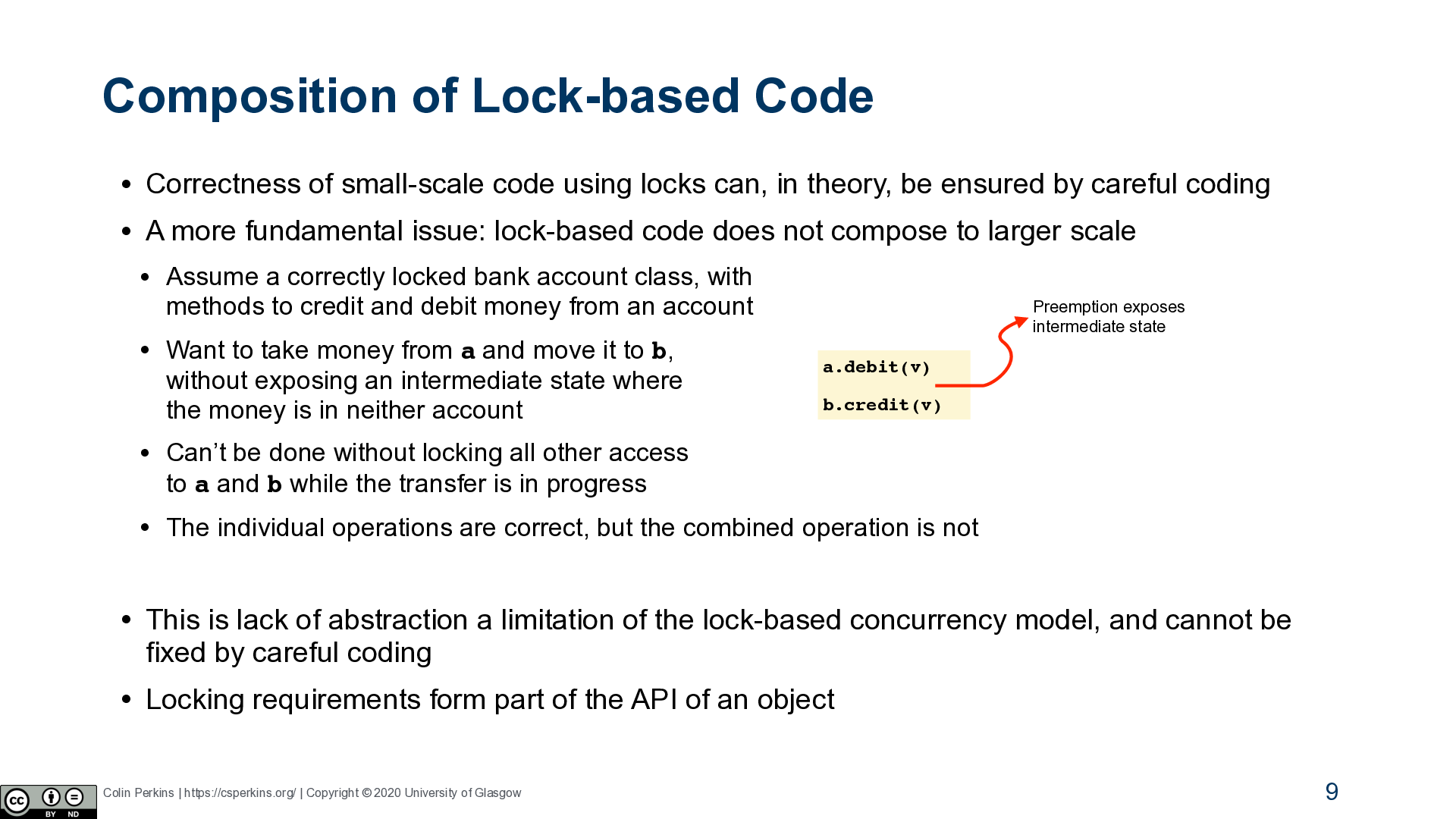
Assume you have a bank account class,
00:11:39.200
that correctly uses locks to protect access
00:11:41.400
to the account. You want to write
00:11:43.966
a program to transfer money between two
00:11:46.833
accounts. And that program shouldn’t expose the
00:11:49.533
intermediate state. That is, the money should
00:11:53.300
either be in account A, or it
00:11:55.166
should be in account B, but it
00:11:57.366
shouldn’t be possible to see a situation
00:11:59.466
where the money is in both accounts, or in neither account.
00:12:03.566
Unfortunately, the locking on the individual accounts
00:12:06.966
doesn’t protect this. Even if the accounts
00:12:10.600
are correctly locked, it’s still possible for
00:12:12.966
another thread to observe the intermediate state
00:12:15.666
where the money is gone from one
00:12:17.500
account but not arrived in the other.
00:12:21.266
The individual operations are correct, but the
00:12:24.200
combined operation is not. We need to
00:12:27.333
add extra locks to make the combination correct.
00:12:31.633
And this is fundamental to the way
00:12:33.600
locks work. It cannot be fixed by
00:12:36.333
careful coding. It’s a limit of the
00:12:38.666
locking abstraction itself.
00:12:43.000
And for these reasons, it’s time we
00:12:45.166
thought again about alternative concurrency models.
00:12:49.266
Multicore systems are now ubiquitous.
00:12:52.033
Concurrency is everywhere.
00:12:54.566
But multithreaded code with shared access protected
00:12:57.666
by locking is incredibly hard to write
00:12:59.966
correctly. And even when written correctly,
00:13:03.800
is prone to failures when combined into complete systems.
00:13:09.000
In the following parts, I’ll talk about
00:13:11.166
two alternatives to lock-based concurrency: transactions and
00:13:14.566
message passing.

00:13:19.000
So that’s all for this part.
00:13:20.966
I’ve spoken about the need for languages
00:13:22.833
to have a well-defined memory model.
00:13:24.733
And about some of the limitations of
00:13:26.533
lock-based concurrency and multi-threading.
00:13:29.266
In the next part, I’ll talk about
00:13:30.933
transactions as a concurrency model.
Part 2: Managing Concurrency Using Transactions
The second part of this lecture discusses the atomic transactions
as an alternative concurrent programming model. It reviews the ACID
properties of transactions, and introduces the transactions programming
model and its consequences and benefits. It discusses how this style
of programming is a good fit for Haskell, and the monadic programming
style, any why it's not a good fit for more mainstream programming
languages.
00:00:00.066
In this part, I’d like discuss an
00:00:02.133
alternative approach to managing concurrency, based on
00:00:04.966
the idea of atomic transactions.
00:00:07.400
I’ll talk about the transactional programming model,
00:00:10.100
the benefits it claims to offer,
00:00:12.166
and some of the implications of adopting
00:00:14.100
that approach to concurrency.
00:00:16.166
And I’ll discuss how transactions integrate with
00:00:18.500
Haskell, and how they fit into more
00:00:20.200
mainstream programming languages.
00:00:24.000
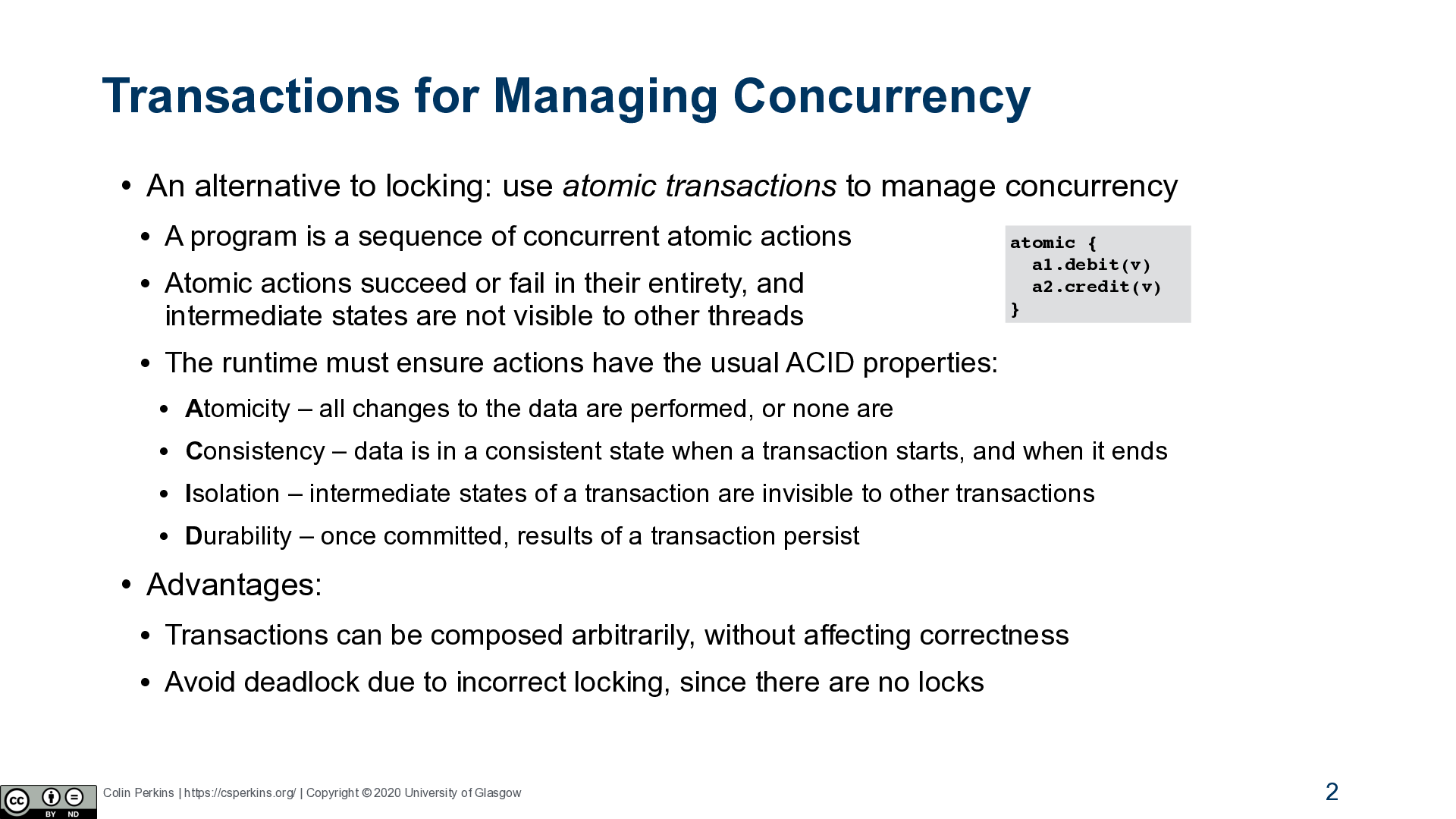
The goal of atomic transactions is to
00:00:26.233
provide an alternative way of managing concurrency,
00:00:29.166
that avoids the problems inherent in the
00:00:31.166
use of multithreading with shared mutable state
00:00:33.733
managed by locks.
00:00:36.133
The fundamental idea is to structure a
00:00:38.300
program as a sequence of atomic transactions,
00:00:41.300
where transactions in different threads
00:00:43.266
can proceed concurrently.
00:00:45.900
Each transaction wraps some computation,
00:00:48.933
such that it either succeeds or it fails in
00:00:51.500
its entirety, and so that intermediate states
00:00:54.300
are not visible to other threads
00:00:57.000
The execution of the transactions is managed
00:00:59.500
by a runtime, and the runtime ensures
00:01:02.066
that the transactions obey the usual four
00:01:04.333
ACID properties.
00:01:06.833
Firstly, that each transaction is atomic.
00:01:10.166
That is, it succeeds or fails in
00:01:13.000
its entirety, and any intermediate states are
00:01:15.933
not visible to other threads. All of
00:01:19.000
the actions in a transaction are performed,
00:01:21.166
or none of them are.
00:01:23.266
Secondly, that transactions are consistent.
00:01:27.200
The runtime ensures that the data in the system
00:01:29.733
is in a consistent state when the
00:01:31.166
transaction starts, is left in a consistent
00:01:33.966
state when it ends, and at no
00:01:36.166
point are inconsistent values visible to the
00:01:38.900
rest of the system.
00:01:41.233
If the transaction succeeds, that consistent state
00:01:44.366
reflects the completed action. If it fails,
00:01:47.633
the effects are cleanly rolled back,
00:01:49.600
and the state is as-if the transaction
00:01:51.600
was never attempted.
00:01:54.300
Third, transactions are isolated.
00:01:57.266
The execution of a transaction will, of course, comprise a
00:02:01.233
number of steps, a number of intermediate
00:02:03.566
states. The runtime ensures that none of
00:02:06.700
those intermediate states are visible outside of
00:02:09.166
the transaction. To the rest of the program,
00:02:12.133
the transaction proceeds indivisibly and completely,
00:02:15.700
or not at all.
00:02:18.266
And, finally, transactions are durable. A transaction
00:02:21.966
may succeed, or it may fail and
00:02:24.166
be rolled back. But, if it succeeds
00:02:26.800
and commits its result, then that result
00:02:28.566
will persist. A successful transaction will never
00:02:32.200
be rolled back.
00:02:35.000
These, properties, known as the ACID properties,
00:02:37.900
are probably familiar to you, since they
00:02:40.066
frequently apply to database systems.
00:02:44.033
Why might it make sense to structure
00:02:46.800
a program in this way?
00:02:49.000
Because transactions structured in this way can
00:02:52.133
be composed arbitrarily, without affecting correctness.
00:02:56.733
As we saw in the previous part,
00:02:59.200
with the example of the bank account
00:03:00.700
class, how two correctly locked bank account
00:03:03.700
objects, when combined, could produce a system
00:03:06.533
that exposed the internal state.
00:03:10.266
And this problem doesn’t occur with transactions.
00:03:13.333
No matter how they are composed,
00:03:15.033
it doesn’t affect correctness of the code.
00:03:18.466
And transactions also avoid deadlocks that can
00:03:20.933
occur due to acquiring locks in the
00:03:22.766
wrong order, since there are no locks.
00:03:26.000
And they avoid race conditions.
00:03:31.000
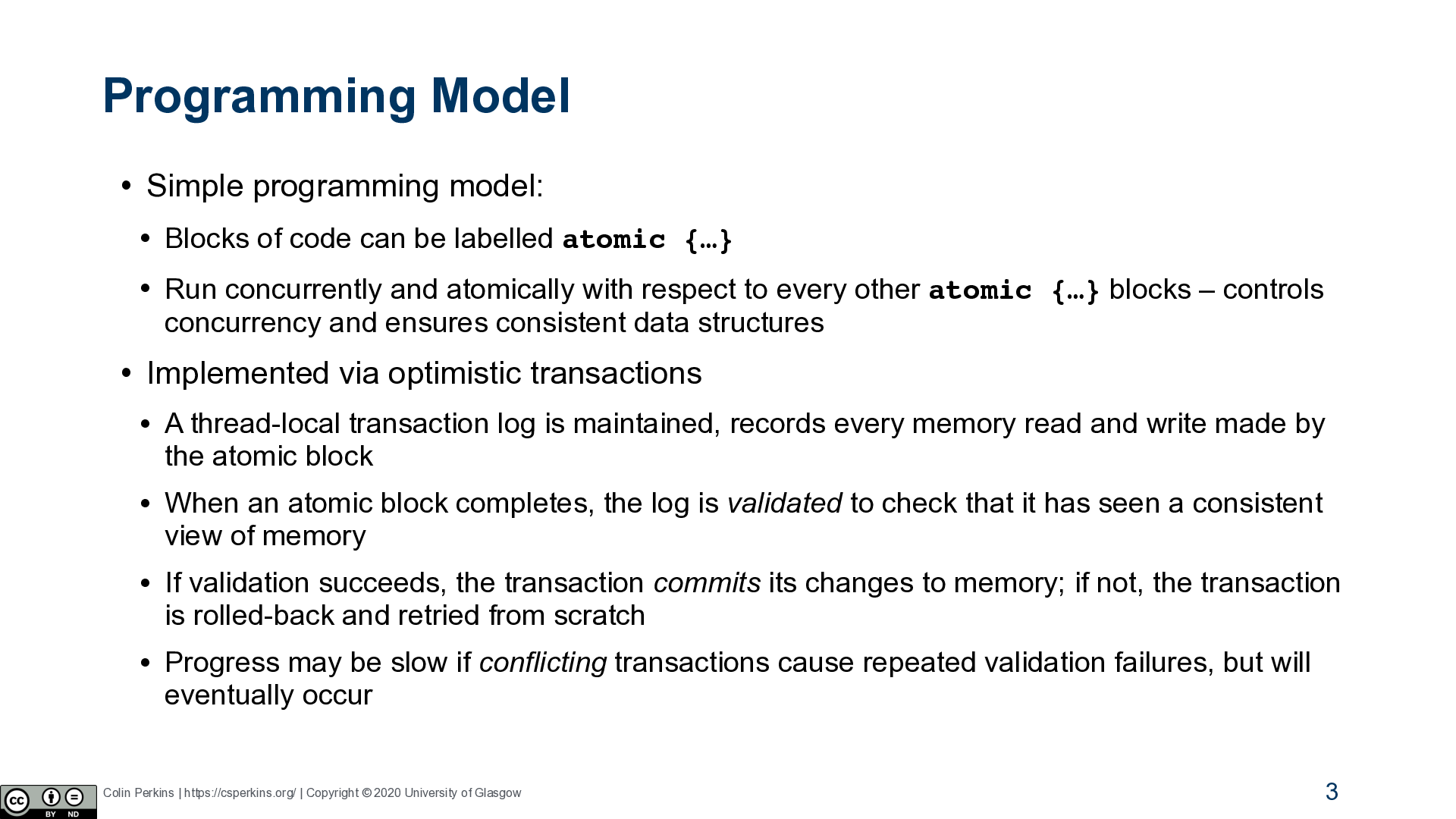
The programming model for systems using transactions
00:03:33.666
is straight forward.
00:03:36.000
Blocks of code are labelled as atomic.
00:03:38.866
And the runtime executes those code blocks,
00:03:41.333
ensuring that execution respects the ACID properties,
00:03:44.666
and allows atomic blocks to run concurrently
00:03:47.466
with respect to other atomic blocks.
00:03:50.000
And the programmer doesn’t have to worry
00:03:52.000
about locking or synchronisation. The runtime takes
00:03:54.866
care of all that.
00:03:57.000
This is implemented using optimistic transactions.
00:04:01.300
When an atomic block is entered,
00:04:03.300
the runtime starts to maintain a thread
00:04:05.100
local transaction log. This transaction log maintains
00:04:08.933
a record of every memory read or
00:04:11.133
write, and every potential I/O operation,
00:04:13.966
made by the atomic block.
00:04:16.833
When the block completes, the transaction log
00:04:19.166
is validated, to check that it saw
00:04:21.100
a consistent view of memory.
00:04:24.000
If the validation succeeds, then the atomic
00:04:26.666
block, the transaction, commits its changes to memory.
00:04:31.066
If not, if this transaction was competing
00:04:36.100
with another transaction and lost out,
00:04:39.600
then the atomic block, the transaction,
00:04:43.100
is rolled block to the beginning,
00:04:44.966
undoing any changes, and retried from scratch.
00:04:50.000
The assumption, of course, is that conflicts
00:04:51.866
between transaction are rare, and that most
00:04:54.266
atomic blocks complete and commit their results
00:04:56.333
the first time.
00:04:58.833
And if that’s not the case,
00:05:00.433
if there are many conflicting transactions,
00:05:02.866
then progress will be slow, due to
00:05:04.566
repeated rollbacks, but the transactions will eventually
00:05:07.933
make progress.

00:05:12.000
Now, as we’ve seen, the runtime will
00:05:14.866
roll-back and retry transactions, if their transaction
00:05:17.766
log fails to validate because they lose
00:05:20.800
out in competition to one of the
00:05:22.233
other transactions proceeding concurrently.
00:05:26.133
A consequence of this, is that it
00:05:28.100
needs to be possible to roll-back and
00:05:29.766
retry a transaction. And to make this
00:05:32.666
possible, the runtime has to place some
00:05:34.800
restrictions on transaction behaviour.
00:05:39.000
The key restriction is that a transaction
00:05:41.333
needs to be referentially transparent. That is,
00:05:44.900
the result returned by a transaction must
00:05:47.333
depend solely on its inputs, and it
00:05:49.666
must generate the same result each time it executes.
00:05:53.466
And it must not perform I/O operations
00:05:55.833
during the transaction. It must not do
00:05:58.433
anything irrevocable.
00:06:01.333
The code sample on the slide is
00:06:03.966
problematic, for example, because a concurrent transaction
00:06:07.666
might modify the values of n or k.
00:06:11.800
Now, this would be detected when the
00:06:13.666
transaction log is validated, at the end
00:06:15.766
of the atomic block, when it’s time
00:06:18.300
to commit or rollback the transaction.
00:06:21.200
But that might be too late to
00:06:22.566
stop the missiles being launched by accident.
00:06:26.000
So the runtime system has to enforce
00:06:28.233
these restrictions, else we’ve just traded hard
00:06:30.666
to find locking bugs, for hard to
00:06:32.533
find transaction consistency bugs.
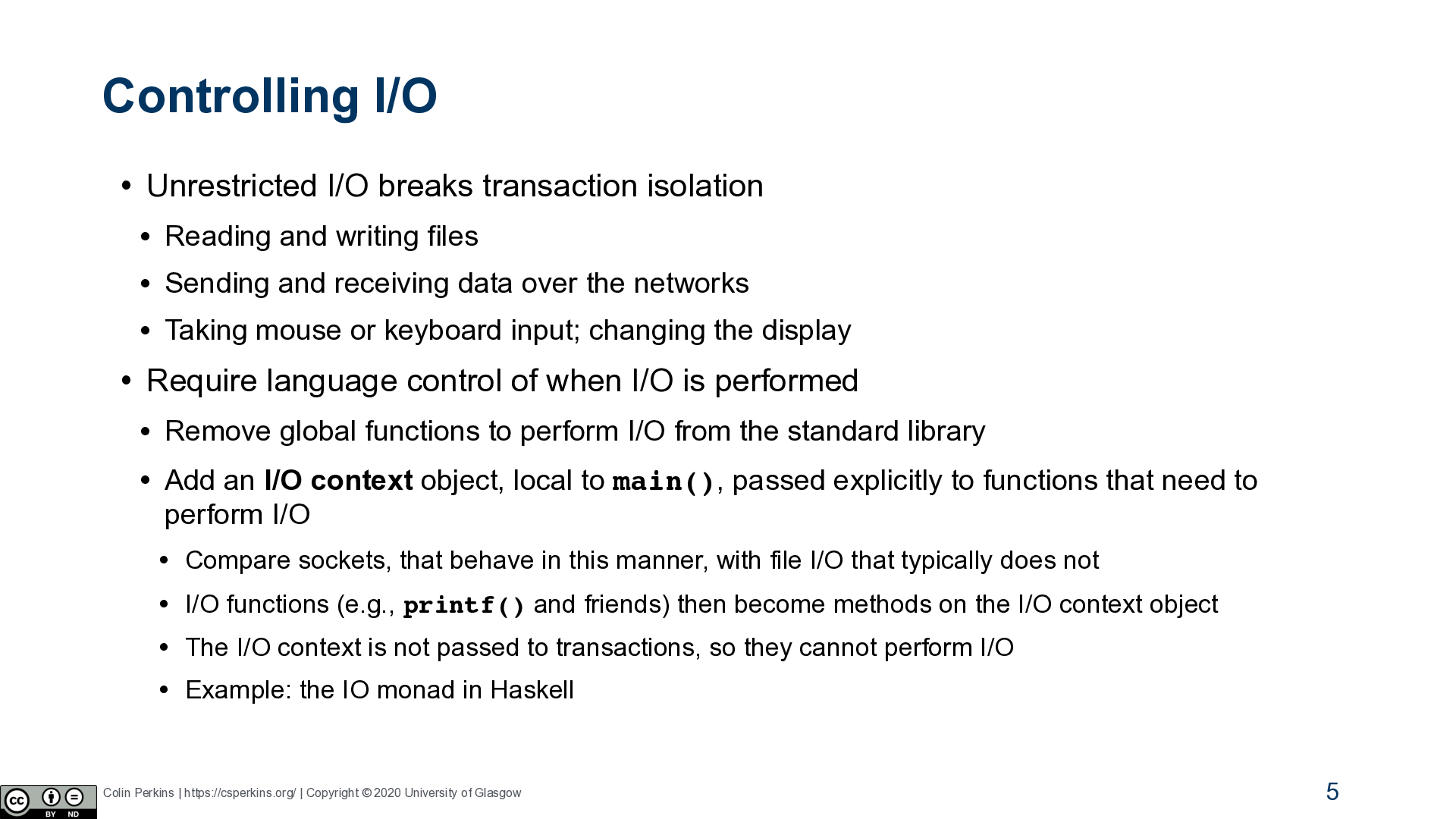
00:06:38.300
So, what we see is that unrestricted
00:06:40.733
I/O breaks transaction isolation.
00:06:44.833
If a transaction can read or write
00:06:46.600
files, if it can send or receive
00:06:48.600
data over the network, if it can
00:06:50.533
take input from the mouse or keyboard,
00:06:52.600
update the display, play or record sound,
00:06:54.800
etc., then the progress of the transaction
00:06:58.033
can be observed before it commits.
00:07:01.000
This breaks the ACID properties. It breaks isolation.
00:07:05.400
And it makes it impossible to roll-back the transaction.
00:07:10.000
To address this, the language and runtime
00:07:13.200
need to control when I/O is performed.
00:07:16.700
They need to remove the global functions
00:07:18.833
that allow unrestricted I/O from the standard
00:07:21.200
library, instead replace them with versions that
00:07:24.333
allow control over when I/O can occur.
00:07:28.900
One way this could work is if
00:07:30.800
the system provided an I/O context object,
00:07:33.800
that was passed as a parameter to
00:07:35.566
main(). This object would have methods that
00:07:38.666
allow reading and writing to files,
00:07:40.866
access to standard input and standard output, and so on.
00:07:45.066
And functions such as printf() would become
00:07:47.266
methods on the I/O context object.
00:07:51.000
And if a function needs to perform
00:07:53.000
I/O, then it would need to be
00:07:54.300
passed this I/O content object, so it
00:07:56.700
could invoke the appropriate methods.
00:08:00.866
This would allow control over what functions
00:08:03.100
can perform I/O. If you want to
00:08:05.900
prevent a transaction from writing to a
00:08:08.000
file, for example, don’t pass it the
00:08:10.066
I/O context object, and it can’t read
00:08:12.500
or write to any files.
00:08:15.166
Now, this is not how I/O works
00:08:18.166
in Rust, or in C, or in
00:08:20.400
Java, or in any other mainstream languages,
00:08:23.766
although arguably it maybe should be.
00:08:27.900
But it is how I/O works in
00:08:30.766
Haskell. The I/O context object I’m describing
00:08:35.166
is essentially the I/O monad, and Haskell
00:08:38.166
shows that this approach to controlling I/O can work.
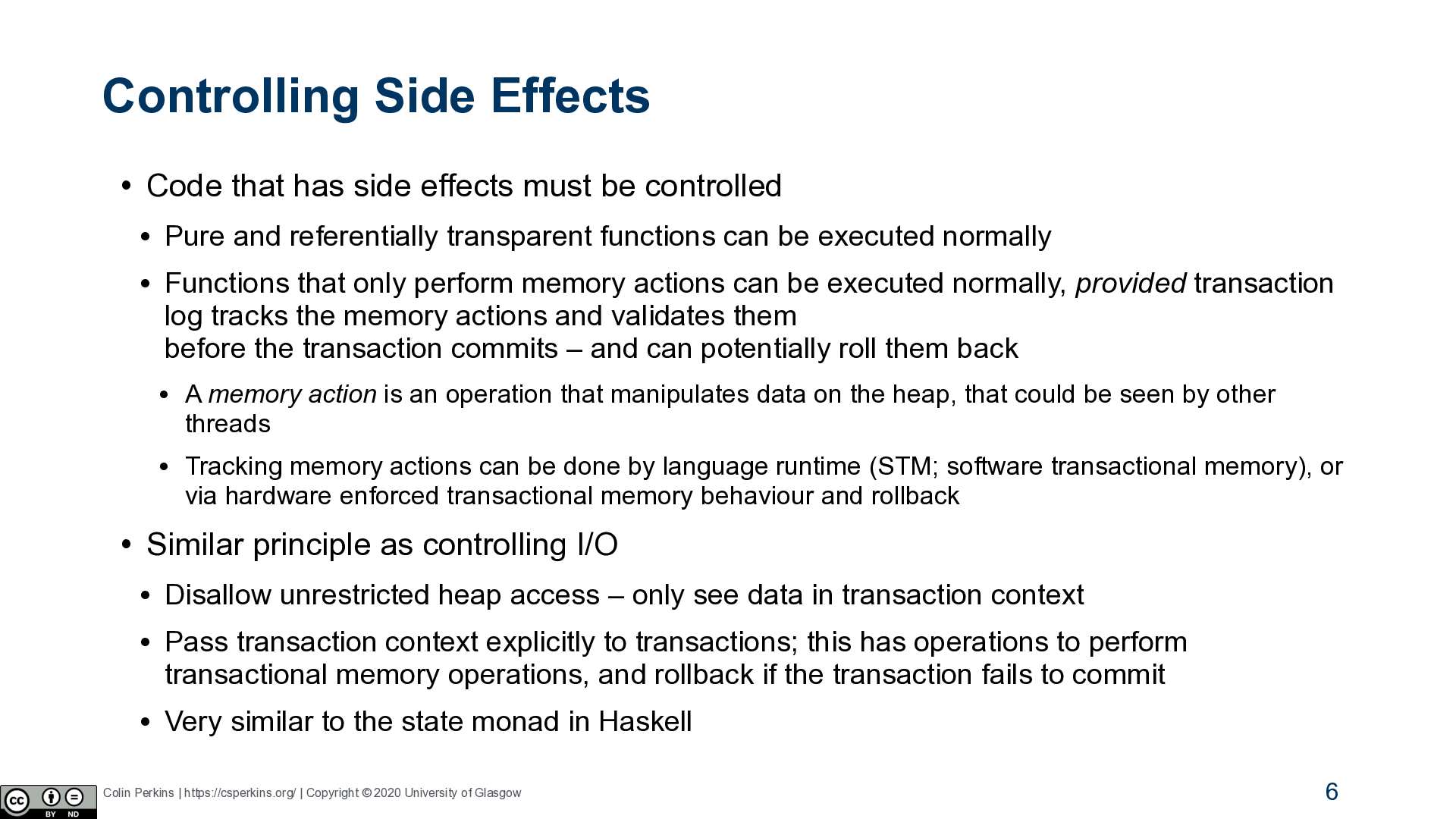
00:08:44.833
In addition to controlling I/O operations,
00:08:47.533
atomic transactions require control over side effects.
00:08:52.266
Functions that are referentially transparent, that only
00:08:55.700
depend on their arguments and that don’t
00:08:57.666
depend on access to shared state,
00:08:59.500
to shared memory, can be accessed normally.
00:09:03.400
But, if a function accesses memory that
00:09:05.466
might be shared with other functions,
00:09:07.666
if it manipulates a value on the
00:09:09.600
heap that might be shared with other
00:09:11.133
transactions, then that access must be controlled.
00:09:15.600
Functions within a transaction can perform memory
00:09:18.700
accesses, but the runtime must track those
00:09:21.700
accesses. The runtime must track memory reads
00:09:25.433
and writes during a transaction, so it
00:09:28.100
can validate that there are no conflicts
00:09:29.933
with other ongoing transactions, and so that
00:09:32.700
it can roll-back any changes, if necessary,
00:09:34.833
if such conflicts occur.
00:09:38.500
And this can be done in software,
00:09:40.200
by the language runtime, by wrapping memory
00:09:42.733
access in some kind of smart pointer
00:09:44.600
object. And this approach is known as
00:09:47.133
software transactional memory, STM.
00:09:50.766
Alternatively, some processors provide hardware support to
00:09:53.866
accelerate such pointer tracking.
00:09:58.033
The principle is similar to that for
00:10:00.333
controlling I/O. Disallow unrestricted heap access,
00:10:04.866
in the same way unrestricted file access
00:10:07.633
was disallowed, and provide a memory transaction
00:10:10.633
context. And require this transaction context to
00:10:13.666
be passed to atomic blocks if they
00:10:16.700
are to access memory, to allow them
00:10:19.433
to perform only checked memory access,
00:10:21.600
and to provide the abilIty to validate
00:10:23.333
and rollback memory accesses if necessary.
00:10:27.766
And, again, this is not, perhaps,
00:10:30.833
mainstream, but it’s familiar to Haskell programmers
00:10:33.766
as the state monad.
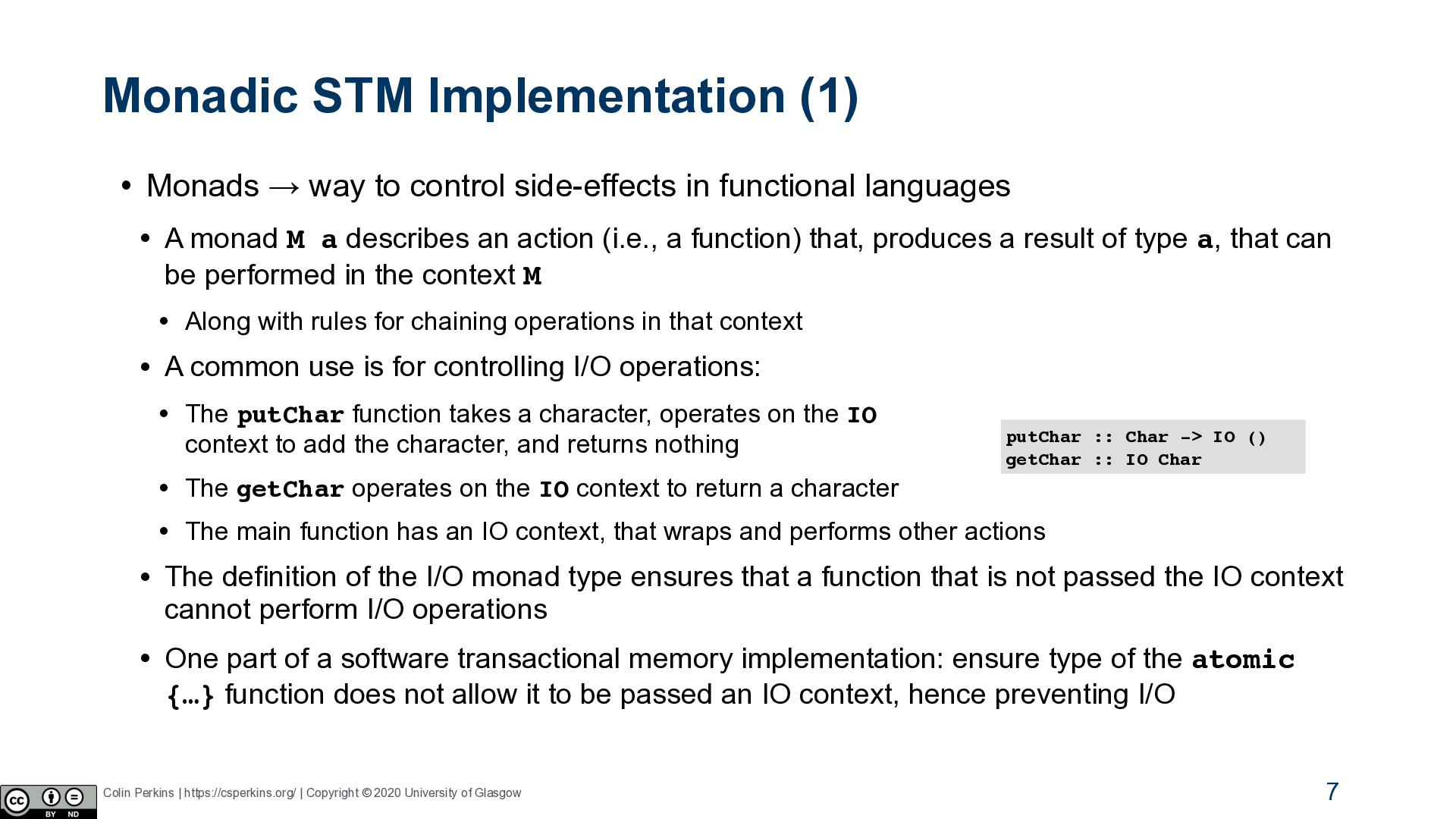
00:10:38.700
So, we’ve seen that Haskell limits the
00:10:40.766
ability of a function to perform I/O,
00:10:42.966
or access memory by using monads.
00:10:46.866
Monads are one of the less well
00:10:48.966
understood parts of Haskell.
00:10:52.566
The way I think of them,
00:10:54.066
as someone who’s not a Haskell programmer,
00:10:56.666
is that Haskell defines a set of
00:10:58.333
actions that can be performed in a
00:10:59.933
certain context, along with some rules,
00:11:02.966
a monad, for chaining together those actions
00:11:05.866
in that context.
00:11:08.633
The putChar function, for example, as we
00:11:10.933
see on the slide, takes a character
00:11:13.800
and returns an action that writes the
00:11:15.633
character to the I/O context.
00:11:18.766
The getChar function returns an action that
00:11:21.566
retrieves a character from the I/O context.
00:11:24.366
And so on.
00:11:26.700
The main function holds the I/O context,
00:11:29.533
and functions that need to read or
00:11:31.533
write to files are tagged as operating
00:11:33.500
in that context. And if a function
00:11:36.733
is not tagged in this way,
00:11:38.433
it can’t read or write to files.
00:11:42.333
And this gives us the ability to
00:11:44.033
restrict I/O during atomic transactions.
00:11:47.700
We make sure the definition of the
00:11:49.366
atomic block isn’t tagged as being part
00:11:51.633
of the I/O context.
00:11:54.666
This gives a way of preventing atomic
00:11:56.300
transactions from reading or writing files.
00:12:00.066
It’s wrapped in complex type-theoretic abstractions,
00:12:03.633
because Haskell, but essentially it’s just restricting
00:12:06.833
access to the functions that perform I/O.
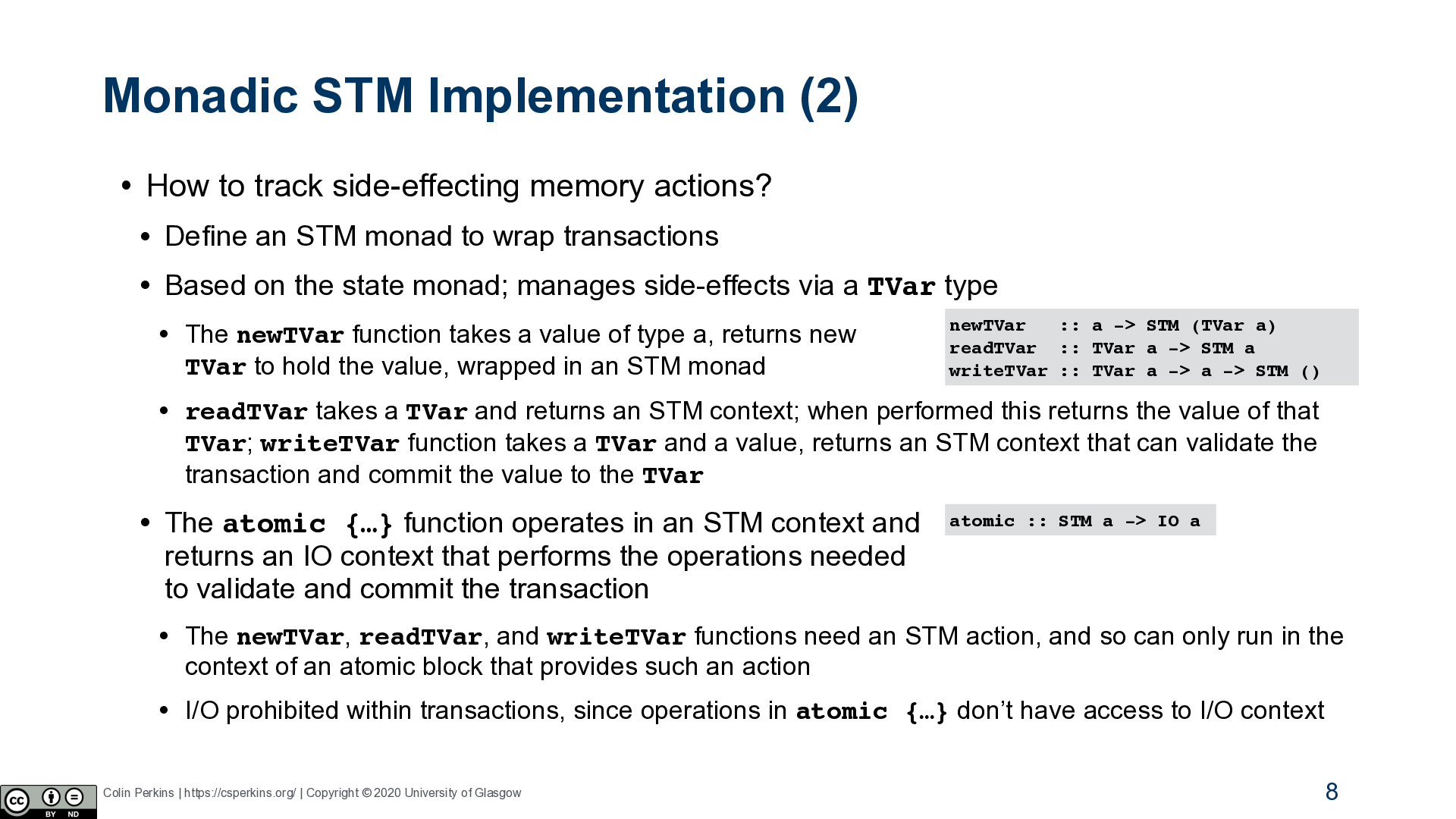
00:12:13.000
That works for controlling I/O, but how
00:12:15.333
to control access to memory?
00:12:18.366
Well, Haskell uses a similar approach.
00:12:22.466
The state monad is used to define
00:12:25.066
an STM, software transactional memory, context.
00:12:30.000
The function, newTVar, defines a transactional variable,
00:12:33.766
that exists within such a context.
00:12:36.666
This holds a reference to a potentially
00:12:38.700
shared value on the heap.
00:12:41.000
And the readTVar and writeTVar functions return
00:12:44.400
actions that allow reading and writing to
00:12:46.666
that shared value within an STM context,
00:12:50.566
but that coordinate with the runtime and
00:12:53.066
atomic transaction implementation,
00:12:55.500
to track conflicting access
00:12:57.200
to such values between different transactions.
00:13:01.466
And the implementation of an atomic block
00:13:04.000
provides an STM context that allows the
00:13:07.266
transactional variables to be used within a
00:13:09.433
transaction, but prohibits their use outside that
00:13:12.400
context. And, as we see from the
00:13:16.166
slide, the atomic block returns an I/O
00:13:18.766
context that actually reads and write the values to memory.
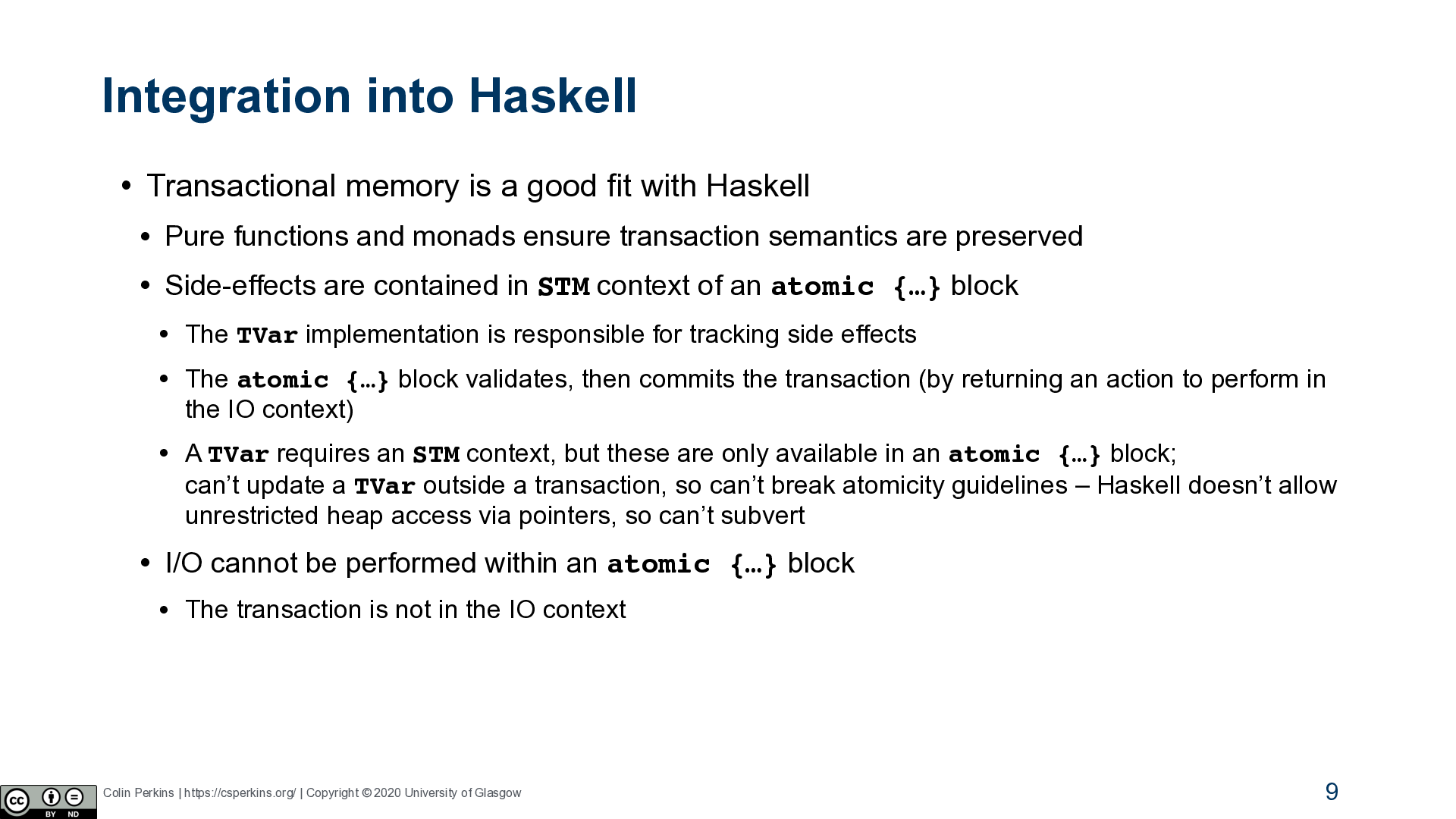
00:13:25.000
Transactional memory is a good fit with Haskell.
00:13:29.200
And the reason it works is that
00:13:30.900
Haskell provides the necessary type system features
00:13:33.633
to control I/O and control other side effects.
00:13:38.066
The use of pure functions, lazy evaluation,
00:13:41.666
and monads, all ensure that the transaction
00:13:44.833
semantics, the ACID properties, are preserved.
00:13:49.500
The STM context, and the use of
00:13:52.166
transactional variables, constrains and limits access to
00:13:55.300
memory, and tracks side effects, allowing conflicting
00:13:59.833
transactions to be detected and rolled back.
00:14:03.233
And the definition of the atomic block,
00:14:05.566
that ensures the transaction is not in
00:14:07.900
the IO context, prevents reading or writing
00:14:10.466
to files, or otherwise performing I/O.
00:14:15.000
The result is clean and elegant.
00:14:17.433
It’s a nice abstraction for concurrency.
00:14:20.200
It allows composition of functions without worrying
00:14:23.066
about locking. It can’t deadlock. And it’s
00:14:26.500
easy to reason about, easy to use.
00:14:32.000
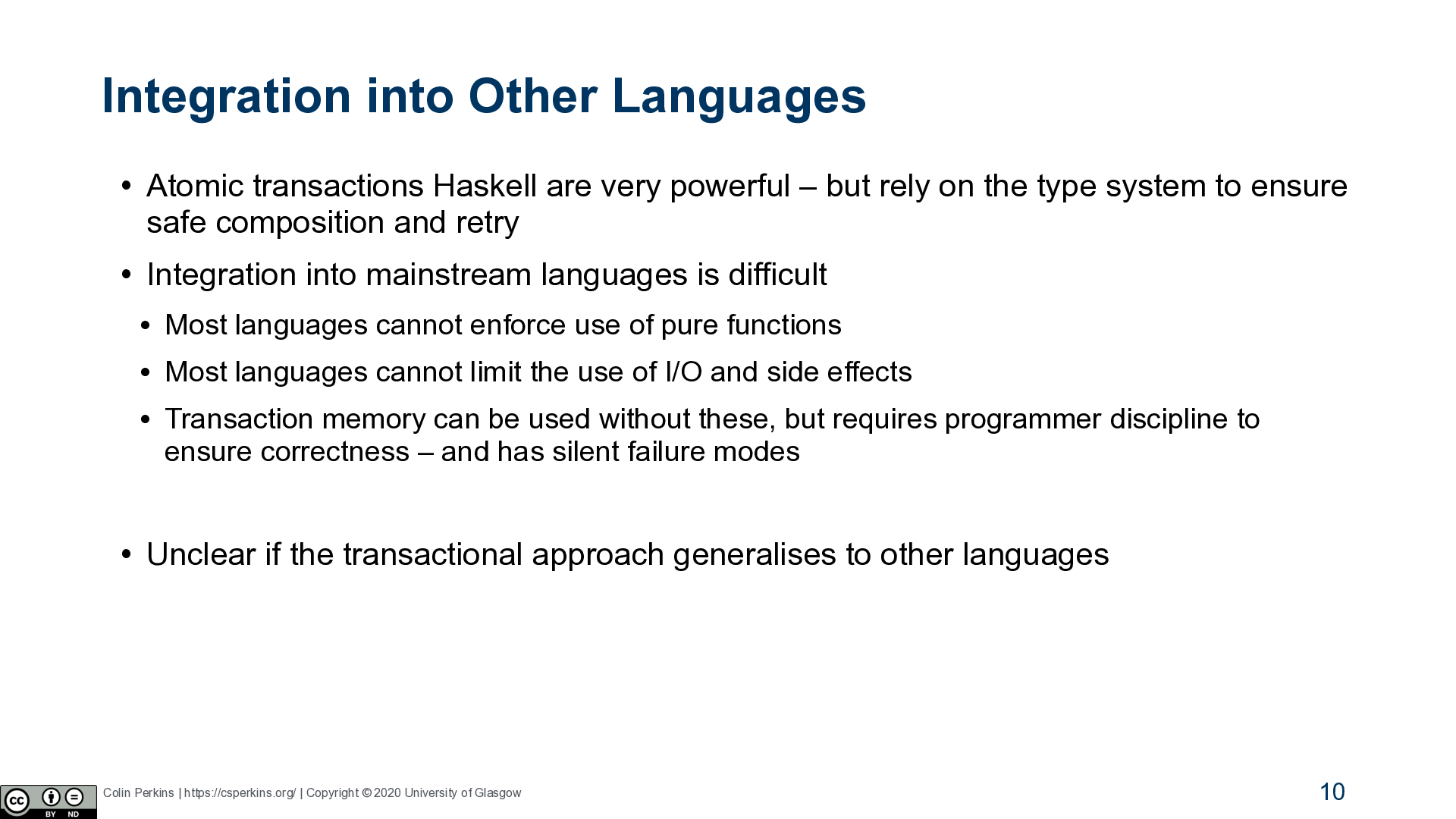
If you’re a Haskell programmer, atomic transactions
00:14:35.233
are very powerful.
00:14:38.000
But they rely on features of the
00:14:39.500
type system that are not commonly or
00:14:41.766
widely understood, in order to provide safety.
00:14:47.000
Integrating atomic transactions into more mainstream
00:14:50.133
languages is not straightforward.
00:14:54.000
Most languages can’t enforce the use of
00:14:56.133
pure functions, or referential transparency. Most languages
00:15:00.166
can’t limit the use of I/O,
00:15:02.100
and can’t track memory accesses to avoid side effects.
00:15:07.000
Atomic transactions can be used without these
00:15:09.633
restrictions, of course, but doing so requires
00:15:12.733
the programmer to have discipline to ensure
00:15:15.200
correctness. The programmer has to avoid side
00:15:18.733
effects, and avoid I/O, without help from
00:15:21.333
the compiler. And if the programmer does
00:15:24.533
this incorrectly, difficult to find bugs get introduced.
00:15:29.300
And this is the risk. Atomic transactions
00:15:32.900
are only safe if the language and
00:15:34.766
the runtime can control I/O and control
00:15:36.966
side effects. And the only language that
00:15:39.933
has the necessary mechanisms to do that
00:15:42.333
safely, is Haskell.
00:15:45.500
It’s not clear that the transactional approach
00:15:47.666
generalises to other languages.
00:15:54.000
Atomic transactions are an interesting idea.
00:15:58.333
In Haskell, they offer a compelling experience.
00:16:02.366
They avoid problems due to race conditions,
00:16:04.933
locking, and deadlocks in concurrent code.
00:16:08.300
And they allow arbitrary composition of functions
00:16:11.233
without having to worry whether the result
00:16:13.000
is correctly locked.
00:16:16.000
In other languages, though, the benefits are less clear cut.
00:16:20.966
And what’s not clear to me,
00:16:22.633
is whether this is an example of
00:16:24.000
Haskell doing the right thing, and the
00:16:26.400
rest of the world just needs to
00:16:27.833
learn to program in a pure functional
00:16:29.333
style if we want safe concurrent code.
00:16:33.033
Or if Haskell has developed an approach
00:16:34.933
that’s interesting in theory, but that will
00:16:37.800
be forever impractical in mainstream languages.
00:16:43.000
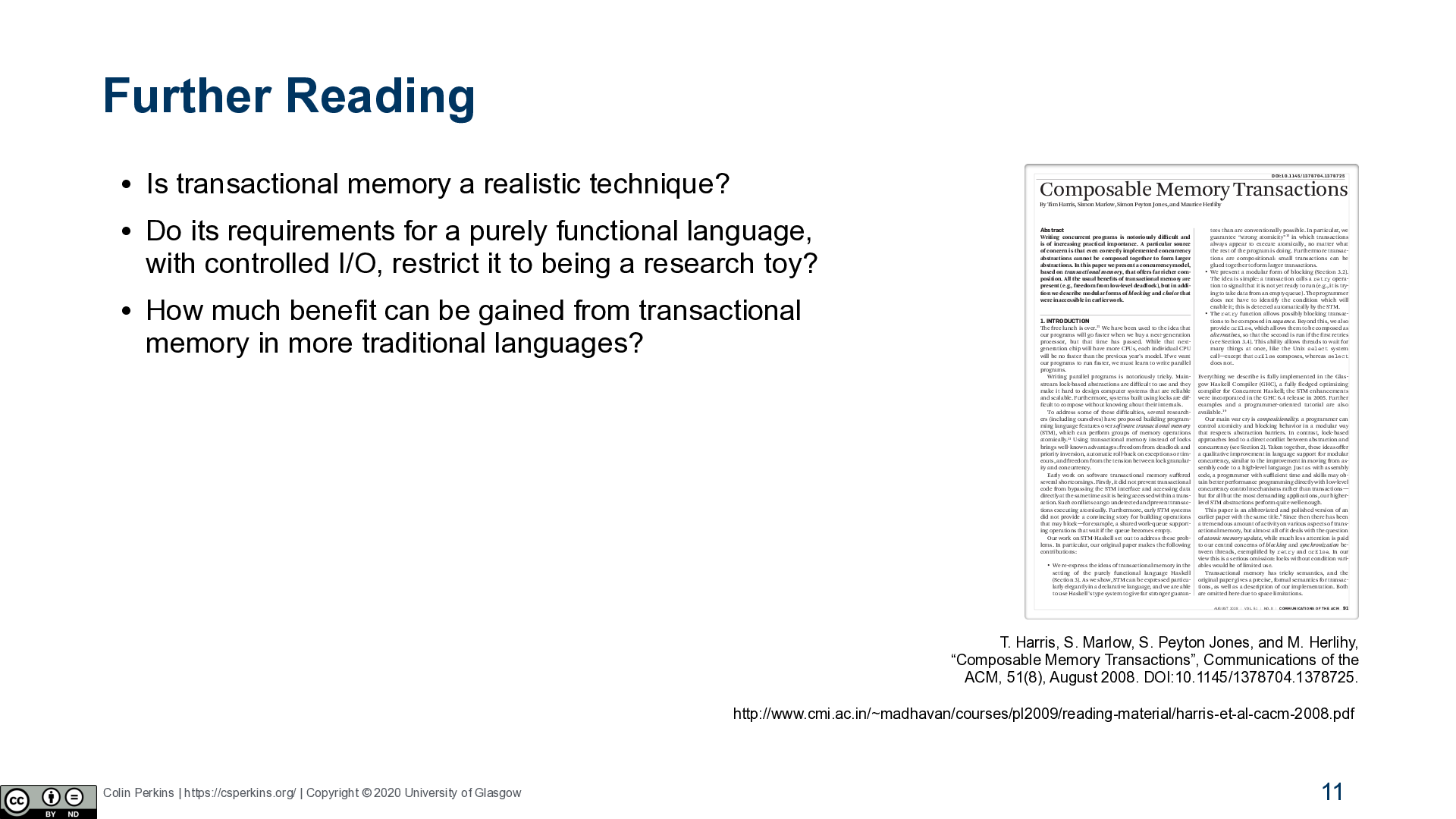
The paper linked from the slide talks
00:16:45.033
about atomic transactions and how they work
00:16:46.966
in detail. I encourage you to read
00:16:48.800
it, and to think about the ideas.
00:16:53.666
And that concludes our discussion of atomic transactions.
00:16:57.466
I’ve outlined the programming model,
00:16:59.633
how transactions can be integrated into Haskell,
00:17:02.600
and some of the difficulties in integrating
00:17:04.700
them into more mainstream languages.
00:17:08.333
In the next part, I’ll move on
00:17:09.933
to discuss another alternative concurrency mechanism,
00:17:13.100
that more friendly to mainstream languages:
00:17:15.733
message passing.
-
T. Harris, S. Marlow, S. Peyton Jones, and M. Herlihy,
Composable Memory Transactions, Communications of
the ACM, 51(8), August 2008.
Part 3: Message Passing Systems
The third part of the lecture moves on from transactions, to discuss
message passing as a concurrency model. It introduces actor-based
programming, and the various styles of message passing system, using
examples in Scala + Akka and Rust. It shows how message passing can
provide a natural model for concurrent programming, that's familiar
for those with experience writing networked applications, but discusses
the limited guarantees provided compared to transactions.
00:00:00.466
In the previous part I spoke about
00:00:02.366
transactions as an alternative concurrency mechanism,
00:00:05.433
and we discussed how they're a good
00:00:07.300
fit for languages such as Haskell,
00:00:09.166
but perhaps not so well suited for
00:00:11.800
more mainstream languages.
00:00:14.366
In this part I want to move
00:00:15.966
on and talk about message passing systems
00:00:18.300
as another alternative to shared state concurrency
00:00:21.500
using multi-threading.
00:00:23.433
I’ll talk a bit about the concept
00:00:25.600
of actor-based systems and message passing,
00:00:27.733
about how communications is structured in these
00:00:30.833
systems. And I’ll give some examples of
00:00:32.933
how it's used in languages like Scala and in Rust.
00:00:38.800
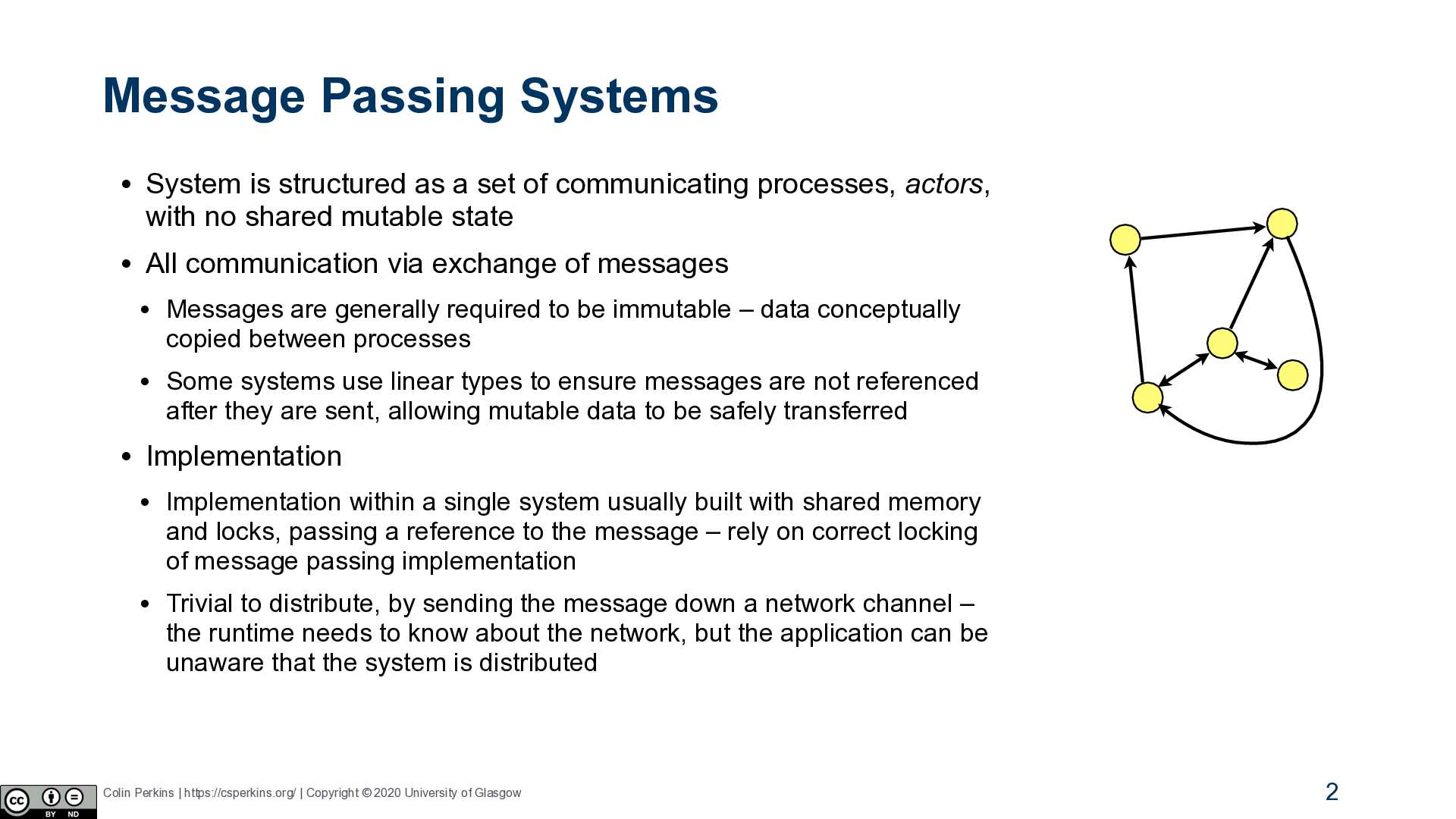
So what is a message passing system?
00:00:41.933
Well, the goal of a message passing
00:00:44.366
system is that the system gets structured
00:00:46.300
as a set of communicating processes.
00:00:49.000
These tends to be known as actors,
00:00:51.300
and they're structured such that they share
00:00:53.400
no mutable state.
00:00:55.633
The actors communicate by sending messages to
00:00:57.866
each other. And the act of sending
00:01:00.200
a message is the only way communication
00:01:02.766
can occur in these systems. There's no
00:01:05.066
shared memory, there's no shared mutable state.
00:01:09.166
The messages in such systems are generally
00:01:11.933
required to be immutable, they can't change
00:01:14.833
after they've been sent.
00:01:16.866
The data is conceptually copied between processes
00:01:19.600
in these systems, although in practice it’s
00:01:22.333
implemented by copying a reference. But,
00:01:24.466
since the data is immutable, this has
00:01:26.466
no practical difference; you're exchanging messages that
00:01:29.000
can’t change.
00:01:31.033
Alternatively, some systems using a technique known
00:01:33.800
as linear types, essentially ownership tracking,
00:01:36.833
to ensure that messages are not referenced
00:01:39.066
after they've been sent. This allows mutable
00:01:42.033
data to be safely transferred.
00:01:46.233
The way this is implemented, if you
00:01:49.166
have a single system with shared memory,
00:01:51.633
is using threads and locks. You're passing
00:01:54.866
a reference to the message between threads.
00:01:58.000
And this obviously relies on the communication
00:02:01.666
mechanism being implemented correctly,
00:02:03.400
and being correctly locked.
00:02:05.633
The benefit, I think, comes because that
00:02:07.500
only has to be done once.
00:02:09.366
You have to implement the locks to
00:02:11.466
exchange messages once, as part of the
00:02:13.633
system, but then every system which is
00:02:16.400
built on top of that gets the
00:02:18.033
correctly locked communication mechanism for free.
00:02:22.300
And these systems have the advantage,
00:02:23.900
of course, that they’re trivial to distribute.
00:02:25.933
Since you're passing messages between systems,
00:02:29.366
and those messages are either immutable,
00:02:31.633
or the runtime, the type system,
00:02:34.066
ensures that ownership is tracked and enforces
00:02:38.466
that they’re sent, it becomes possible to
00:02:40.966
make a distributed system very easily
00:02:43.333
just by sending the messages down a
00:02:45.333
socket to another node on the network,
00:02:47.333
rather than passing them by shared memory
00:02:50.633
within a single system.
00:02:53.133
So the runtime obviously needs to be
00:02:55.000
aware that it's distributed, but it's possible
00:02:56.966
to build these applications, such that they
00:02:59.233
can run across multiple nodes on the
00:03:00.966
network, and such that the application is
00:03:02.866
unaware that they are distributed.

00:03:07.566
The implementation of one of these,
00:03:09.700
if you look at how an actor is implemented,
00:03:14.166
tends to have a queue of messages
00:03:17.533
which have arrived and are waiting to
00:03:20.200
be processed. The queue is where synchronisation
00:03:23.266
happens; there's a lock on the queue
00:03:26.633
data structure and processes,
00:03:28.833
other actors, which are sending messages,
00:03:30.766
get a lock on the queue and
00:03:34.133
append their messages to the queue.
00:03:37.200
The message at the head of the
00:03:38.800
queue is de-queued. It goes to a
00:03:41.733
dispatcher, which then looks at the type
00:03:44.366
of the message and pattern matches against the type.
00:03:48.166
And the receiving process then executes a
00:03:50.133
different action depending on what type of
00:03:51.833
message has been received.
00:03:54.433
And when that's done, it just loops
00:03:56.066
around and pulls the next message off
00:03:57.633
the queue, and just executes in a
00:03:59.600
loop, processing message, after message, after message.
00:04:03.666
If it needs to communicate with the
00:04:06.066
other actors in the system, it can
00:04:08.133
send messages out, and they get queued
00:04:09.900
up to be processed by the other actors.
00:04:13.233
The entire system, then, proceeds as a
00:04:15.300
set of actors, each processing messages in
00:04:18.900
a loop, sending messages out to other actors.
00:04:22.400
It looks a lot like a networked
00:04:24.033
system; a lot like a networked server.
00:04:26.533
It processes messages and it sends replies.
00:04:32.133
There are lots of different ways in
00:04:33.800
which you can structure these systems.
00:04:36.766
It’s possible to build actor-based message passing
00:04:40.000
systems that operate in a synchronous or
00:04:42.700
an asynchronous manner; it’s possible to make
00:04:45.066
them statically or dynamically typed; or that
00:04:48.466
they deliver messages directly to actors,
00:04:51.400
or indirectly via channels.
00:04:54.433
And each of these different approaches has
00:04:56.733
its own advantages and its own disadvantages.
00:05:04.266
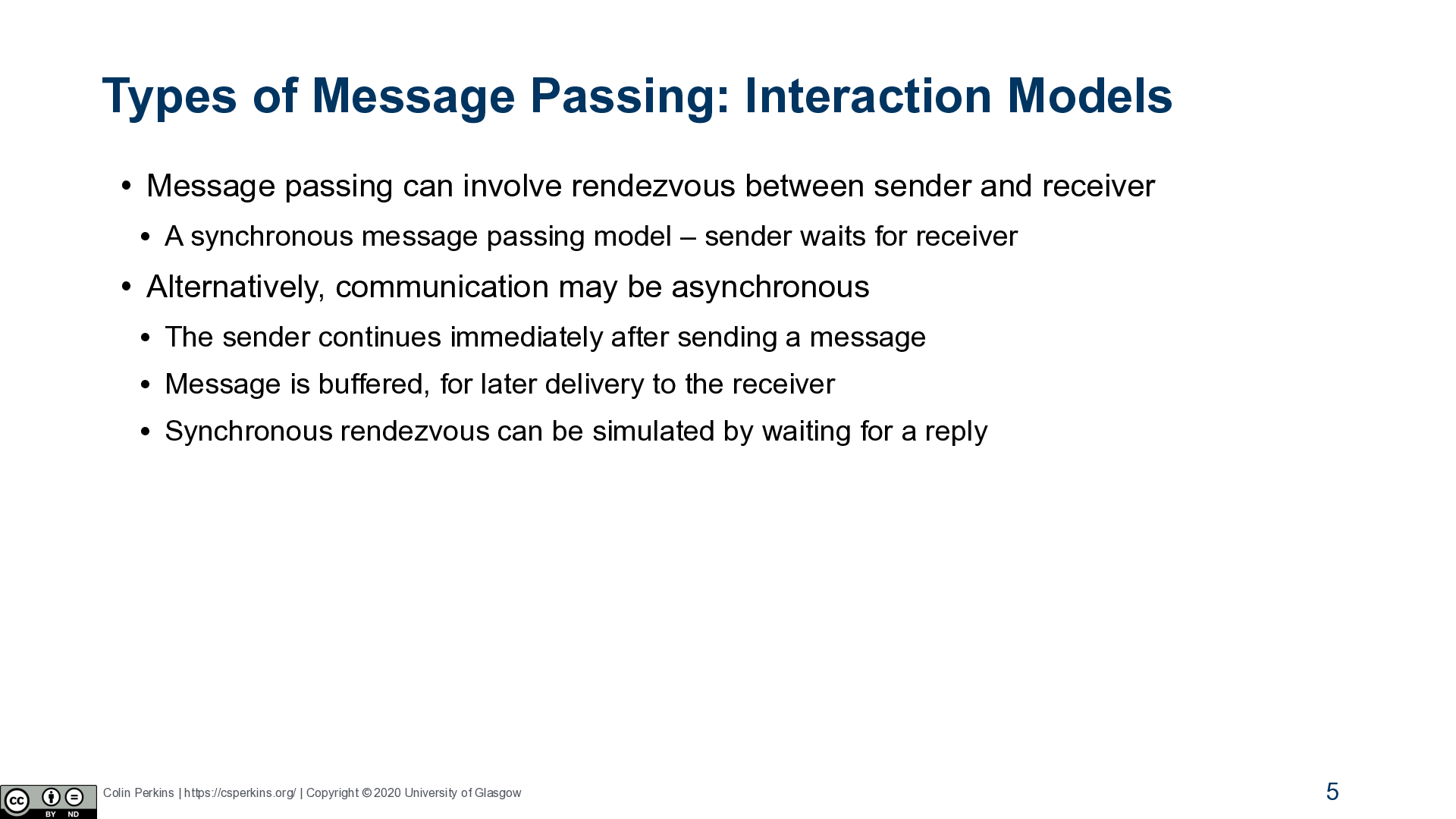
It’s possible for the communication be synchronous
00:05:07.166
or asynchronous.
00:05:10.066
It’s possible that message passing involves a
00:05:12.733
rendezvous between the sender and the receiver.
00:05:14.933
A synchronous message exchange.
00:05:18.066
In this case, the sender waits for
00:05:21.000
the receiver to become available when the
00:05:23.000
message is sent. Or, if the receiver
00:05:25.300
gets to the rendezvous first, it waits for the sender.
00:05:29.933
And this has the benefit of making
00:05:33.466
the two time-aligned. You know that both
00:05:37.000
are available, both sender and receiver are
00:05:39.466
available, at the point of communication.
00:05:43.633
Alternatively, the communication can be asynchronous.
00:05:46.533
The sender can send a message and
00:05:49.166
continue, without waiting for the receiver to receive it.
00:05:53.266
In this case, the message is buffered
00:05:54.900
up somewhere, and eventually gets delivered to the receiver.
00:06:00.366
And, in some ways, that's advantageous because
00:06:02.966
the sender can keep doing some other
00:06:05.466
work while waiting for the receiver to
00:06:07.966
process the message.
00:06:10.200
But it has the risk that the
00:06:12.033
receiver has somehow failed, and is not
00:06:14.833
processing messages, or it's not processing messages
00:06:17.666
quickly enough.
00:06:19.366
You can get a backlog of messages
00:06:21.533
building up. And to some extent that
00:06:24.200
can be problematic. You don't want the
00:06:26.833
sender to keep putting messages into the
00:06:28.966
queue if the receiver isn't processing them.
00:06:31.300
It wants to somehow be aware of
00:06:36.200
the failure, of the delays.
00:06:39.266
And these systems can get unbalanced.
00:06:43.633
There's no back-pressure to gradually slow the
00:06:46.833
system down, if one part of it isn't keeping up.
00:06:51.366
So there are perhaps advantages to
00:06:54.666
systems where there’s a synchronous rendezvous,
00:06:57.366
or where there’s a limited amount of
00:06:59.100
buffering capacity and, beyond that, the rendezvous
00:07:01.833
become synchronous. Just to provide back-pressure,
00:07:04.733
to make sure the whole system is
00:07:06.400
operating at the speed of it’s slowest component.
00:07:10.300
Of course, if you have an asynchronous
00:07:12.200
system, you can simulate a synchronous system
00:07:14.400
by waiting for a reply, so you
00:07:15.933
know the message was received.
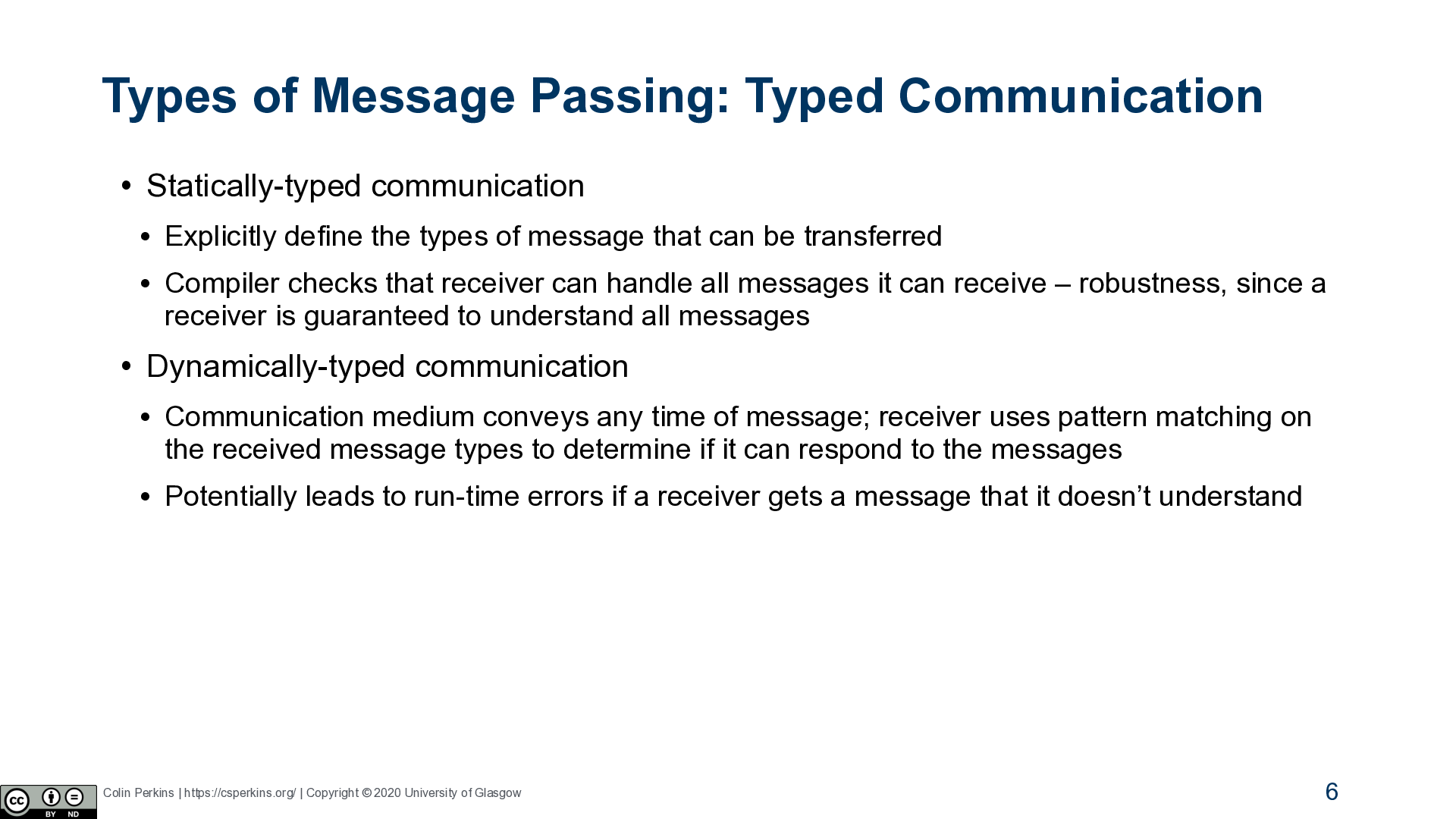
00:07:21.366
Different systems also make different choices around
00:07:24.333
the typing of messages.
00:07:27.133
it’s possible to build statically typed systems,
00:07:30.033
where the types of the messages which
00:07:32.966
can be sent to a particular actor
00:07:35.866
are well defined and checked in the
00:07:37.933
type system, checked by the compiler.
00:07:41.366
In these types of systems, the compiler
00:07:43.266
checks that a receiver can handle all
00:07:45.233
the possible messages it can receive.
00:07:47.766
And the system won't compile if it
00:07:51.166
can't handle the different messages.
00:07:55.500
And, in some ways, this provides robustness.
00:07:57.533
A receiver is guaranteed to be able
00:07:59.500
to understand all the messages it receives.
00:08:03.133
Alternatively, the system can be more dynamically
00:08:05.933
typed, where the communication medium, the communication
00:08:10.766
channel, the message passing system, conveys the
00:08:13.300
type of the message
00:08:14.933
and the receiver pattern matches on those
00:08:16.900
types, and tries to figure out if
00:08:18.566
it can respond to the messages.
00:08:21.366
If the typing is very dynamic,
00:08:23.066
this has the potential for runtime failures,
00:08:25.666
of course. It's possible to send a
00:08:27.533
message to a receiver which it doesn't
00:08:29.266
understand. So these types of system tend
00:08:31.700
to have a catch-all in there,
00:08:33.466
and they tend to specify what the receiver does
00:08:36.466
if it receives an unknown message type.
00:08:42.566
And these are perhaps more flexible.
00:08:45.566
You don't need to
00:08:47.933
evolve the system all at once.
00:08:50.566
And it's possible to build systems that
00:08:52.800
can optionally handle certain types of messages,
00:08:55.500
and just discard messages they don’t understand.
00:08:58.233
So this may potentially make a more
00:09:00.766
evolvable system. And, especially for distributed systems,
00:09:05.633
this potentially offers the flexibility to upgrade
00:09:09.833
the system in parts, and to evolve the system.
00:09:12.966
But it does mean you have to
00:09:14.633
think about how to handle unknown messages,
00:09:16.666
and have the risk of runtime failures.
00:09:22.700
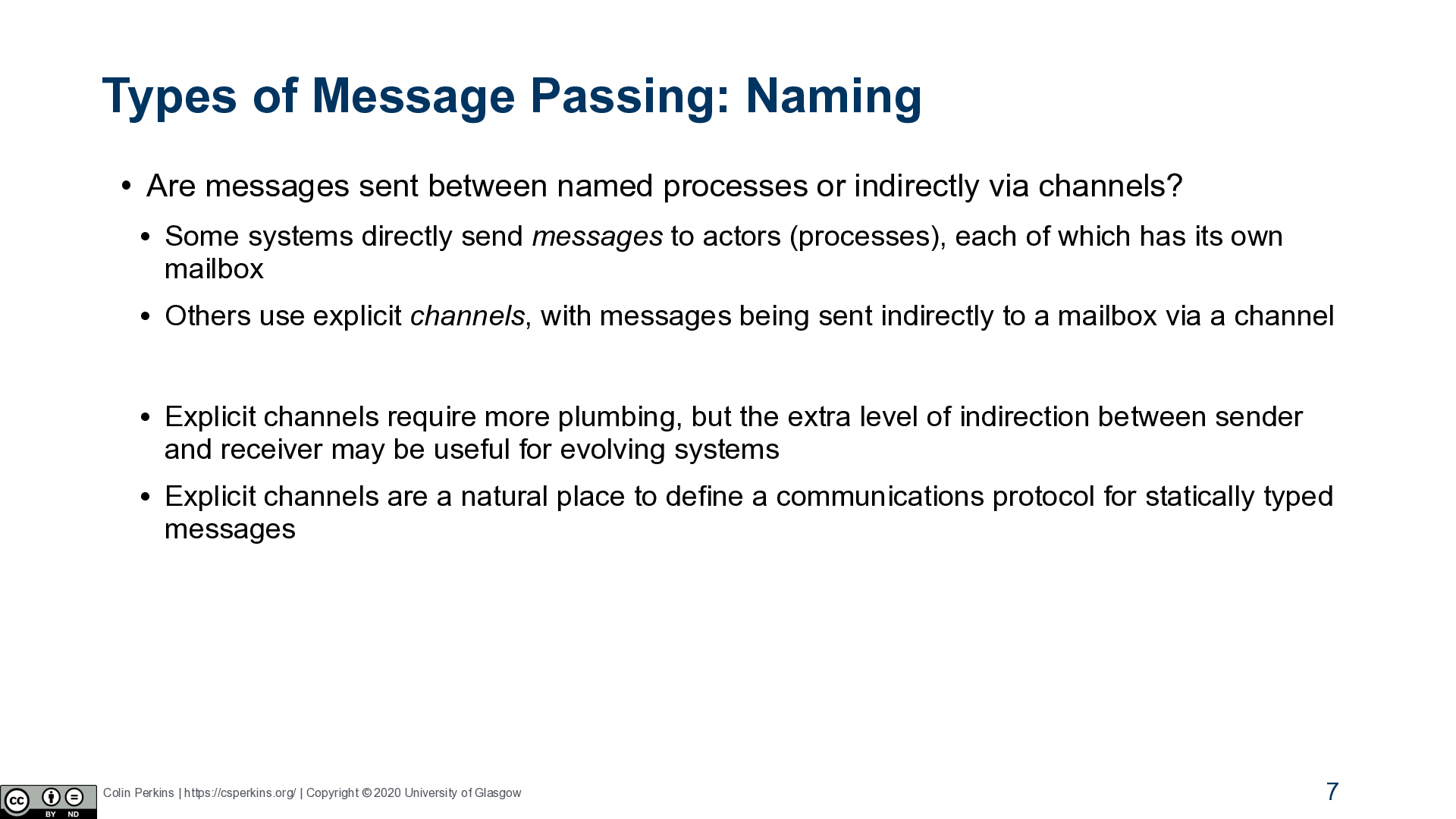
You also need to think about whether
00:09:24.366
messages are being sent directly between named
00:09:26.800
processes, whether messages being sent directly to an actor,
00:09:31.333
or whether they're being sent indirectly via
00:09:33.433
some communications channel.
00:09:37.133
Some of these systems are arranged such
00:09:39.500
that they directly send messages to actors.
00:09:42.600
You get a reference to the actor,
00:09:44.633
and you can directly message that actor.
00:09:48.633
Others have this idea of channels,
00:09:51.533
where you get a reference to a
00:09:53.366
communications channel, and you put messages into
00:09:55.866
that channel. And the receiver takes them
00:09:58.166
out of the channel, out of the
00:10:00.466
communications link, and puts them into its
00:10:03.200
mailbox for processing.
00:10:08.300
The use of explicit channels
00:10:11.600
adds overhead in some ways. It requires
00:10:14.533
you to explicitly plumb the system together,
00:10:17.000
and connect up the communications channels to
00:10:19.300
the senders and receivers.
00:10:21.800
But, it provides an extra level of indirection.
00:10:24.900
And this can potentially be useful for
00:10:27.533
evolving the system, in that you can
00:10:29.766
change the receiver without the senders having
00:10:32.900
to know that the receiver has changed.
00:10:35.433
Or, similarly, you can change the senders
00:10:37.266
without the receiver having to know.
00:10:40.266
And, as long as the communications link
00:10:42.266
is there, you can change what's connected
00:10:44.566
to the endpoints. And that potentially is
00:10:46.933
useful to evolve the system. You don't
00:10:49.233
have to tell all the senders when
00:10:50.933
you change the receiving process.
00:10:54.000
And explicit channels are also perhaps a
00:10:56.066
natural place to define a communications protocol,
00:10:59.533
and to specify the types for messages
00:11:01.333
that can be transferred,
00:11:03.500
so they perhaps have an advantage that
00:11:05.400
way. Though, of course, the issue is
00:11:08.300
complexity, and having to plumb the system
00:11:11.233
together, so there’s some overhead too.
00:11:18.100
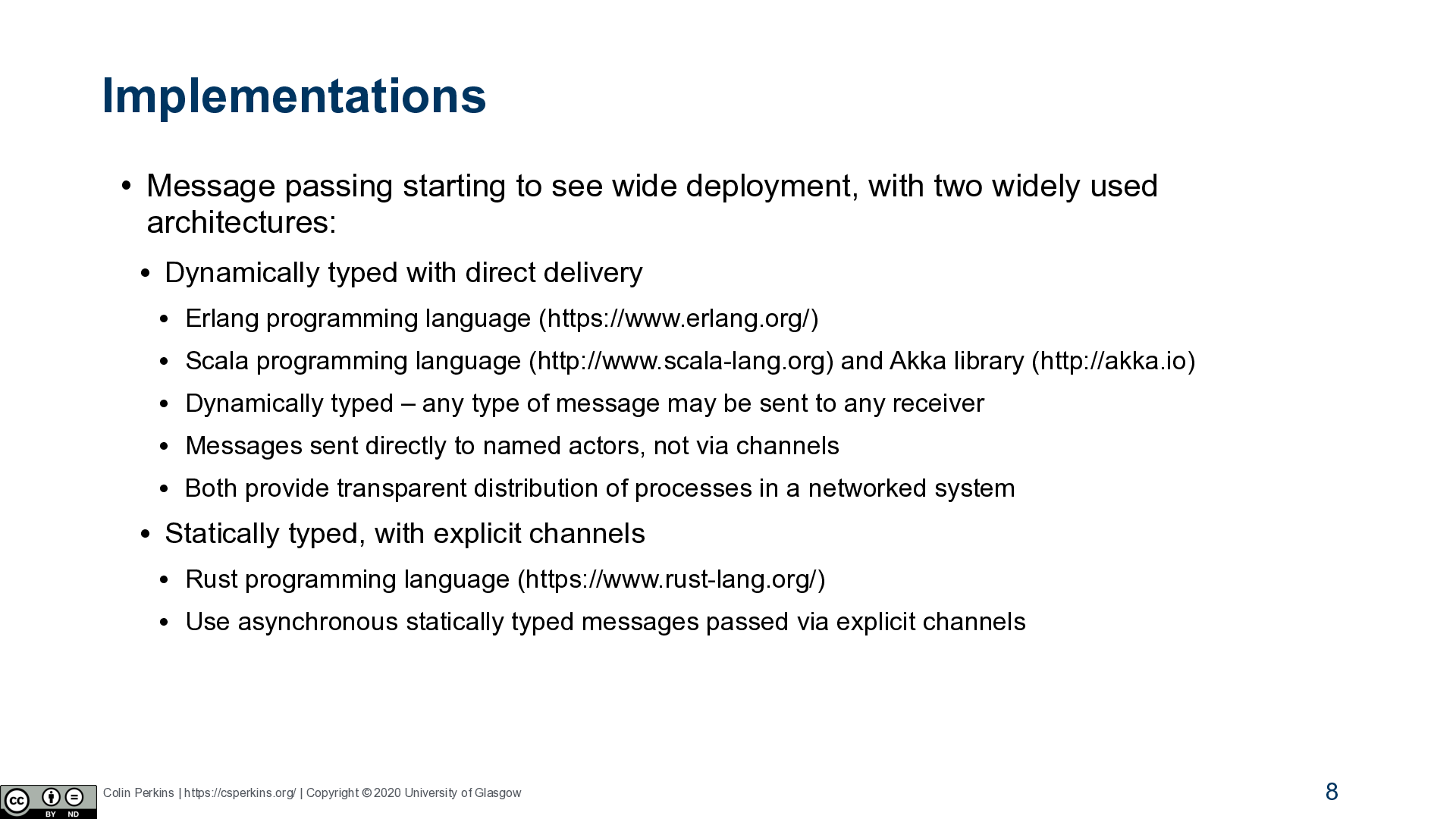
Actor-based systems are actually starting to see
00:11:21.333
fairly wide deployment.
00:11:24.333
And there's two different architectures
00:11:26.233
that are getting used.
00:11:29.633
The original architecture is that adopted by
00:11:32.200
the Erlang programming language, more recently by
00:11:35.466
Scala with the Akka library.
00:11:38.733
And these systems,
00:11:41.033
these systems are very dynamically typed.
00:11:44.333
You can send any type of message
00:11:46.300
to any receiver, and it pattern matches
00:11:48.400
on the type of messages and decides
00:11:50.300
whether it can handle them. And the
00:11:52.066
system has some sort of error handling
00:11:54.733
built in for what happens if it
00:11:57.633
gets a message it doesn't understand.
00:11:59.800
And maybe that kills the process,
00:12:01.466
maybe it ignores the message, or maybe
00:12:03.300
it drops into a custom error handling routine.
00:12:06.833
So these systems are very dynamically typed.
00:12:09.466
They allow messages to be sent directly
00:12:11.766
to named actors, so you get an
00:12:14.300
actor reference and you send it a message, rather than
00:12:16.933
sending messages via channels. And they both
00:12:19.666
provide transparent distribution of
00:12:22.500
processes across the network.
00:12:26.133
The alternative approach, which is starting to
00:12:29.166
see some interest, is a very statically-typed
00:12:32.566
approach, using explicit channels. This is what
00:12:36.800
we're seeing in the Rust programming language, for example.
00:12:40.866
It’s asynchronous, it’s statically typed, and the
00:12:44.300
messages are sent into explicit channels,
00:12:47.466
and you have to explicitly plumb the
00:12:49.466
multiple threads together with the communication channels.
00:12:54.200
And they both work, they’re both seeing
00:12:56.400
use, but they’re quite different philosophies to
00:12:58.400
building actor-based systems.
00:13:03.966
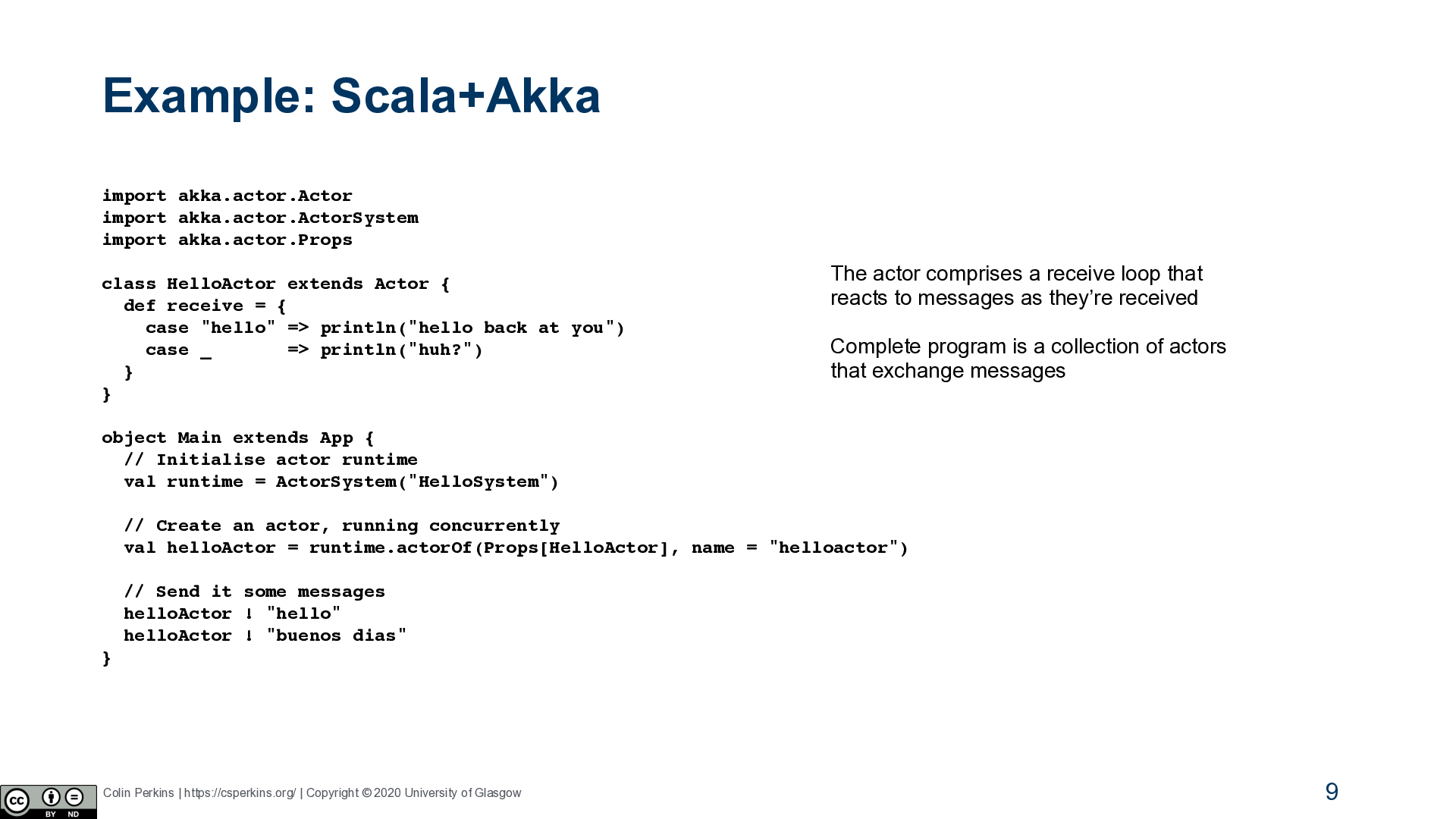
So let's look at an example of each of the two approaches.
00:13:08.166
So, the first one is an example
00:13:10.866
written in Scala programming language, using an
00:13:13.733
actor system known as Akka.
00:13:16.566
And Scala is a functional language,
00:13:18.733
which runs on the Java Virtual Machine.
00:13:22.800
And, what we see here, at the
00:13:24.866
bottom of the slide, we see the
00:13:26.433
main object being created. It says “object
00:13:28.966
Main extends App”. This is the main
00:13:31.500
object in the system, the equivalent of the main function.
00:13:36.100
And this creates an actor runtime.
00:13:38.200
And then it creates an actor.
00:13:40.200
It says “val helloActor = runtime.actorOf”,
00:13:44.400
and this creates an actor of type
00:13:46.833
HelloActor, and it gives it a name,
00:13:49.533
and it assigns this to an immutable
00:13:52.533
variable helloActor.
00:13:55.100
And then it sends it some messages.
00:13:57.666
And the syntax with the actor name,
00:14:00.166
and the exclamation mark, and the message
00:14:01.966
is the syntax Akka uses to send
00:14:03.666
messages. And this sends the two messages
00:14:08.066
firstly “hello”, and then secondly “buenos dias”,
00:14:11.233
to the HelloActor.
00:14:14.366
And the code we see at the
00:14:15.566
top of the slide, the class HelloActor,
00:14:18.800
defines the entirety of the actor which
00:14:22.066
is receiving those messages.
00:14:25.200
It's got to receive method. The syntax
00:14:29.066
“def receive =” is defining a method.
00:14:33.033
And this method just pattern matches on
00:14:36.766
the types of messages it receives,
00:14:38.533
so it's like a match statement in Rust.
00:14:41.866
it's got a case where, if it
00:14:43.566
receives the string “hello” it prints “hello
00:14:46.500
back at you”, and if it receives
00:14:48.366
any other type of message it just says “huh?”.
00:14:53.566
And the actor just runs in a
00:14:54.900
loop. It just continually receives these messages
00:14:58.066
and processes them.
00:15:00.133
And it can pattern match in a
00:15:01.500
way that gets the message object,
00:15:03.333
which allows it to send a response if it wants.
00:15:06.166
And it can store data in the
00:15:08.866
actor object, and that can include references
00:15:13.066
to other actors which it’s been sent,
00:15:17.900
and that allows it to build up
00:15:19.266
more complex communication patterns.
00:15:22.666
And everything’s very dynamic but it's quite low
00:15:25.866
overhead, it’s quite syntactically clean.
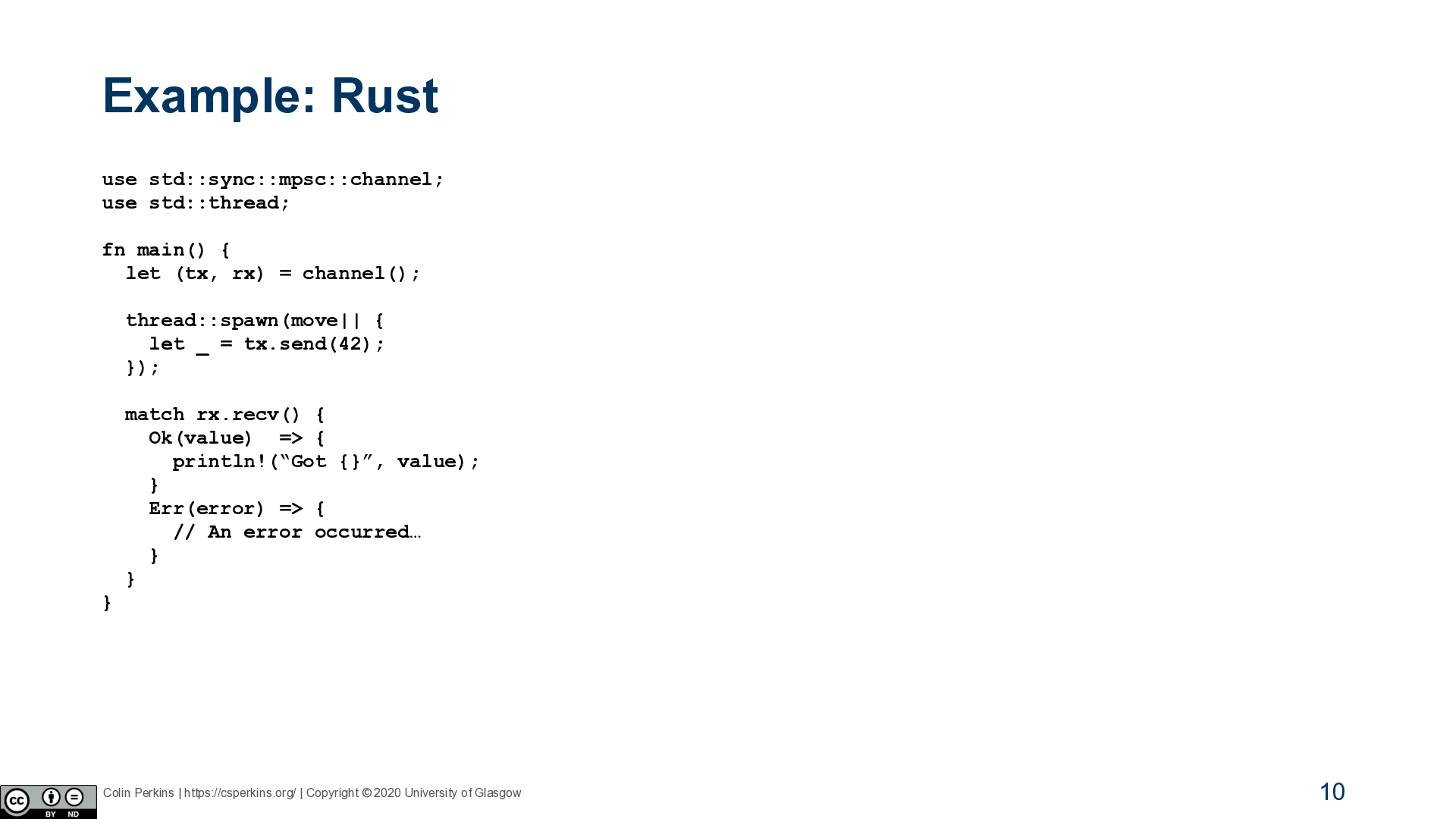
00:15:32.766
We can also see, in this example,
00:15:35.600
how you might do it in Rust.
00:15:38.566
In this case, we have a main
00:15:40.133
function which creates a channel, spawns a
00:15:43.500
thread, and sends a message between them.
00:15:47.200
So let's walk through this.
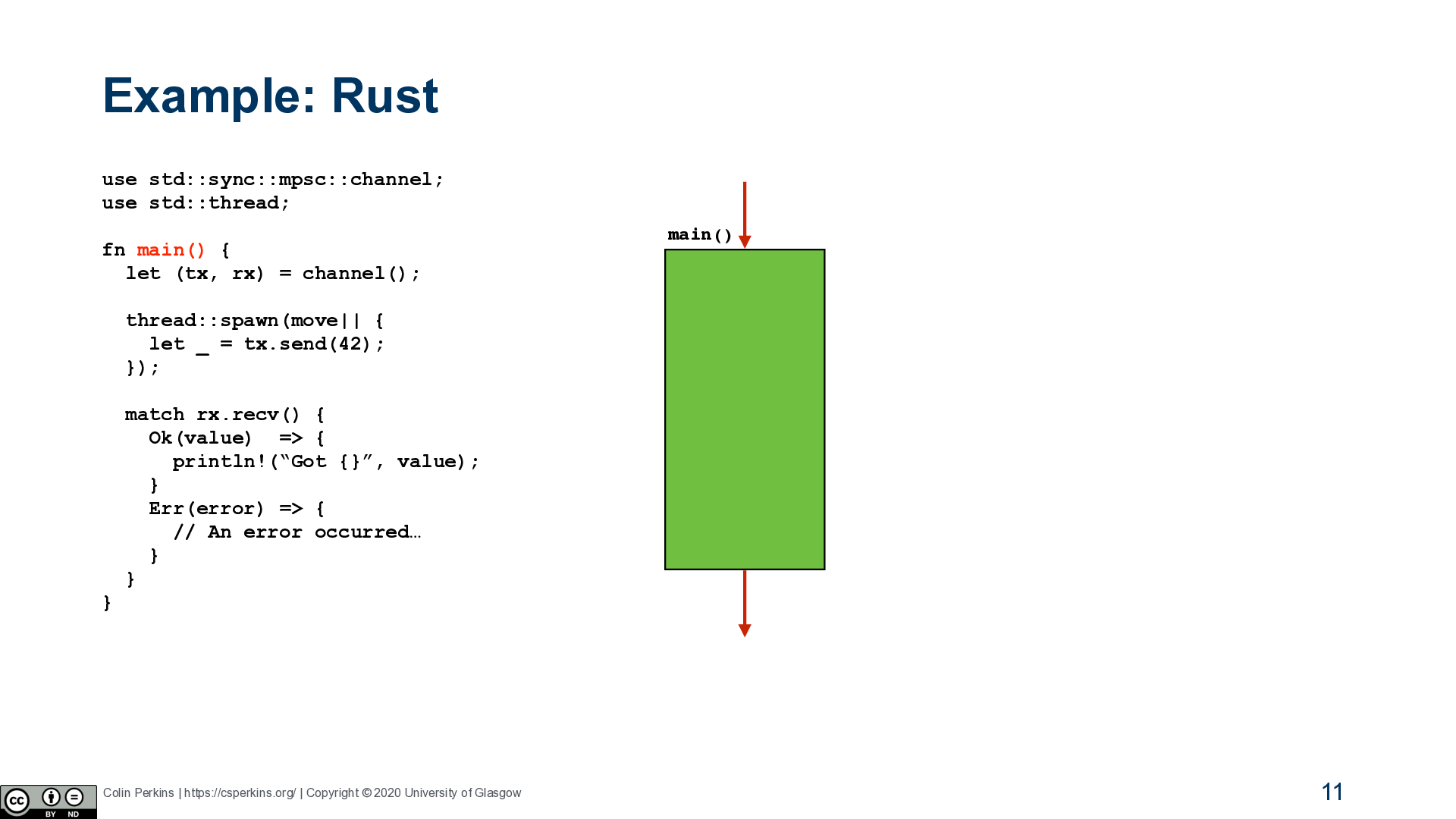
00:15:49.333
To start with, we have a function, main(),
00:15:52.333
and this holds the entire state of
00:15:54.700
the system, as is normal in Rust programs.
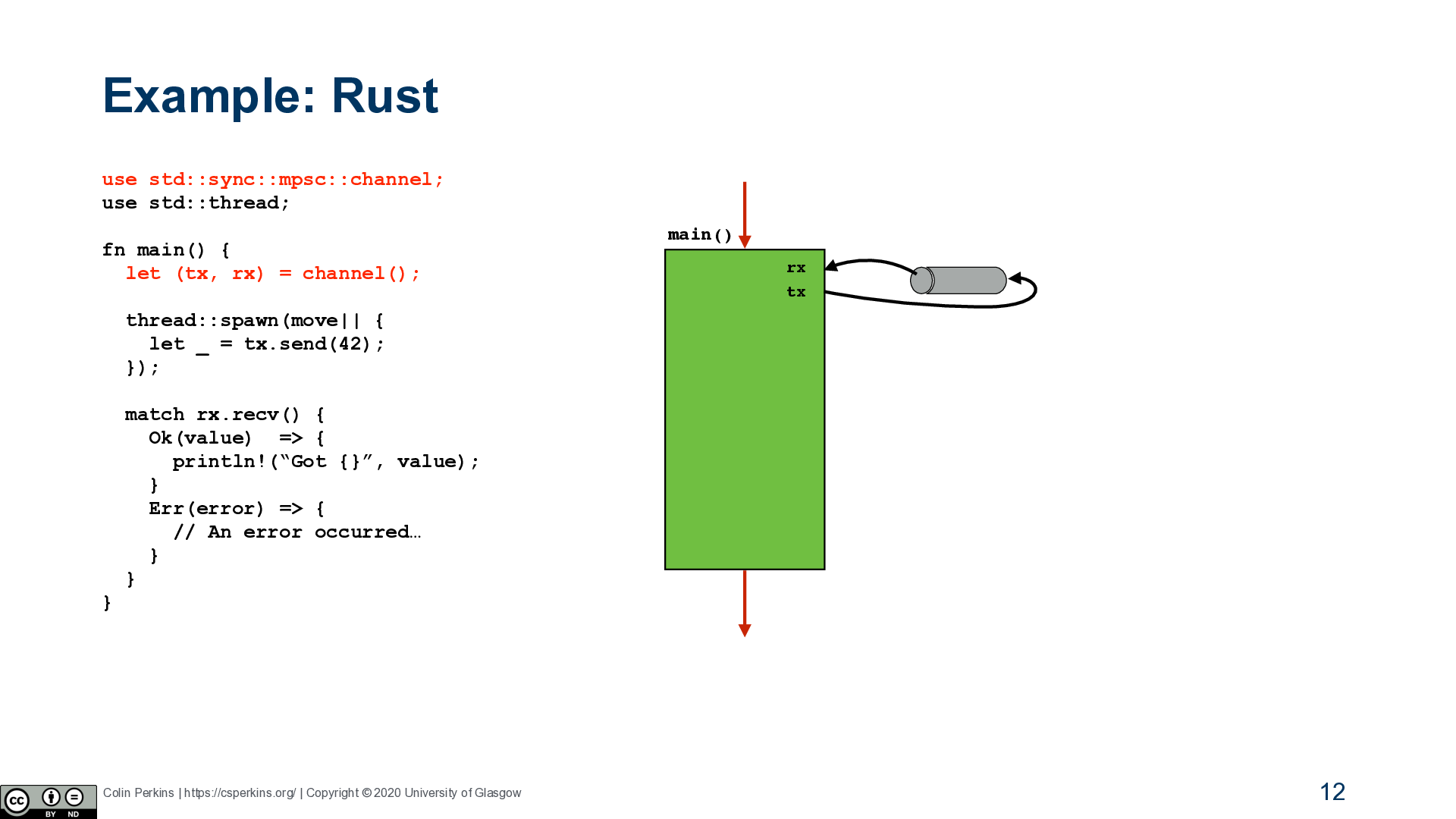
00:15:59.566
The first thing that the main() function
00:16:01.233
does is create a channel.
00:16:04.500
The channel is defined in the standard
00:16:06.233
library, and is the inter-thread communication mechanism
00:16:11.100
for Rust.
00:16:13.100
And by calling the channel() call,
00:16:15.000
it returns you a tuple of the
00:16:16.600
transmitting and receiving ends of that channel.
00:16:19.100
The channels are unidirectional, and you transmit
00:16:21.633
into one end, and it comes out of the receiving end.
00:16:25.233
And the main() function now has references
00:16:29.100
to both ends of channel.
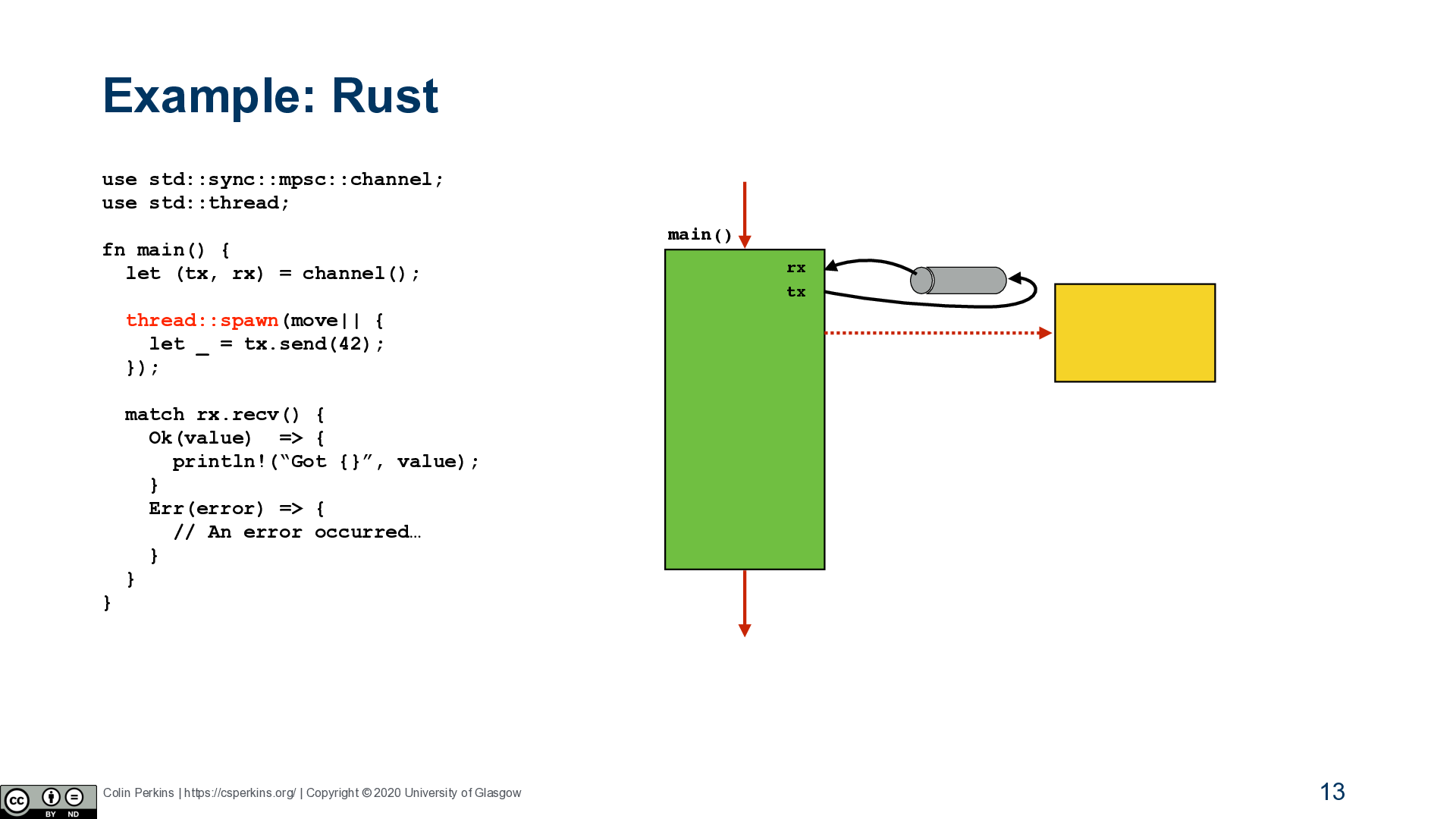
00:16:34.000
We call thread::spawn(). This is the way
00:16:37.733
you create a new thread in Rust.
00:16:39.633
And, again, this comes from the standard
00:16:41.366
library, and the thread spawn() call creates
00:16:43.700
a new thread of execution.
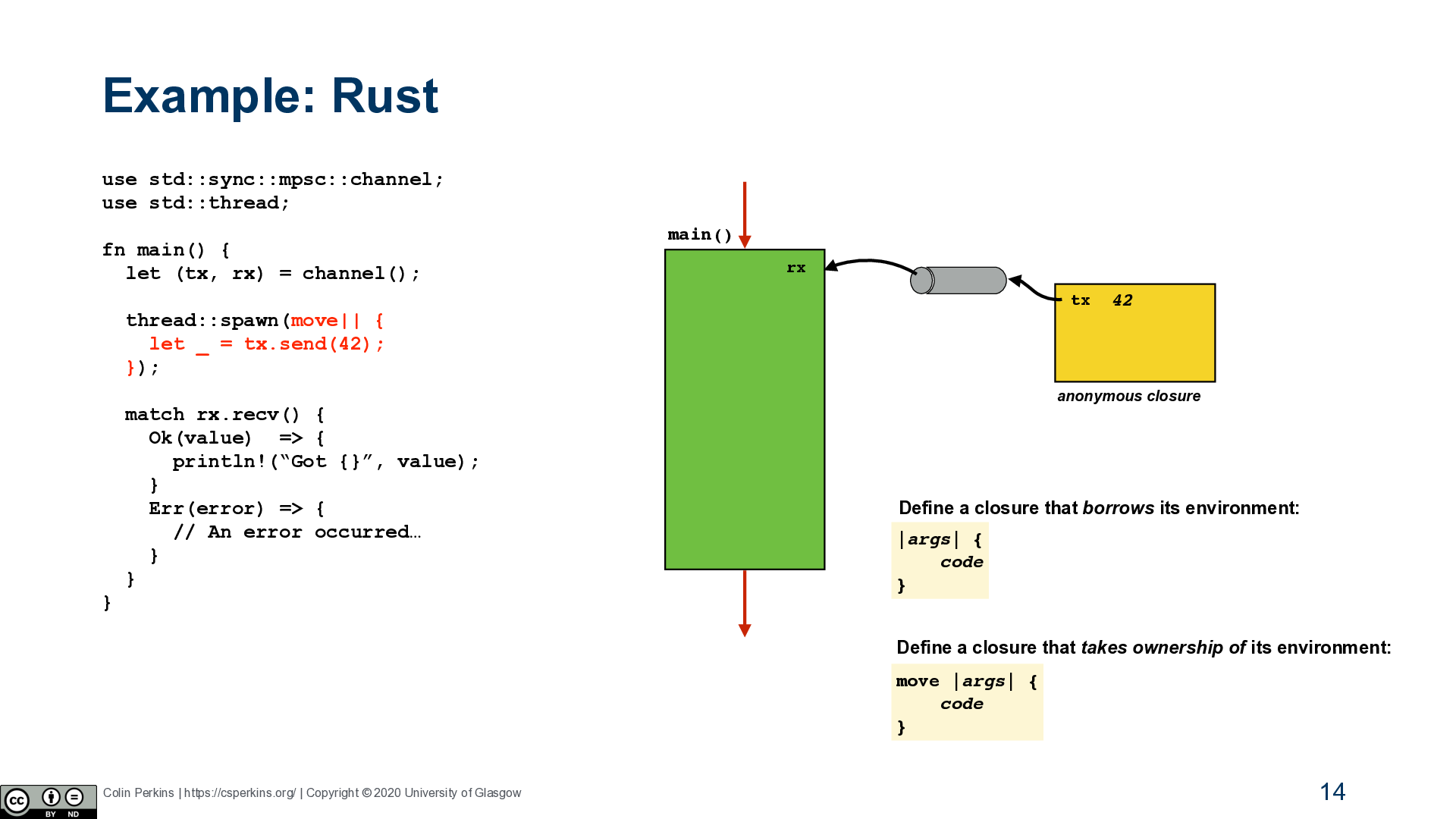
00:16:48.166
What gets executed by that thread is
00:16:50.633
the contents of its argument. It's passed
00:16:54.433
what’s known as a closure. It's passed
00:16:56.933
a block of code, which captures the
00:16:59.900
necessary variables from its environment.
00:17:04.566
There’s two ways of writing an anonymous
00:17:06.966
closure like this, as we see in the bottom of the slide.
00:17:10.700
You can just specify the arguments within
00:17:13.300
the bars, and then the code.
00:17:16.900
And, in that case, the closure borrows
00:17:18.833
its environment. It borrows the values of
00:17:20.866
its arguments, and any variables it references,
00:17:23.433
from the enclosing function.
00:17:26.666
Or you can define it by saying
00:17:28.300
“move”, followed by the arguments in bars,
00:17:30.766
followed by the code. And that takes
00:17:32.866
ownership of its arguments, it takes ownership
00:17:35.433
of the values it needs from the
00:17:36.900
environment. So it transfers ownership of the
00:17:39.866
data to the closure.
00:17:42.900
Now, in this particular case, we specify a move closure,
00:17:47.500
so it's taking ownership. And there are
00:17:50.466
the two bars, with no arguments between
00:17:52.100
them, because this particular closure doesn't take
00:17:54.566
any explicit arguments.
00:17:56.900
And the body of the closure is
00:17:58.633
just code within the braces, where it
00:18:03.433
says “let _ = tx.send(42)”.
00:18:07.733
And you see this references the value
00:18:09.800
of tx, which was defined in the
00:18:11.833
main() function. So it's referenced a value
00:18:14.333
from its environment.
00:18:16.433
And, because it's a move closure,
00:18:18.633
it takes ownership of that. So the
00:18:20.566
ownership of the value tx has been
00:18:23.766
moved into this closure, and that's been
00:18:26.666
passed to the thread::spawn() call. So this
00:18:29.200
has moved the ownership of tx into
00:18:31.533
the other thread.
00:18:34.533
So, at this point, we have two
00:18:36.200
threads of execution running. We've got the
00:18:38.833
main thread, and we've got the new
00:18:42.066
thread which has been spawned. And the
00:18:44.200
thread which has been spawned has taken
00:18:45.800
ownership of the variable tx, so it's
00:18:47.933
got access to the transmit descriptor of the channel.
00:18:52.233
But the receive descriptor still remains with
00:18:56.333
the main() function.
00:19:00.066
And it calls tx.send().
00:19:02.766
It transmits the number 42 down that
00:19:05.800
channel, and it assigns the return value
00:19:08.766
to underscore so it's not waiting for a response.
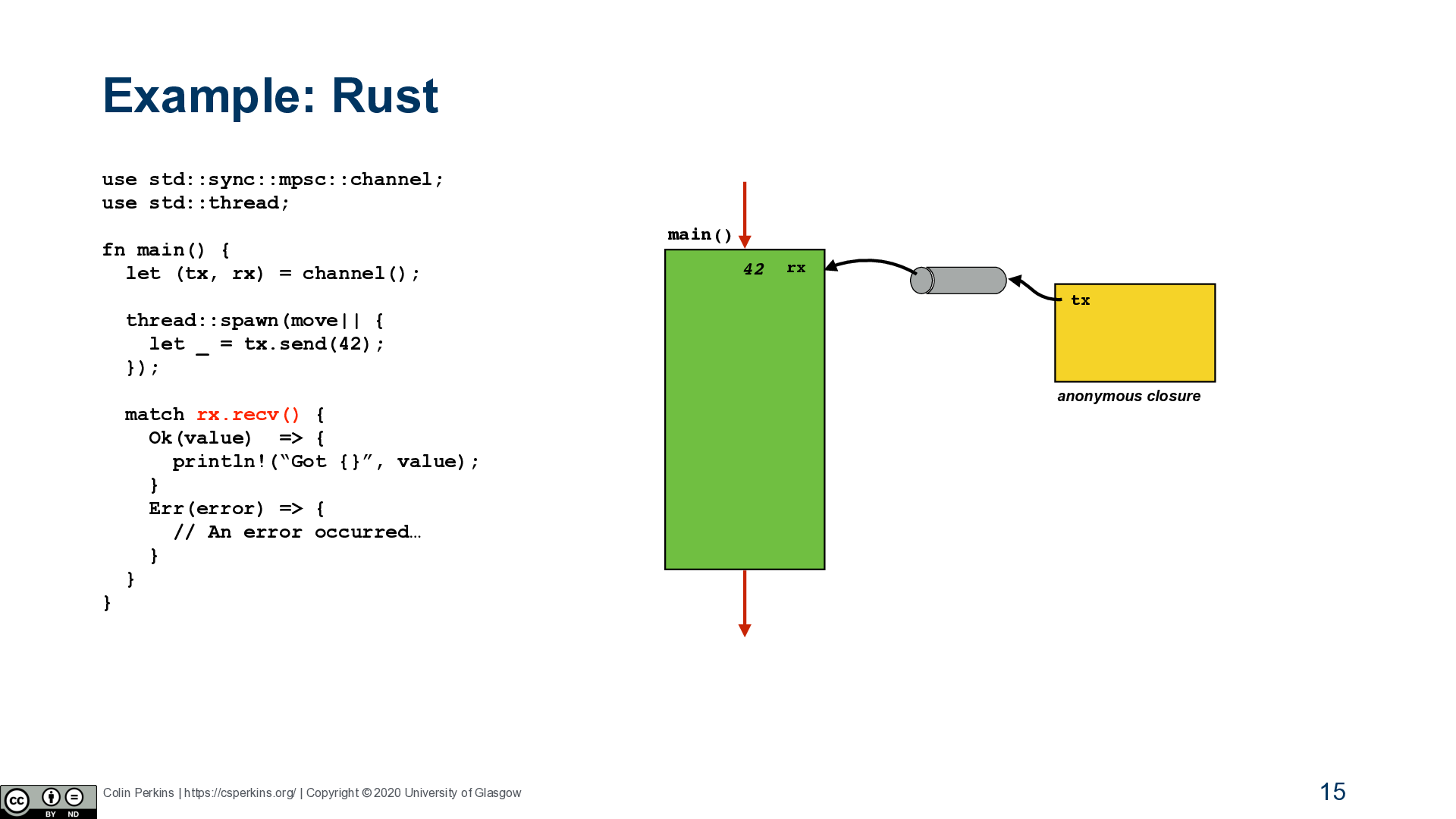
00:19:12.800
And this passes the value back to
00:19:14.766
the main thread, down the channel.
00:19:18.966
Back in the main thread, you call
00:19:21.600
recv() on the rx variable, the receive
00:19:25.933
side of the channel, and you pattern match on the result.
00:19:29.800
And if you get a success value,
00:19:32.233
you can look at the contents of
00:19:34.100
the value which was sent over,
00:19:37.166
and process that.
00:19:39.766
Or it can error, depending if something
00:19:41.933
went wrong with the transmission.
00:19:45.500
It’s a much more explicit process than in Scala.
00:19:49.233
We’re explicitly plumbing together the sender and
00:19:52.000
the receiver by creating the channel.
00:19:56.733
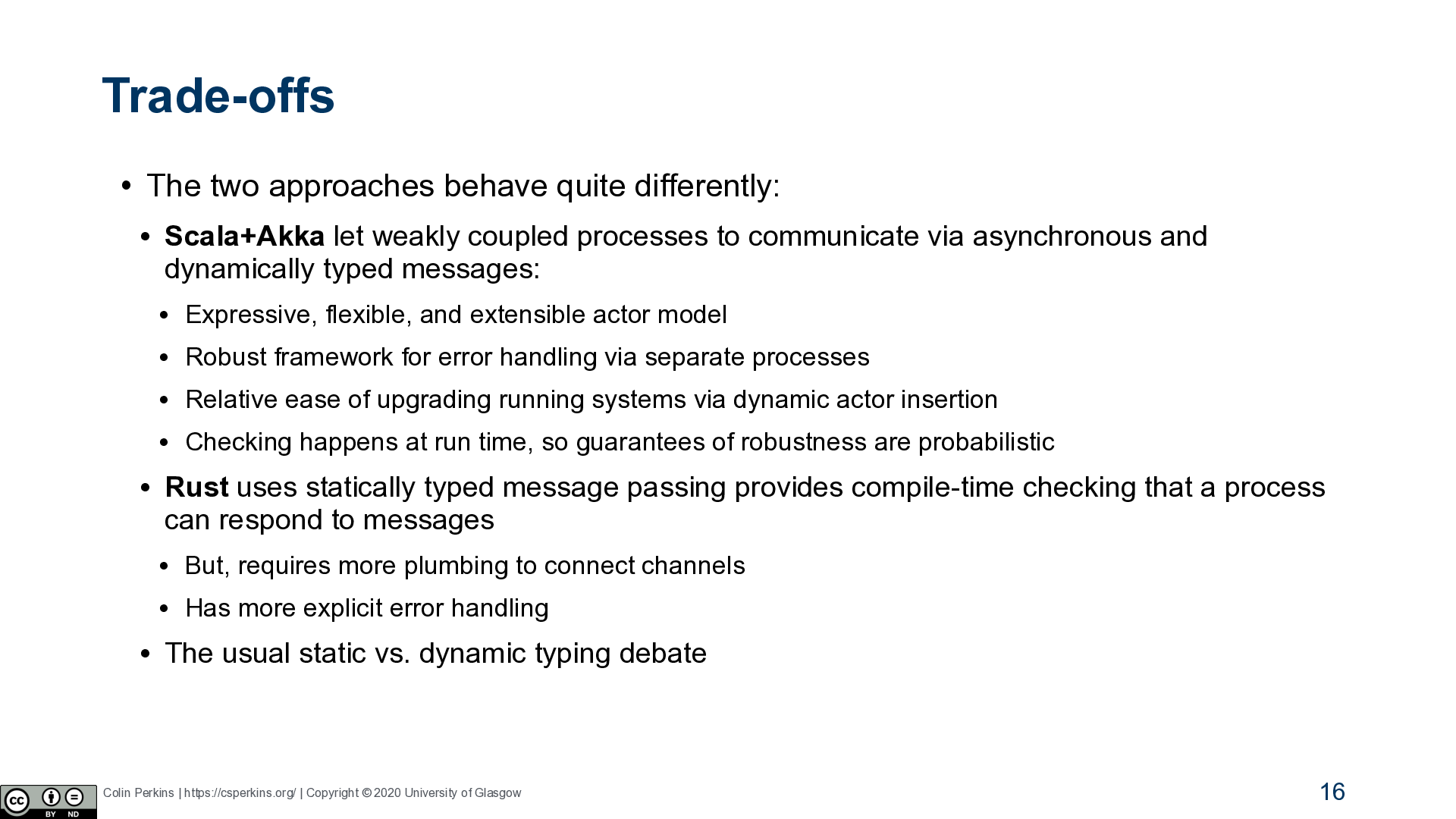
And the two approaches behave quite differently.
00:20:00.800
The approach taken in Scala and Akka
00:20:03.200
lets you couple weakly-typed processes together.
00:20:07.633
And they can communicate in a very
00:20:09.400
asynchronous and very dynamic way.
00:20:12.666
It’s very expressive, it’s very flexible,
00:20:15.900
and it's got a reasonably interesting error
00:20:19.500
handling model using
00:20:21.766
separate processes for error handling which we'll
00:20:24.466
talk about later.
00:20:26.600
And it makes it relatively easy to
00:20:28.233
upgrade the system by dynamically inserting actors
00:20:31.800
into the system as needed, by building
00:20:35.266
systems which can which can deal with optional messages.
00:20:40.100
And the checking happens at runtime,
00:20:42.900
and so you get probabilistic guarantees of
00:20:45.766
correctness. The system can fail at runtime,
00:20:49.933
due to not understand sending messages.
00:20:53.333
Rust, on the other hand, is very
00:20:55.033
statically typed, and it provides compile time
00:20:57.266
checking that a process can respond to
00:20:59.233
all the messages it’s sent. But,
00:21:01.266
it's more explicit, it requires more plumbing
00:21:03.533
to connect the channels together.
00:21:06.366
And it needs more explicit error handling,
00:21:08.333
so there's perhaps more overhead there.
00:21:11.566
Essentially, is the usual static versus dynamic
00:21:14.033
typing debate, but playing out in types
00:21:16.066
of messages you’re exchanging.
00:21:19.866
And that's it for this part.
00:21:21.433
I spoke about actors and message passing,
00:21:23.666
and the different types and structures of
00:21:25.466
message passing systems.
00:21:28.300
In the next part, I’ll finish up
00:21:29.866
by talking about race conditions, and the
00:21:32.633
reasons why these systems are built using
00:21:35.133
immutable data, or the reason why they
00:21:38.066
track ownership to avoid races between actors.
Part 4: Race Conditions
The fourth part of the lecture discusses race conditions. It introduces
what is a race condition, why they're problematic, and how they can
occurs in both message passing and shared memory systems.
00:00:00.400
In this final part of the lecture
00:00:02.300
I want to talk briefly about race
00:00:03.833
conditions. I’ll talk about what is a
00:00:06.033
race condition, and how race conditions can
00:00:08.633
occur in message passing and shared memory systems.
00:00:13.900
So, what is a race condition?
00:00:16.833
A race condition can occur when the
00:00:18.666
behaviour of a system depends on the
00:00:20.900
relative timing of different actions, different events,
00:00:23.400
that can occur,
00:00:24.900
or when a shared value is modified
00:00:27.066
without coordination between the different threads,
00:00:30.466
the different parts of the system,
00:00:32.000
which are modifying that value. And it
00:00:34.233
introduces non deterministic behaviour into the program.
00:00:37.566
It's difficult to predict the exact timing
00:00:40.266
behaviour of a program. It’s difficult to
00:00:42.666
predict what happens if multiple threads asynchronously
00:00:46.566
modify a shared value. And, as a
00:00:48.966
result, you get hard to debug problems,
00:00:51.600
and behaviour which is not predictable from
00:00:53.900
the system as a whole.
00:00:56.800
There are two types of race that
00:00:59.066
can fundamentally happen. In message passing systems,
00:01:02.200
you can get races due to the
00:01:03.666
order in which messages arrive, and in
00:01:06.000
shared memory systems you can get,
00:01:08.666
in addition, races due to modification of values.
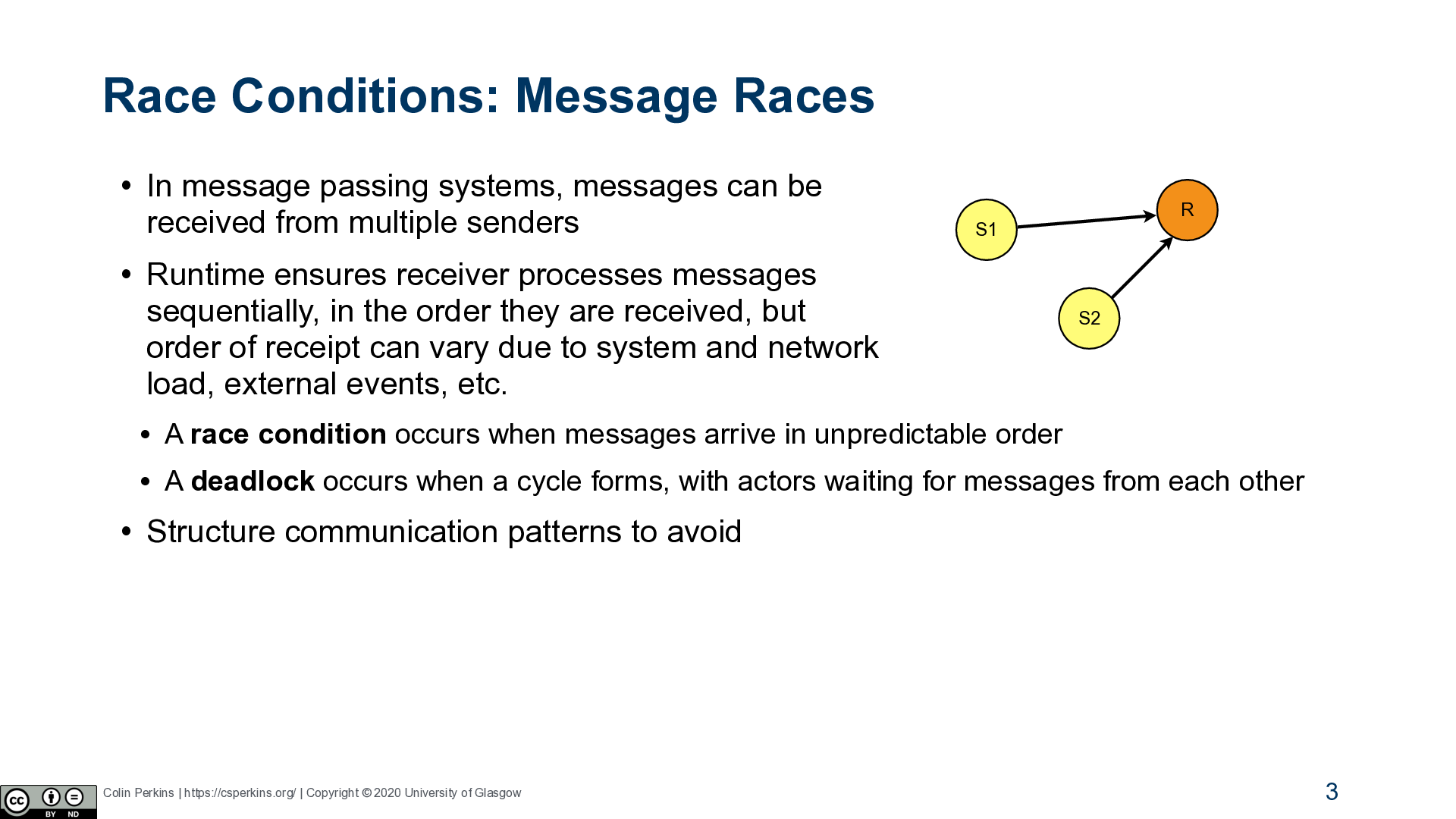
00:01:16.500
In message passing systems, the race condition
00:01:19.733
can occur when messages are received from
00:01:22.466
multiple senders to a particular receiver.
00:01:26.366
In these types of systems, the runtime
00:01:28.300
ensures that the receiver processes the messages
00:01:30.766
sequentially, and processes the messages in the
00:01:33.066
order that they’re received.
00:01:35.100
But, unfortunately, the order in which the
00:01:37.400
messages are received can vary.
00:01:39.800
And the order the messages are received
00:01:41.600
can vary because of system load,
00:01:44.600
because of network load, because of details
00:01:48.066
in the scheduling processes,
00:01:50.533
if a network is involved, because of
00:01:52.633
congestion control or packet loss, for example.
00:01:56.833
And, as a result, the messages,
00:01:59.200
if you have messages arriving at receiver
00:02:01.466
from multiple senders, can arrive in unpredictable order.
00:02:04.733
You’re not always guaranteed that a message
00:02:07.066
from sender one will necessarily arrive before
00:02:10.400
a message from sender two.
00:02:12.400
And, if it matters which order the messages arrive in,
00:02:15.933
if the system takes different actions,
00:02:19.433
depending on the order the messages arrive,
00:02:21.266
you then have the potential for unpredictable behaviour.
00:02:25.733
Similarly, it's possible for such a system
00:02:27.733
to deadlock. It’s possible to arrange the
00:02:31.133
system such that the messages flow in
00:02:33.033
a cycle, and if the timing doesn't
00:02:35.900
work out, the actors end up waiting
00:02:38.500
for messages from each other in a mutually dependent loop.
00:02:42.066
Again, if this is likely to be
00:02:44.366
a problem, you need to structure the
00:02:46.400
communication differently, so there are no loops
00:02:48.766
of messages, and so there's no chance
00:02:50.766
of things accidentally ending-up mutually dependent.
00:02:56.400
Essentially, in message passing systems, you're building
00:02:59.566
a network protocol. And the tools which
00:03:01.966
we have to analyse network protocols,
00:03:04.033
to detect deadlocks and detect race conditions
00:03:06.833
in network protocols, can also be applied
00:03:08.966
to the patterns of communication in actor based systems.
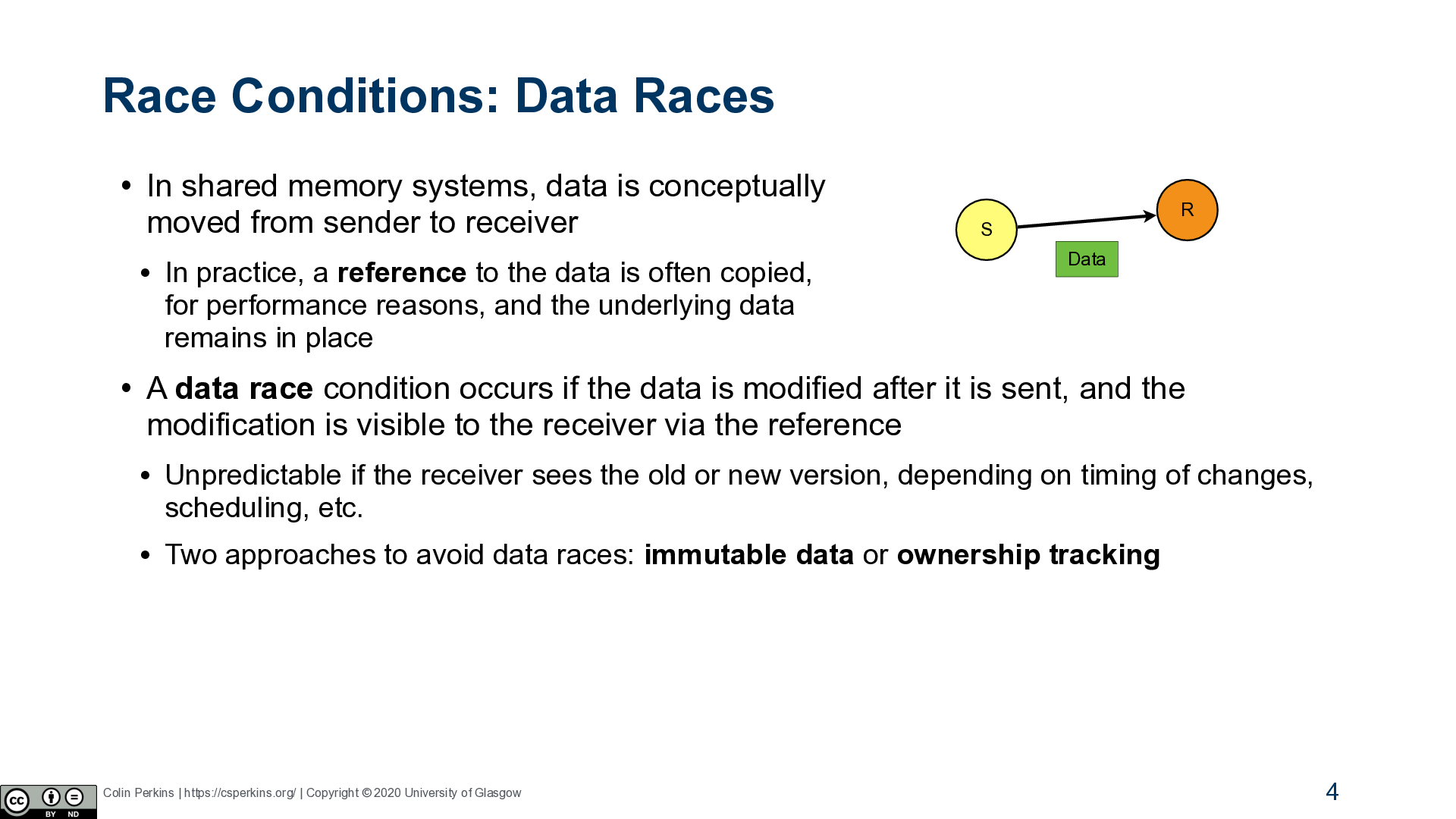
00:03:15.966
In shared memory systems it's also possible
00:03:18.866
to get these types
00:03:20.966
of race conditions, due to the timing
00:03:23.500
at which communications happens between different threads.
00:03:27.333
And it's also possible to get deadlocks
00:03:29.333
because of acquiring locks in the wrong order.
00:03:32.466
But there's also a third type of
00:03:34.200
race, which is what's known as a data race.
00:03:37.766
Now, in shared memory systems,
00:03:41.133
when two threads communicate, we're conceptually moving
00:03:45.066
the data from one thread to another.
00:03:48.266
So, conceptually, the data goes from one
00:03:50.866
thread, and is moved to the other
00:03:53.600
thread. The sender loses access to the
00:03:57.100
data after it has been sent,
00:03:58.633
and the receiver gains access, and there's
00:04:00.733
no potential for a race.
00:04:03.500
In practice, though, in order to get
00:04:06.000
good performance, what often happens is that
00:04:08.400
a reference to the data is moved.
00:04:11.166
And for performance reasons, the underlying data
00:04:13.400
remains in place, and quite often it's
00:04:16.066
possible, the result is incorrect, but it's
00:04:19.300
possible for the sender to keep a
00:04:21.633
reference to the data after it has
00:04:24.933
been passed to the receiver.
00:04:27.766
And this allows the possibility of what's
00:04:29.633
known as a data race. Where both
00:04:31.566
the sender and the receiver have access
00:04:33.800
to the same piece of data ,and
00:04:36.133
the sender modifies it after it's been sent.
00:04:41.600
And the problem with this, is that
00:04:43.666
it's unpredictable at what point that modification
00:04:47.033
happens, and whether it becomes visible to
00:04:49.200
the receiver before, or after, it uses the value.
00:04:53.566
Depending on the timing of the changes,
00:04:55.766
depending on the scheduling, it's possible that
00:04:58.166
the receiver may see the modified value,
00:05:00.466
or it’s possible that it won’t,
00:05:01.800
leading to unpredictable behaviour.
00:05:05.200
And are two approaches to avoid this,
00:05:07.100
as you might expect.
00:05:08.966
One is immutable data: make sure the
00:05:12.033
data can’t change. And the other is
00:05:13.933
tracking ownership, to make sure that it
00:05:15.700
really is, make sure that the reference
00:05:17.800
really is moved to the receiver.
00:05:22.800
So, the common approach to avoiding data
00:05:25.566
races is just to make the data
00:05:27.733
immutable. Make sure that anything which is
00:05:30.100
sent between threads cannot be modified.
00:05:33.766
And languages like Erlang, which make extensive
00:05:37.433
use of message passing, ensure this by
00:05:39.833
making all variables immutable. You simply can't
00:05:43.666
change the value, you can’t change the
00:05:47.400
value of a variable in Erlang.
00:05:50.900
And that works, and it certainly avoids
00:05:53.333
the race conditions, but it forces quite
00:05:56.333
a different programming style.
00:06:00.433
Alternatively, you have languages like Scala with
00:06:03.566
the Akka library
00:06:05.733
which, again, are widely used for message passing systems.
00:06:10.233
But the language doesn't enforce immutability.
00:06:14.100
It has tools to enable it,
00:06:16.033
but it requires programmer discipline. It requires
00:06:18.266
the programmer to track what values which
00:06:22.066
can be passed between threads, and ensure
00:06:24.000
it treats them immutably.
00:06:26.600
And this opens up the potential for
00:06:28.800
race conditions if message data is modified
00:06:31.966
after the messages are sent. And it's
00:06:34.633
a source of bugs in those types of language.
00:06:40.666
The other way of avoiding data races,
00:06:44.133
avoiding race conditions, is by transferring ownership.
00:06:48.200
Race conditions, obviously, can't occur if the
00:06:50.900
data isn't shared.
00:06:53.300
If we make sure that the ownership
00:06:55.866
of the object is actually being transferred,
00:06:58.766
so the sender can't access it after
00:07:01.100
it has been sent. And if the
00:07:02.500
program, and the compiler, and the runtime,
00:07:04.833
can somehow enforce that, then you're guaranteed
00:07:07.200
that races can't occur, even if the values are mutable.
00:07:12.233
And this is a natural fit for
00:07:13.866
the way Rust works. The standard library
00:07:17.233
in Rust provides an abstraction known as
00:07:20.200
a channel, which allows for communication between
00:07:22.733
threads, and it provides send() and recv() functions.
00:07:27.233
The send() function on a channel takes
00:07:29.600
ownership of the data to be sent,
00:07:31.833
and the recv() function, called by the
00:07:34.233
receiving thread, returns ownership of that data.
00:07:38.533
And the type system of Rust,
00:07:40.533
because it tracks ownership, can actually make
00:07:43.300
this work, so that once the value
00:07:45.600
is sent into a channel, because that
00:07:47.800
function takes ownership, the sender doesn't have
00:07:50.200
access to it anymore.
00:07:52.400
Similarly, on the receiving side, once the
00:07:55.300
receiver has called the recv() call and
00:07:57.600
returned ownership, the data is not accessible
00:08:00.500
by the channel anymore.
00:08:02.600
And the usual ownership rules in Rust
00:08:04.766
ensure that the data is not accessible
00:08:07.233
once it's been sent. And you don't
00:08:09.033
have to worry about mutability, because it's
00:08:11.600
guaranteed that once it's been sent,
00:08:14.033
the original thread, the sending thread, loses ownership.
00:08:17.600
It can't access the object once it's
00:08:19.600
been sent, it can't change it,
00:08:21.533
and so race conditions can’t happen.
00:08:25.700
And that works well in Rust,
00:08:27.800
because it has the ability to track
00:08:30.566
ownership. It doesn't work so well in
00:08:33.133
other languages, because Rust is unusual in
00:08:36.033
having ownership tracking.
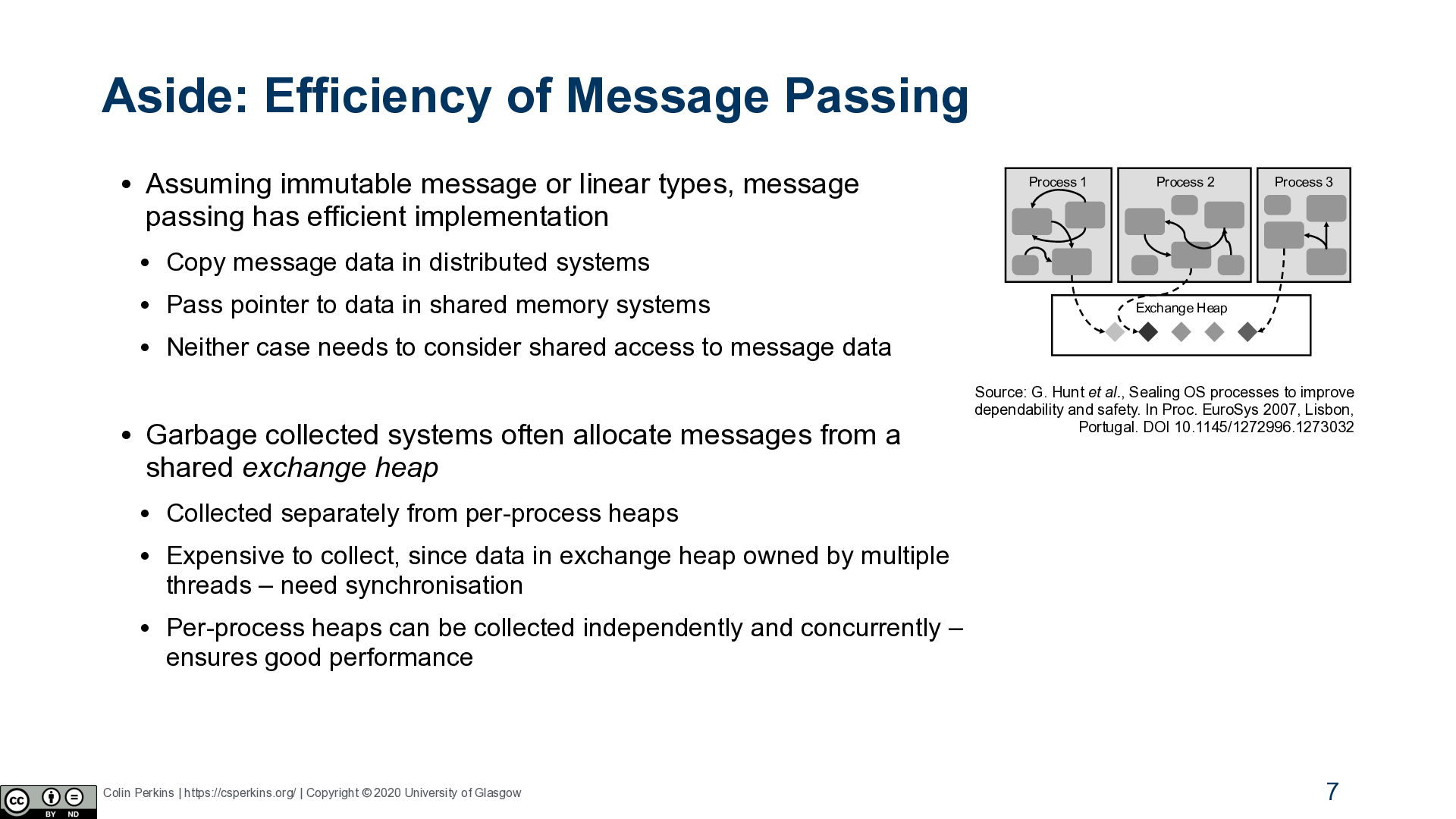
00:08:39.700
And that’s essentially all I want to say about data races
00:08:44.800
You need to make sure that the
00:08:46.266
system is structured to avoid race conditions,
00:08:48.800
avoid data races. And you can either
00:08:50.733
do that by making the messages immutable,
00:08:52.933
or by tracking ownership.
00:08:55.433
If you do either of these, you can actually
00:08:58.133
implement message passing pretty efficiently.
00:09:01.966
In the case where the system really
00:09:03.766
is distributed, it turns into a message
00:09:06.933
being copied across the network, but in
00:09:09.266
the case of shared memory systems,
00:09:10.933
it's implemented by passing a pointer to
00:09:13.533
the data be transferred. And
00:09:16.733
either the data is immutable, so you
00:09:19.900
don't need to worry about locking access
00:09:22.166
to it, or the type system has
00:09:24.633
tracked ownership and guaranteed that ownership has
00:09:27.766
been transferred, and again you don't need
00:09:29.633
to worry about locking access to the
00:09:32.533
data at that point.
00:09:37.100
These types of systems do, though,
00:09:39.700
interact, if you have a garbage collector.
00:09:43.033
The issue here is that
00:09:46.400
the data, which has been passed between
00:09:49.533
threads, is potentially accessible from the different
00:09:52.266
threads. And, if the multiples threads in the system
00:09:55.766
are each running a garbage collector,
00:09:57.900
you then have to coordinate the garbage
00:09:59.733
collection between the two threads, because you
00:10:02.533
have these shared values.
00:10:05.966
And what you don't want to do,
00:10:09.233
is have one thread reaching into the
00:10:13.066
region of the heap used by another
00:10:15.900
to perform garbage collection, because this involves
00:10:19.000
locking all of the values accessed by
00:10:21.200
the other thread, and potentially stopping the
00:10:23.133
other thread while the system is running.
00:10:26.933
You want each thread to be able
00:10:28.666
to collect its garbage separately.
00:10:31.466
The usual fix for this, is that
00:10:33.933
values which are shared between threads,
00:10:36.466
because they've been passed in a message,
00:10:38.600
are put into what's known as an exchange heap.
00:10:41.300
The system allocates a separate region of
00:10:43.400
memory for potentially shared values and
00:10:48.466
it ensures that any access to these
00:10:50.800
values is synchronised. So a lock is
00:10:53.766
acquired, and
00:10:55.833
this makes sure that the garbage collector
00:11:00.766
can safely look for pointers from that heap.
00:11:04.666
And it only has to lock memory
00:11:07.666
access while it's accessing the exchange heap,
00:11:10.633
which hopefully has a very small number
00:11:12.533
of values in it, and so is
00:11:13.833
quick to garbage collect. The vast majority
00:11:17.033
of the data is not shared between
00:11:18.600
threads, and so can be garbage collected in the usual way.
00:11:22.900
So this can improve performance significantly,
00:11:25.900
if you have garbage collection,
00:11:28.433
and you're passing data between multiple threads.
00:11:35.200
So, to finish up.
00:11:39.200
As we've seen, in this part,
00:11:41.866
in the previous part, message passing is
00:11:43.600
an alternative concurrency mechanism.
00:11:47.433
And it's getting increasingly popular.
00:11:50.033
It’s available in languages like Erlang,
00:11:53.166
and in Scala with the Akka toolkit,
00:11:56.666
and it works extremely well.
00:11:59.733
It's available in Rust, it's perhaps not
00:12:04.166
so fashionable there, people seem to like
00:12:06.666
the asynchronous approach which we'll talk about
00:12:08.700
in the next lecture in Rust,
00:12:10.466
but message passing is certainly possible.
00:12:13.033
And it's possible in languages like Go,
00:12:16.500
with Go routines, and with systems like
00:12:20.133
ZeroMQ for C programs, and so.
00:12:23.900
I think the reason it's popular is
00:12:25.766
because it's easy to reason about.
00:12:27.633
It's a simple programming model.
00:12:29.833
We're used to building networked systems,
00:12:33.100
and it brings in the same programming
00:12:35.200
model for communication between threads. And it
00:12:39.133
makes the communication explicit, and it's clear
00:12:41.266
when messages are being passed.
00:12:43.766
And if you have ownership tracking,
00:12:45.600
or if the data is immutable,
00:12:47.533
it's also pretty safe.
00:12:49.866
You still have the potential for race
00:12:52.733
conditions, due to the ordering between messages,
00:12:55.300
but it avoids a lot of the
00:12:59.466
synchronisation issues with multi-threaded code.
00:13:04.766
So, that's all I have for this
00:13:07.466
lecture. We spoken about concurrency, and the
00:13:10.733
different memory models. We spoke about transactions,
00:13:14.133
and we spoke about message passing systems
00:13:16.533
and race conditions.
Part 5: Robustness of Message Passing Systems
The lecture concludes with a discussion of robustness and error
handling in message passing systems, In particular, it focusses
on the let-it-crash philosophy of Erlang, and how organising the
system as many cooperating processes with explicit supervision,
changes error handling.
00:00:00.833
I'd like to conclude by talking about some of the issues
00:00:04.133
around the robustness of message passing systems
00:00:07.400
In particular, I'd like to talk a little about the Erlang
00:00:10.766
programming language,
00:00:12.000
how it handles system updates and evolution,
00:00:14.833
and how it manages error handling
00:00:18.133
Erlang doesn't really fit the definition we've
00:00:20.700
been using for systems, programming languages.
00:00:23.233
It runs on a virtual machine.
00:00:25.366
It's garbage, collected.
00:00:27.166
And it offers only limited control over data representation.
00:00:31.266
But it offers a compelling concurrency model,
00:00:34.333
and has an interesting approach to recovering from failures.
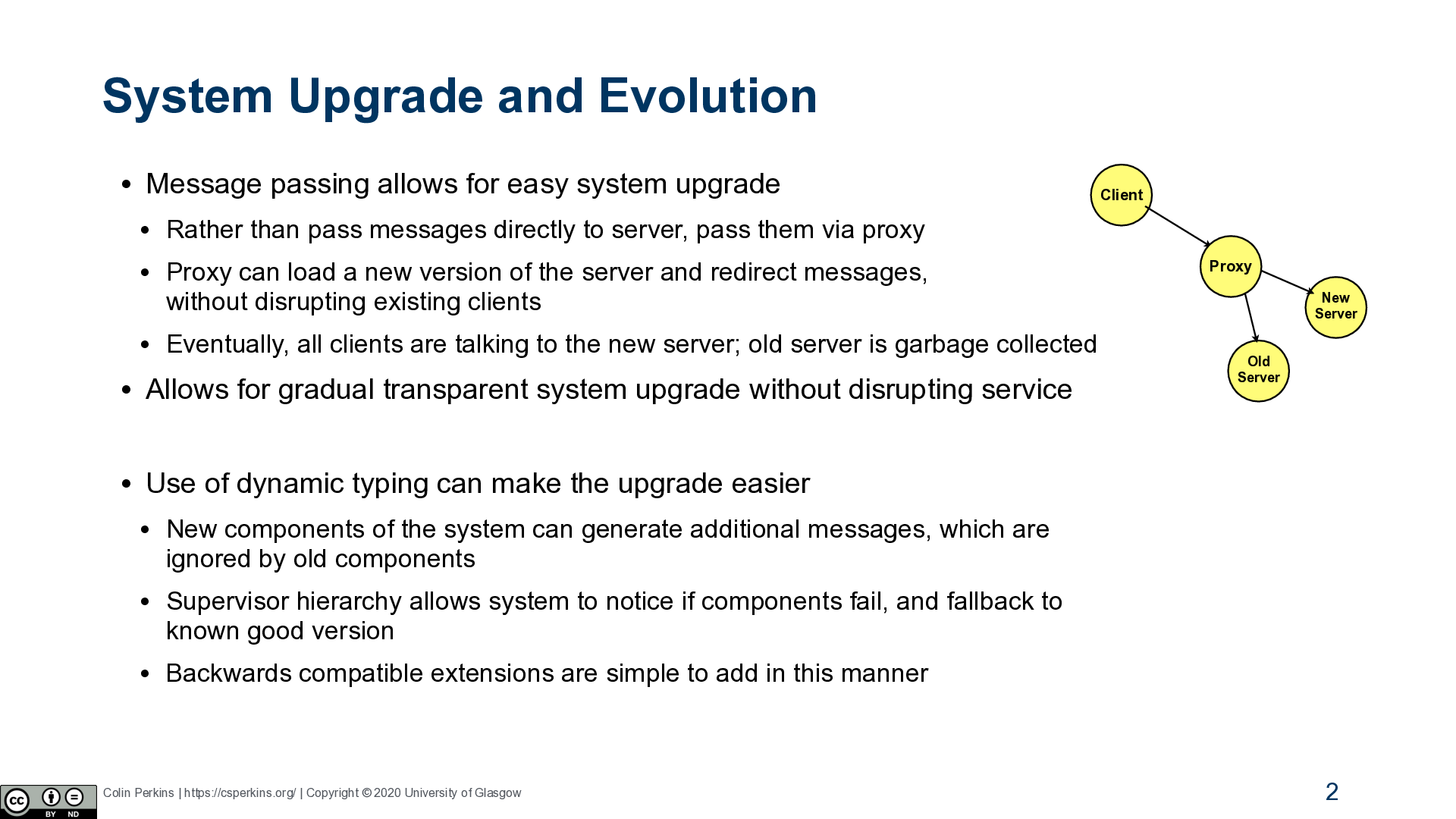
00:00:41.000
One of the key features of message passing systems
00:00:44.466
is that the messages decouple
00:00:46.600
the different components of the system.
00:00:49.866
Unlike function calls,
00:00:52.033
where there's a close coupling
00:00:53.800
between different parts of the code,
00:00:56.100
a message passing system
00:00:57.800
has some abstraction
00:00:59.000
separating the sender and receiver of the message.
00:01:02.500
There's an abstraction representing a channel
00:01:05.333
or a mailbox that allows them to be teased apart a little.
00:01:10.100
One advantage of this approach,
00:01:12.733
is that it makes it possible to insert a proxy
00:01:15.166
into the message passing path.
00:01:18.233
Messages are not passed
00:01:20.500
from the client directly to the server,
00:01:23.300
but rather from the client, to a proxy
00:01:25.633
that then forwards them to the relevant server process.
00:01:29.233
This introduces some overhead.
00:01:31.700
but it has a number of advantages.
00:01:35.666
Firstly.
00:01:36.800
if the server process crashes,
00:01:39.200
or moves to a new location,
00:01:41.266
the proxy can buffer messages temporarily,
00:01:44.300
before delivering them to the new instance of the server.
00:01:48.633
This is useful for handling temporary failures
00:01:51.633
of either the software of the hardware.
00:01:55.266
Secondly,
00:01:56.900
the proxy can handle failover
00:01:59.100
to a new version of the server code.
00:02:02.600
Once a new version of the server process is available,
00:02:06.333
some fraction of the requests
00:02:08.400
can be diverted to it, to check that it works.
00:02:11.933
Then, gradually,
00:02:13.733
all requests cut over
00:02:15.400
until all the clients are talking to the new server,
00:02:18.266
and the old version of
00:02:19.600
the server process is garbage collected.
00:02:22.766
It's essentially A/B testing,
00:02:24.900
same as you might apply to a microservices web architecture,
00:02:28.466
except applied to updating functions within an application.
00:02:33.733
It provides fine-grained updates of
00:02:36.166
parts of a running system.
00:02:40.466
Now the type system helps of course.
00:02:43.333
If the system is strongly typed,
00:02:45.600
and provides a fixed interface,
00:02:47.366
where you know the new version of the server can respond
00:02:50.100
to all the messages it might receive.
00:02:52.633
Or, the system is dynamically typed,
00:02:55.966
allowing the new components of the system
00:02:58.600
to generate additional messages
00:03:00.633
that are ignored by the old components,
00:03:03.133
allowing for a gradual update to add new functionality.
00:03:08.600
And the system can automatically
00:03:10.533
perform a gradual switch over,
00:03:12.366
detecting crashes of the new server processes,
00:03:15.333
or other errors,
00:03:16.466
and automatically reverting to the old version,
00:03:18.933
if necessary.
00:03:21.400
The decoupling provided by the message passing interface
00:03:25.233
provides flexibility to change the system.
00:03:31.866
This approach leads to one of the
00:03:33.800
more interesting design decisions in Erlang.
00:03:37.866
The Erlang language and runtime
00:03:40.333
assume the system is massively concurrent.
00:03:43.866
It's normal for Erlang systems to comprise hundreds,
00:03:47.700
or thousands, of communicating processes,
00:03:50.700
and the runtime ensures these are handled efficiently.
00:03:55.466
A consequence of this
00:03:57.600
is that Erlang can handle errors differently.
00:04:02.866
Erlang doesn't have the concept of exception handling.
00:04:08.000
If an Erlang process encounters as an error, it crashes.
00:04:13.133
Erlang programs tend not
00:04:14.933
to have much in the way of in-process error handling.
00:04:18.166
If they encounter problems, they crash.
00:04:22.566
But,
00:04:24.266
when they crash they tell another process.
00:04:29.300
The idea is that processes are cheap and plentiful,
00:04:34.066
and that a process that's encountered an error
00:04:36.800
is no longer trustworthy.
00:04:39.600
Accordingly,
00:04:40.666
it's best to let the failing process die
00:04:43.066
and replace it with another.
00:04:46.200
The supervisor process will detect the problem,
00:04:48.700
and cleanly restart the failed process.
00:04:52.500
The goal
00:04:54.066
is to be concerned with the overall system reliability,
00:04:57.433
not the reliability of any one component.
00:05:02.433
The document linked on the slide,
00:05:04.633
the PhD thesis from Joe Armstrong,
00:05:07.033
one of the inventors of Erlang,
00:05:08.833
has a really nice,
00:05:10.600
and surprisingly easy to read,
00:05:12.500
description of Erlang
00:05:14.033
and how it handles failures.
00:05:15.700
I encourage you to take a look at it.
00:05:21.700
Erlang is the first language
00:05:23.866
to fully embrace the shift
00:05:25.733
that comes from massive concurrency.
00:05:29.566
In a single-process system
00:05:32.200
that process must
00:05:33.566
be responsible for handling errors that occur.
00:05:36.533
After all,
00:05:37.866
if it crashes,
00:05:39.200
the entire application has failed.
00:05:42.533
This leads to the introduction of
00:05:44.733
complex exception handling and error recovery schemes,
00:05:48.133
to try to detect and correct for errors within a process,
00:05:52.266
and to recover and correct the failed state.
00:05:58.366
In a massively concurrent system,
00:06:00.766
each process is less precious.
00:06:03.600
It's just one of many.
00:06:07.133
This changes the philosophy of error handling.
00:06:11.400
A process that encounters a problem
00:06:13.633
should not try to handle that problem
00:06:16.366
instead, it should fail.
00:06:19.000
Loudly, cleanly, and quickly.
00:06:22.533
That is, let it crash,
00:06:25.166
and let another process clean up and deal with the problem.
00:06:30.133
The idea is that processes become much simpler,
00:06:33.433
since they're not cluttered with error-handling code.
00:06:37.433
And the error handling code itself becomes simpler.
00:06:40.600
It doesn't have to deal with corrupt
00:06:42.800
and inconsistent state resulting from the error.
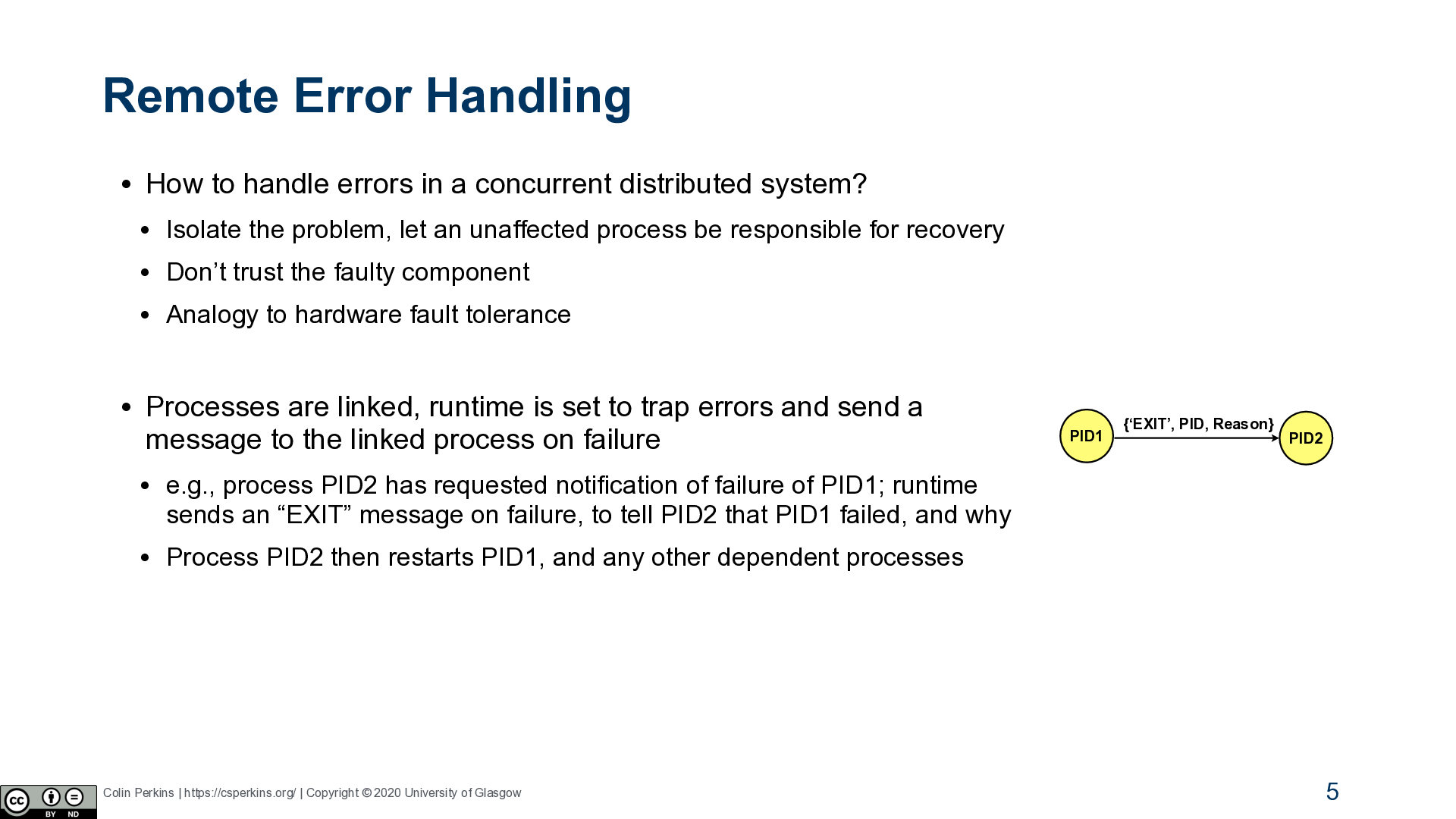
00:06:49.833
This, then, is the approach to handling errors in Erlang.
00:06:55.100
Isolate the problem,
00:06:56.800
and let an unaffected process be responsible for recovery.
00:07:02.000
Don't trust the faulty process
00:07:05.566
Pass responsibility for cleaning up the problem,
00:07:08.266
for correcting the mistake,
00:07:10.400
to another unaffected process.
00:07:16.033
To support this,
00:07:17.400
all processes in an Erlang system are linked.
00:07:21.533
Whenever a process exits,
00:07:23.833
whether correctly
00:07:25.500
or due to an error or exception,
00:07:27.700
it notifies its supervisor process,
00:07:30.700
and the supervisor handles any problems that occurred
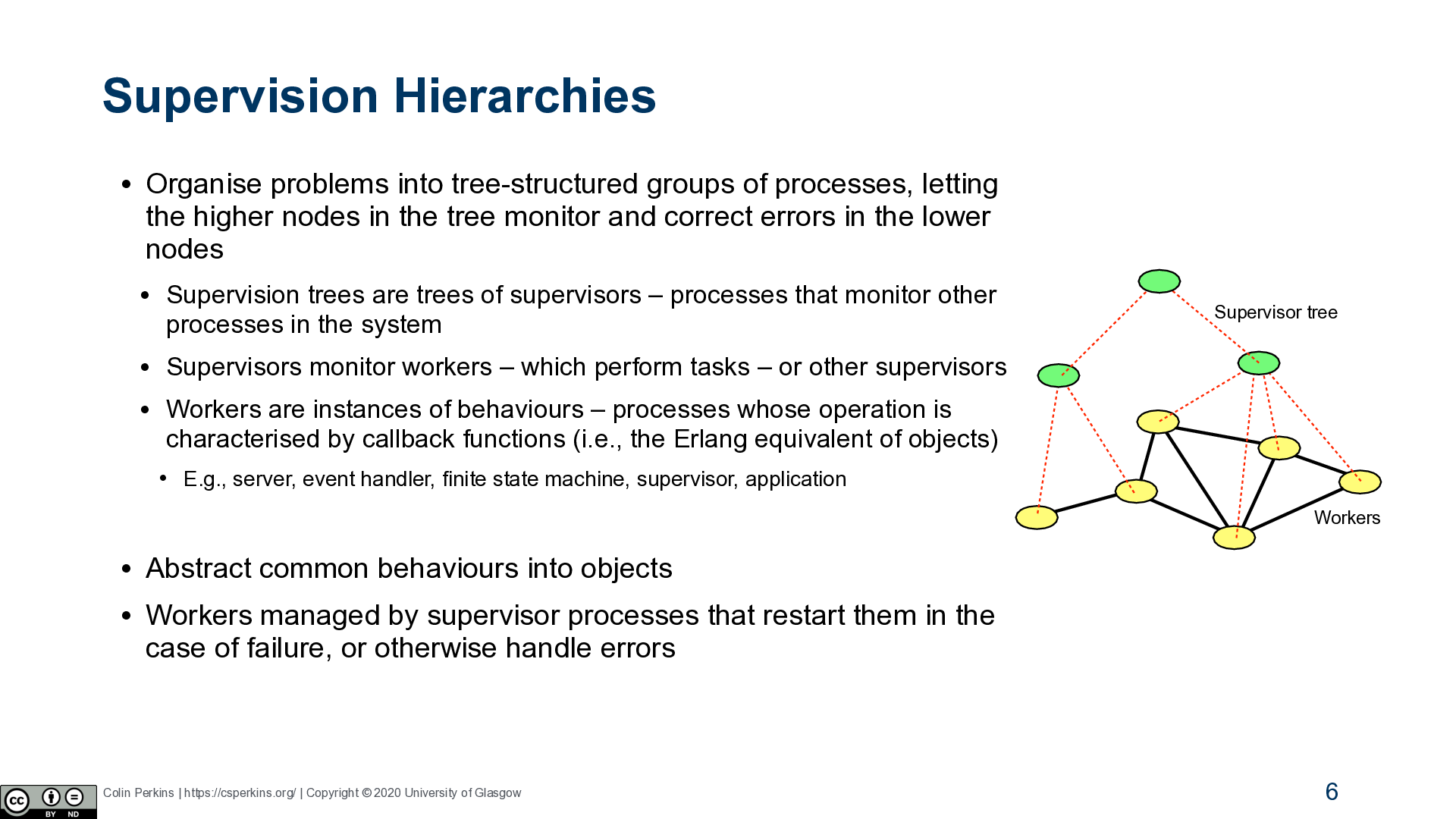
00:07:36.933
Erlang applications are structured into
00:07:39.833
tree-structured groups of processes,
00:07:42.333
where the higher-level nodes in the tree
00:07:44.366
supervise and correct errors in the low-level processes.
00:07:49.433
The lowest level processes do the actual work.
00:07:53.066
They have direct supervisor processes
00:07:55.433
that monitor their correct operation,
00:07:57.533
and restart them if they fail.
00:08:01.366
And the supervisor processes themselves
00:08:03.833
tend to have higher-level managers
00:08:05.866
that account for failures of
00:08:07.233
arger components within the system,
00:08:09.366
and either restart them on failure,
00:08:12.233
or handle problems by running multiple
00:08:14.700
disparate versions of the subsystem,
00:08:16.900
comparing results to pick the majority correct answer.
00:08:21.200
Triple modular redundancy, or similar,
00:08:24.600
but implemented in software
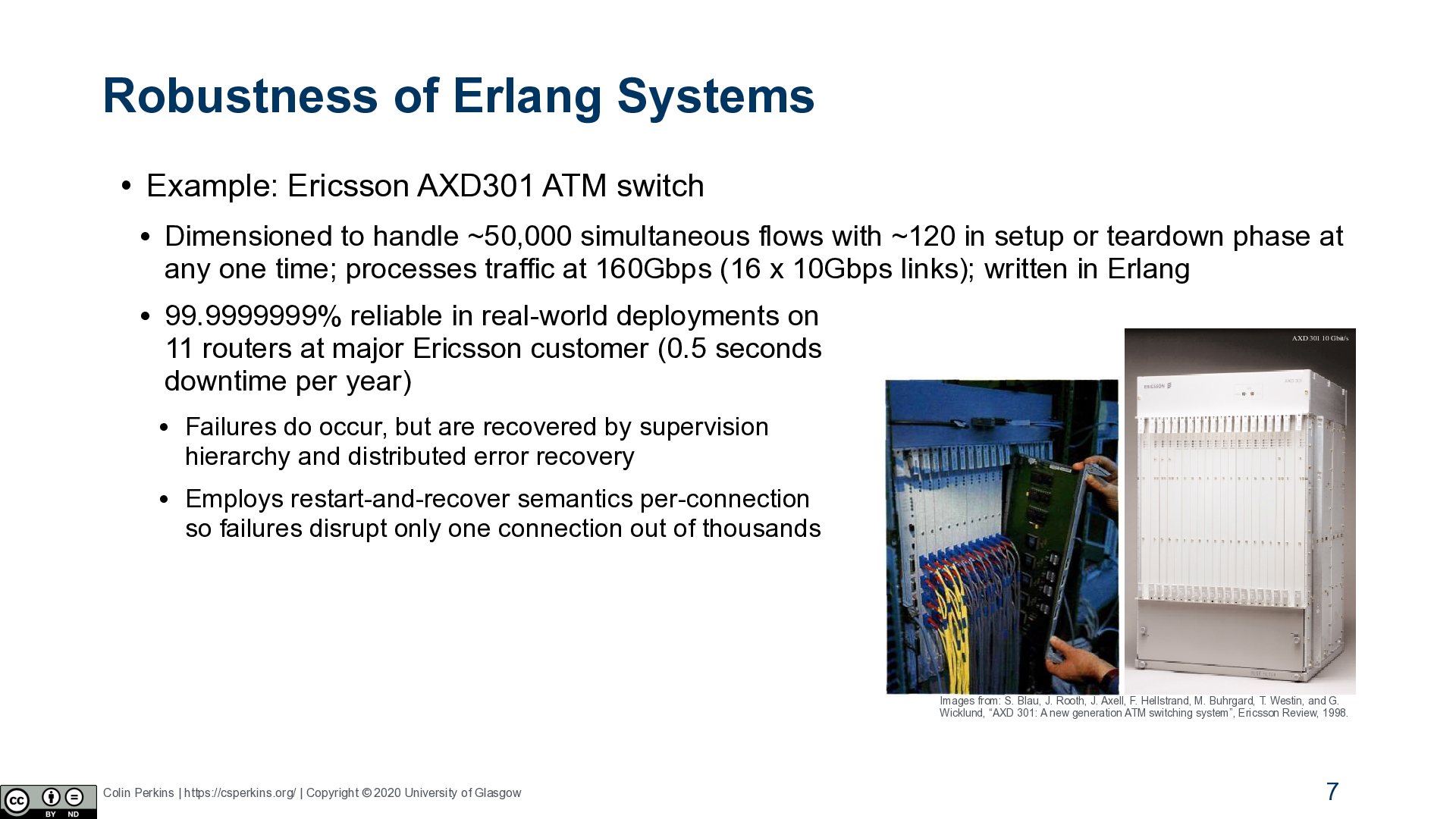
00:08:29.466
Does this approach work?
00:08:32.766
Does it make sense to move error handling out of a process
00:08:36.233
to some level of supervisor hierarchy?
00:08:40.433
Well, obviously, it depends on the application
00:08:43.100
and the skill of the programmers.
00:08:45.633
but there are certainly examples where it can work.
00:08:50.333
The slide shows one of these examples,
00:08:52.533
taken from Joe Armstrong's thesis,
00:08:54.900
the Ericsson AXD301 ATM switch.
00:09:01.200
This switch was,
00:09:02.833
at the time it was introduced,
00:09:04.700
one of the core components of a telephone exchange.
00:09:08.266
it was essentially a high-end Internet router,
00:09:12.133
capable of forwarding traffic at 160 gigabits per second.
00:09:17.800
And its control software was written in Erlang
00:09:23.166
Joe Armstrong reports that
00:09:24.800
these switches proved exceptionally reliable,
00:09:27.900
running for several years
00:09:30.200
with only around half-a-second per year down time.
00:09:35.700
Was this because they never failed?
00:09:38.666
No.
00:09:40.433
it was because the failures were successfully handled
00:09:43.133
by the supervisor hierarchy implemented in the switches.
00:09:47.666
The let-it-crash and restart model,
00:09:50.233
and the multiple layers of fault tolerance
00:09:52.400
implemented in the switch
00:09:54.266
meant that failures only affected single calls
00:09:57.733
out of tens of thousands of simultaneous connections,
00:10:01.166
and were rapidly recovered
00:10:02.933
without affecting the performance of the switch as a whole.
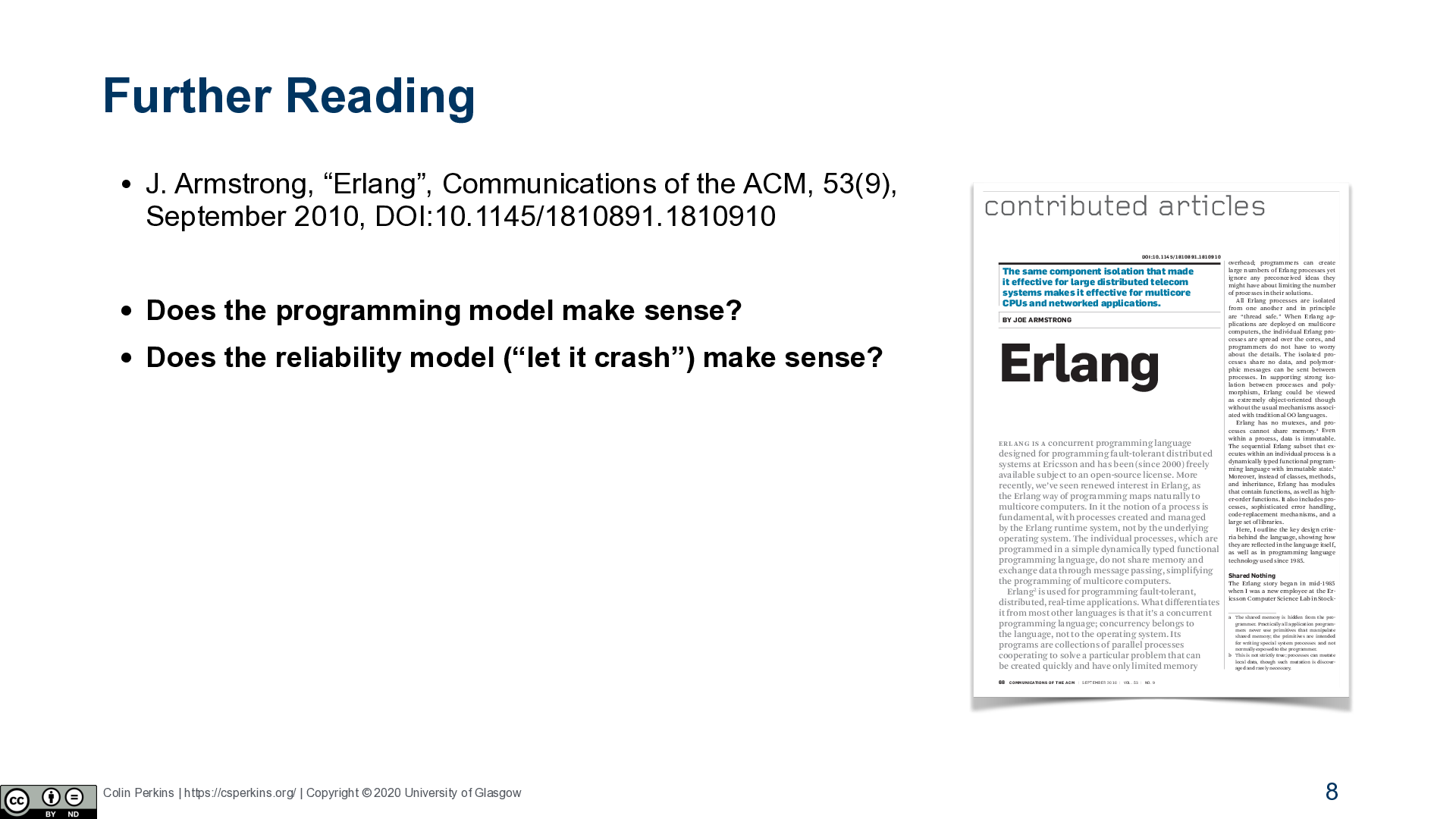
00:10:10.466
Erlang approaches error handling
00:10:12.566
very differently to other programming languages.
00:10:16.966
This is only possible
00:10:18.400
because it assumes pervasive concurrency,
00:10:21.566
and organizes programs to support
00:10:23.700
out of process error handling.
00:10:27.866
It's not clear this approach can
00:10:29.833
be adopted by other languages.
00:10:31.900
but it's certainly interesting to consider,
00:10:34.500
and to think whether the Erlang programming model,
00:10:37.400
and the let-it-crash approach,
00:10:39.533
has potentially wider applicability.
00:10:44.366
The paper shown on the slide
00:10:45.933
is a tutorial introduction to Erlang,
00:10:48.066
and its error-handling model,
00:10:49.800
that expands on these ideas.
00:10:52.166
I encourage you to read and think about it.
00:10:58.300
And that's all for this lecture.
00:11:00.733
We spoke about concurrency and memory models,
00:11:03.400
atomic transactions, and message passing systems.
00:11:08.200
All these provide different
00:11:09.533
approaches to handling concurrency,
00:11:11.433
that avoid some of the problems inherent
00:11:13.700
in multi-threading and shared mutable state.
00:11:17.466
Concurrency is not yet a solved problem.
00:11:21.166
But hopefully the different approaches discussed
00:11:23.400
in this lecture give you ideas to how it might be solved,
00:11:26.533
and some ideas for how to program in future.
-
J. Armstrong,
Making reliable distributed systems in the presence of software
errors, PhD thesis, KTH, Stockholm, December 2003.
-
J. Armstrong,
Erlang,
Communications of the ACM, 53(9), September 2010.
Discussion
Lecture 7 focussed on concurrency. It stared with a discussion on the
implications of modern multi-core hardware for concurrent programming,
and a discussion of the limitations of shared state concurrency using
threads and locks. Then, it discussed two alternative approaches to
concurrent programming, using transaction and using message passing.
The transactional approach structures a program as a sequence of atomic
actions, that obey the ACID properties, and that execute concurrently.
It provides a clean programming model, that avoids race conditions and
deadlocks, and allows straightforward composition of functions. But, in
order to do this, it requires control over I/O operations and memory
access. As the lecture discusses, this is a natural fit for Haskell, but
fits less cleanly with more mainstream languages.
Message passing structures the program as a set of actors that
communicate solely by exchanging messages. The lecture discussed the
structure of an actor-based system, the types of messages passing and
the interaction models, differences between statically and dynamically
typed actor-based systems, and differences between channel-based and
direct communication. It used Scala with Akka, and Rust, as examples.
Discussion will focus on the need for alternatives to shared state
concurrency with threads; on the applicability of the transactional
programming model; and on the suitability of message passing. We'll
consider which approaches make conceptual sense, which offer the
most appropriate guarantees, and which are most suitable for
practical deployments.