Lecture 3: Secure Communications
This lecture considers secure communications in the Internet. It
reviews the need for security, and the principles of encryption,
integrity protection, and authentication of messages. It explains
the principles of operation of the Transport Layer Security Protocol
(TLS), version 1.3, and how it protects Internet traffic. And it
briefly reviews some of the issues around writing secure software.
Part 1: Secure Communications
The 1st part of this lecture discussed the need for security in
Internet communications. It reviews why end-to-end encryption and
message integrity protection are essential to protect Internet users
for eavesdropping, identity theft, fraud, and other attacks. And it
discusses some of the tensions and concerns that have been raised
about the provision of such protection.
00:00:00.766
In the last lecture, I discussed the behavior of TCP
00:00:04.100
and some issues around connection establishment.
00:00:07.700
One of these issues was the observation
00:00:09.600
that establishing a secure connection, using TLS,
00:00:12.533
was slower than establishing an insecure connection.
00:00:16.100
In this lecture, I want to talk more about TLS
00:00:19.400
and about security in general.
00:00:23.400
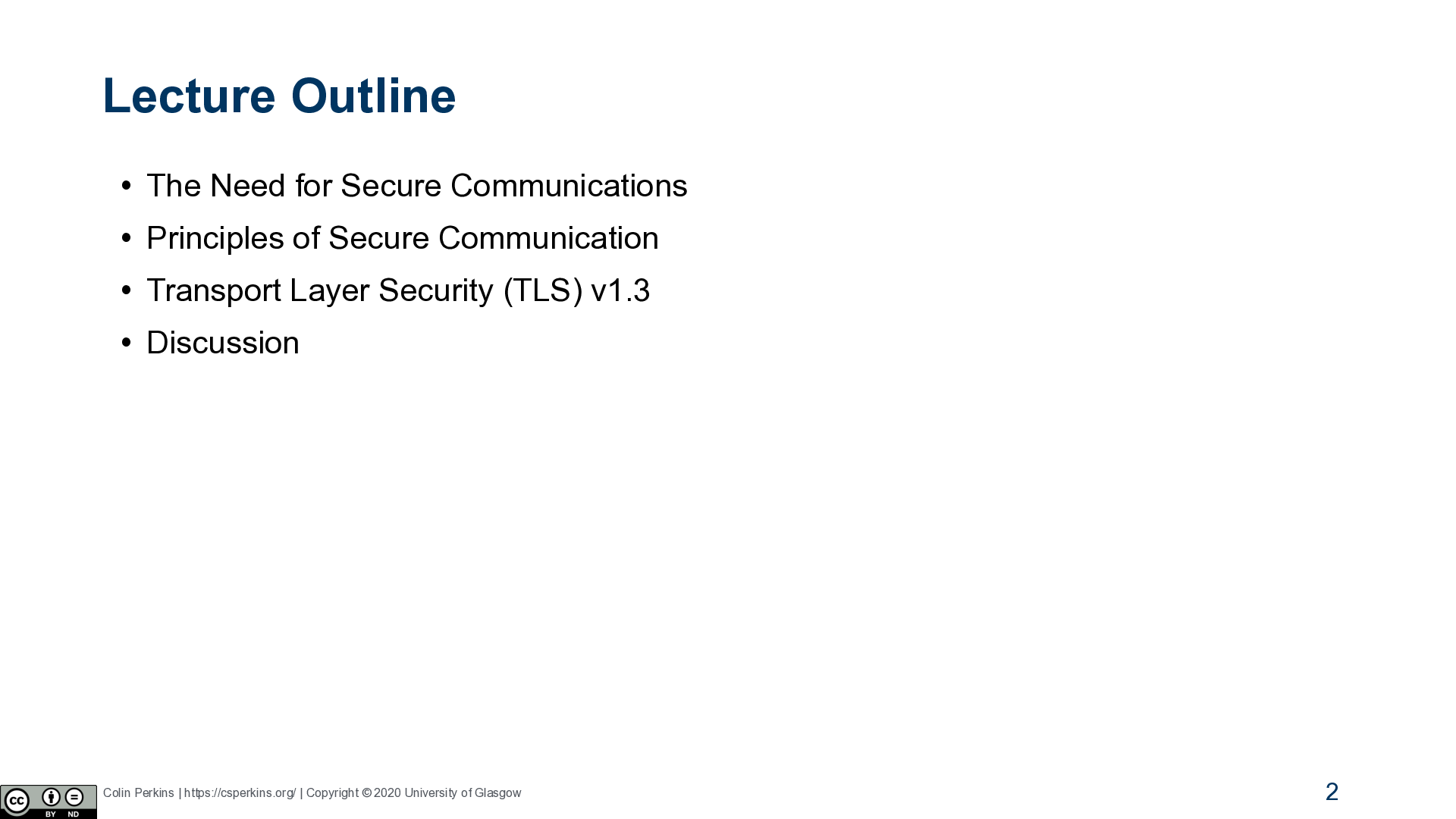
In this first part,
00:00:24.400
I'll talk about why security is important,
00:00:26.900
and why we need to secure communications.
00:00:30.200
Then, in part two,
00:00:31.800
I'll talk about the principle of secure communication
00:00:34.833
and the cryptographic techniques
00:00:36.533
that can be used to protect data.
00:00:39.866
Part three of the lecture will describe
00:00:41.600
some of the behavior of the transport layer security
00:00:44.033
protocol, that provides security for most Internet traffic.
00:00:48.100
And, finally, in part four,
00:00:50.033
I'll talk about some general issues around network security,
00:00:53.500
and how to write secure networks applications.
00:00:59.133
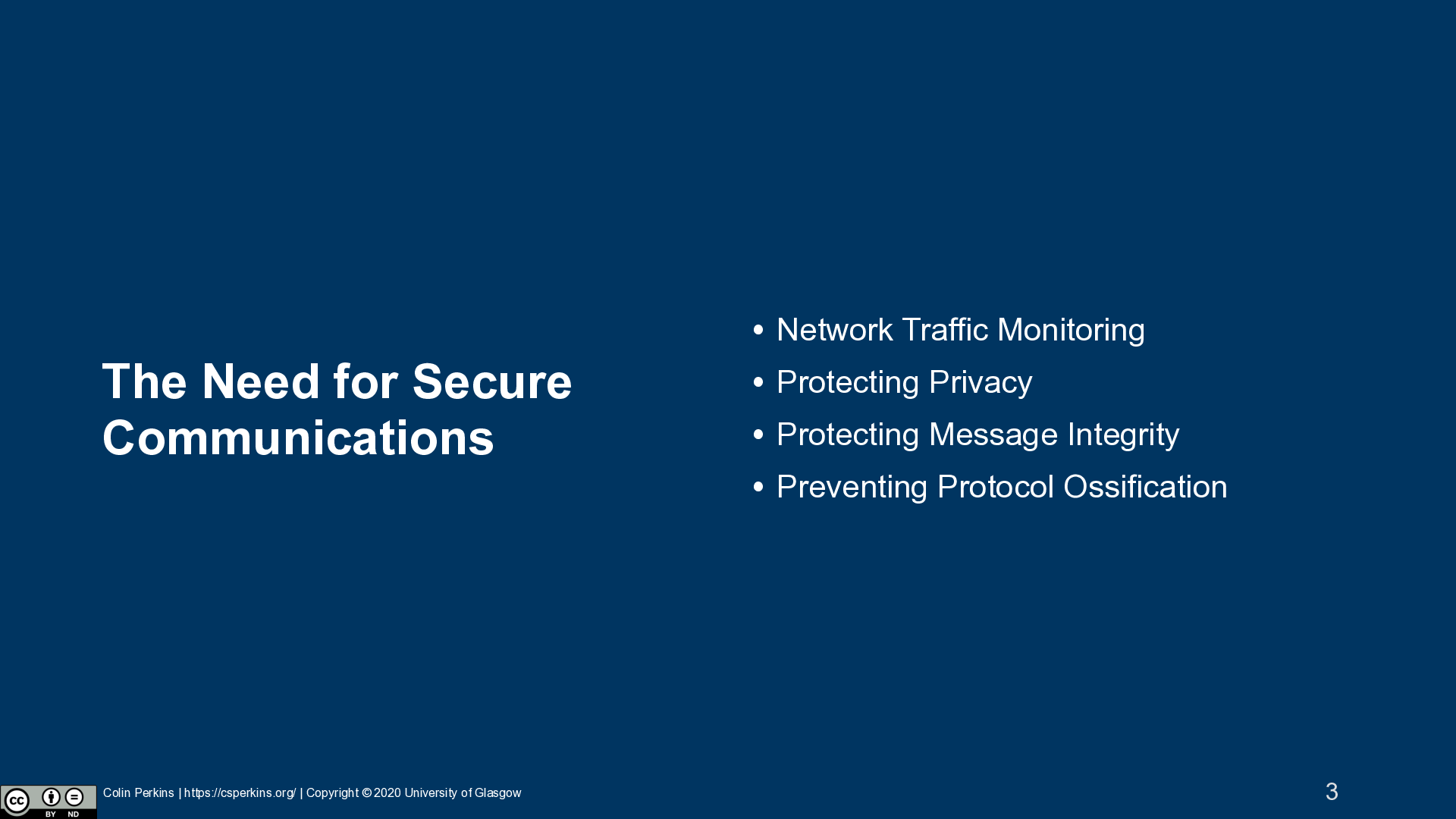
So why do we need secure communications?
00:01:03.300
Well, the fundamental problem
00:01:05.566
is that it's possible to eavesdrop on network traffic.
00:01:09.866
This can be done by wiretapping the network links
00:01:12.666
down which the data flows,
00:01:14.366
or it can be done by configuring the network routers
00:01:17.333
to save a copy of the packets they forward.
00:01:20.700
The result is that traffic passing across the network
00:01:23.700
can be monitored by third parties.
00:01:26.666
If you want to ensure that the data you send
00:01:28.866
across the network is private,
00:01:30.566
then that data needs to be encrypted somehow.
00:01:34.700
Similarly, network routers can modify
00:01:37.133
the packets they forward.
00:01:39.566
This means that the router can change the data
00:01:42.000
being delivered without the consent of the sender.
00:01:45.533
The sender cannot stop this happening.
00:01:47.966
But they can add some message integrity protection,
00:01:51.000
such as a digital signature,
00:01:53.100
to allow the receiver to detect and reject
00:01:55.700
messages that have been tampered with.
00:01:59.266
Finally, there are numerous devices in the network,
00:02:02.533
known as middle boxes,
00:02:03.933
that try to improve communication
00:02:06.266
by somehow interpreting or modifying the data being sent.
00:02:10.933
For example, we spoke about network address
00:02:13.800
translation in the last lecture
00:02:15.733
where a NAT router rewrites the addresses and ports
00:02:18.566
in TCP/IP headers to allow several machines
00:02:21.800
to share a single IP address.
00:02:25.733
Other examples include network firewalls,
00:02:28.233
that monitor traffic and try and prevent bad traffic
00:02:30.933
from entering a network,
00:02:32.266
as well as the various accelerator devices
00:02:34.666
that try to improve the performance of TCP
00:02:36.800
connections running over satellite links.
00:02:40.300
If not carefully maintained,
00:02:42.033
these devices tend to lead to network ossification,
00:02:45.700
where they tend to limit the ability to
00:02:47.833
change network protocols.
00:02:50.633
A final role of secure communications
00:02:53.633
is therefore to limit the ability of such devices to inspect
00:02:56.600
and act on the traffic,
00:02:58.100
so helping to ensure that the network
00:03:00.266
can continue to evolve.
00:03:05.933
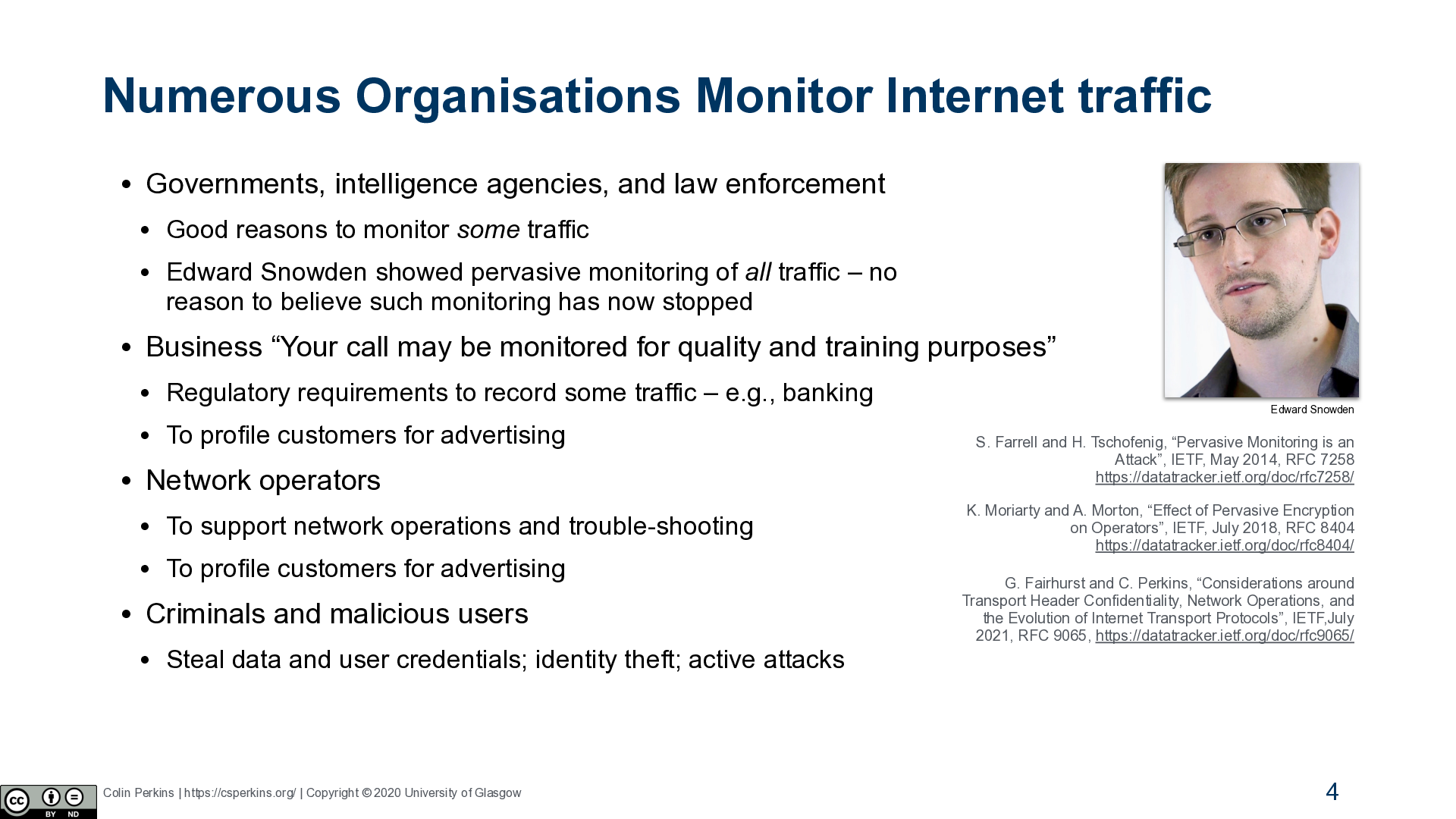
A lot of different organizations monitor the network,
00:03:09.166
for many different reasons.
00:03:13.000
These include governments, intelligence agencies,
00:03:15.600
and law enforcement agencies.
00:03:17.933
For example, the police have to monitor the network
00:03:21.366
as part of their crime prevention activities;
00:03:24.200
domestic intelligence agencies inspect traffic
00:03:26.966
to protect against terrorism, or to monitor foreign targets;
00:03:30.733
and foreign intelligence agencies might try to
00:03:33.533
spy on domestic targets.
00:03:36.800
That this happens shouldn't be a surprise.
00:03:40.666
And are clearly good reasons for some of this monitoring.
00:03:46.366
Many people would agree, I think,
00:03:48.166
that targeted wiretaps on suspected criminals,
00:03:51.133
subject to appropriate oversight,
00:03:53.233
the need to obtain a warrant of some sort,
00:03:55.500
and when there's probable cause,
00:03:57.633
are probably not unreasonable.
00:04:01.500
Relatively few people would object
00:04:03.800
to actively monitoring the network traffic of those
00:04:06.466
actively suspected of being engaged in serious crimes,
00:04:09.800
terrorist activities, child abuse, and so on.
00:04:14.866
People differ on what crimes they consider serious,
00:04:18.433
or on the standards of probable cause,
00:04:20.966
or on the amount of oversight needed.
00:04:24.000
But all societies accept some degree of monitoring
00:04:26.633
and oversight of network traffic.
00:04:30.566
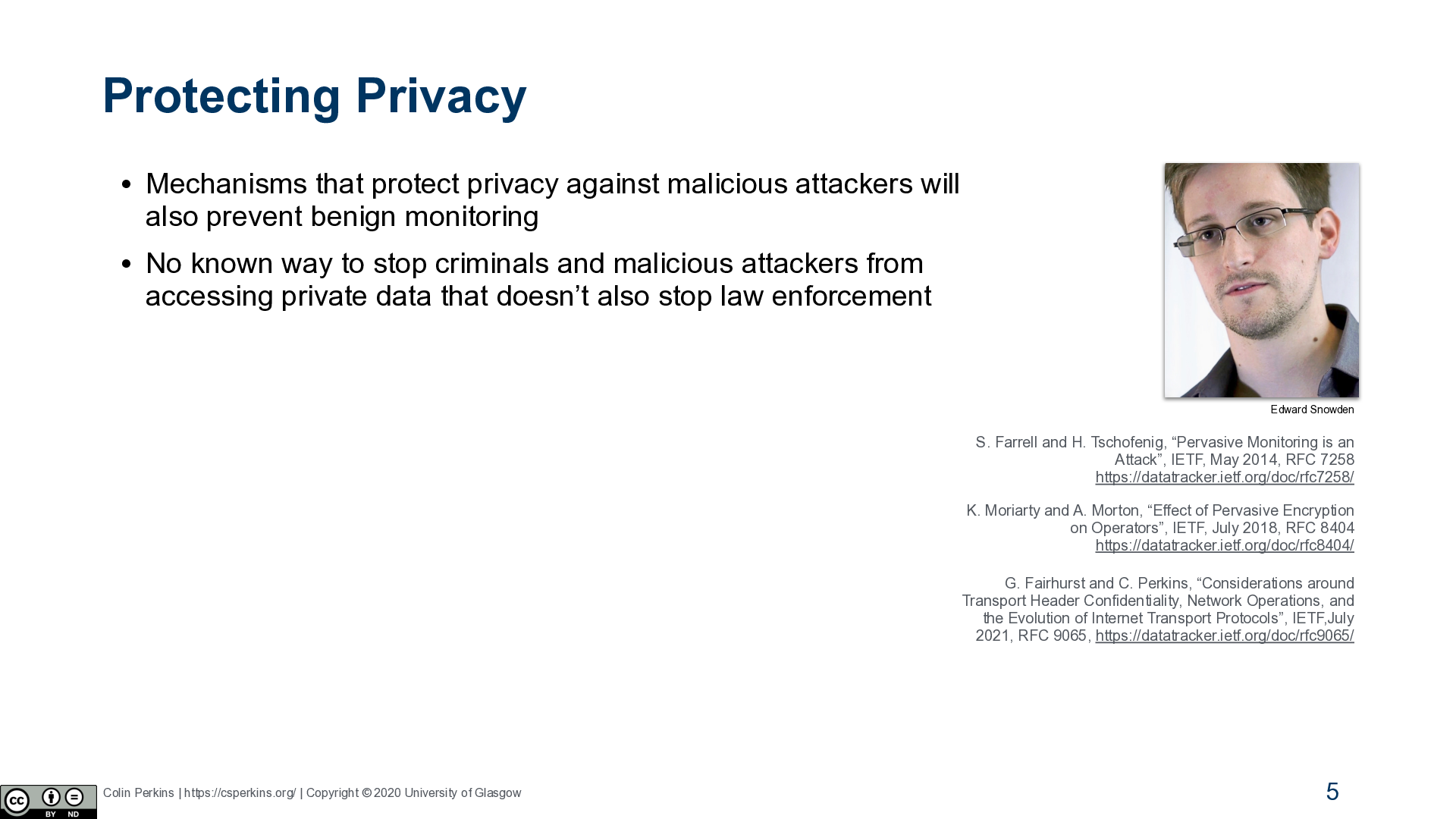
However, Edward Snowden showed that
00:04:33.833
some intelligence agencies, including,
00:04:36.900
but certainly not limited to the five eyes,
00:04:39.500
the UK, the US, Canada, Australia, and New Zealand,
00:04:43.733
were conducting pervasive monitoring of all network traffic.
00:04:49.400
Other governments are also known to conduct such monitoring.
00:04:53.100
The great firewall of China is a common example,
00:04:56.100
along with monitoring by Russia,
00:04:57.966
Iran, Saudi Arabia, and others.
00:05:02.166
Many felt that this indiscriminate monitoring
00:05:04.933
of all network traffic without probable cause or suspicion,
00:05:08.500
was a step too far.
00:05:11.766
In part, I think this came from distrust
00:05:14.433
of those governments, their motives,
00:05:16.366
and how they might use the data.
00:05:19.433
The people they were supposed to represent were unconvinced
00:05:22.200
that the monitoring was actually doing them good.
00:05:25.833
But, in part, there was also the realization
00:05:28.833
that if supposedly friendly governments
00:05:30.933
were monitoring traffic indiscriminately,
00:05:33.266
then so were others.
00:05:36.166
Even if I completely trust our government
00:05:39.033
to monitor Internet traffic only good reasons,
00:05:41.833
the fact that they're able to monitor that traffic
00:05:45.133
means that others are able to do so too.
00:05:48.266
And those others might not have my best interests at heart.
00:05:53.633
This led to a push to enable pervasive encryption,
00:05:56.766
to encrypt more and more of the traffic
00:05:58.933
crossing the Internet.
00:06:01.333
The most visible manifestation of this
00:06:03.700
is that most websites now use HTTPS
00:06:06.433
and encrypt their traffic.
00:06:07.933
But the spread of encryption has been wider than the web.
00:06:12.400
The result is that most Internet traffic
00:06:14.800
is now encrypted by default,
00:06:16.700
hindering, but not preventing, pervasive monitoring .
00:06:23.200
Governments are not the only organizations
00:06:25.833
to monitor network traffic, of course.
00:06:29.100
We've all contacted a business and been told that our
00:06:31.833
call may be monitored for quality and training purposes.
00:06:36.733
Some of this monitoring by businesses is necessary
00:06:39.500
for regulatory compliance.
00:06:42.133
Banking and insurance industries, for example,
00:06:44.833
require records to be kept in most cases, to prevent fraud.
00:06:49.433
There are good reasons for some of this monitoring.
00:06:53.833
Other aspects of monitoring and tracking by
00:06:56.100
businesses are perhaps less beneficial.
00:06:59.333
Targeted advertising and customer profiling is
00:07:02.300
frequently cited as problematic, for example.
00:07:06.300
Communication security measures, such as encryption,
00:07:09.600
can help reduce such unwanted monitoring,
00:07:13.800
though the effect is small, since this type of
00:07:16.066
monitoring and tracking is often delivered
00:07:18.133
by the sites we intentionally visit,
00:07:20.233
rather than by snooping on communications.
00:07:27.300
We also see network operators
00:07:29.733
monitoring traffic on the networks they operate.
00:07:33.400
Again, there are both beneficial,
00:07:35.800
and problematic, reasons for this.
00:07:39.366
Network operators monitor traffic
00:07:41.533
to understand how well their networks are operating,
00:07:44.333
and whether they're meeting their quality of service goals.
00:07:48.800
it's common, for example,
00:07:50.533
for network operators to inspect
00:07:52.400
the sequence and acknowledgement numbers
00:07:54.433
in the headers of TCP packets traversing their networks.
00:07:59.000
This lets them understand if packets are being lost,
00:08:01.766
or if the time taken for packets to traverse
00:08:04.333
the network is building up,
00:08:06.400
both of which are signs that the network
00:08:08.166
is becoming overloaded.
00:08:11.166
This helps the operators decide when to reroute traffic
00:08:14.366
onto less busy paths, or when to install
00:08:17.066
more network capacity to keep good performance.
00:08:20.566
And a few would argue that this sort of
00:08:22.733
monitoring is a problem.
00:08:26.066
On the other hand, operators can monitor to traffic
00:08:29.200
to profile what sites that customers are visiting.
00:08:32.600
This information could then be sold to advertisers,
00:08:35.533
or could be used to negatively influence
00:08:37.900
the performance of the traffic.
00:08:40.500
For example, an operator might choose to lower the
00:08:43.100
priority of Netflix traffic
00:08:44.666
for customers who haven't signed up
00:08:46.133
to their video streaming package.
00:08:49.433
Many people are less comfortable with such behaviors,
00:08:52.566
and communication security measures can limit
00:08:55.066
their effectiveness.
00:08:59.300
Finally, of course, are criminals and malicious users
00:09:02.666
that try to steal data and user credentials,
00:09:05.566
that try to perform identity theft,
00:09:07.600
or conduct other attacks.
00:09:10.533
Communication security clearly cannot prevent
00:09:13.366
all such attacks, but it can limit their scope
00:09:16.800
by limiting the amount of information that's available
00:09:19.466
and visible to those monitoring the networks.
00:09:26.366
As a result of these various attacks,
00:09:28.366
there are a range of measures that can be deployed
00:09:30.666
that can help to protect
00:09:31.800
privacy by encrypting network traffic.
00:09:35.500
Unfortunately, what makes this problem space challenging,
00:09:39.333
is that the mechanisms used to protect
00:09:41.433
against malicious attacks also prevent benign monitoring.
00:09:46.700
There's no known way to stop criminals
00:09:49.066
and malicious attackers from accessing private data
00:09:52.066
that doesn't also stopped legitimate law enforcement
00:09:55.100
from doing so, for example.
00:10:01.533
In addition to monitoring and observing data
00:10:03.666
as it traverses the network,
00:10:05.266
many organizations might also try to modify messages.
00:10:10.266
Governments and law enforcement, for example,
00:10:13.266
might require ISPs to censor,
00:10:15.466
or modify, DNS responses
00:10:17.300
to restrict access to certain sites.
00:10:20.133
They might require DNS responses to be modified
00:10:23.000
to indicate that certain sites don't exist,
00:10:25.633
or to change the addressing the DNS response
00:10:28.366
to direct users to a page indicating that the
00:10:30.700
content is blocked.
00:10:33.700
Alternatively, governments might require ISPs
00:10:36.166
and network operators to block or rewrite traffic
00:10:39.266
containing certain content.
00:10:43.166
As with government traffic monitoring,
00:10:45.266
there can be reasonable, and unreasonable,
00:10:47.566
reasons for governments to modify messages.
00:10:51.833
Many countries have widely accepted laws
00:10:54.466
about restricting hate speech,
00:10:56.366
blocking child pornography,
00:10:58.166
or preventing terrorism.
00:11:01.033
Part of the implementation of such laws
00:11:03.433
is often by modifying DNS responses
00:11:06.033
to limit access to certain sites.
00:11:09.966
The same techniques can, of course,
00:11:12.400
also be used to block other types of content,
00:11:15.166
or restrict other kinds of speech.
00:11:19.833
Businesses and network operators might also block
00:11:22.700
or modify content.
00:11:24.700
The DNS server in a cafe, or a train,
00:11:27.633
that redirects you to a sign up page,
00:11:29.400
and asks asks for payment before letting you browse the web
00:11:32.300
on their Wi-Fi is an example.
00:11:35.400
Other examples might be services that filter spam
00:11:38.266
or block malicious attachments,
00:11:40.200
that enforce terms of service,
00:11:42.166
or that try to prevent copyright infringement.
00:11:46.666
And finally, of course, there are criminals,
00:11:48.666
and malicious users,
00:11:50.166
people modifying content to conduct phishing scams,
00:11:53.100
steal identity, mislead, and defraud.
00:11:57.800
And, again, what makes this problem space challenging
00:12:01.433
is that mechanisms that protect message integrity
00:12:03.966
against malicious attackers
00:12:05.900
also prevent benign modification.
00:12:10.400
For example, a recent development
00:12:12.833
in network security is DNS over HTTPS.
00:12:17.300
This is an approach to encrypting DNS traffic
00:12:20.233
that was designed to protect users from phishing attacks
00:12:23.500
where an attacker on the local network
00:12:25.566
spoofs DNS responses to perform identity theft.
00:12:29.633
It does this successfully.
00:12:32.900
Unfortunately, some Internet service providers in the UK
00:12:37.333
intentionally spoofed DNS responses
00:12:40.766
to block access to sites hosting child abuse material,
00:12:44.100
as part of a government mandated blocklist.
00:12:49.200
Encrypting DNS traffic, using DNS over HTTPS,
00:12:53.766
to protect identity theft
00:12:57.733
unintentionally also prevented
00:13:00.333
the child abuse block list from working,
00:13:02.300
since both relied on the same vulnerability in DNS.
00:13:07.433
And again, this is an area, whether a difficult questions,
00:13:10.933
and it's not we have all the right answers.
00:13:18.266
The final reason for securing communications
00:13:20.900
relates to protocol ossification.
00:13:24.233
it's common for network operators to deploy middle boxes,
00:13:27.300
of various sorts, to monitor and modify traffic.
00:13:32.600
These can be devices such as NATs and firewalls,
00:13:35.400
traffic shapers, filters, or protocol accelerators.
00:13:39.666
And these middle boxes need to understand the traffic
00:13:42.566
they're observing or modifying.
00:13:45.166
For example, in order to translate IP addresses and ports,
00:13:48.966
a NAT needs to know the format of an IP packet,
00:13:52.500
and where the ports are located in the TCP and UDP header.
00:13:57.500
Equally, a traffic shaping device,
00:14:00.100
intended to limit the throughput of TCP connections
00:14:03.000
for a particular user,
00:14:04.366
needs to understand the congestion control
00:14:06.933
algorithm used by TCP,
00:14:08.800
otherwise how can it influence
00:14:10.766
the sending rate of a connection?
00:14:14.700
This means that the network becomes more complex.
00:14:18.566
It means that devices in the network no longer just look at
00:14:21.766
the IP headers and forward the packets
00:14:23.800
based on the destination address.
00:14:26.066
They also understand details of TCP and UDP,
00:14:29.866
and other protocols,
00:14:31.433
and observe, inspect, and modify those protocols too.
00:14:36.300
And this leads to a problem known as protocol ossification,
00:14:40.566
where it becomes difficult to change the protocols
00:14:43.766
running between the endpoints,
00:14:45.533
because doing so interacts poorly with middle boxes
00:14:48.333
that don't understand the new version of the Protocol.
00:14:52.400
For example, it'd be very difficult to change the format
00:14:55.500
of the TCP header now, even if we could
00:14:58.566
upgrade all the systems to support the new version,
00:15:01.400
because of all the NATs and firewalls
00:15:03.833
that would also need updating.
00:15:07.300
This protocol ossification,
00:15:09.466
where the network learns about the transport
00:15:11.766
and higher layer protocols,
00:15:13.366
effectively prevents those protocols from being upgraded,
00:15:16.733
and occurs because the network has visibility
00:15:19.466
into those protocols.
00:15:22.933
Encryption offers one way to prevent ossification.
00:15:27.700
The more of a protocol that's encrypted,
00:15:30.033
the easier it is to change that protocol,
00:15:32.566
since the encryption will have stopped middleboxes
00:15:35.166
from understanding or modifying the data.
00:15:39.200
There's a trade off, though,
00:15:40.933
between the ability to change end-to-end protocols
00:15:43.733
and the ability of the networks offer helpful features.
00:15:47.866
The more of a protocol that's encrypted,
00:15:50.200
the easier it is to change the protocol.
00:15:53.300
But the harder it is for middle boxes,
00:15:55.400
to provide help from the network.
00:15:58.733
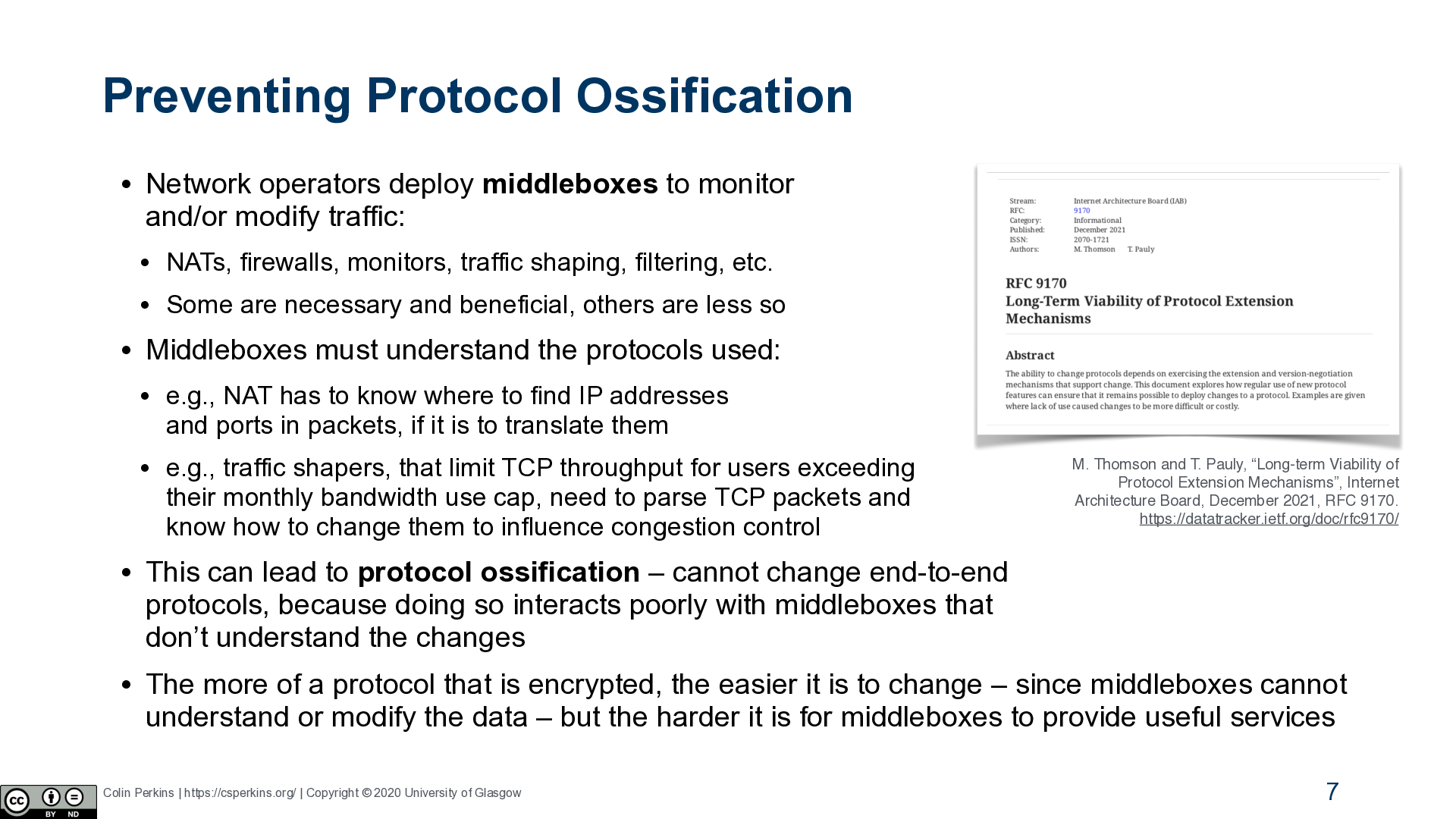
The draft shown on the slide,
00:16:00.966
on "Long-term viability of protocol extension mechanisms",
00:16:04.266
talks about these issues further,
00:16:06.100
and talks about how to extend and modify protocols
00:16:08.866
and ensure that protocols remain changeable.
00:16:11.466
It's very much worth reading.
00:16:18.366
As we've seen there are good reasons to encrypt
00:16:21.900
and authenticate data.
00:16:24.533
Doing so helps to provide privacy,
00:16:26.733
it helps to prevent fraud,
00:16:28.366
and it helps to allow protocols to evolve
00:16:30.600
while avoiding network ossification.
00:16:34.033
Providing security in this way is a good thing,
00:16:36.733
but they're always trade offs,
00:16:38.300
and I've tried to highlight some of these.
00:16:41.433
In particular, it's always possible to find examples
00:16:45.033
where providing security to protect against some attacker
00:16:48.633
will prevent some beneficial monitoring or service.
00:16:53.533
There are no easy solutions here.
00:16:58.500
It's easy to argue that we must encrypt everything
00:17:01.700
to ensure privacy,
00:17:03.100
missing that this causes some real problems.
00:17:07.433
Equally, it's easy to argue that law enforcement
00:17:10.766
should have exceptional access to communications,
00:17:13.533
to help prevent terrorism and child abuse, for example,
00:17:16.833
missing, that there are very real risks that this will cause
00:17:20.500
serious other problems.
00:17:24.466
We need more dialogue between engineers,
00:17:27.400
protocol designers, network operators,
00:17:30.100
policymakers, and law enforcement,
00:17:32.566
to better understand the constraints and the concerns.
00:17:38.200
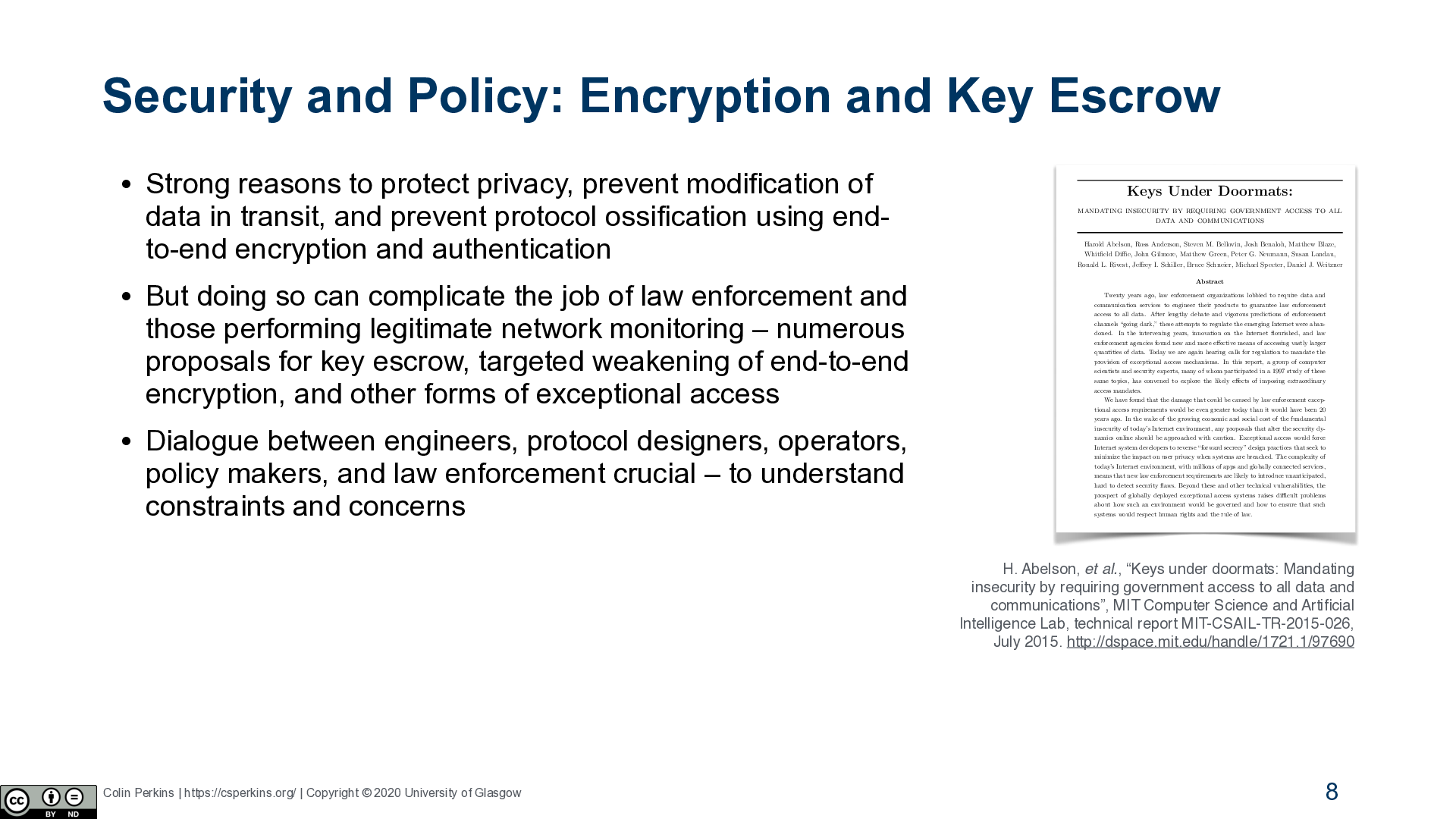
The "Keys Under Doormats" paper, linked from the slide,
00:17:41.233
talks about these issues in more detail,
00:17:43.433
and I very much encourage you to read it.
00:17:48.933
Finally, as more and more data is encrypted and protected,
00:17:52.900
we're also starting to see increasing discussion
00:17:55.700
of end system based content monitoring.
00:17:59.866
The argument here is that encryption is important
00:18:02.733
to prevent attacks by malicious users,
00:18:05.400
but that law enforcement need access to protect us.
00:18:09.000
But, since effective encryption prevents law enforcement
00:18:12.466
from monitoring traffic on the network,
00:18:14.400
then maybe they should be able to monitor the traffic
00:18:16.833
on the end systems, after it's traversed the network.
00:18:20.866
And there's a certain appeal to this.
00:18:24.933
If done correctly, the encryption provides
00:18:27.833
protection against a large class of attacks,
00:18:30.500
and correct implementation of end-system based monitoring
00:18:34.033
limits who can monitor traffic
00:18:35.633
to those with legitimate needs and legitimate authority.
00:18:40.200
And, in some cases that's an appropriate compromise.
00:18:45.100
It doesn't seem problematic for social networks
00:18:48.033
like Facebook,for example,
00:18:49.566
to support law enforcement in monitoring their network
00:18:52.933
to detect people sharing child abuse material.
00:18:56.833
But,
00:18:58.633
as Apple found out when they announced that they were
00:19:00.900
to implement similar monitoring running on iPhones
00:19:03.533
for one-to-one and group iMessage chats,
00:19:07.433
the expectations around privacy,
00:19:09.800
law enforcement access, and abuse protection,
00:19:12.633
vary very much between social networks,
00:19:15.566
one-to-one communications,
00:19:17.466
group communications, and public posts.
00:19:20.366
And the boundaries between these categories,
00:19:22.866
and what's acceptable in terms of monitoring
00:19:25.466
and protection and privacy,
00:19:27.400
can be very hard to distinguish.
00:19:31.333
And again, there are some difficult questions
00:19:33.600
relating to what type of privacy protection
00:19:36.133
and what type of monitoring is technically
00:19:38.500
possible to implement on end-systems,
00:19:40.933
and what's socially acceptable,
00:19:43.033
and what's desirable.
00:19:46.100
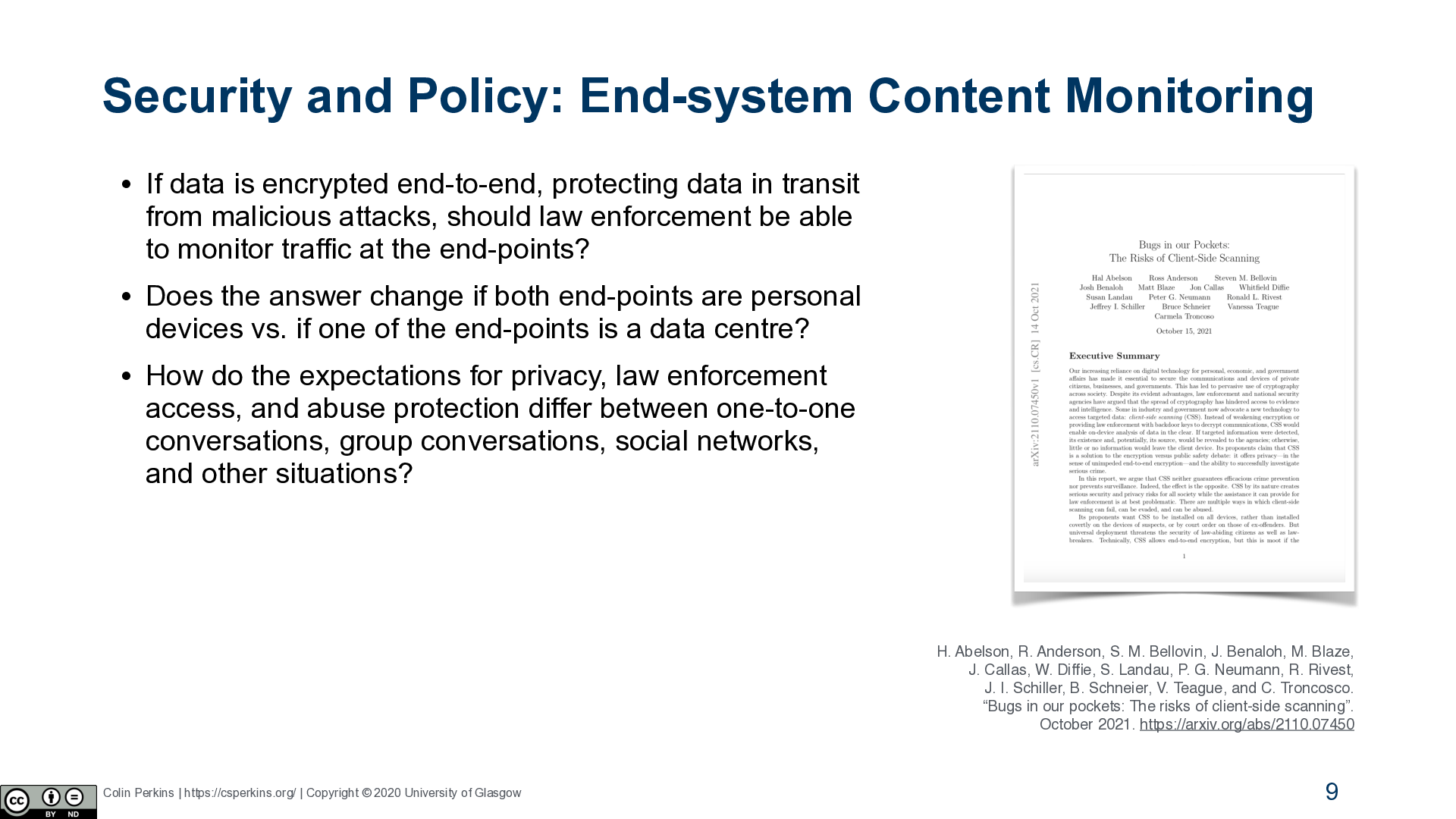
And the the paper on the slide,
00:19:48.600
"Bugs in our pockets",
00:19:49.700
talks about this issue in a lot more detail.

00:19:56.133
So that wraps up the discussion of why
00:19:58.766
secure communication is needed.
00:20:02.166
Network traffic is frequently monitored
00:20:04.866
by governments, businesses,
00:20:07.166
network operators, and malicious users.
00:20:10.466
Some of this monitoring is beneficial,
00:20:13.100
some of it less so.
00:20:15.966
In the following parts, I'll talk about
00:20:18.200
the technologies we can use to provide privacy,
00:20:21.433
to protect message integrity,
00:20:23.266
and to protect and prevent protocol ossification.
-
S. Farrell and H. Tschofenig,
Pervasive
Monitoring is an Attack, IETF, May 2014, RFC 7258.
-
K. Moriarty and A. Morton,
Effect of
Pervasive Encryption on Operators, IETF, July 2018, RFC 8404.
-
G. Fairhurst and C. Perkins,
Considerations
around Transport Header Confidentiality, Network Operations, and the
Evolution of Internet Transport Protocols, IETF,July 2021, RFC
9065.
-
M. Thomson and T. Pauly,
Long-term
Viability of Protocol Extension Mechanisms, Internet Architecture
Board, December 2021, RFC 9170.
-
R. Anderson, S. M. Bellovin, J. Benaloh, M. Blaze, W. Diffie, J.
Gilmore, M. Green, S. Landau, P. G. Neumann, R. L. Rivest, J. Schiller,
B. Schneier, M. Specter, D. J. Weitzner,
Keys under doormats:
Mandating insecurity by requiring government access to all data and
communications, MIT Computer Science and Artificial Intelligence
Lab, technical report MIT-CSAIL-TR-2015-026, July 2015.
-
H. Abelson, R. Anderson, S. M. Bellovin, J. Benaloh, M. Blaze,
J. Callas, W. Diffie, S. Landau, P. G. Neumann, R. Rivest,
J. I. Schiller, B. Schneier, V. Teague, and C. Troncosco.
Bugs in our
pockets: The risks of client-side scanning, October 2021.
Part 2: Principles of Secure Communication
The 2nd part of the lecture reviews the principles of secure
communication. It describes the concepts behind symmetric, public-key,
and hybrid cryptography. It outlines techniques for message integrity
protection and authentication including cryptographic hash functions
and digital signatures. And it reviews the need for a public key
infrastructure.
00:00:00.233
In this part, I want to talk
00:00:02.200
about some of the principles of secure
00:00:04.366
communication. I’ll talk about how we go
00:00:06.566
about ensuring confidentiality of messages as they
00:00:08.733
traverse the network.
00:00:09.766
About how we authenticate messages to ensure
00:00:12.500
that they're not modified in transit,
00:00:14.800
and about how we can go about
00:00:17.500
validating the identity of the participants in
00:00:20.233
a communication.
00:00:21.100
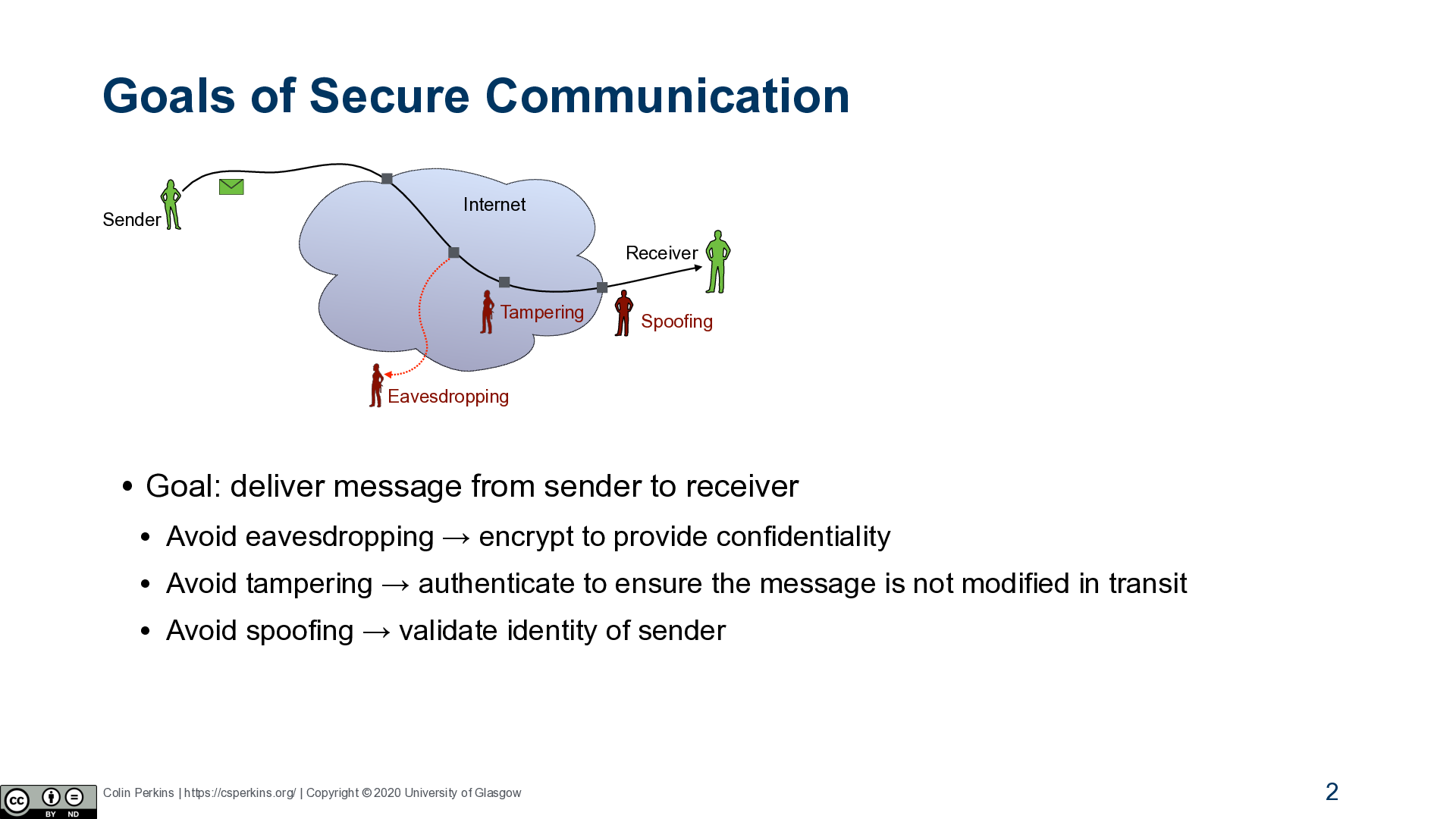
So what are the goals of secure communication?
00:00:24.933
Well, we're trying to deliver a message
00:00:27.066
across the internet from a sender to a receiver.
00:00:30.600
In the process we want to avoid
00:00:32.833
eavesdropping on the message – we need
00:00:35.033
to encrypt it in order to provide
00:00:37.266
confidentiality, to make sure no one other
00:00:39.500
than the intended receiver can have access
00:00:41.700
to the content of the message.
00:00:43.700
We want to avoid tampering with the
00:00:45.666
message – we need to authenticate the
00:00:47.600
message to ensure that it's not modified
00:00:49.533
in transit by any of the devices
00:00:51.466
which are which are involved in the
00:00:53.433
delivery of that message.
00:00:54.633
And we want to avoid spoofing –
00:00:57.233
we want to somehow validate the identity
00:00:59.800
of the sender, so that the receiver
00:01:01.733
knows, and can be sure of who the message came from.
00:01:07.000
So how do we go about providing confidentiality?
00:01:10.300
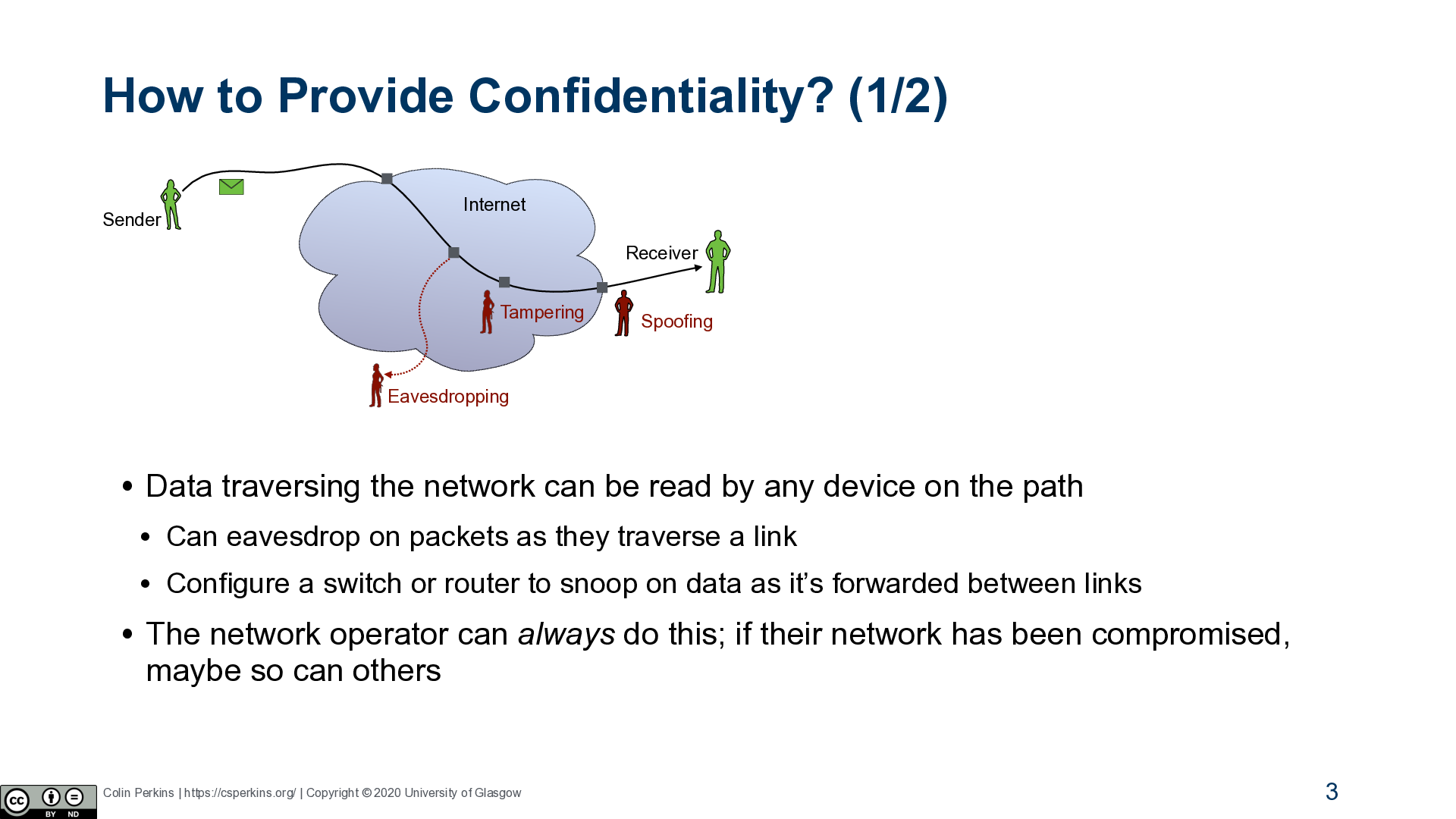
Well unfortunately data traversing the network can
00:01:13.033
be read by any of the devices
00:01:15.033
on the path between the sender and the receiver.
00:01:17.566
It's possible to eavesdrop on packets as
00:01:19.266
they traverse the links that comprise the
00:01:21.000
network. And it's also possible to configure
00:01:23.066
the switches or routers to snoop on
00:01:25.166
the data as they're forwarding it between
00:01:27.266
the different links in the network.
00:01:29.333
The network operator can always do this.
00:01:32.366
They own the network;
00:01:33.933
they can configure the devices to save
00:01:36.000
a copy of the data if they choose to do so.
00:01:38.600
If the network's been compromised, maybe so can others.
00:01:42.333
If an attacker can break
00:01:43.800
into the routers, for example, there's nothing
00:01:46.500
stopping them saving the data, redirecting copies
00:01:49.200
of data traversing the network to some other location.
00:01:52.800
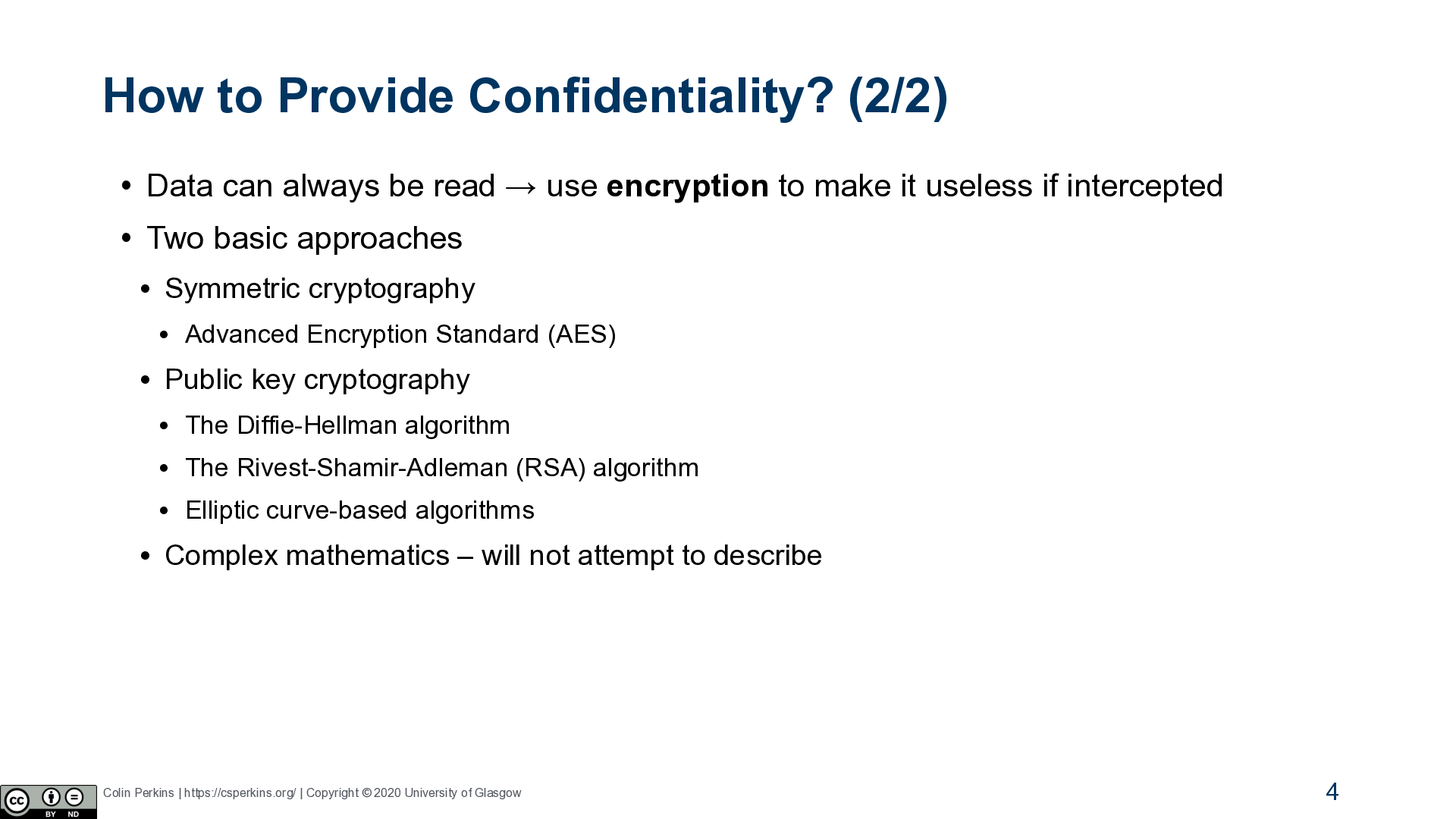
If the data can always be read,
00:01:55.366
how do we provide confidentiality?
00:01:57.300
Well, we use encryption to make sure
00:01:59.400
that the data is useless if it's
00:02:01.500
intercepted or copied. We can't stop an
00:02:03.600
attacker, or the network operator, from reading
00:02:05.700
our data. But we can make sure
00:02:07.333
that they can't make sense of it
00:02:09.166
if they do read it.
00:02:11.500
There are two basic approaches to providing encryption.
00:02:15.233
The first is called symmetric cryptography.
00:02:18.066
Algorithms such as the Advanced Encryption Standard, AES.
00:02:22.133
The other approach is what's known as
00:02:24.466
public key cryptography.
00:02:25.700
Algorithm such as the
00:02:27.033
Diffie-Hellman algorithm, the RSA algorithm, and elliptic
00:02:30.100
curve algorithms.
00:02:31.700
They have quite different properties and are
00:02:34.200
used in different situations. I’ll talk about
00:02:36.700
the details and the differences between them in a minute.
00:02:40.366
Both of them are based on some
00:02:42.666
fairly complex mathematics. I'm not going to
00:02:44.933
attempt to describe how that works.
00:02:47.066
What's important is not the details of
00:02:49.133
the maths. But what are their properties,
00:02:51.433
what behaviours do they provide, and how
00:02:53.300
do they help us secure data as it traverses the network?

00:02:57.366
So we’ll start with the idea of symmetric cryptography.
00:03:01.300
The idea of symmetric encryption is that
00:03:03.566
it can convert plain text into cipher
00:03:05.833
text with the aid of a key.
00:03:08.700
If you have, for example, the plain
00:03:10.433
text as we see on the top-right
00:03:12.666
of the slide, and we pass it
00:03:14.933
through the encryption algorithm, in this case,
00:03:17.166
the AES Advanced Encryption Algorithm, with the
00:03:19.400
aid of an encryption key, we get
00:03:21.633
a blob of encrypted text as we
00:03:23.900
see it in the middle.
00:03:25.600
If we pass that encrypted text through
00:03:28.700
the inverse algorithm, the decryption algorithm,
00:03:31.333
using the same key, then we get
00:03:34.433
the original text back out.
00:03:36.766
The point is that a single secret
00:03:39.200
key controls both the encryption and the
00:03:41.666
decryption process. The key used to encrypt
00:03:44.100
is the same as the key used
00:03:46.566
to decrypt.
00:03:47.366
Now, provided the key is kept secret.
00:03:49.900
And it's known only to the sender
00:03:52.433
and receiver. This can be very secure,
00:03:54.933
and it can be very fast.
00:03:57.200
Symmetric algorithms such as AES can encrypt
00:04:00.433
and decrypt many gigabits per second.
00:04:03.200
This makes them very suitable for Internet
00:04:06.433
communications because they don't slow down the
00:04:09.666
communications, while still providing security.
00:04:12.100
There are a wide range of different
00:04:15.333
symmetric encryption algorithms, probably the most widely
00:04:18.566
used is the US Advanced Encryption Standard, AES.
00:04:22.600
The AES algorithm was developed as part
00:04:24.933
of the output of an open competition,
00:04:27.533
run by the US National Institute of
00:04:30.100
Standards, and it's actually a Dutch algorithm
00:04:32.700
known as Rijndael.
00:04:33.900
Importantly, the AES algorithm, the Rijndael algorithm,
00:04:36.700
is public and the security of the
00:04:39.533
algorithm depends only on keeping the key
00:04:42.333
secret, not on keeping the algorithm itself secret.
00:04:45.966
The link on the slide is a
00:04:47.966
pointer to the specification for the algorithm,
00:04:50.266
and there’s a large amount of open
00:04:52.566
source code which implements it.
00:04:54.333
The problem with symmetric cryptography is that
00:04:56.900
you need to keep the key secret.
00:04:59.500
If anyone other than the sender and
00:05:02.066
the receiver know the key, then the
00:05:04.666
security of the encryption fails.
00:05:06.600
The question then, is how do you
00:05:09.100
security distribute the key? If you want
00:05:11.600
to exchange message a secure message with
00:05:14.100
someone I know well, then this is
00:05:16.600
straightforward. I can meet them in person,
00:05:19.100
give them the key, and ensure that
00:05:21.600
no one else can eavesdrop on that communication.
00:05:24.833
The problem comes when I'm trying to
00:05:26.700
communicate securely with someone where I can't
00:05:28.833
meet them in person.
00:05:30.166
How do I securely get a key
00:05:32.400
from an Internet shopping site, for example?
00:05:34.666
The only means of communication. I have
00:05:36.900
is over the Internet. And if I
00:05:39.166
send the key over the Internet,
00:05:41.066
someone can eavesdrop on the key,
00:05:43.000
and that gives them the ability to
00:05:45.266
decrypt our communications and breaks the security.
00:05:47.600
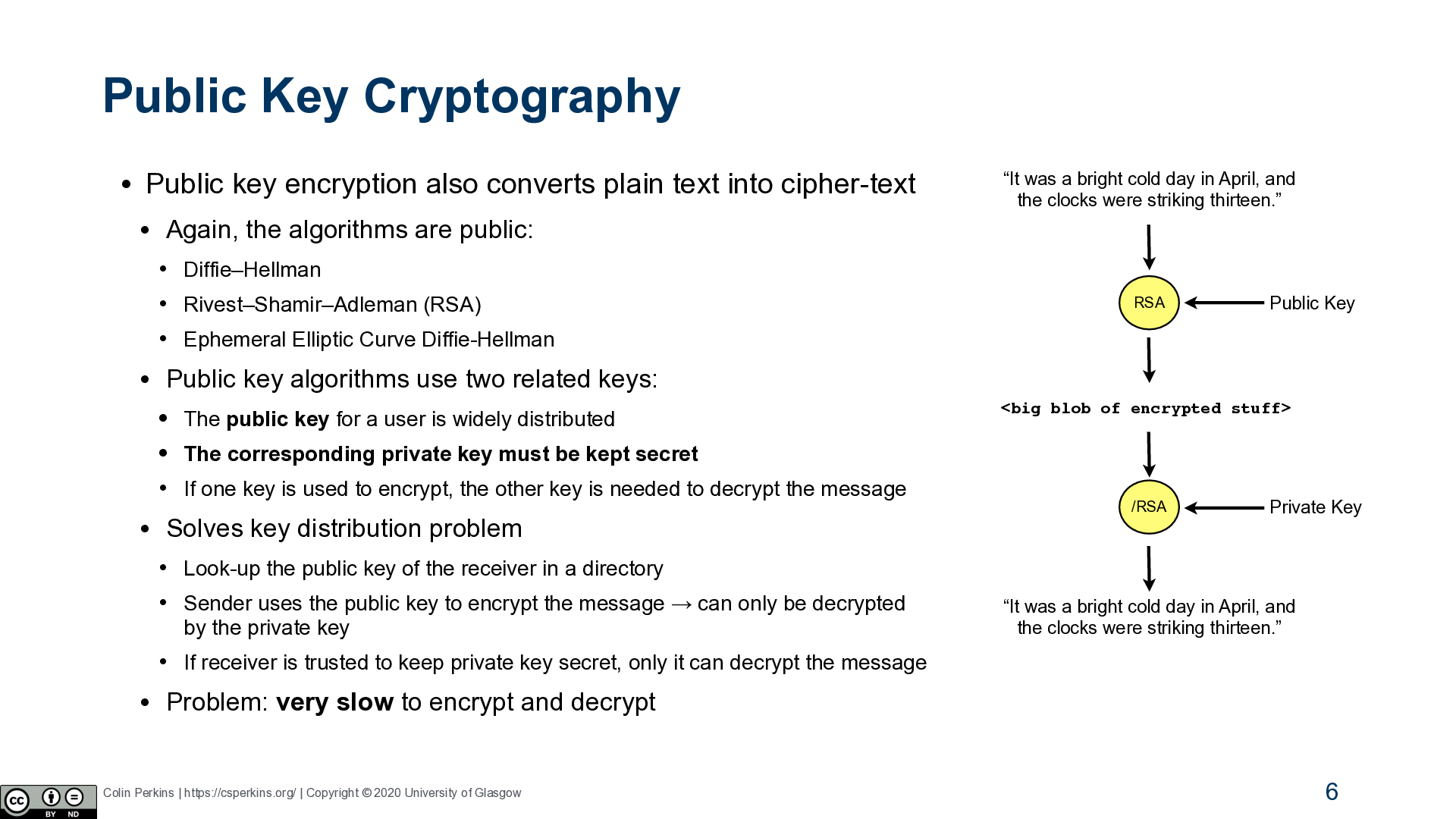
The solution to this is an approach
00:05:50.466
known as public key cryptography.
00:05:52.600
public key cryptography, like symmetric cryptography,
00:05:54.833
is used to convert a plain text
00:05:57.466
message into an encrypted form. The difference,
00:06:00.100
though, is that there are two different
00:06:02.733
keys, and the key used to encrypt
00:06:05.333
the message, and the key to decrypt
00:06:07.966
the message are different
00:06:09.566
The keys come in pairs. The two
00:06:11.633
halves of the pair are known as
00:06:13.733
the public key and the private key.
00:06:15.900
Importantly, a message which is encrypted using
00:06:18.466
one of those keys can only be
00:06:21.000
decrypted using the other key. If the
00:06:23.566
message is encrypted with the public key,
00:06:26.133
for example, then only the private key
00:06:28.666
can decrypt that message.
00:06:30.233
As you might expect from the names.
00:06:32.400
The idea is that you keep the
00:06:34.566
private key from the key pair secret,
00:06:36.766
and you make the public key as
00:06:38.933
public as is possible.
00:06:40.266
You publish it in the phone book,
00:06:42.200
you put it on your webpage,
00:06:43.866
you write it on your business card,
00:06:45.833
and you make sure everybody knows that
00:06:47.766
this is your public key.
00:06:49.266
In order to send you a message,
00:06:51.566
someone looks up your public key and
00:06:53.866
uses that to encrypt the message.
00:06:55.933
Once the message has been encrypted using
00:06:58.333
a particular public key, the only thing
00:07:00.733
which can decrypt it is the corresponding
00:07:03.166
private key. And since the private key
00:07:05.566
has been kept private, you're the only
00:07:07.966
one who can receive the message.
00:07:10.133
This solves the key distribution problem.
00:07:12.500
Provided you can look up the appropriate
00:07:15.266
public key for the receiver in a directory,
00:07:19.066
and you can trust that the receiver
00:07:20.633
has kept their private key secret,
00:07:22.433
then you use their public key to
00:07:24.533
encrypt the message, and you know that
00:07:26.600
they're the only one who can decrypt it.
00:07:29.433
This allows Internet shopping sites, and the
00:07:31.633
like, to work. If I wish to
00:07:33.266
buy something from Amazon, I look up
00:07:35.333
the key for Amazon in a directory,
00:07:37.433
use that to encrypt the message I'm
00:07:39.500
sending to Amazon, and I know that
00:07:41.600
they're the only ones that can decrypt it.
00:07:44.266
The problem with public key cryptography is
00:07:46.833
that it’s very slow. The public key
00:07:49.600
algorithms such as the Diffie-Hellman algorithm,
00:07:52.000
the RSA algorithm,
00:07:53.266
and the elliptic curve algorithms, work millions
00:07:56.300
of times slower than symmetric encryption algorithms.
00:07:59.333
The result is that they’re too slow
00:08:02.366
to use for any realistic amount of
00:08:05.366
communication. The performance just isn't there.
00:08:08.066
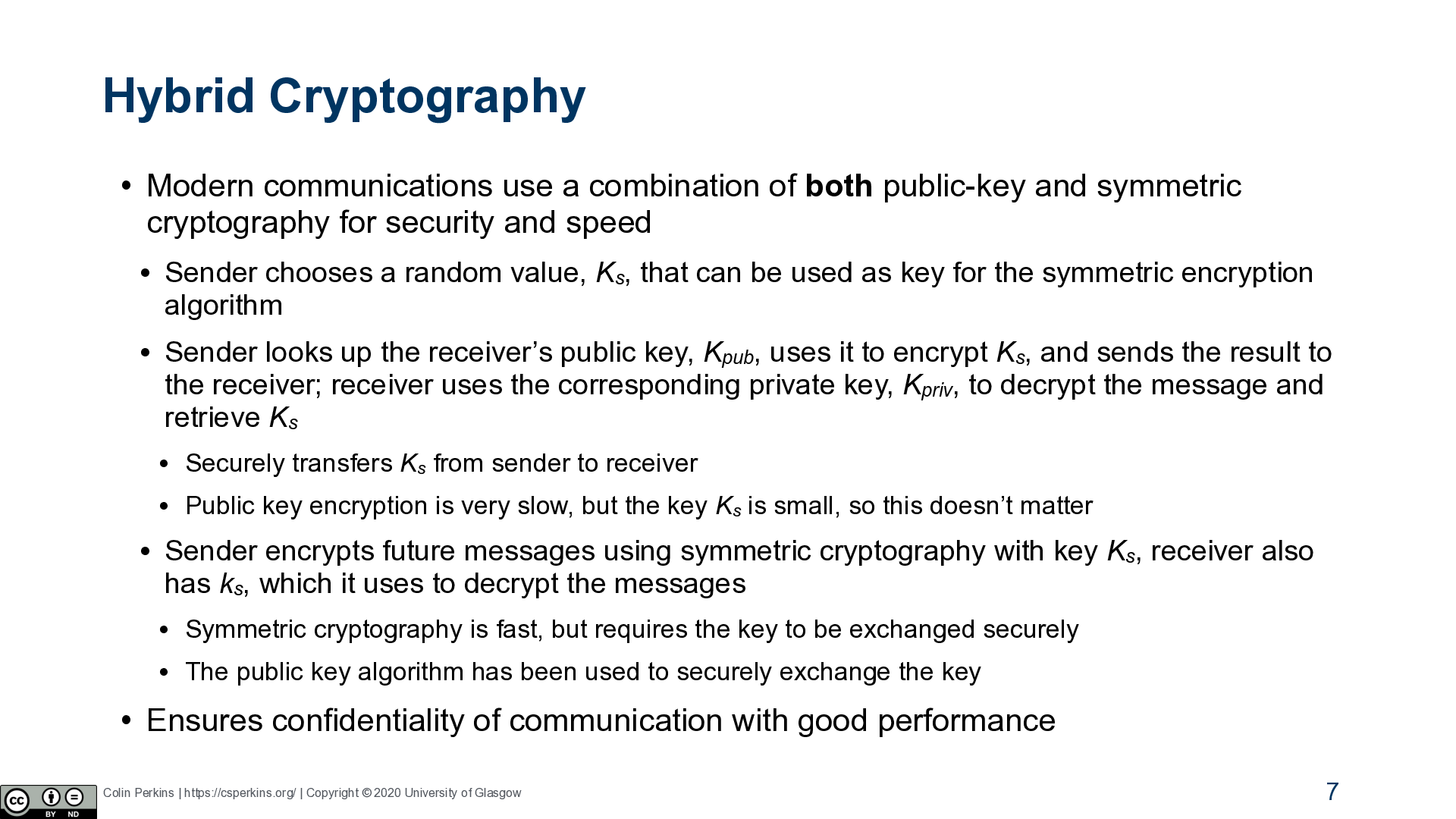
Accordingly, modern communications use what's known as
00:08:11.433
hybrid cryptography, where they use a combination
00:08:14.800
of both public key and symmetric cryptography.
00:08:18.266
This provides both security and speed.
00:08:21.866
The way this works is that the
00:08:24.666
sender and receiver use public key cryptography,
00:08:27.466
which is very slow, to exchange a
00:08:30.266
small amount of information.
00:08:31.966
That information is then used as the
00:08:34.633
key for the symmetric encryption algorithm,
00:08:36.866
which is very fast.
00:08:38.500
In detail, the sender chooses a random
00:08:41.133
value, that we’ll call Ks, which will
00:08:43.733
be used as the key for the symmetric encryption.
00:08:47.233
The sender then looks up the receiver’s
00:08:49.933
public key, Kpub, uses it to encrypt
00:08:52.600
Ks and sends the result to the receiver.
00:08:56.066
The receiver uses its corresponding private key,
00:08:59.133
Kpriv, to decrypt the message and retrieve Ks.
00:09:03.200
This securely transfers Ks, the key for
00:09:07.000
the symmetric encryption algorithm, from the sender
00:09:10.300
to the receiver.
00:09:11.933
Doing this using public key encryption is
00:09:14.466
very slow, but the key for the
00:09:16.966
symmetric encryption, Ks, is very small,
00:09:19.100
so the fact it's very slow doesn't matter.
00:09:22.266
The sender, then uses that key,
00:09:24.866
Ks, to encrypt future messages using symmetric
00:09:28.133
cryptography, for example, using the AES algorithm.
00:09:31.466
The receiver also has Ks, which it
00:09:34.100
exchanged using the public key encryption,
00:09:36.333
and can use that to decrypt the messages.
00:09:39.733
Symmetric cryptography is very fast, so the
00:09:42.400
performance of the communication, once it's got
00:09:45.400
started, is very quick, but it requires
00:09:48.400
the key to be exchanged securely.
00:09:50.966
The public key algorithm, which is slow,
00:09:53.933
is used to securely exchange the key.
00:09:57.033
The result is something which achieves both
00:10:01.266
confidentiality, and solves the key distribution problem,
00:10:05.533
and also achieves good performance.
00:10:08.666
Encryption gives you confidentiality of data and
00:10:10.833
makes sure that no one can eavesdrop
00:10:13.000
on the messages being sent from the
00:10:15.200
sender to the receiver.
00:10:16.533
We also, though, need to verify the
00:10:18.866
identity of the sender, and make sure
00:10:21.166
that messages haven't been modified in transit.
00:10:23.600
In order to do this, we generate
00:10:26.033
a digital signature to authenticate the messages.
00:10:28.466
And the receiver can then validate that
00:10:30.900
signature, check the signature, to make sure
00:10:33.300
they came from the expected sender.
00:10:35.500
The digital signature relies on a combination
00:10:39.400
of public key cryptography,
00:10:41.066
and a cryptographic hash algorithm.
00:10:44.366
So first of all, what is a cryptographic hash?

00:10:47.966
A cryptographic hash function is a function
00:10:50.733
that takes some arbitrary length input and
00:10:53.533
produces a fixed length output hash that
00:10:56.300
somehow represents that input.
00:10:58.000
For example, at the top of the
00:11:00.466
slide, we see some input text going
00:11:02.933
through a hash algorithm, known as SHA256,
00:11:05.400
that produces the fixed length output block
00:11:07.866
you see on the right.
00:11:09.766
A cryptographic hash algorithm has four fundamental
00:11:12.533
properties. The first is that every input
00:11:15.300
will generate a different output, and the
00:11:18.100
slightest change to the input will change
00:11:20.866
the output value.
00:11:22.166
The second is that it should be
00:11:24.466
infeasible to find two inputs
00:11:26.733
that gives the same output.
00:11:28.466
The third is that calculating the hash
00:11:30.800
itself should be fast, and going from
00:11:33.100
input to output should happen very quickly.
00:11:35.533
And the fourth, and perhaps most important,
00:11:37.800
is that reversing a hash should be
00:11:40.100
infeasible. If you're only given the output,
00:11:42.400
there should be no way of finding
00:11:44.666
out what the input was.
00:11:46.400
A cryptographic hash therefor acts as a
00:11:49.200
unique fingerprint for the input data.
00:11:51.600
It provides a short output, that uniquely
00:11:54.400
identifies a given message.
00:11:56.100
There are many different cryptographic hash algorithms.
00:11:59.800
The current recommendation is the SHA256 algorithm
00:12:03.500
specified by the IETF in RFC 6234.
00:12:07.300
There are a number of older algorithms,
00:12:10.066
such MD5 and SHA1, which you may
00:12:12.866
hear about, but these all have known
00:12:15.666
security flaws and are not recommended for use.
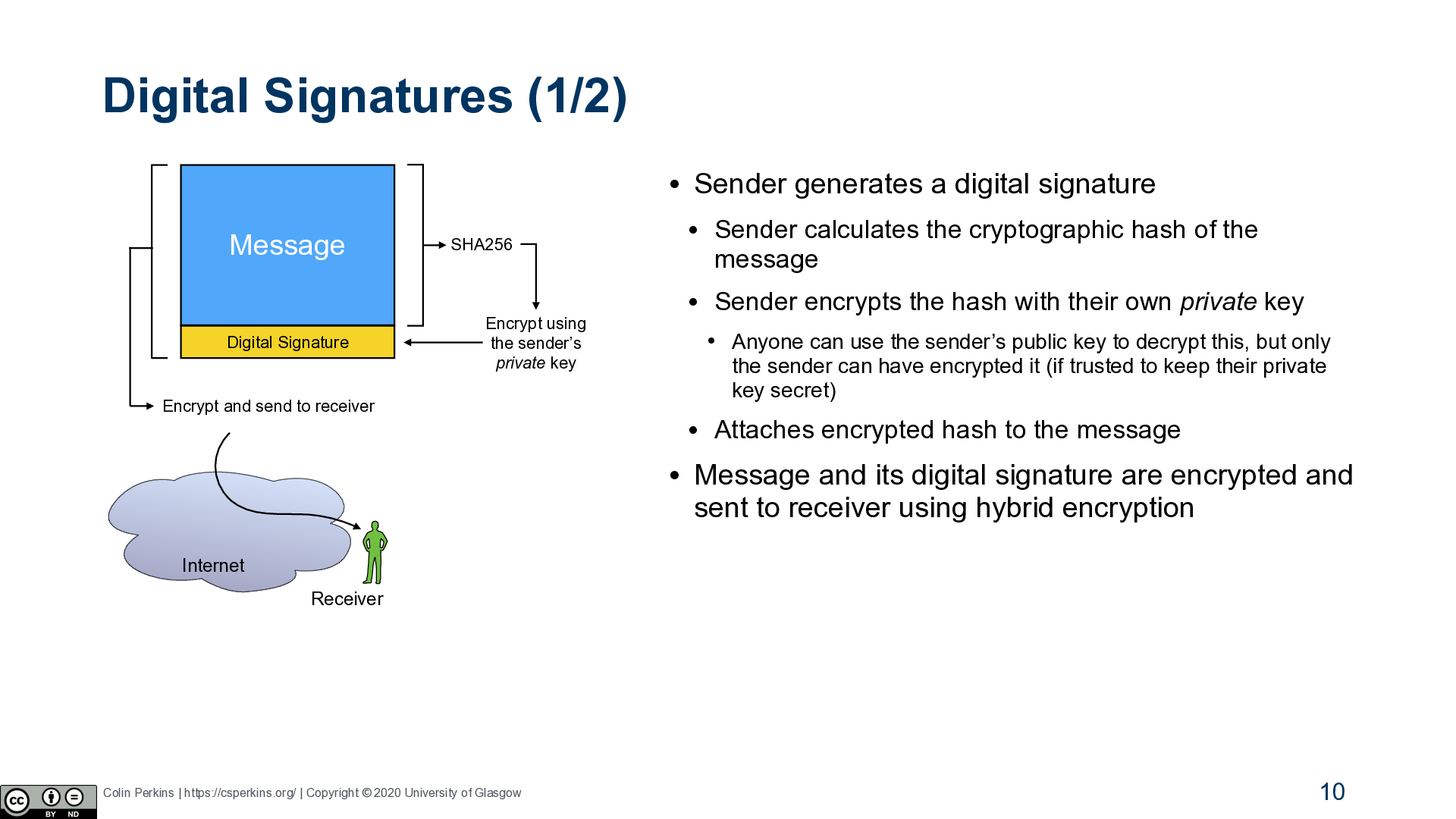
00:12:19.466
So how can we use a cryptographic
00:12:21.333
hash to help build a digital signature?
00:12:23.800
Well, in order to do that,
00:12:25.933
you take the message you wish to
00:12:28.400
send, and you calculate a cryptographic hash
00:12:30.900
of that message.
00:12:32.066
The sender that encrypts that hash with
00:12:34.300
their private key. Now the private key
00:12:36.533
is known only to the sender,
00:12:38.433
so they're the only one who can
00:12:40.633
encrypt that message.
00:12:41.700
But the thing which would decrypt it
00:12:44.133
is the sender’s public key, which is
00:12:46.566
available to everybody. Encrypting the hash with
00:12:48.966
the sender’s private key doesn't provide any
00:12:51.400
confidentiality, because anyone can decrypt the message
00:12:53.833
using the public key.
00:12:55.333
What it does do though, provided the
00:12:57.633
sender can be trusted to keep its
00:12:59.966
private key private, is demonstrate that the
00:13:02.266
sender must have encrypted the hash.
00:13:04.266
Since the hash is a fingerprint of
00:13:06.566
the message, this means that the sender
00:13:08.900
must have generated the original message.
00:13:10.966
The sender then attaches the encrypted hash
00:13:14.033
to the message, forming the digital signature.
00:13:17.200
The message, and its digital signature,
00:13:19.833
are then encrypted and sent to the
00:13:22.933
receiver using hybrid encryption.
00:13:24.766
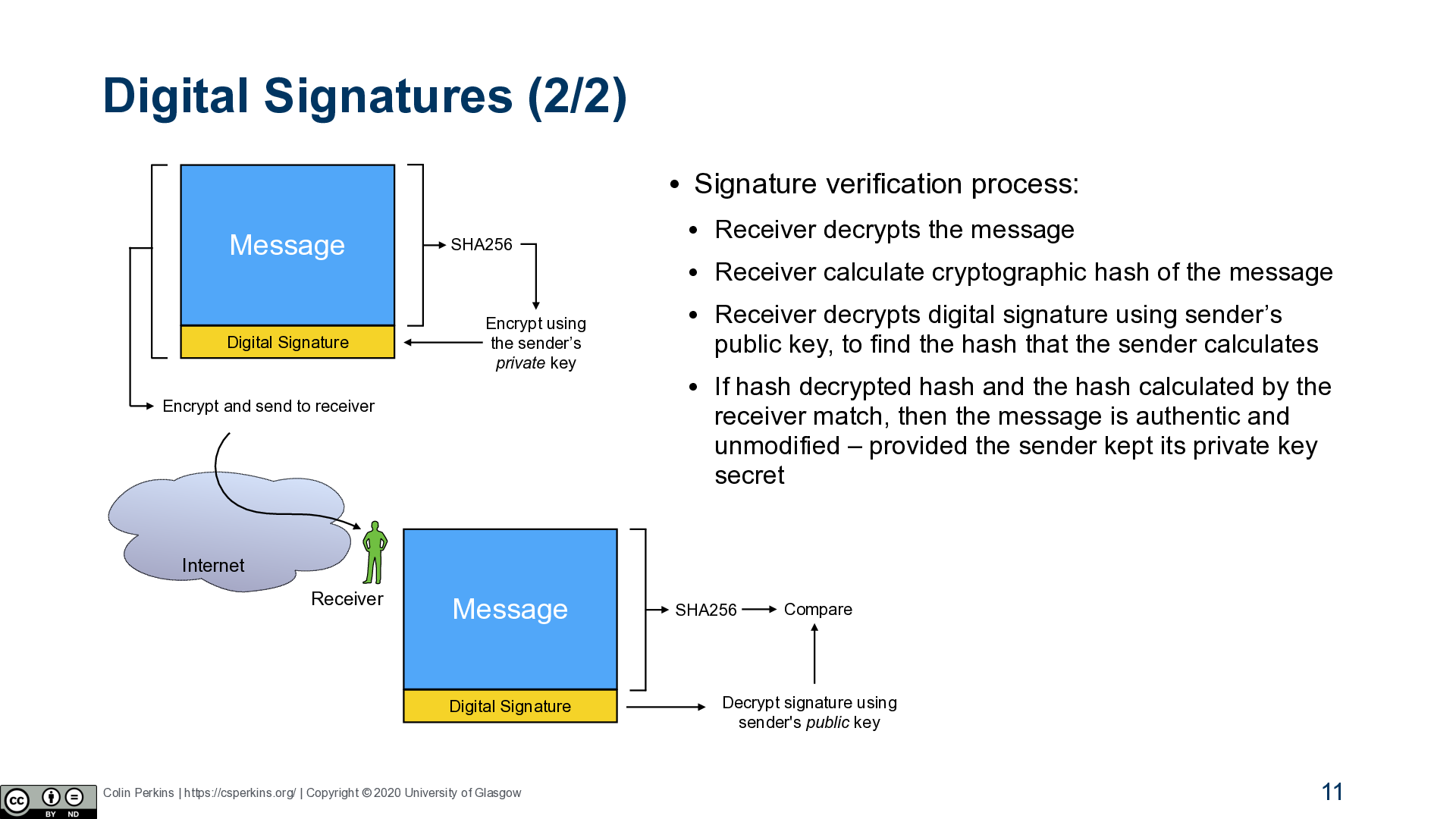
When the message arrives at the receiver,
00:13:27.466
the receiver can verify the signature.
00:13:29.866
To do this, it first decrypts
00:13:32.566
the message and its digital signature.
00:13:34.900
The receiver then takes the message itself,
00:13:37.600
and calculates its cryptographic hash.
00:13:39.633
Having done that, it takes the digital
00:13:42.333
signature, looks up the sender’s public key,
00:13:45.000
and uses that to decrypt the digital
00:13:47.700
signature to retrieve the original
00:13:49.700
cryptographic hash that was in the message.
00:13:52.233
It compares the hash, which has sent
00:13:54.800
in the message as part of the
00:13:57.333
digital signature, with the cryptographic hash it
00:13:59.866
just calculated.
00:14:00.700
If the two match, then it knows
00:14:02.966
the messages is authentic and has been
00:14:05.266
unmodified, provided is trusts the sender to
00:14:07.566
have kept its private key private.
00:14:09.633
If the hash of the message it
00:14:11.900
calculated, and the hash that was sent
00:14:14.166
in the digital signature, don't match then
00:14:16.400
it knows that somehow the message has
00:14:18.666
been modified in transit.
00:14:20.066
Public Key Encryption is therefore one of
00:14:22.200
the fundamental building blocks of a secure network.
00:14:25.066
It allows us to send a message
00:14:26.900
to a recipient securely, even if we've
00:14:29.100
not met that recipient, and be sure
00:14:31.300
that they're the only one who’ll be
00:14:33.466
able to decrypt that message. And it
00:14:35.666
allows us to use digital signatures to
00:14:37.866
verify that messages have not been modified
00:14:40.033
in transit.
00:14:40.766
The security of public key encryption,
00:14:43.166
though, depends on knowing which public key
00:14:45.933
corresponds to a particular receiver.
00:14:48.033
There are three ways you can know
00:14:50.300
this. The first is that the receiver
00:14:52.566
gives you their key in person.
00:14:54.633
The second is that the receiver sends
00:14:56.966
you their key, but the message in
00:14:59.300
which they send it is authenticated by
00:15:01.666
someone you trust.
00:15:02.766
That is, there’s a digital signature in
00:15:05.266
the message, signed by someone who's key
00:15:07.766
already have, that authenticates that this message
00:15:10.300
is from who it claims to be from.
00:15:13.633
The third is that someone you trust
00:15:16.166
gives you the receivers key.
00:15:18.333
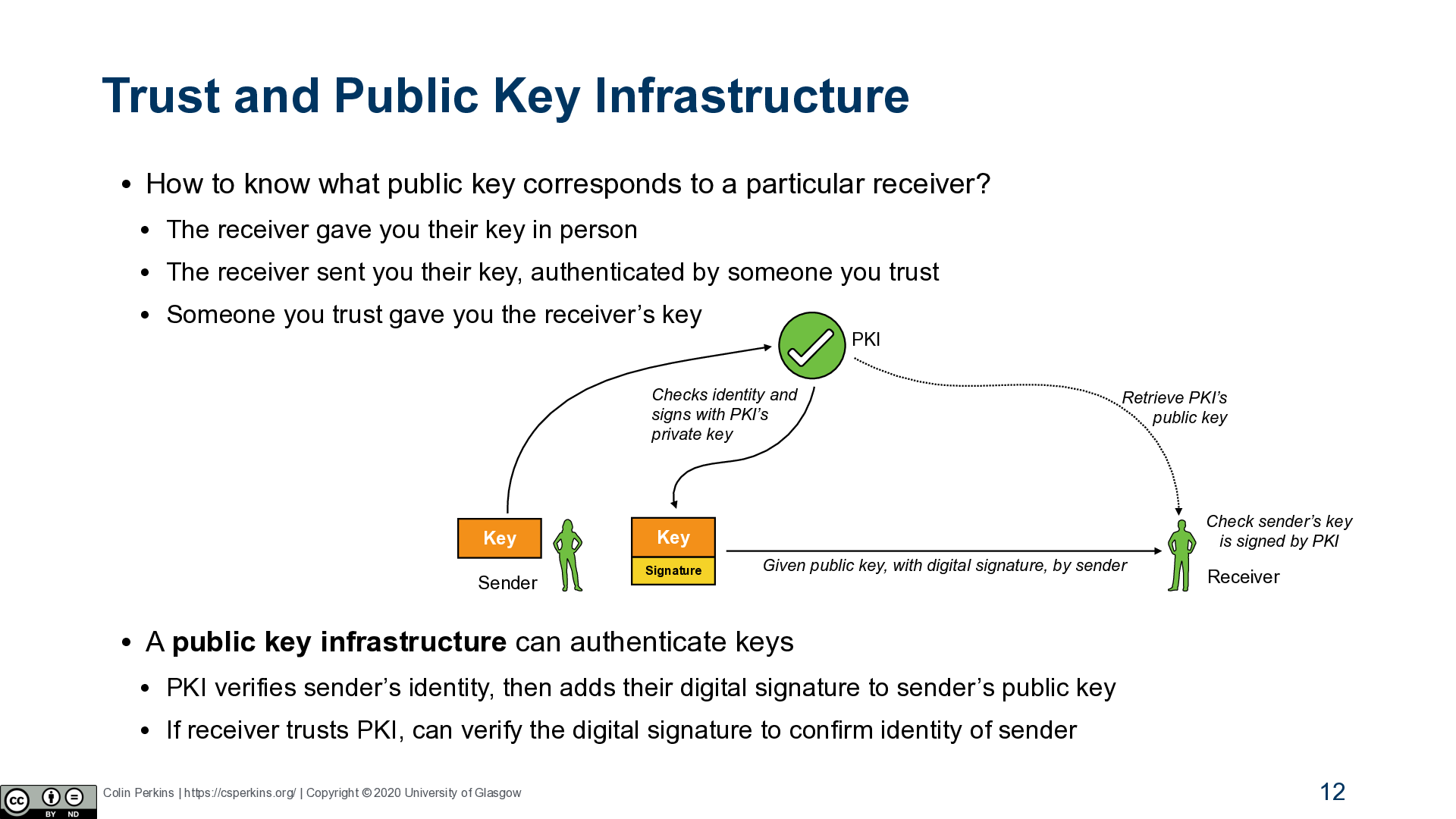
In the Internet, the role of someone
00:15:20.800
you trust is often played by an
00:15:23.300
organisation known as a certificate authority,
00:15:25.400
as part of a public key infrastructure.
00:15:28.000
The role of a certificate authority is
00:15:30.733
to validate the identity of potential senders.
00:15:33.466
The certificate authority checks the identity of
00:15:36.200
a potential sender, and then adds a
00:15:38.933
digital signature to the sender’s public key
00:15:41.666
to indicate that it's done so.
00:15:44.100
If a receiver trusts the public key
00:15:47.300
infrastructure, trusts the certificate authority, then it
00:15:50.500
can verify that digital signature, added by
00:15:53.700
the certificate authority, to confirm the identity
00:15:56.866
of the sender.
00:15:58.366
These mechanisms, symmetric and public key encryption,
00:16:01.766
and digital signatures, allow us to provide
00:16:05.200
confidentiality for communication over the Internet that
00:16:08.600
performs well and is secure.
00:16:11.600
They allow us to authenticate messages,
00:16:13.700
and demonstrate that they've not been modified in transit.
00:16:16.633
And they allow us to validate the identity of senders
00:16:19.466
of those messages.
-
Federal Information Processing Standards Publication 197,
Specification for the ADVANCED ENCRYPTION STANDARD (AES),
November 2001.
Part 3: Transport Layer Security (TLS) v1.3
The 3rd part of the lecture describes the operation of the Transport
Layer Security Protocol (TLS) v1.3; one of the key security protocols
used in the Internet.
00:00:00.333
In previous parts of this lecture I
00:00:02.333
spoke about network security in general terms.
00:00:05.166
In part one, I discussed why security
00:00:07.625
is needed in order to protect Internet communications,
00:00:10.959
and in part two, I spoke about
00:00:13.500
how security is provided in outline.
00:00:16.208
I spoke about the different types of
00:00:18.250
encryption, public key and symmetric,
00:00:20.583
the use of hybrid encryption, in order
00:00:22.875
to improve performance while still maintaining security,
00:00:26.291
and the ideas of digital signatures and
00:00:29.959
public key infrastructure.
00:00:32.125
In this third part of the lecture,
00:00:34.125
I want to move on to talk
00:00:35.834
about Internet security in specific terms.
00:00:38.458
I want to talk about the Transport
00:00:40.000
Layer Security protocol, TLS version 1.3
00:00:43.792
I’ll begin by introducing what is TLS,
00:00:46.625
talking about conceptually what role it performs
00:00:48.750
in the network stack. And I'll talk
00:00:50.834
through some of the details of TLS.
00:00:53.208
I'll talk about the TLS handshake protocol,
00:00:55.792
that's used to establish TLS connections.
00:00:58.458
The record protocol, that's used to exchange
00:01:00.667
data. The 0-RTT extension, that reduces connection
00:01:04.792
setup times. And finally, I'll talk about
00:01:07.208
some of the limitations of TLS.
00:01:11.542
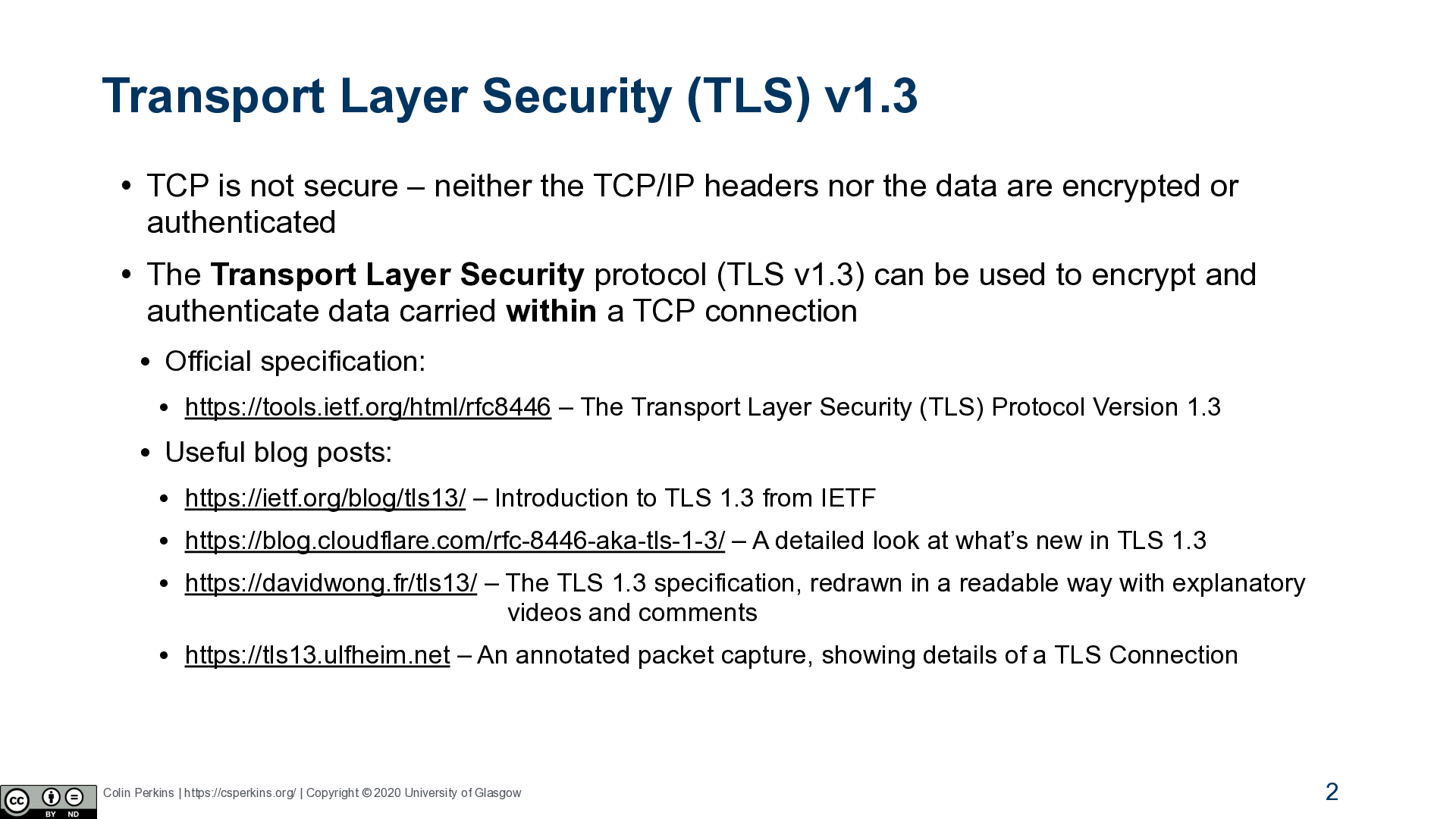
As we saw in some of the
00:01:12.583
earlier lectures, TCP connections are not secure.
00:01:16.959
Neither the TCP headers, nor the IP
00:01:19.333
headers, nor the data they transfer are
00:01:21.750
encrypted or authenticated in any way.
00:01:25.125
Data sent in a TCP connection is
00:01:27.583
not confidential. It can be observed by
00:01:30.041
governments, businesses, network operators, criminals,
00:01:33.834
or malicious users.
00:01:35.750
Similarly, the data is not authenticated.
00:01:38.417
Anyone who's able to access the network
00:01:41.291
connections, or the routers over which the
00:01:43.166
data flows, is able to modify that
00:01:44.834
data. And the sender and the receiver
00:01:47.333
will not be able to tell that
00:01:48.834
such modifications have been performed.
00:01:51.625
In order to provide security for data
00:01:54.041
going across a TCP connection, we need
00:01:56.625
to run some sort of additional security
00:01:58.291
protocol within that TCP connection to protect
00:02:01.708
the data.
00:02:03.166
The way this is typically done in
00:02:04.708
the Internet, is using a protocol called
00:02:06.667
the Transport Layer Security protocol.
00:02:09.625
The latest version of this is TLS
00:02:11.458
1.3 and it's used to encrypt and
00:02:13.875
authenticate data that is carried within a
00:02:16.583
TCP connection.
00:02:19.125
The official specification for TLS 1.3 is
00:02:22.125
RFC 8446, which was published by the
00:02:24.917
IETF in the last couple of years.
00:02:28.041
The TLS specification is not a simple
00:02:30.792
document to read.
00:02:32.250
In part, this is because it's solving
00:02:34.083
a difficult problem. Providing security over the
00:02:37.291
top of an insecure connection, a TCP
00:02:39.667
connection, is a complex challenge, and TLS
00:02:43.291
has to define the number of complex
00:02:45.125
mechanisms in order to provide that security.
00:02:48.083
In other part, the complexity comes because
00:02:50.333
TLS is an old protocol.
00:02:52.875
The latest versions of TLS have to
00:02:54.875
be backwards compatible, not only with previous
00:02:57.417
versions of TLS as specified, but with
00:03:00.750
previous implementation problems, and bugs in the
00:03:03.542
TLS specification and in its implementations
00:03:06.917
The protocol designers have done a good
00:03:08.792
job, though. TLS version 1.3 is smaller,
00:03:12.708
faster, and simpler than previous versions of
00:03:15.583
TLS, and it's also more secure.
00:03:18.834
The slide lists four blog posts which
00:03:21.333
provide more information about TLS. The first
00:03:24.458
one is an introduction to TLS 1.3
00:03:26.917
from the IETF. This was written by
00:03:29.583
the TLS working group chairs, and introduces
00:03:31.959
the new features in the protocol.
00:03:34.375
The second, from CloudFlare, is a detailed
00:03:37.000
look at what's new in TLS 1.3,
00:03:39.917
as compared to previous versions of TLS.
00:03:42.417
It talks about some of the advantages
00:03:44.458
of TLS 1.3, and how it improves
00:03:46.792
security, and reduces the connection set up times.
00:03:50.583
The third of these, from David Wong,
00:03:52.917
attempts to redraw the TLS specification in
00:03:55.625
a way that makes it easier to read.
00:03:57.458
This is a copy of RFC
00:03:59.125
8446, the TLS specification, with the diagrams
00:04:02.583
redrawn in an easier to read way,
00:04:05.041
and with explanatory videos and comments added
00:04:07.458
to make it easier to follow.
00:04:09.625
The final post is the most detailed.
00:04:12.375
It's an annotated packet capture showing the
00:04:15.041
details of a TLS connection.
00:04:17.708
This walks through the TLS connection establishment
00:04:20.417
handshake, byte by byte, labelling each byte
00:04:23.750
with reference to the specification to explain
00:04:26.500
exactly what it means, and how the handshake proceeds.
00:04:29.708
I encourage you to review these four
00:04:31.375
blog posts. They give a nice complement
00:04:33.917
to the material I'll talk about in
00:04:35.417
the rest of this lecture, introducing how TLS 1.3 works.
00:04:41.375
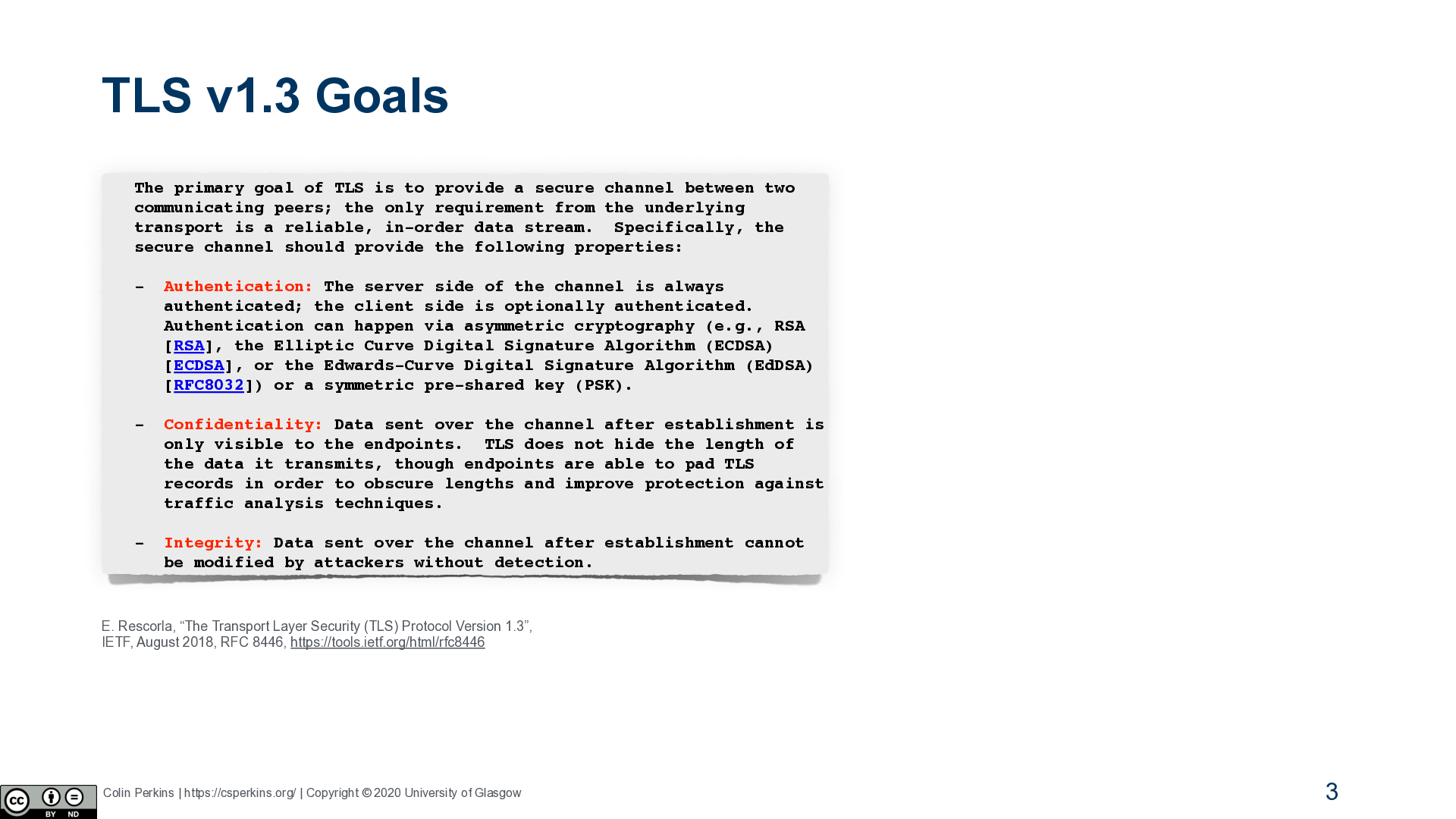
So what's the goal of TLS 1.3?
00:04:44.542
Well, given an existing connection, that's capable
00:04:48.125
of delivering data reliably and in the
00:04:50.208
order it was sent, but is insecure,
00:04:53.166
TLS 1.3 aims to add security.
00:04:56.708
That is given a TCP connection,
00:04:59.583
it aims to add authentication, confidentiality,
00:05:03.542
and integrity protection to the data sent
00:05:06.208
over that connection.
00:05:08.000
In terms of authentication, it uses public
00:05:11.125
key cryptography, and a public key infrastructure,
00:05:14.000
in order to verify the identity of
00:05:16.166
the server to which the connection is made.
00:05:19.375
That is, the client can always verify
00:05:21.500
that it's talking to the desired server.
00:05:23.959
In addition, it provides optional authentication for
00:05:26.708
the client, to allow the server to
00:05:28.834
verify the identity of the client.
00:05:31.875
Once the connection has been established,
00:05:34.000
and verified to be correct, TLS provides
00:05:37.125
confidentiality for data sent across that connection.
00:05:40.625
It uses hybrid encryption schemes to provide
00:05:43.583
good performance, while still providing a strong
00:05:45.708
amount of security.
00:05:47.417
Finally, TLS authenticates data sent across the
00:05:50.458
connection, to provide integrity protection. It's not
00:05:53.708
possible for an attacker to modify data
00:05:55.834
sent across a TLS connection without that
00:05:58.458
modification being detectable by the endpoints.
00:06:03.333
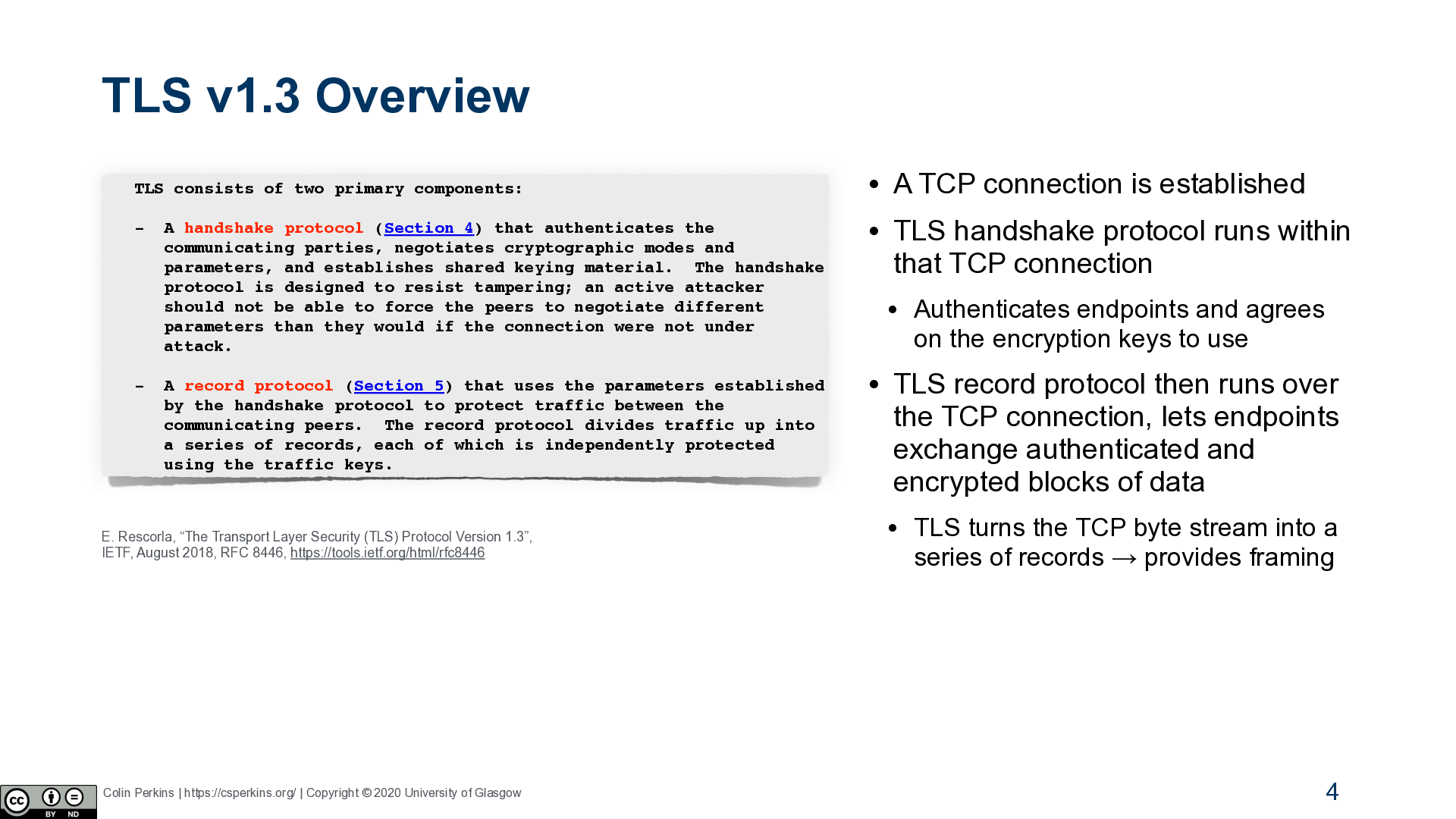
How does TLS 1.3 work?
00:06:06.000
Well, first of all, a TCP connection
00:06:08.583
must be established. TLS is not a
00:06:11.333
transport protocol itself, and it relies on
00:06:14.083
an underlying TCP connection in order to
00:06:16.291
exchange data.
00:06:17.750
Once the TCP connection has been established,
00:06:21.166
TLS runs within that connection.
00:06:23.875
There are two parts to a TLS
00:06:25.625
connection. It begins with a handshake protocol,
00:06:29.250
and then proceeds with a record protocol.
00:06:32.250
The goal of the handshake protocol,
00:06:34.208
at the beginning of the connection,
00:06:36.250
is to authenticate the endpoints and agree
00:06:38.708
on what encryption keys to use.
00:06:40.917
Once this is completed, TLS switches to
00:06:43.834
running the record protocol, which lets endpoints
00:06:46.500
exchange authenticated and encrypted blocks of data
00:06:49.333
over the connection.
00:06:51.083
TLS turns the TCP byte stream into
00:06:54.208
a series of records. It provides framing,
00:06:57.000
delivers data block by block, each block
00:06:59.667
being encrypted and authenticated to ensure that
00:07:02.667
the data being sent in that block
00:07:04.250
is confidential, and arrives unmodified.
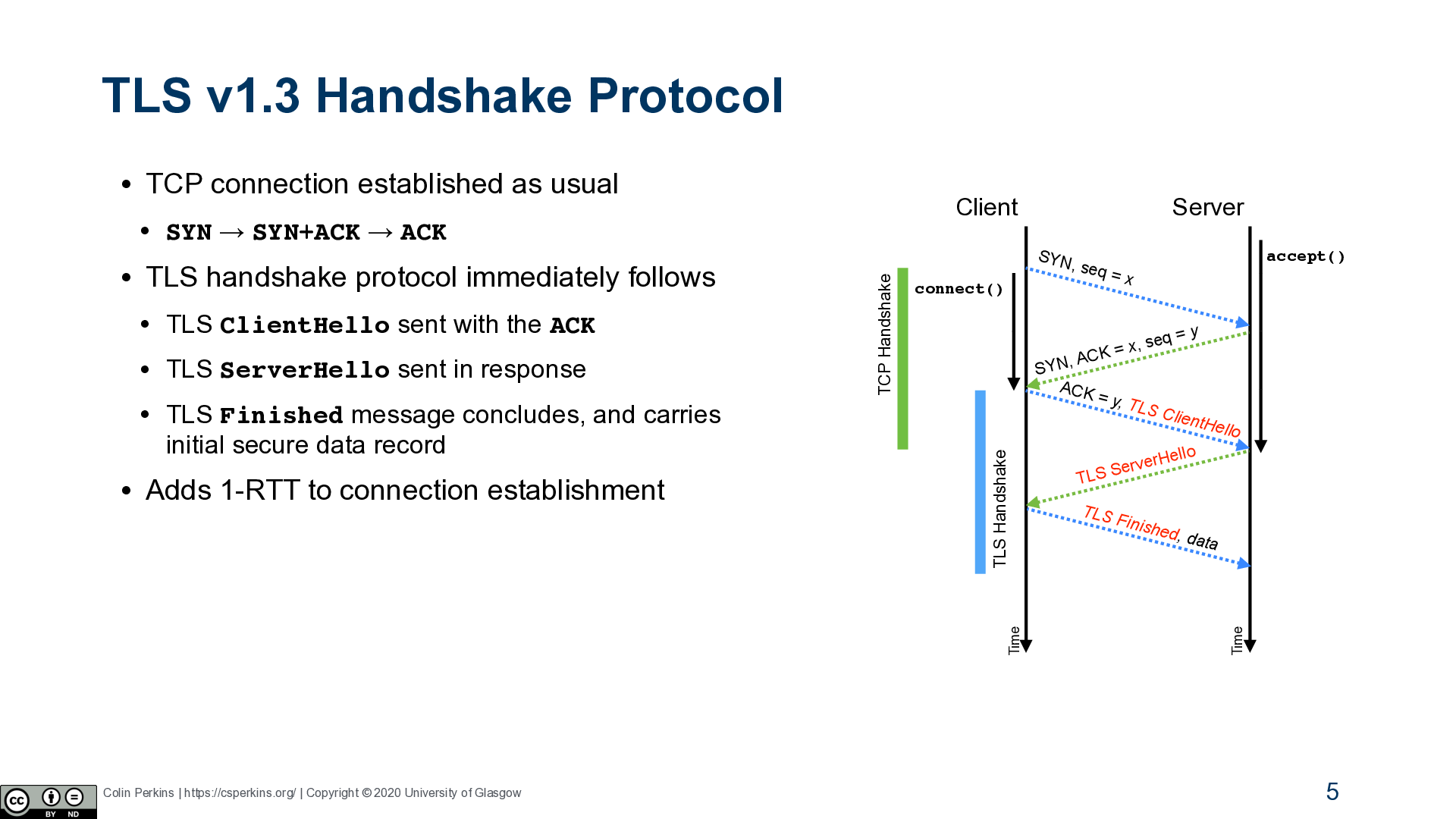
00:07:09.834
A secure connection over the Internet starts
00:07:12.583
up establishing a TCP connection as normal.
00:07:15.750
The client connects to the server,
00:07:17.708
sending a SYN packet, along with its
00:07:20.000
initial sequence number.
00:07:21.875
The server response with the SYN-ACK,
00:07:23.875
acknowledging the client’s initial sequence number,
00:07:26.750
and providing the server’s initial sequence number.
00:07:29.333
And then the client responds with an
00:07:30.792
ACK packet, acknowledging that packet from the server.
00:07:35.083
This sets up a TCP connection.
00:07:37.625
Immediately following that, the TLS handshake starts,
00:07:41.083
running within the TCP connection itself.
00:07:44.250
The TLS client sends a TLS ClientHello
00:07:46.959
message to a server immediately following the
00:07:49.750
final ACK of the TCP handshake.
00:07:52.542
The server responds to that with a
00:07:54.417
TLS ServerHello message,
00:07:56.083
and then the client in return
00:07:58.125
responds with a TLS Finished message.
00:08:00.667
This concludes the handshake, and carries the
00:08:03.125
first block of secure data.
00:08:06.333
Following this, the client and the server switch to
00:08:09.000
running the TLS record protocol over the
00:08:11.291
TCP connection, and exchange further secure data blocks.
00:08:15.625
As can be seen the TLS handshake
00:08:18.000
adds an additional round trip time to
00:08:20.000
the connection establishment.
00:08:22.041
At the start of the connection,
00:08:23.542
there's an initial round trip time while
00:08:25.583
TCP connection is set up.
00:08:27.500
And then this is followed by an
00:08:28.875
additional round trip, while the TLS connection
00:08:31.375
and the security parameters are negotiated,
00:08:33.792
before the data can be set.
00:08:36.208
There's a minimum of two round trip
00:08:37.917
times from the start of the TCP
00:08:39.875
connection to the conclusion of the TLS
00:08:42.250
handshake and the first secure data segment being sent.
00:08:47.750
The first part of the TLS handshake

00:08:50.250
is the ClientHello message. This is sent
00:08:52.166
from the client to the server,
00:08:53.834
and begins the negotiation of the security parameters.
00:08:57.917
The ClientHello message does three things.
00:09:00.625
It indicates the version TLS that is
00:09:03.041
to be used. It indicates the cryptographic
00:09:05.708
algorithms that the client supports, and provides
00:09:08.667
its initial keying material. And it indicates
00:09:11.208
the name of the server to which
00:09:13.417
the client is connecting.
00:09:15.834
You may wonder why the ClientHello message
00:09:17.959
needs to indicate server name, given that
00:09:20.291
it's running over a TCP connection that's
00:09:22.583
just been established to that server.
00:09:24.792
The reason for this, is that TLS
00:09:26.750
is often used with web hosting,
00:09:28.500
and it's common for web servers to
00:09:30.458
host more than one website,
00:09:32.166
so the server name provided in the
00:09:34.291
TLS ClientHello indicates which of the sites,
00:09:37.041
which are accessible over that TCP connection,
00:09:39.875
the TLS message is trying to establish
00:09:41.917
a connection, establish a secure connection, to.
00:09:46.333
The ClientHello message also indicates which version
00:09:48.792
of TLS is to be used.
00:09:51.208
What you would expect to happen here,
00:09:53.333
is that it would indicate that it
00:09:54.959
wishes to use TLS 1.3.
00:09:58.041
What actually happens, though, is that the
00:10:00.000
ClientHello message includes a version number indicating
00:10:03.708
that it wants to use TLS version
00:10:05.375
1.2, the previous version of TLS.
00:10:09.417
The ClientHello message includes an optional set
00:10:11.917
of extension headers, and one of those
00:10:14.125
extension headers includes an extension which says
00:10:16.959
“actually I’m really TLS version 1.3”.
00:10:20.875
The reason the version negotiation happens in
00:10:23.291
such a weird way, specifying an old
00:10:25.542
version of TLS in the version field,
00:10:27.792
and using an extension to indicate the real version,
00:10:31.041
Is because there are too many middle boxes,
00:10:33.417
too many devices which try to
00:10:35.166
inspect TLS traffic in the network,
00:10:37.542
and which fail if the version number changes.
00:10:40.875
The protocol has become ossified.
00:10:43.250
We waited too long between versions of TLS.
00:10:46.667
Too many devices were deployed, to many
00:10:48.959
endpoints were deployed, which only understood version 1.2
00:10:53.000
and which didn't correctly support the version
00:10:54.917
negotiation. And then, when it came to
00:10:57.917
deploying a new version, and people tried
00:11:00.041
with early versions of TLS to just
00:11:02.417
change the version number to 1.3,
00:11:04.583
it was found that those new versions
00:11:06.208
didn't support the change.
00:11:09.708
The result was that connections that indicated
00:11:11.917
TLS version 1.3 in the header would
00:11:14.333
tend to fail,
00:11:15.792
whereas those that pretended to be TLS
00:11:17.708
version 1.2, using an extension header to
00:11:21.000
upgrade the version number, would work through
00:11:23.583
those middleboxes, and the connection could succeed
00:11:26.667
and proceed with the new version.
00:11:29.083
The ClientHello message is the first part
00:11:31.250
of the connection setup handshake. It doesn't
00:11:33.750
carry any new data.
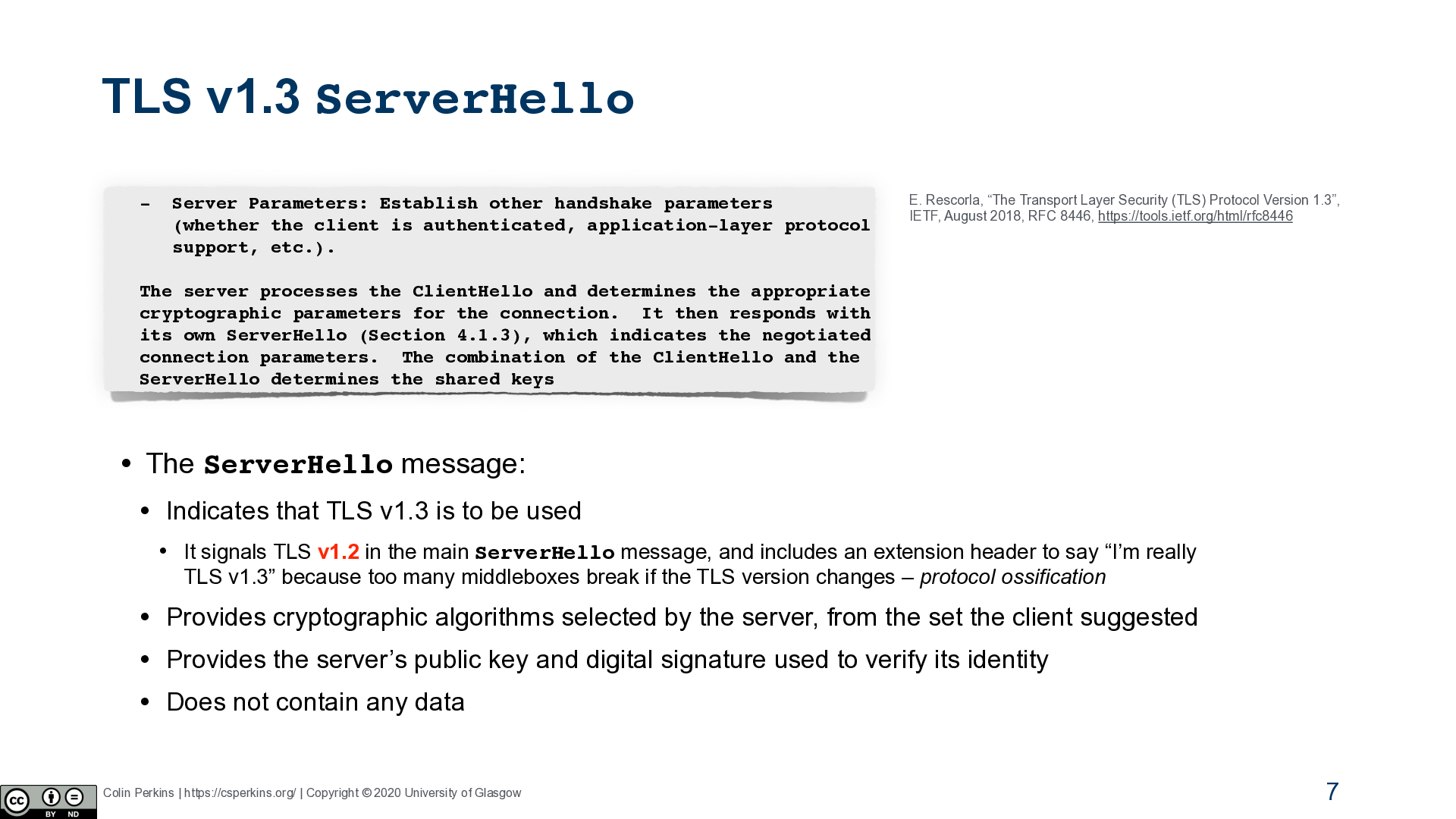
00:11:37.542
Following the ClientHello, the server responds with
00:11:40.083
a ServerHello message.
00:11:42.792
The ServerHello message also indicates the version
00:11:45.875
of TLS which is to be used
00:11:47.875
and, like the ClientHello, it indicates that
00:11:50.667
the version is actually TLS version 1.2
00:11:53.959
and includes an extension header to say
00:11:56.375
that it’s really a TLS 1.3 connection
00:11:58.667
that's being established
00:12:01.083
In addition to the version negotiation,
00:12:03.250
the TLS ServerHello includes the cryptographic algorithms
00:12:06.041
selected by the server, which are a
00:12:08.208
subset of the set suggested by the client.
00:12:11.834
That is, the client suggests the cryptographic
00:12:14.750
algorithms which it supports, and the server
00:12:17.291
looks at those, finds the subset of
00:12:19.333
them which are acceptable to it,
00:12:21.291
picks one of them, and includes that in its response.
00:12:25.834
The ServerHello message also includes the server’s
00:12:28.083
public key, and a digital signature which
00:12:30.250
can be used to verify the identity of the server.
00:12:33.291
Like the ClientHello, it doesn't include any data.

00:12:38.083
Finally, the TLS handshake concludes with a
00:12:40.834
Finished message, which flows from the client
00:12:43.458
to the server. The TLS Finished message
00:12:46.041
includes the clients public key and optionally,
00:12:49.208
it includes a certificate which is used
00:12:51.125
to authenticate the client to the server.
00:12:53.667
The TLS Finished message concludes
00:12:55.792
the connection setup handshake.
00:12:58.500
In addition to the connection setup,
00:13:00.458
it may therefore include the first part
00:13:02.291
of application data that is sent from
00:13:03.917
the client to the server.
00:13:07.959
TLS uses the ephemeral elliptic curve Diffie-Hellman
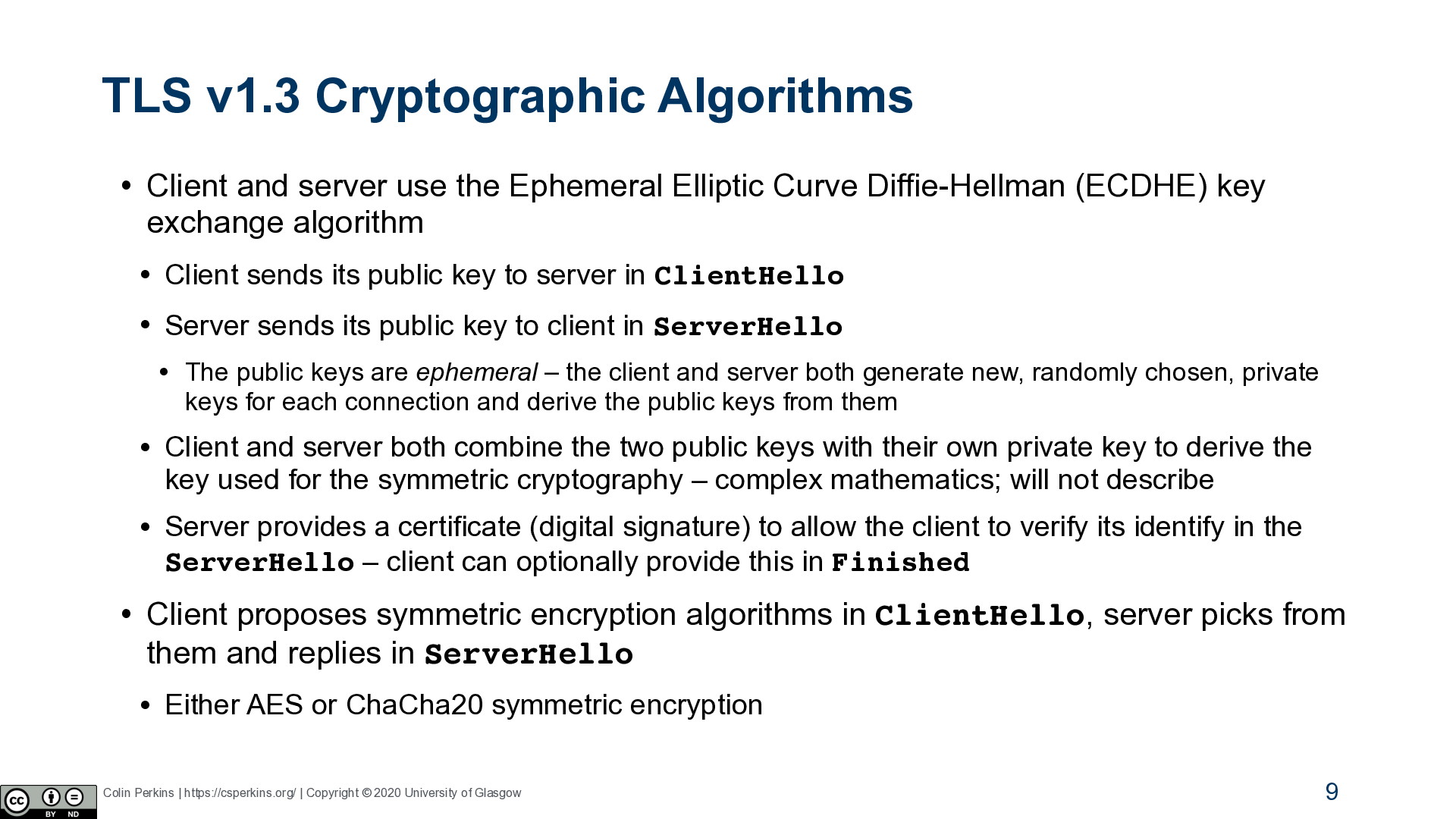
00:13:11.583
key exchange algorithm in order to derive
00:13:14.625
the keys used for the symmetric encryption.
00:13:17.834
The client and the server exchange their
00:13:19.667
public keys, as part of the connection
00:13:21.542
setup handshake, and they then combine those
00:13:24.083
two public keys to derive the key
00:13:26.083
that's used for the symmetric cryptography.
00:13:29.041
The maths of how this works is
00:13:30.583
complex. I'm not going to attempt to describe it here.
00:13:34.417
What's important though, is that the symmetric
00:13:36.542
key is never exchanged over the wire.
00:13:39.000
The client and the server only exchange
00:13:40.917
their public keys, and the symmetric key
00:13:42.959
is derived from those.
00:13:45.875
A TLS server provides a certificate that
00:13:48.417
allows the client to verify its identity
00:13:50.959
as part of the ServerHello message.
00:13:53.333
The client can optionally provide this information
00:13:55.875
along with its Finished message.
00:13:58.417
Result is that the client can always
00:14:00.083
verify the identity of the server,
00:14:02.250
and the server can optionally verify the
00:14:04.083
identity of the client.
00:14:07.125
The choice of encryption algorithm is driven
00:14:09.625
by the client, which provides the list
00:14:11.875
of the symmetric encryption algorithms that it
00:14:13.792
supports as part of its ClientHello message.
00:14:16.583
The server picks from these, and replies
00:14:18.708
in its ServerHello.
00:14:20.834
The usual result is that either the
00:14:22.959
Advanced Encryption Standard, AES, or the ChaCha20
00:14:26.750
symmetric encryption algorithm is chosen.
00:14:31.625
Once the TLS connection establishment protocol,
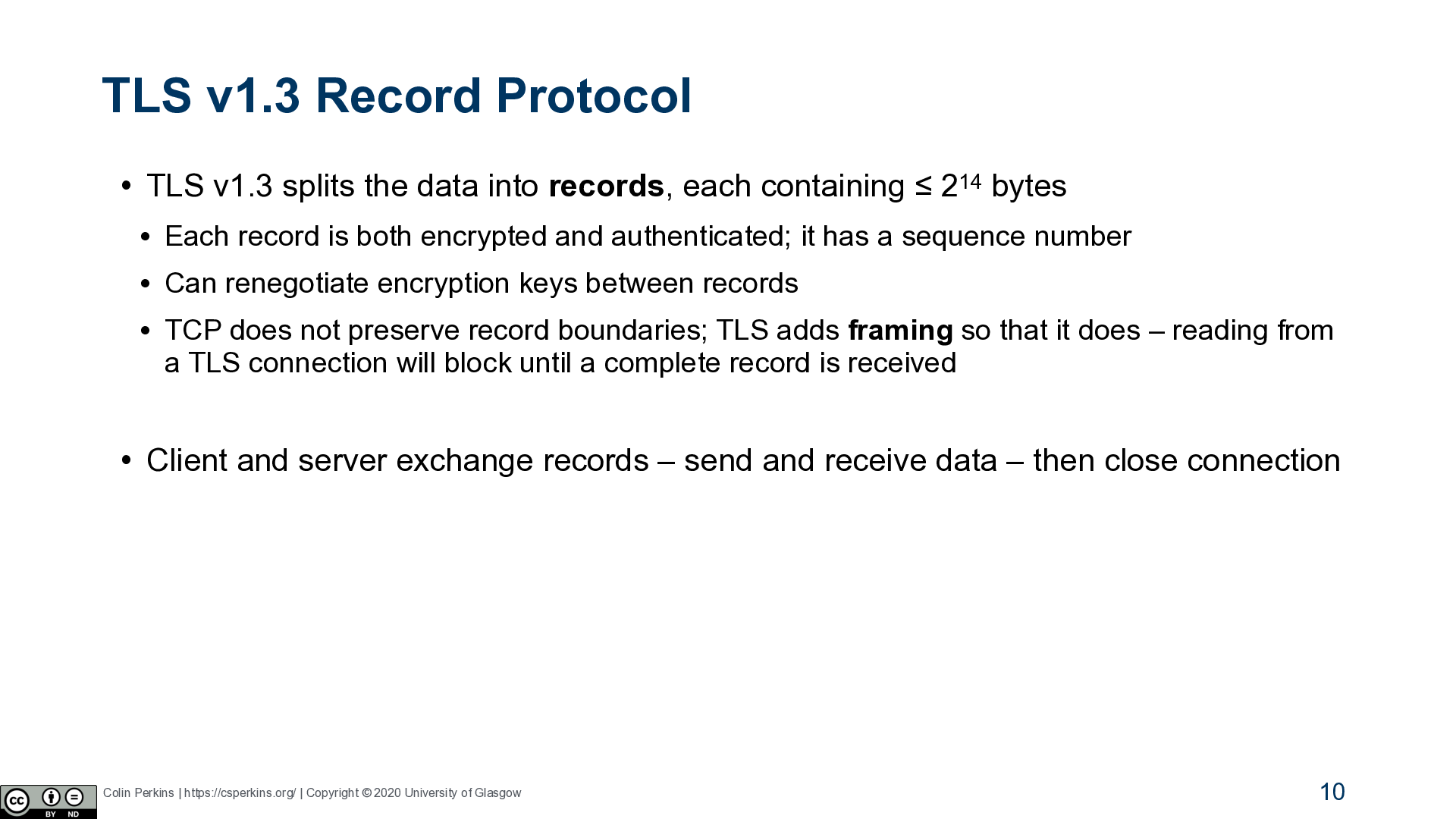
00:14:34.166
the handshake protocol, has completed the TLS
00:14:37.166
record protocol starts. The record protocol allows
00:14:40.875
the client and the server to exchange
00:14:42.708
records of data over the TCP connection.
00:14:45.917
Each record can contain up to two
00:14:49.041
to the power 14 bytes of data,
00:14:51.208
and is both encrypted and authenticated.
00:14:54.166
Records of data have a sequence number,
00:14:56.750
and they are delivered reliably, securely,
00:14:59.333
and in the order in which they were sent.
00:15:02.125
The underlying TCP connection does not preserve
00:15:04.875
record boundaries. TLS adds framing to the
00:15:08.083
connection so that it does so,
00:15:10.458
and reading from a TLS connection will
00:15:12.792
block until a complete record of data is received.
00:15:16.792
A TLS connection usually uses the same
00:15:19.500
encryption key to protect data for the
00:15:22.291
entire connection. However, in principle, it can
00:15:25.583
renegotiate encryption keys between records, if there's
00:15:28.166
a need to change the encryption key
00:15:30.166
partway through a connection.
00:15:32.959
The TLS record protocol allows the client
00:15:35.542
and the server to exchange records,
00:15:37.375
to send and receive data as they see fit.
00:15:40.834
Once they finish doing so, they close
00:15:43.166
the connection, which closes the underlying TCP connection.
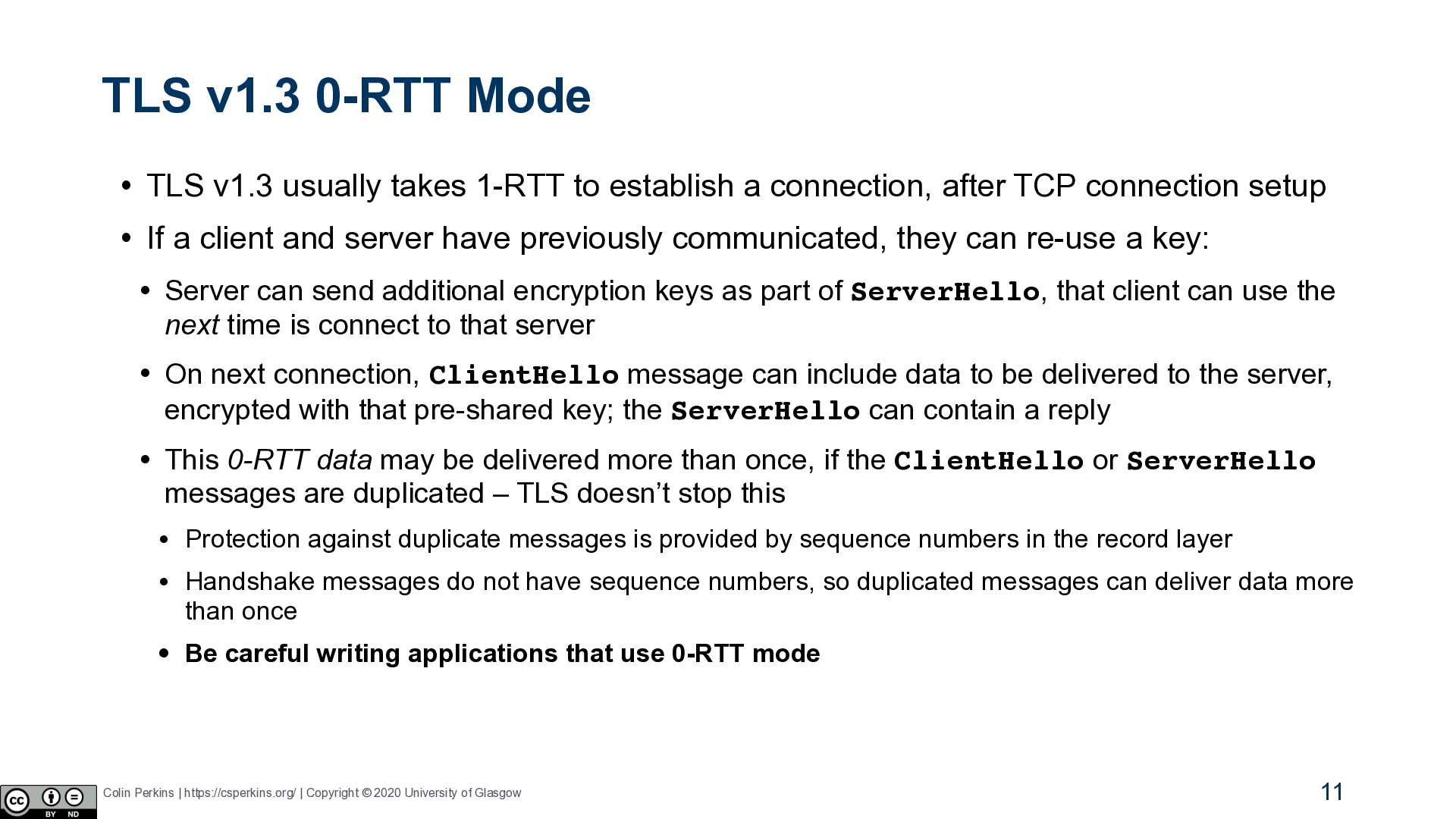
00:15:48.625
TLS 1.3 usually takes one round trip
00:15:52.083
time to establish the connection after the
00:15:54.542
TCP connection set up.
00:15:56.500
That is, there's the TCP SYN,
00:15:59.000
SYN-ACK, ACK handshake to establish the TCP
00:16:01.417
connection, and then an additional round trip
00:16:03.959
time for the TLS ClientHello, ServerHello,
00:16:07.708
Finished exchange.
00:16:09.875
However, if the client and the server
00:16:11.875
have previously communicated, TLS 1.3 allows them
00:16:15.375
to reuse some of the connection setup
00:16:17.166
parameters, and re-use the same encryption key.
00:16:20.959
The way this works is that the
00:16:22.542
server can send an additional encryption key
00:16:24.917
as part of its ServerHello message,
00:16:27.333
and the client can remember that key,
00:16:29.250
and use it the next time it
00:16:30.667
connects to the server. This is known
00:16:33.125
as a pre-shared key.
00:16:34.917
When the client next connects to that
00:16:36.834
server, it sends its ClientHello message as
00:16:39.750
normal. However, in addition to that ClientHello
00:16:42.875
message, it can also include some data,
00:16:45.417
and that data is encrypted using the
00:16:47.542
pre-shared key.
00:16:49.750
The ServerHello also proceeds as normal.
00:16:52.208
But again, can contain data encrypted using
00:16:54.667
the pre-shared key, and sent in reply
00:16:57.250
to the client, to the data included
00:16:59.083
in the ClientHello message.
00:17:01.458
The use of the pre-shared key therefore
00:17:03.750
allows the client and the server to
00:17:05.583
exchange data along with the initial connection
00:17:07.667
setup handshake. It allows data to be
00:17:10.166
exchanged within zero RTTs of the connection
00:17:12.834
set up, as part of the first round trip.
00:17:16.083
This extension is therefore known as the
00:17:17.959
0-RTT mode of TLS 1.3.
00:17:22.834
The 0-RTT mode is useful, because it
00:17:25.333
allows connections to start sending data much
00:17:27.959
earlier. It removes one round trip times
00:17:30.083
worth of latency. However, it has a limitation.
00:17:34.333
The limitation is that, unlike the record
00:17:38.083
packets which contain a sequence number,
00:17:40.583
TLS ClientHello and ServerHello messages don't contain
00:17:44.125
a sequence number.
00:17:46.417
A consequence of this, is that data
00:17:48.250
sent as part of a ClientHello,
00:17:49.875
or a ServerHello, may be duplicated,
00:17:52.583
and TLS has no way of stopping this.
00:17:55.917
If you're writing an application that uses
00:17:58.291
TLS in 0-RTT mode you need to
00:18:00.875
be careful, and only send what's known
00:18:02.834
as idempotent data,
00:18:04.542
data where it doesn't matter if that
00:18:06.583
data is delivered more than once to
00:18:08.583
the server, in the 0-RTT packets.
00:18:12.166
Data that is sent after the first
00:18:13.875
round trip time has concluded, as part
00:18:16.333
of the regular TLS connection, doesn't suffer
00:18:18.917
from this problem, and is only ever
00:18:20.875
delivered to the application once.
00:18:25.208
A TLS connection is secure, but it
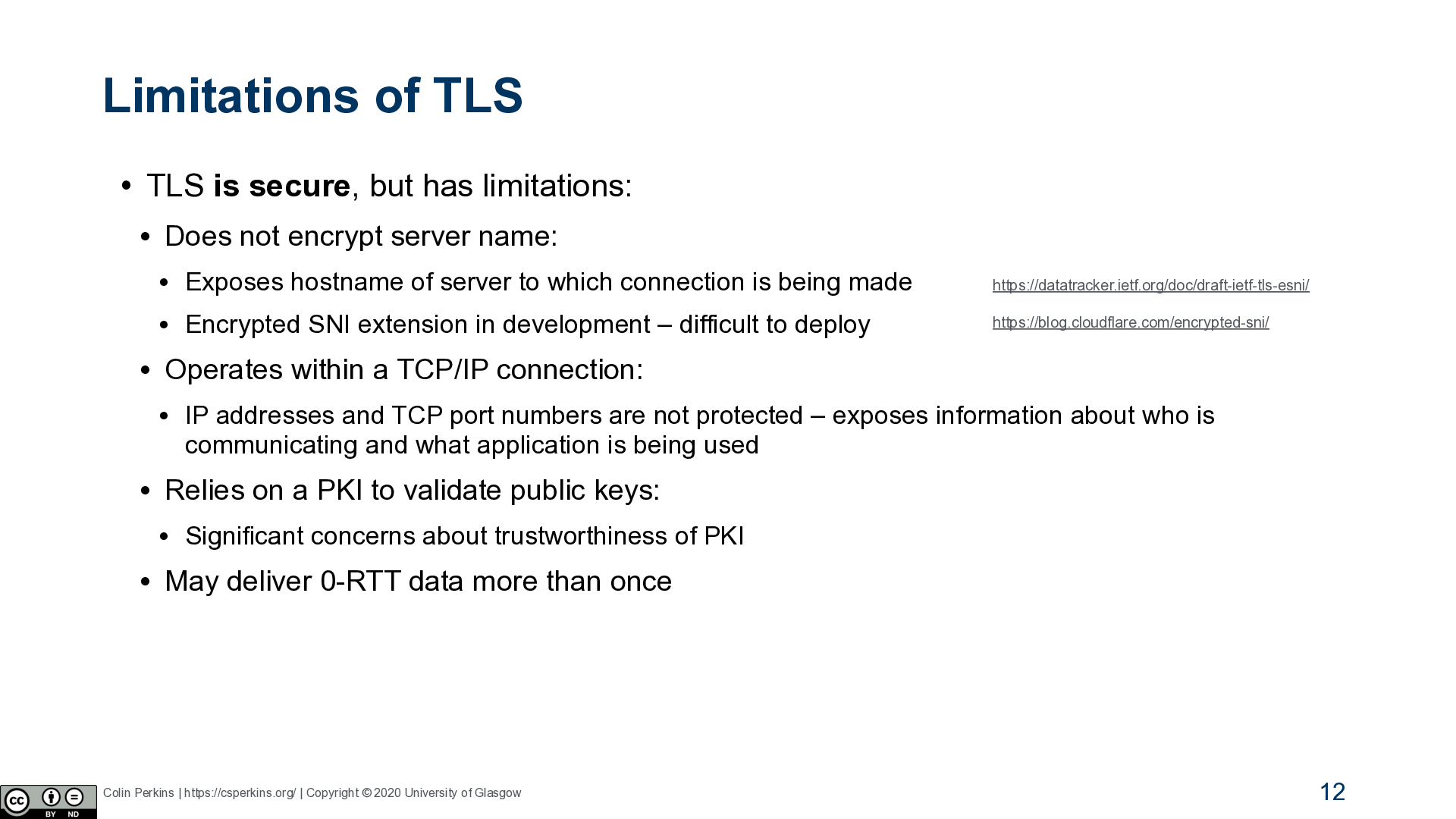
00:18:27.625
has a number of limitations.
00:18:30.208
TLS operates within a TCP connection.
00:18:33.959
A consequence of this, is that the
00:18:35.834
IP addresses and the TCP port numbers
00:18:37.959
are not protected. This exposes information about
00:18:41.291
who is communicating, and what application is being used.
00:18:45.458
Further, the TLS ClientHello message includes the
00:18:48.750
server name, but doesn't encrypt that.
00:18:52.041
This exposes the host name of the
00:18:54.083
server to which the connection is being
00:18:55.917
made, and may be a significant privacy leak.
00:18:59.625
An extension, known as Encrypted Server Name
00:19:02.250
Indication, is under development, but this is
00:19:05.083
not finished yet, and there are some
00:19:07.125
concerns that it may be very difficult to deploy.
00:19:10.375
TLS also relies on a public key
00:19:12.375
infrastructure to validate the keys, and to
00:19:14.875
verify the identity of clients and servers.
00:19:18.500
There are some significant concerns about the
00:19:20.458
trustworthiness this public key infrastructure.
00:19:24.166
The reasons for this are not that
00:19:26.542
the cryptographic algorithms or the mechanisms are
00:19:28.625
insecure, they’re that the browsers tend to
00:19:31.625
trust a very large range of certificate authorities,
00:19:34.625
and it's not clear to which extent all of these certificate
00:19:37.166
authorities are actually trustworthy.
00:19:41.291
The final limitation of TLS is that
00:19:43.875
the 0-RTT extension may deliver data more than once.
00:19:48.208
0-RTT is a very useful extension,
00:19:50.875
because it allows data to be delivered
00:19:53.583
with low latency at the start of
00:19:55.750
the connection, but it runs the risk
00:19:57.875
that the data is delivered multiple times,
00:20:00.583
so must be used with care.
00:20:04.083
That concludes the discussion TLS.
00:20:06.834
I spoke about what is TLS. I've talked about
00:20:10.125
the TLS handshake protocol, that establishes the
00:20:13.125
connection using the ClientHello, ServerHello,
00:20:15.458
and Finished messages,
00:20:16.792
and that agrees the appropriate cryptographic parameters.
00:20:19.917
And I spoke about the TLS record
00:20:21.667
protocol, which is used to actually exchange the data.
00:20:25.000
The TLS 0-RTT extension allows for faster
00:20:28.542
data transfer at the beginning of the
00:20:30.792
connection, but comes with some risks of
00:20:33.458
data replay attack. Finally, I spoke about
00:20:36.125
some of the limitations of TLS.
00:20:38.834
The TLS protocol has actually been wildly
00:20:41.333
successful. It's used to secure all the
00:20:44.208
traffic sent over the web. And when
00:20:46.417
used correctly, is very much a secure
00:20:48.625
protocol, that performs very well.
00:20:52.583
In the final part of the lecture,
00:20:54.750
I'll move on from talking about the details of the
00:20:57.083
cryptographic mechanisms, and the transport protocols,
00:20:59.959
to talk about some of the issues
00:21:01.375
with writing secure software.
-
E. Rescorla,
The Transport Layer Security (TLS) Protocol Version 1.3,
IETF, August 2018, RFC 8446.
-
J. A. Salowey, S. Turner, and C. A. Wood,
TLS 1.3,
IETF Blog Post, August 2018.
-
N. Sullivan,
A Detailed Look at RFC 8446 (a.k.a. TLS 1.3),
Cloudflare blog post, August 2018.
-
D. Wong,
A Readable Specification of TLS 1.3,
Blog post.
-
M. Driscoll,
The Illustrated TLS 1.3 Connection,
Blog post.
Part 4: Discussion
The final part of the lecture discusses systems aspects of providing
secure communication. It reviews the need for end-to-end security to
protect communications. It discusses the robustness principle, and
its implications for the design on input parsers and other aspects
of networked systems. And it briefly reviews some of the challenges
in writing secure code.
00:00:00.000
00:00:00.666
In the previous parts, I've spoken about the
00:00:03.066
general principles underlying secure
00:00:04.900
communication
00:00:06.000
and about the Transport Layer Security Protocol,
00:00:08.266
TLS 1.3, that protects most Internet
00:00:11.766
communications.
00:00:13.266
In this final part of the lecture, I want to
00:00:15.833
raise some issues to consider when developing
00:00:18.000
secure networked applications.
00:00:20.233
In particular, I want to discuss the need for end
00:00:23.200
-to-end security and the problems of making secure
00:00:26.000
communication
00:00:27.000
in the presence of content distribution networks,
00:00:29.566
servers, and middle boxes.
00:00:32.066
I want to talk about the Robustness Principle and
00:00:34.200
the difficulty in designing and building networked
00:00:36.733
applications.
00:00:38.266
And I want to talk about the need to carefully
00:00:40.033
validate input data and part of the issues around
00:00:43.033
writing secure code.
00:00:46.766
For communications to be secure, it must be end- to-end.
00:00:51.066
That is, a secure communication must run between
00:00:54.166
the initial sender and the final recipient.
00:00:57.066
And the message must not be decrypted or lose
00:00:59.700
integrity protection at any point along the path.
00:01:03.400
That is harder to arrange than you might imagine.
00:01:07.133
If the communication is between a client and a
00:01:09.666
server located in a data centre, it's easy to
00:01:12.533
understand what's the client endpoint.
00:01:15.000
It's the phone, tablet, or laptop on which the
00:01:18.066
application making the request is running.
00:01:21.233
What is the endpoint in the data centre, though?
00:01:24.333
Does the secure communication terminate at the
00:01:26.866
load balancing device at the entrance to the data centre
00:01:30.233
that chooses which of the many possible servers
00:01:32.500
responds to the request?
00:01:34.566
If so, does that load balancer make a secure
00:01:37.033
onward connection to the back-end server?
00:01:39.933
Or is the connection unprotected within the data centre?
00:01:43.266
Alternatively, if the secure connection passes
00:01:45.633
through the load balancer and terminates on the
00:01:48.400
back-end server,
00:01:49.466
are the connections between the back-end servers
00:01:52.033
and the databases, compute servers, and storage
00:01:55.000
servers in other parts of the data centre secure?
00:01:58.966
And, once the request has been handled, how is
00:02:02.233
the data protected once it's stored in the data centre?
00:02:06.133
What's your threat model?
00:02:08.066
Are you concerned about protecting your
00:02:09.800
communication as it traverses the wide area
00:02:12.033
network between your client and the data centre?
00:02:15.800
Or are you also concerned with protecting
00:02:17.566
communications within the data centre?
00:02:21.066
If you're concerned about communications and data
00:02:23.466
storage within the data centre,
00:02:25.000
are you trying to protect against other tenants
00:02:27.533
in the data centre,
00:02:29.000
or against malicious users that may have
00:02:31.066
compromised the data centre infrastructure,
00:02:33.800
or against the data centre operator?
00:02:38.000
Similar issues arise with content distribution networks.
00:02:41.600
CDNs, such as Akamai, are widely used as the back
00:02:45.100
-end infrastructure for websites, software updates,
00:02:48.100
streaming video services, and gaming services.
00:02:51.966
Applications like the Steam Store, the BBC
00:02:55.133
iPlayer, Netflix, and Windows Update have all run
00:02:59.333
on CDNs at various times,
00:03:01.333
although many of them now use their own infrastructure.
00:03:05.000
CDNs are essentially large-scale, highly
00:03:07.300
distributed web caches.
00:03:08.966
They provide local copies of data to improve
00:03:12.233
performance compared to having to fetch the
00:03:13.966
content from the master site.
00:03:16.133
The secure HTTPS connection is therefore from the
00:03:19.900
client to the CDN, rather from the client to the
00:03:23.233
original site.
00:03:25.233
This introduces an intermediary into the path.
00:03:28.966
The CDN now has visibility into what requests the
00:03:32.933
client is making, in addition to the original service.
00:03:37.033
Performance is better, but you're forced to trust
00:03:39.866
a third party with information about what sites
00:03:42.033
you're visiting.
00:03:43.366
Equally, the data has to get to the CDN caches
00:03:46.300
somehow, and has to be protected as it's fetched
00:03:49.033
from the original server to populate the cache.
00:03:51.900
You have to trust the CDN to do this correctly.
00:03:55.166
As a user of the CDN, you have no way of knowing
00:03:58.033
how, or indeed if, that data is secure.
00:04:02.066
In many cases, data is moving between two users.
00:04:06.000
Is that data encrypted end-to-end between the two users?
00:04:10.000
Or is the data encrypted between the users and
00:04:13.100
some data centre, but visible to the data centre?
00:04:17.333
The difference can matter.
00:04:19.433
If the data centre has access to the unprotected
00:04:21.966
data, it may be used to target advertising, and
00:04:25.000
it's much more likely to be accessible to law
00:04:27.100
enforcement or government monitoring.
00:04:31.466
Many applications use some form of in-network
00:04:34.866
processing.
00:04:36.400
For example, video conferencing systems often use
00:04:39.666
a central server to perform audio mixing, and to
00:04:42.400
scale the video to produce thumbnails.
00:04:45.066
For example, in a large video conference, if many
00:04:48.666
users are sending video, then all the video goes
00:04:51.333
to a central server.
00:04:53.000
That server only forwards high-quality video for
00:04:55.766
the active speaker, and sends a smaller, more
00:04:58.766
heavily compressed version for the other participants.
00:05:02.600
This reduces the amount of video sent out to each
00:05:05.166
of the participants, and prevents overloading
00:05:07.233
their network connections.
00:05:09.066
This is a good thing.
00:05:11.100
But it also means that the central server has
00:05:13.800
access to the audio and video data.
00:05:16.300
The server can record that video if it so chooses,
00:05:19.566
and potentially share it with others.
00:05:22.000
That may be a concern, depending on what's being discussed.
00:05:26.700
An alternative way of building such an
00:05:28.833
application leaves the data encrypted, and doesn't
00:05:31.666
give the server access.
00:05:33.500
This increases the privacy of the users, since
00:05:36.566
the data is encrypted end-to-end, and isn't
00:05:38.700
available to the server.
00:05:40.366
That means that the server can't help compress
00:05:42.466
the data and manage the load.
00:05:44.533
And it means that server-based features, like
00:05:46.833
cloud recording and captioning, become much
00:05:49.300
harder to provide.
00:05:51.033
It trades off features and performance for
00:05:53.766
increased privacy.
00:05:57.800
When building networked applications, it's
00:06:00.133
important to consider how the network protocol is
00:06:02.800
implemented.
00:06:04.766
Network protocols can be reasonably complex, and
00:06:07.866
difficult to implement.
00:06:09.933
They have a syntax and semantics, in many ways
00:06:12.833
similar to a programming language.
00:06:15.000
And, like a program, the protocol messages your
00:06:17.966
application receives may contain syntax errors or
00:06:20.866
other bugs.
00:06:22.633
What do you do if the protocol data you receive
00:06:25.433
is incorrect?
00:06:27.600
A frequently quoted guideline is Postel's Law.
00:06:31.200
This is named after Jon Postel, the original
00:06:34.266
editor of what became the IETF's RFC series of
00:06:37.133
documents, and an influential contributor to the
00:06:40.566
early Internet.
00:06:42.866
Postel's Law can be summarised as "Be liberal in
00:06:45.900
what you accept, and conservative in what you
00:06:48.233
send."
00:06:49.666
That is, when generating protocol messages, try
00:06:52.800
your hardest to do so correctly.
00:06:55.466
Make sure the messages you send strictly conform
00:06:58.600
to the protocol specification.
00:07:01.033
But, when receiving messages, accept that the
00:07:04.333
generator of those messages may be imperfect.
00:07:07.700
If a message is malformed, but unambiguous and
00:07:11.300
understandable, Postel's Law suggests to accept
00:07:14.600
it anyway.
00:07:17.000
That's fine, but it's important to balance
00:07:19.700
interoperability with security.
00:07:21.966
Don't be too liberal in what you accept.
00:07:26.000
Having a clear specification of how and when you
00:07:28.766
fail might be more appropriate.
00:07:32.800
Postel's Law says "Be liberal in what you accept,
00:07:36.333
and conservative in what you send."
00:07:39.433
That makes sense if you trust the other devices
00:07:42.433
on the network.
00:07:44.266
It makes sense if the problems with the messages
00:07:47.100
they send are likely to be honest mistakes, and
00:07:49.700
not intended to be malicious.

00:07:53.466
The network has changed since Postel's time though.
00:07:57.333
As Poul Henning Kamp, one of the FreeBSD
00:08:01.200
developers says, "Postel lived on a network with
00:08:04.600
all his friends. We live on a network with all
00:08:07.266
our enemies. Postel's Law was wrong for today's
00:08:10.066
Internet."

00:08:12.600
This is an important point.
00:08:15.333
Any network system is frequently attacked.
00:08:19.300
There are many people scanning the network for
00:08:21.466
vulnerabilities, actively trying to break your
00:08:24.000
applications.
00:08:25.566
If you write a server and make it accessible on
00:08:28.300
the Internet, then people will try to break it.
00:08:32.566
This is not because you're a target.
00:08:35.466
It's because the machines and
00:08:37.100
network communications are now
00:08:38.766
fast enough that it's possible to scan every
00:08:40.800
machine on the Internet to see if it's vulnerable
00:08:43.700
to a particular problem within a few hours.
00:08:47.233
It's not personal, but your server will be attacked.
00:08:52.133
The paper shown on the slide, "Maintaining Robust
00:08:55.266
Protocols" by Martin Thompson and David Schinazi,
00:08:58.533
talks about this in detail, and gives detailed
00:09:01.700
guidance on how to handle malformed messages.
00:09:05.300
If you write networked applications, I strongly
00:09:08.466
encourage you to read it.
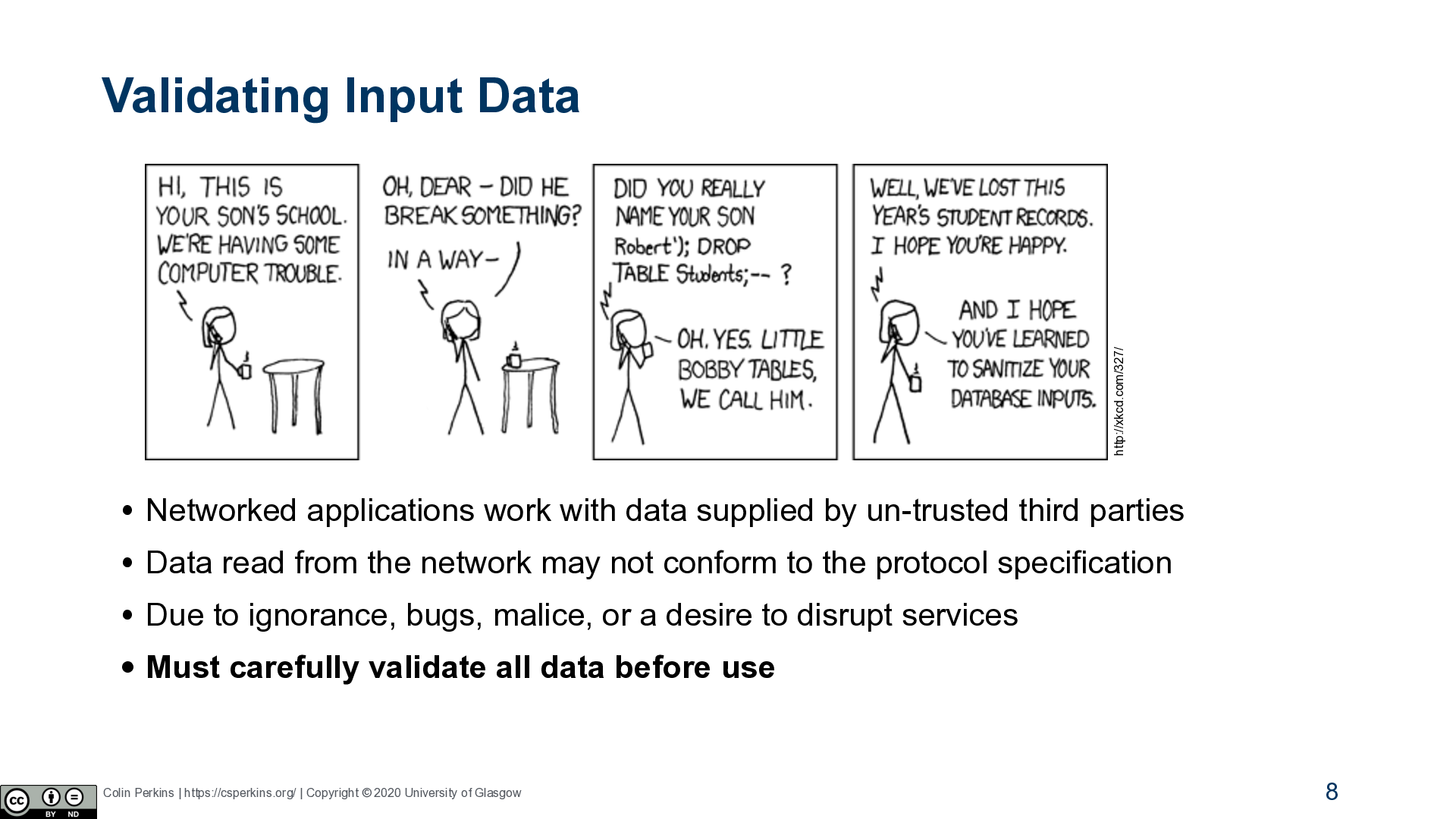
00:09:13.000
One of the key points made is that networked
00:09:15.833
applications work with data supplied by untrusted
00:09:18.666
third parties.
00:09:21.066
As we've discussed, data read from the network
00:09:24.166
may not conform to the protocol specification.
00:09:27.566
This may be due to ignorance, bugs, malice, or a
00:09:31.800
desire to disrupt services.
00:09:34.966
One of the critical lessons is that you must
00:09:37.466
carefully validate all data received from the
00:09:39.833
network before you make use of it.
00:09:43.000
Don't trust arbitrary data that comes from
00:09:45.533
another device over the network.
00:09:48.000
Check it carefully, and make sure it contains
00:09:50.366
what you expect before use.
00:09:54.200
This is especially important when working in
00:09:56.666
scripting languages that often contain escape
00:09:59.666
characters that trigger special processing.
00:10:03.166
The cartoon on the slide is an example.
00:10:07.000
The idea is that the software processing the
00:10:10.066
student's name sees the closing quote and
00:10:13.033
interprets the rest of the name as SQL commands
00:10:16.633
to delete the student records from the database.
00:10:20.066
It's a silly example.
00:10:23.133
But it's surprising how often similar problems,
00:10:26.166
known as SQL injection attacks, occur in practice.
00:10:31.333
And similar problems occur in many other
00:10:33.266
programming languages. It's not just an SQL related problem.
00:10:38.266
Be careful how you process data.
00:10:43.000
And in general, be careful how you write
00:10:45.433
networked applications.
00:10:48.366
The network is hostile.
00:10:51.966
Any networked application is security critical.
00:10:56.900
Anything that receives data from the network will
00:10:59.966
be attacked.
00:11:02.200
When writing networked applications, carefully
00:11:05.433
specify how they should behave with both correct
00:11:08.133
and incorrect inputs.
00:11:11.366
Carefully validate inputs and handle errors.
00:11:15.200
And check that your code behaves as expected.
00:11:18.866
Try to break your application before someone else does.
00:11:23.933
If your application is written using a type or
00:11:26.866
memory unsafe language, such as C or C++, take
00:11:31.633
extra care, since these languages have additional
00:11:34.900
failure modes.
00:11:37.000
It's very easy to write a C or C++ program that
00:11:41.400
suffers from buffer overflows, use after free
00:11:44.600
bugs, race conditions and so on.
00:11:48.400
Such bugs are almost certainly security vulnerabilities.
00:11:53.566
As a rule of thumb, if you've written a C or C++
00:11:56.900
program and can cause it to crash with a segmentation
00:12:00.133
violation message, then that's probably
00:12:03.566
exploitable as a security vulnerability.
00:12:07.333
Have you ever managed to write a non-trivial C
00:12:10.066
program that never crashes that way?
00:12:13.900
This is why network programming is difficult.
00:12:17.966
The network today is an extremely hostile environment.
00:12:22.833
Networked applications are security critical, and
00:12:26.333
writing secure code is a very difficult skill.
00:12:30.900
If you have the choice, use popular, well-tested,
00:12:34.666
pre-existing software libraries for network
00:12:37.566
protocols where possible.
00:12:40.000
Especially do so for implementations of security
00:12:42.733
protocols, such as TLS.
00:12:45.833
And make sure to update these libraries regularly,
00:12:48.900
because problems and security vulnerabilities
00:12:50.933
are found frequently.
00:12:53.900
The best encryption in the world doesn't help if
00:12:56.633
the endpoints can be compromised and the data
00:12:58.933
stolen before it's encrypted.
00:13:05.000
This concludes our discussion of secure communications.
00:13:09.800
In the first part of the lecture, I spoke about
00:13:12.000
the need for secure communication, and some of
00:13:14.466
the challenges and trade-offs in enabling security.
00:13:18.600
In the second part, I discussed the principles of
00:13:21.000
secure communication in abstract terms, talking
00:13:24.433
about symmetric and public key encryption, and
00:13:27.766
how these are combined to give hybrid encryption protocols.
00:13:31.866
I spoke about digital signatures to authenticate
00:13:34.700
data, and about public key infrastructure and
00:13:37.566
certificate authorities.
00:13:40.200
Then I spoke about the Transport Layer Security
00:13:42.933
Protocol, TLS 1.3, that instantiates hybrid
00:13:46.733
encryption and digital signatures into a concrete
00:13:49.500
network protocol that secures web traffic and
00:13:52.333
other applications.
00:13:55.100
And finally, I've discussed some issues to
00:13:57.966
consider when writing networked applications.
00:14:02.866
Ensuring communication security is a difficult problem.
00:14:07.933
It's technically difficult, because you need to
00:14:10.600
write extremely robust software, and need to
00:14:13.633
design secure network protocols that use
00:14:15.966
sophisticated cryptographic mechanisms.
00:14:20.033
And it's politically difficult, because there are
00:14:23.166
some extremely sensitive policy questions around
00:14:25.833
what information should be protected, and against whom.
00:14:31.200
The TLS 1.3 protocol is the current state-of-the-
00:14:34.300
art in secure communications.
00:14:37.200
In the next lecture, we'll move on to further
00:14:39.866
discuss its limitations, and some of the ways in
00:14:42.566
which people are trying to improve network
00:14:44.533
security and performance.
-
M. Thomson and D. Schinazi,
Maintaining Robust Protocols,
IETF, June 2023, RFC 9413.
Discussion
Lecture 3 discussed secure communication. It started with a discussion of
the need for security, and the issues with balancing security, privacy,
and the needs of law enforcement, regulatory compliance for businesses,
and the need to effectively manage networks. It then moved on to discus
the principles by which secure communication can be achieved, via a mix
of symmetric and public key encryption and digital signatures. And it
outlined how these are used in the transport layer security protocol,
TLS.
The focus of the discussion will be to check your understanding of
the principles of security. How do symmetric and public key
encryption work, and how are they combined in practice? And how do
digital signatures work? The mathematics behind this work
is outside the scope of this course, and will not be discussed, but
the principles are important.
Discussion will also consider how does TLS use these techniques to
ensure security. How does the TLS handshake work? What
guarantees does TLS provide to applications? How does the use of 0-RTT
session resumption change those guarantees and what benefits does it
provide in exchange?
Finally, the discussion will also focus on the need to consider the
different impacts of providing secure communication. There are clear
benefits to providing security, but also some unexpected costs that can
lead to tension between users, vendors, network operators, businesses
and governments. The discussion will start to highlight some of these
issues. What should we encrypt? What are the trade-offs of
privacy vs law enforcement access? What doesn't encryption protect?