Lecture 2: Connection Establishment in a Fragmented Network
Lecture 2 discusses connection establishment. It begins by reviewing
the operation of TCP and showing how TCP connections are established,
and what factors influence the performance of connection establishment.
It considers the impact TLS and IPv6 on connection establishment, and
discusses the need for connection racing. And it reviews the idea of
peer-to-peer connection, and the difficulties network address translation
causes for peer-to-peer connection establishment. The lecture concludes
with a brief explanation of how NAT binding discovery, and the ICE
algorithm for peer-to-peer connection establishment, work.
Part 1: Connection Establishment in a Fragmented Network
The 1st part of this lecture reviews the operation of TCP.
It outlines the TCP service model, segment format, and
programming model. Then, it discusses how TCP connections
are established and considers the impact of network latency
on TCP connection establishment performance. It concludes
with a review of how this connection establishment latency
affects protocol design.
00:00:00.366
In this lecture, I’ll talk about the
00:00:02.533
problem of connection establishment in a fragmented
00:00:05.066
network, and discuss some issues that affect
00:00:07.433
the performance of TCP connection establishment and
00:00:10.166
data transfer.
00:00:12.400
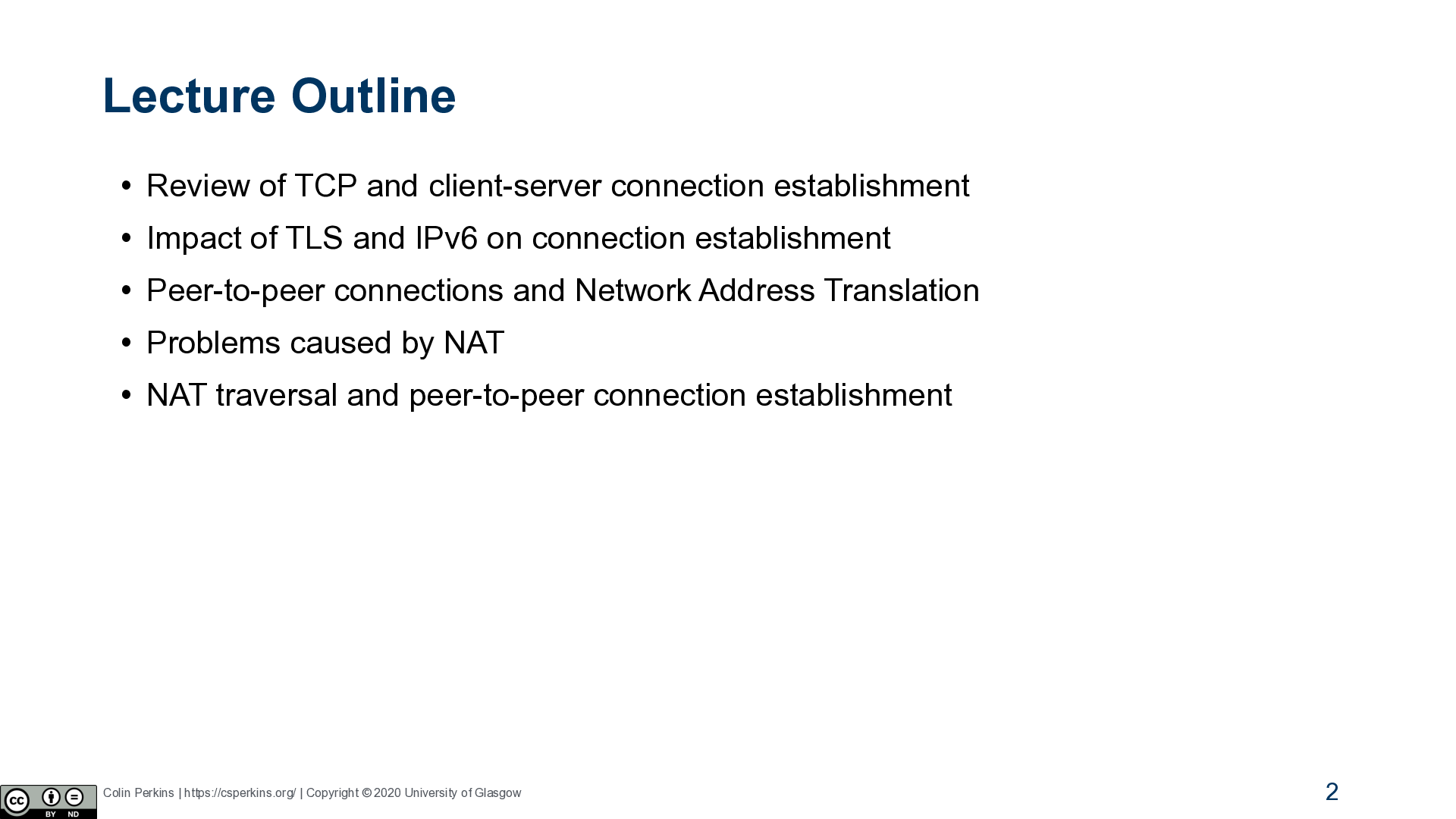
There are five parts to this lecture.
00:00:15.133
In this first part, I’ll review the
00:00:17.333
TCP transport protocol and its programming model,
00:00:20.100
and talk about client-server connection establishment.
00:00:23.433
In the next part, I’ll discuss the
00:00:25.366
implications of Transport Layer Security, TLS,
00:00:28.466
and the use of IPv6 on connection establishment,
00:00:31.600
and show how these changes affect performance.
00:00:35.100
Following that, in part three,
00:00:37.500
I’ll talk about peer-to-peer connections and the impact of
00:00:40.200
network address translation.
00:00:42.266
Then, in the last two parts,
00:00:44.366
I’ll talk about some of the problems
00:00:46.566
caused by NATs, network address translation devices,
00:00:49.300
and outline how NAT traversal works.
00:00:53.133
To begin, I’ll briefly review the Transmission
00:00:57.300
Control Protocol, TCP. I’ll talk about the
00:00:59.166
purpose of TCP, then review the TCP
00:01:01.533
segment format, and the service model TCP
00:01:04.066
offers to applications.
00:01:06.433
Then, I’ll discuss how TCP connections
00:01:08.966
are written using the Berkeley sockets API.
00:01:13.166
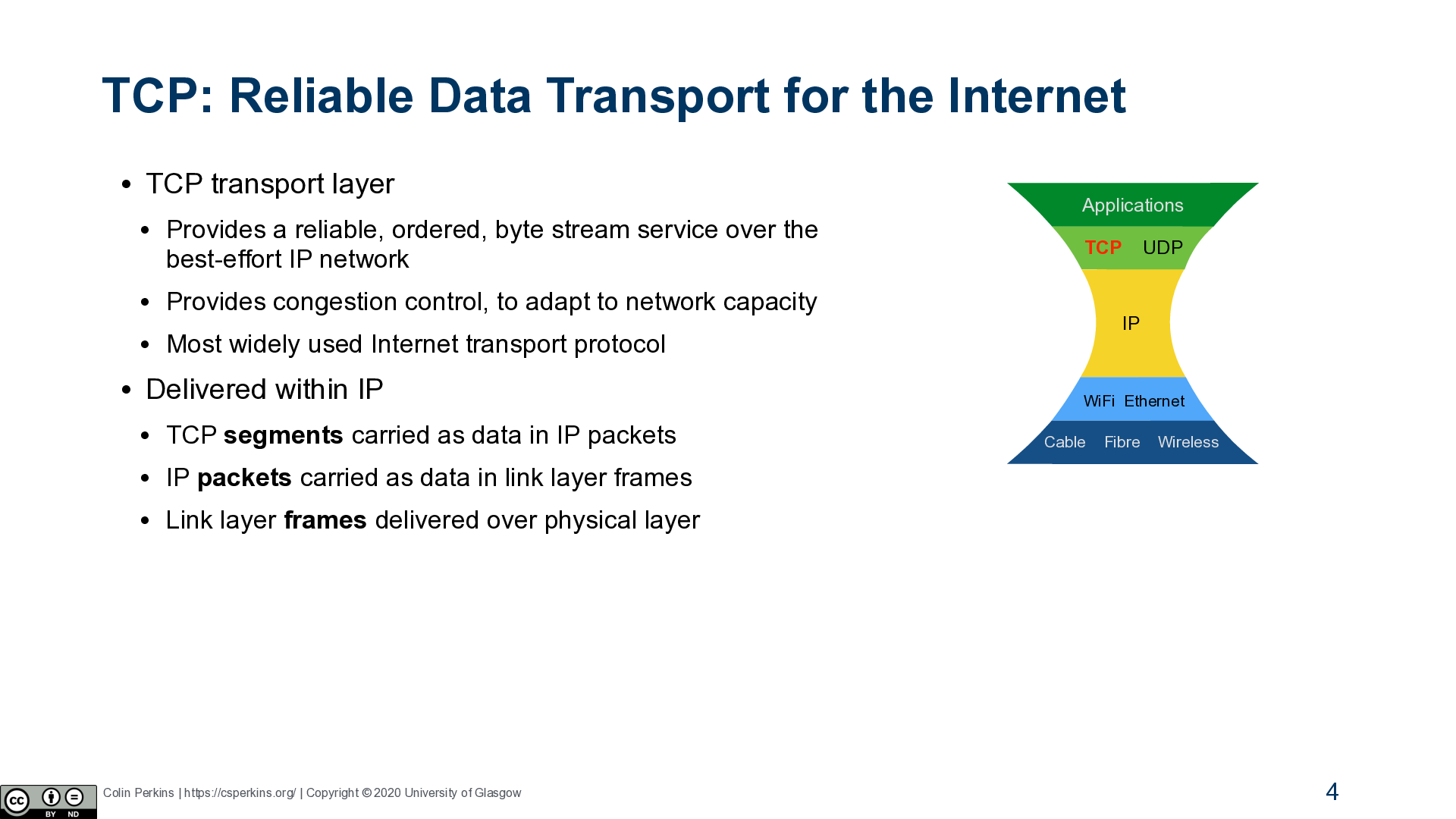
TCP is currently the most widely used
00:01:15.466
transport protocol in the Internet.
00:01:18.133
A TCP connection provides a reliable,
00:01:20.900
ordered, byte stream delivery service
00:01:23.466
that runs on the best-effort IP network.
00:01:26.400
Once a TCP connection is established,
00:01:28.900
an application can write a sequence of bytes
00:01:31.166
into the socket, representing the connection,
00:01:33.600
and TCP will deliver those bytes to the receiver,
00:01:36.433
reliably, and in the correct order.
00:01:39.800
If any of the IP packets containing TCP
00:01:42.333
segments are lost, the TCP stack
00:01:44.933
in the operating system will notice this,
00:01:46.700
and automatically retransmit the missing segments.
00:01:49.766
Similarly, if any of the IP packets
00:01:52.633
are delayed and arrive out of order,
00:01:54.833
the TCP stack will put the data
00:01:56.700
back into the correct order before delivering
00:01:58.633
it to the application.
00:02:00.866
Finally, TCP will adapt the speed
00:02:03.166
at which it sends the data
00:02:04.766
to match the available network capacity.
00:02:07.700
If the network is busy,
00:02:09.566
TCP will slow down the rate at which it sends data,
00:02:12.300
to fairly share the capacity between transmissions.
00:02:16.733
Similarly, if the network becomes idle,
00:02:19.400
TCP connections will speed up to use the spare capacity.
00:02:23.233
This process is known as congestion control,
00:02:25.966
and TCP implements sophisticated
00:02:28.200
congestion control algorithms.
00:02:30.600
We’ll talk more about TCP congestion control in Lecture 6.
00:02:35.566
Applications using TCP are unaware of retransmissions,
00:02:39.266
reordering, and congestion control.
00:02:41.600
They just see a socket,
00:02:43.300
into which they write a stream of bytes.
00:02:45.833
Those bytes are then delivered reliably to the receiver.
00:02:49.233
Internally, those bytes are split into TCP segments.
00:02:52.966
Each segment has a header added to it,
00:02:56.000
to identify the data.
00:02:57.633
The segment is placed inside the data part of an IP packet.
00:03:01.700
That IP packet is, in turn, put inside the
00:03:04.133
data part of a link layer frame,
00:03:06.066
and sent across the network.
00:03:08.466
The IP layer just sees a sequence
00:03:10.833
of TCP segments that it must deliver,
00:03:12.833
and is unaware of their contents.
00:03:15.066
Equally, TCP gives data segments to the
00:03:18.800
IP layer to deliver, and is unaware
00:03:20.733
whether the underlying network is Ethernet,
00:03:22.566
WiFi, optical fibre, or something else.
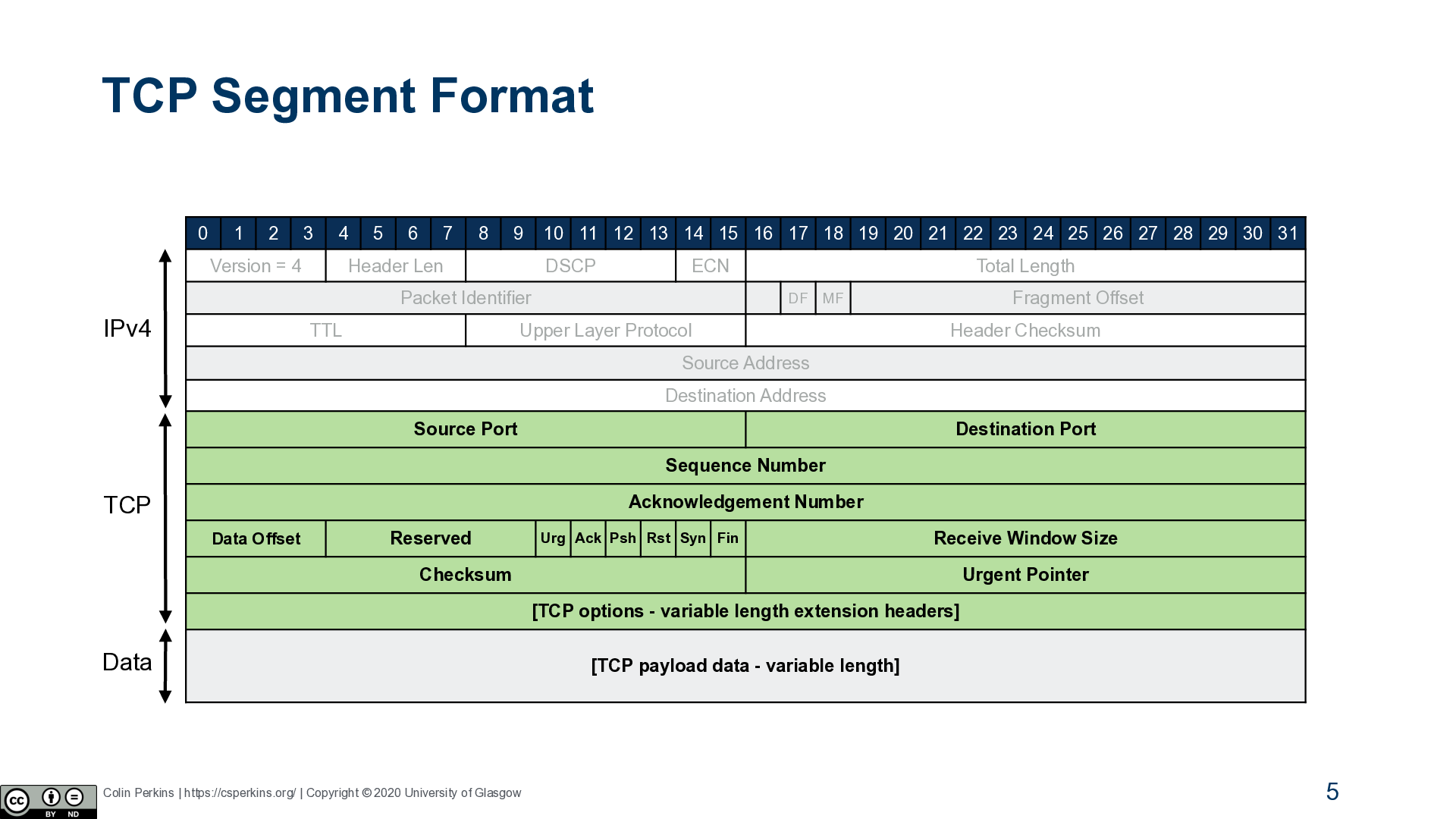
00:03:27.766
The diagram on the slide shows the
00:03:30.066
format of a TCP segment header,
00:03:32.133
inside an IPv4 packet.
00:03:35.066
Data is sent over the link in the order shown,
00:03:38.066
left-to-right, top-to-bottom, in the
00:03:40.033
payload part of a link layer frame.
00:03:43.133
The IP header is sent first,
00:03:45.333
then the TCP segment header,
00:03:47.033
then the TCP payload data.
00:03:49.666
Looking at the TCP segment header,
00:03:52.333
highlighted in green, we see that it
00:03:54.800
comprises a number of fields.
00:03:58.000
A TCP segment starts with the source
00:04:00.166
and destination port numbers.
00:04:02.100
The source port number identifies the socket that sent the
00:04:05.500
segment, while the destination port number identifies
00:04:08.333
the socket to which it should be delivered.
00:04:11.166
When establishing a TCP connection, a TCP
00:04:14.166
server binds to a well-known port that
00:04:16.366
identifies the type of service it offers.
00:04:19.000
For example, web servers bind to port 80.
00:04:22.700
This gives a known destination port
00:04:24.733
to which clients can connect.
00:04:27.300
Clients specify the destination port to which they connect,
00:04:30.766
but usually leave their source port unspecified.
00:04:34.200
The operating system then chooses
00:04:36.333
an unused source port for that connection.
00:04:39.333
All TCP segments sent from the client to the server,
00:04:42.666
as part of a single connection,
00:04:44.400
have the same source and destination ports,
00:04:46.833
and the responses come back with those ports swapped.
00:04:50.166
Each new connection gets a new source port.
00:04:54.300
Following the port numbers in the TCP segment header,
00:04:57.033
come the sequence number and the acknowledgement number.
00:04:59.966
At the start of a TCP connection,
00:05:02.200
the sequence number is set to a random initial value.
00:05:05.533
As data is sent, the TCP sequence
00:05:08.033
number inserted by the sender increases,
00:05:10.233
counting the number of bytes of data being sent.
00:05:14.100
The acknowledgement number indicates the next byte
00:05:16.500
of data that’s expected by the receiver.
00:05:19.366
For example, if a TCP segment is
00:05:21.900
received with sequence number 4,000,
00:05:24.733
and that segment contains 100 bytes of data,
00:05:27.966
then the acknowledgement number will be 4,100.
00:05:31.266
This indicates that the next TCP segment
00:05:33.600
expected is that with sequence number 4,100.
00:05:39.000
If the acknowledgement number that comes back
00:05:41.200
is different from that expected,
00:05:42.900
it’s a sign that some of the packets have been lost.
00:05:45.766
TCP will then retransmit the
00:05:47.700
segments that were in the lost packets.
00:05:50.233
The data offset field indicates where
00:05:52.600
the payload data starts in the segment.
00:05:54.500
That is, it indicates the size of any TCP options
00:05:57.133
included in the packet.
00:05:59.766
The reserved bits are not used.
00:06:03.266
There are then six single-bit flags.
00:06:06.133
The URG bit indicates whether the urgent pointer is valid.
00:06:10.166
The ACK bit indicates whether the
00:06:11.966
acknowledgement number is valid.
00:06:13.700
The PSH bit indicatesthat this is the last
00:06:16.066
segment in a message, and should be pushed
00:06:18.300
up to the application as soon as possible.
00:06:20.966
The SYN, synchronise, bit is set on
00:06:23.966
the first packet sent on a connection.
00:06:25.900
The FIN bit indicates that the connection
00:06:28.500
should be cleanly closed.
00:06:30.166
And the RST bit indicates that the connection will reset,
00:06:33.400
aborted, without cleanup.
00:06:35.933
The receive window size allows the receiver
00:06:38.400
to indicate how much buffer space it
00:06:40.800
has available to receive new data.
00:06:42.633
This allows the receiver tell the sender to slow down,
00:06:45.466
if it’s sending faster than the receiver
00:06:47.200
can process the data.
00:06:49.000
The checksum is used to detect corrupted
00:06:52.333
packets, that can then be retransmitted.
00:06:55.000
Finally, the Urgent Pointer allows TCP senders
00:06:58.100
to indicate that some data is to be processed
00:07:00.200
urgently by the receiver.
00:07:02.366
Unfortunately, experience has shown that the urgent
00:07:05.300
data mechanism in TCP is not usable in practice,
00:07:08.166
due to a combination of
00:07:10.333
an ambiguous specification and inconsistent implementation.
00:07:13.933
The fixed TCP segment header is
00:07:16.166
followed by TCP option headers, that allow TCP
00:07:19.100
to add new features and extensions,
00:07:21.266
and then the payload data.
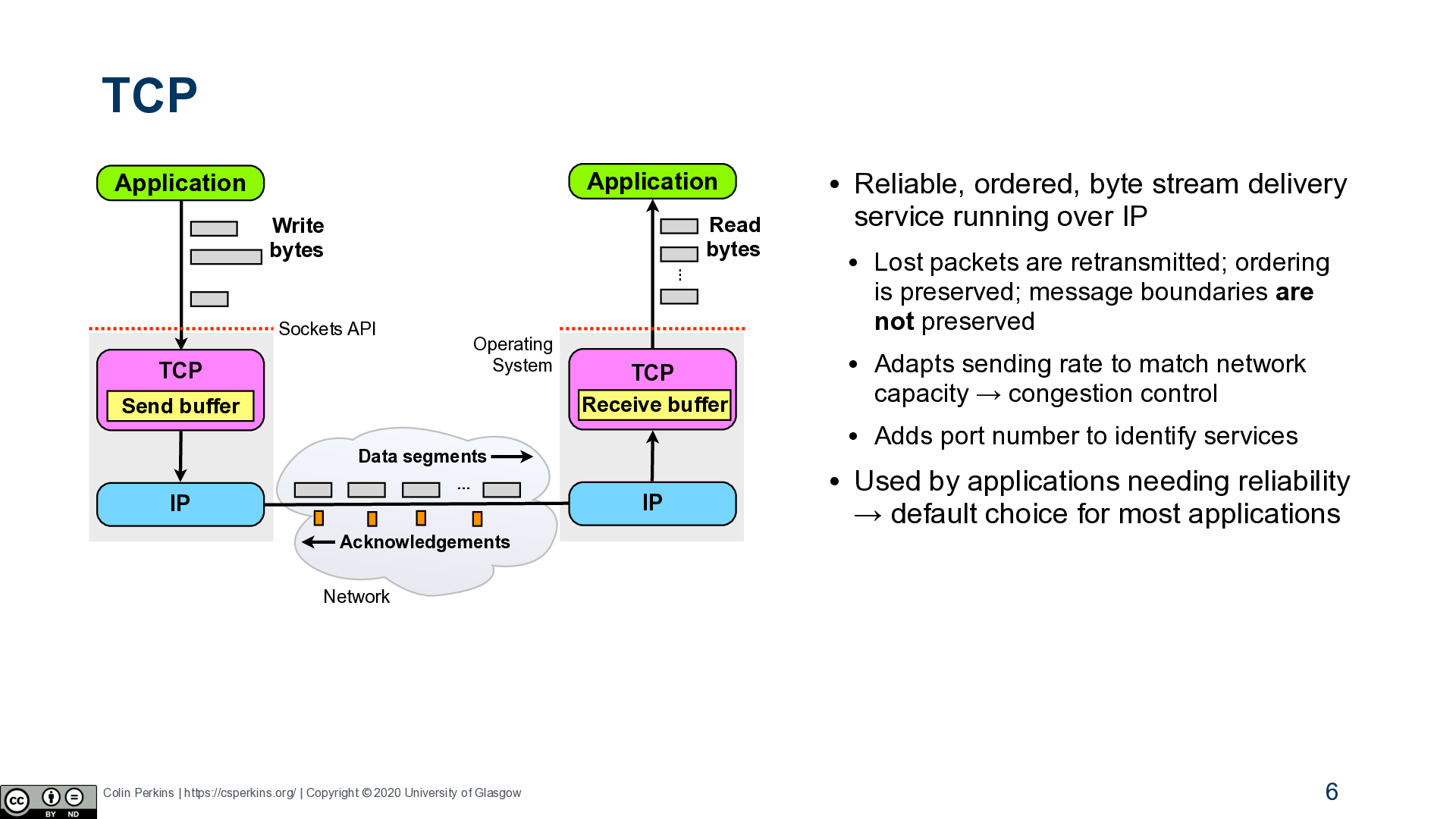
00:07:25.433
TCP retransmits any data
00:07:27.600
that was sent in packets that are lost,
00:07:29.600
and makes sure that data is delivered to the
00:07:31.833
application in the order in which it was originally sent.
00:07:34.933
It also adapts the speed at which it sends data to
00:07:37.333
match the available network capacity.
00:07:39.833
As a result, TCP provides a reliable, ordered,
00:07:43.366
byte stream delivery service.
00:07:45.900
A limitation of the TCP service model
00:07:48.600
is that message boundaries are not preserved.
00:07:51.266
That is, if an application writes,
00:07:53.533
for example, a block of 2,000 bytes
00:07:55.900
to a TCP connection, then TCP will
00:07:58.533
deliver those 2,000 bytes to the receiver,
00:08:00.633
reliably, and in the order they are sent.
00:08:03.966
However, what TCP does not do,
00:08:06.266
is guarantee that those bytes are delivered to the
00:08:08.733
receiving application as a single block of 2,000 bytes.
00:08:12.200
That might happen.
00:08:14.166
Equally, they could be delivered to the
00:08:16.333
application as two blocks of 1,000 bytes.
00:08:19.200
Or as a block of 1,500 bytes,
00:08:21.266
followed by a block of 500 bytes.
00:08:23.400
Or as 2,000 single bytes. Or as
00:08:25.666
any other combination, provided the data is
00:08:28.400
delivered reliably and in the order sent.
00:08:31.966
This complicates the design of applications that
00:08:34.366
use TCP, since they have to parse
00:08:36.900
the data received from a TCP socket
00:08:38.966
to check if they’ve got the complete message.
00:08:42.000
Despite this inconvenience,
00:08:43.666
TCP is the right choice for most applications.
00:08:46.900
If you need to deliver data reliably,
00:08:48.966
and as fast as possible, then use TCP.
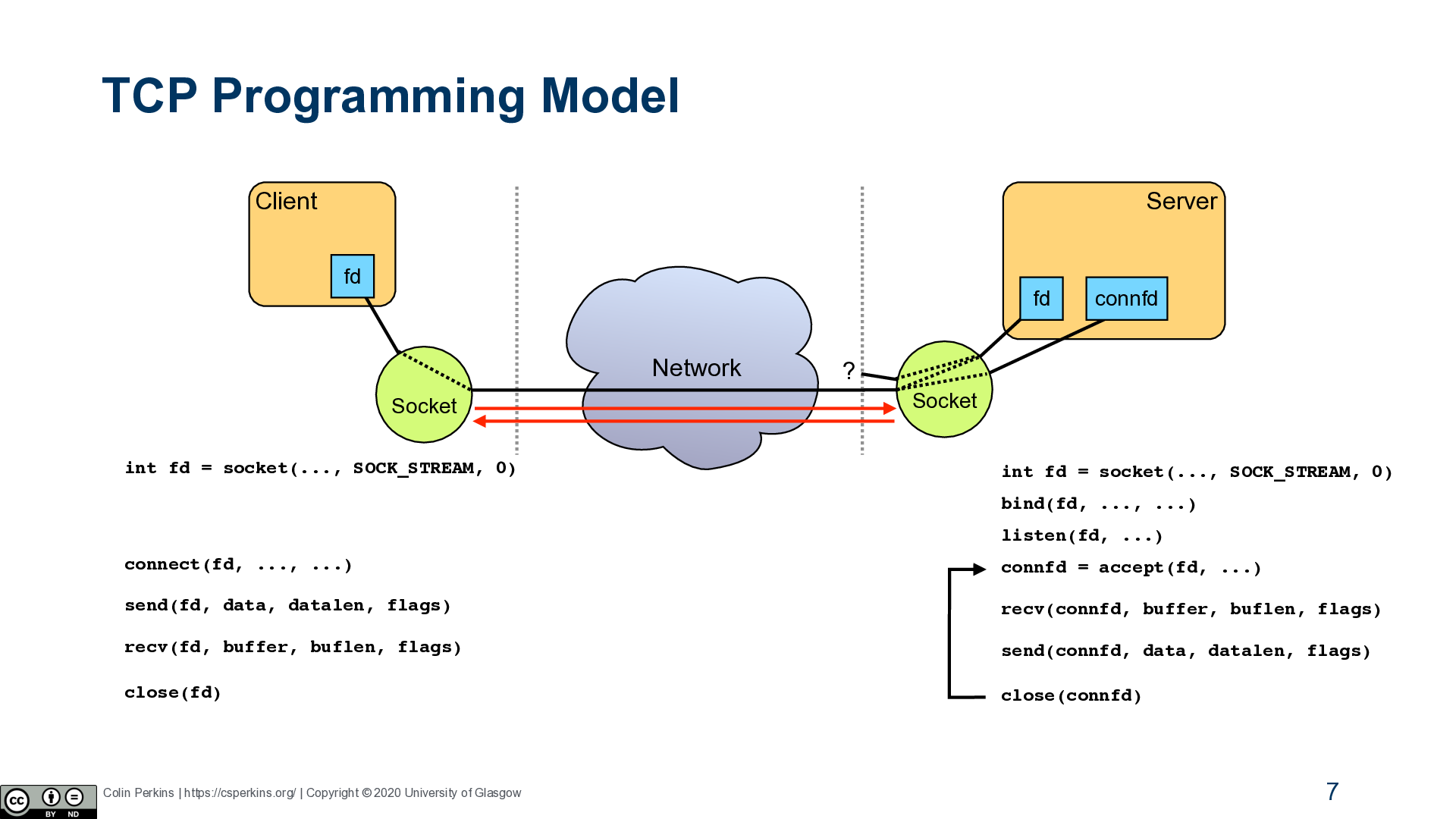
00:08:54.400
TCP is a client-server protocol.
00:08:56.833
Servers listen for, and respond to, requests from clients.
00:09:01.300
The way you write code to use
00:09:03.466
a TCP connection depends on whether you’re
00:09:05.766
writing a client or a server.
00:09:09.000
On the server side, you begin by creating a socket.
00:09:13.100
The first argument to the socket() call
00:09:15.933
is the constant PF_INET, from the sys/socket.h header,
00:09:19.866
if you want the server to listen for connections on IPv4.
00:09:24.333
Alternatively,if you want the server to listen
00:09:26.800
for IPv6 connections, use PF_INET6.
00:09:31.400
The second argument will be the constant,
00:09:33.600
SOCK_STREAM, to indicate that a TCP server is wanted.
00:09:37.733
The third argument is unused as must be zero.
00:09:43.000
You then call the bind() function,
00:09:44.966
passing the file descriptor representing the newly
00:09:48.066
created socket as the first argument.
00:09:50.400
The other arguments to bind() specify the
00:09:52.666
port number on which the server
00:09:54.366
should listen for incoming connections.
00:09:56.600
The bind() function assigns the requested
00:09:59.433
port number to the socket.
00:10:02.000
You then call the listen() function.
00:10:04.966
This starts the server listening for incoming connections.
00:10:08.800
Then, you call accept(), to indicate that
00:10:11.766
your server is ready to accept a new connection.
00:10:14.700
The accept() function doesn’t return
00:10:16.766
until a client connects to the server.
00:10:18.800
This could potentially be a long wait.
00:10:22.966
Meanwhile, the client application creates its own socket.
00:10:26.933
This is done using the socket() function,
00:10:29.666
in exactly the same way as the server.
00:10:33.000
The client then calls connect(),
00:10:34.833
passing the file descriptor for its newly created socket
00:10:37.966
as the first argument. The subsequent arguments
00:10:40.466
contain the IP address of the server,
00:10:42.733
and the port number on which the server is listening.
00:10:45.700
The connect() call makes TCP establish a
00:10:48.433
connection from the client to the server.
00:10:50.833
When it returns, either the connection has
00:10:53.200
been successfully established, or the server is unreachable.
00:10:57.133
When the connection request reaches the server,
00:10:59.866
the accept() call completes.
00:11:02.000
The return value is a new file descriptor,
00:11:04.366
representing the newly established connection.
00:11:07.433
The original file descriptor,
00:11:08.900
that was listening for incoming connections,
00:11:10.700
remains unchanged.
00:11:14.000
The client and server can now call send() and recv(),
00:11:17.033
to send and receive data over the connection.
00:11:20.466
They can send and receive as much,
00:11:22.266
or as little, data as they want, and TCP places
00:11:25.033
no restrictions on the order in which
00:11:26.933
client and server send.
00:11:28.933
Remember to use the file descriptor representing
00:11:31.566
the accepted connection, not the file descriptor
00:11:33.833
representing the listening socket, when writing the
00:11:36.033
server code.
00:11:38.533
Finally, when they’ve finished, client and server
00:11:41.633
call the close() function, to cleanly shut
00:11:43.433
down the connection.
00:11:45.166
Once the client has closed the connection, it’s done.
00:11:48.466
A server can repeatedly accept new connections
00:11:50.666
from the listening socket.
00:11:56.366
How does connection establishment actually work?
00:11:58.933
And what are the factors that affect how
00:12:00.900
quickly connections can be established?
00:12:03.233
In the following, I’ll talk in detail
00:12:05.833
about how client-server connection establishment works for
00:12:08.700
TCP, and what factors limit performance.
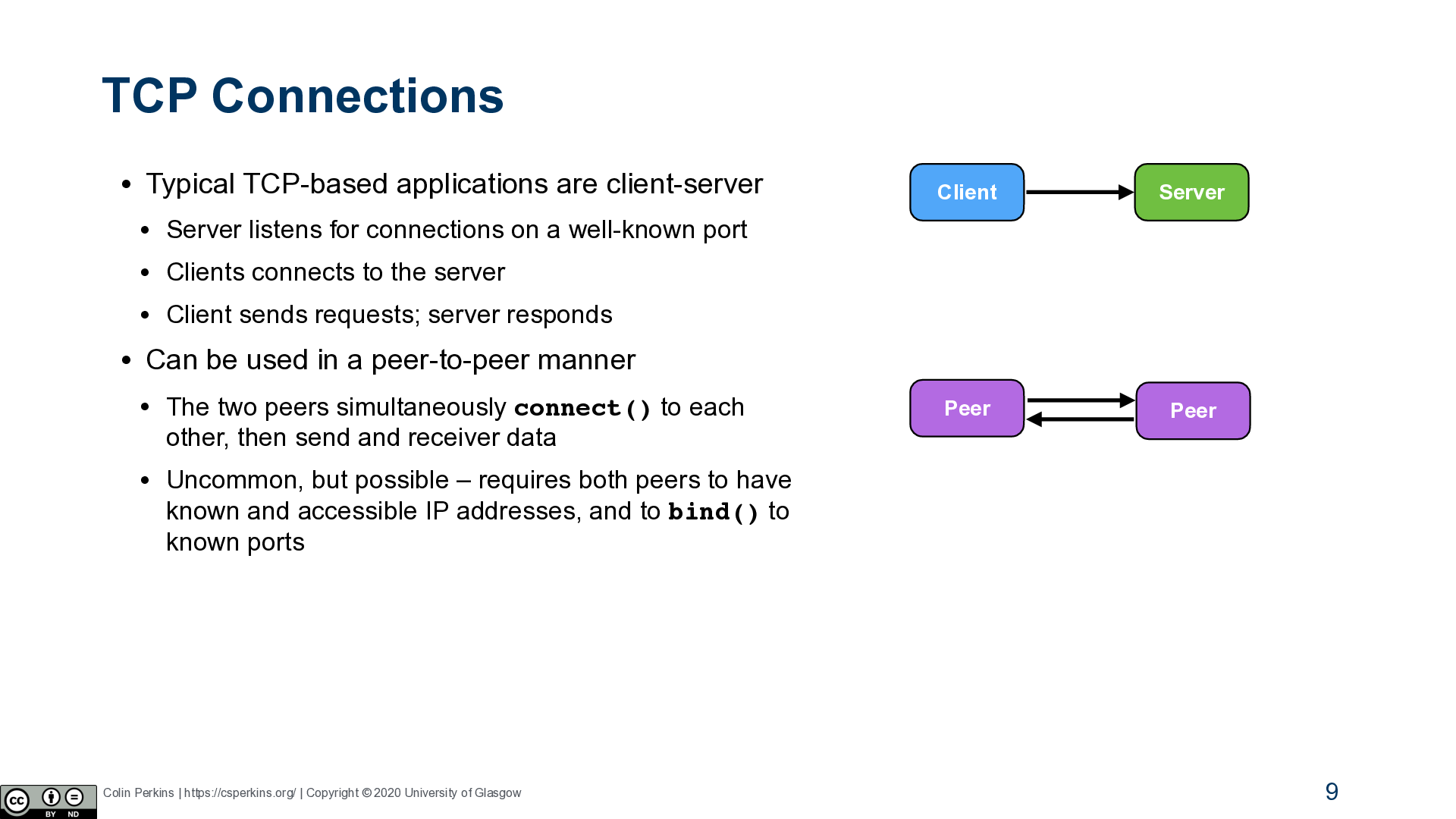
00:12:12.533
TCP-based applications
00:12:14.700
usually work in a client-server manner.
00:12:16.933
The server listens for connections on a well-known port,
00:12:20.100
and the client connects to the server, sends a request,
00:12:23.133
and receives a response.
00:12:25.000
TCP can also, in principle, be used
00:12:27.666
in a peer-to-peer manner.
00:12:30.033
If two devices create TCP sockets,
00:12:32.733
bind to known ports, and simultaneously attempt
00:12:35.633
to connect() to each other, then TCP
00:12:37.633
will able to create a connection,
00:12:39.466
provided there are no firewalls or NAT
00:12:41.400
devices blocking traffic.
00:12:43.233
This is known as simultaneous open.
00:12:45.866
TCP simultaneous open can work,
00:12:48.600
but isn’tespecially useful, since it requires both peers
00:12:51.700
to try to connect at the same time.
00:12:54.033
It’s usually better to work in client-server mode,
00:12:56.933
since the server can wait for clients
00:12:58.700
and the client and server don’t need to synchronise
00:13:01.033
when to connect.
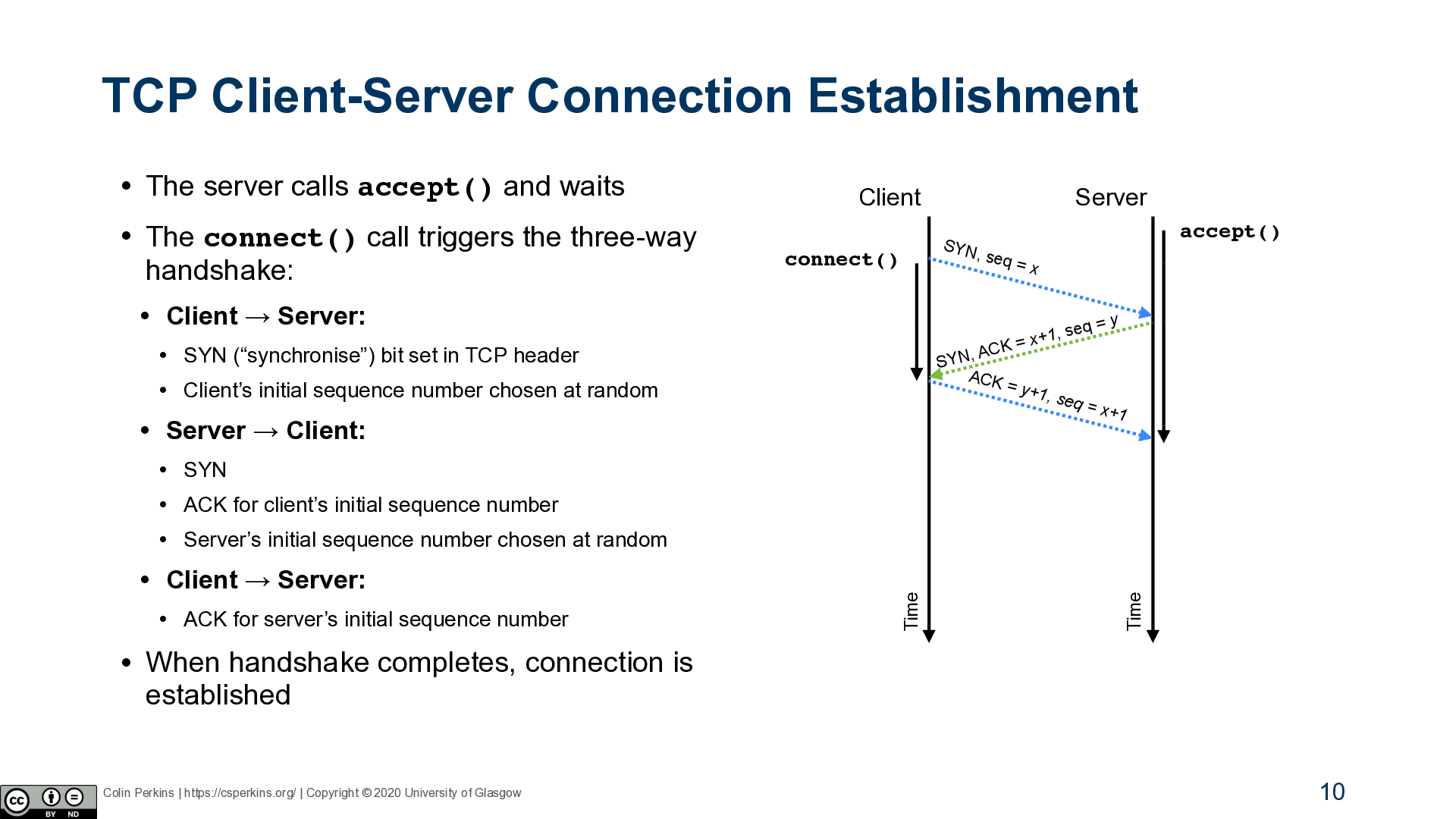
00:13:05.000
How does client-server TCP connection
00:13:07.333
establishment actually work?
00:13:10.133
First, the server creates a TCP socket,
00:13:13.366
binds it to a port, tells it
00:13:16.733
to listen for connections, and calls accept().
00:13:20.100
At that point, the server blocks,
00:13:22.966
waiting for a connection.
00:13:25.000
The client creates a TCP socket and calls connect().
00:13:28.800
This triggers the TCP connection setup handshake,
00:13:31.333
and causes the client to send a
00:13:34.066
TCP segment to the server. This segment
00:13:36.800
will have the SYN (“synchronise”) bit set
00:13:39.500
in its TCP segment header, to indicate
00:13:42.233
that it’s the first packet of the connection.
00:13:44.466
It will also include a randomly chosen sequence number.
00:13:47.500
This is the client’s initial sequence number.
00:13:50.700
The initial segment does not include any data.
00:13:55.200
When this initial segment arrives at the
00:13:57.533
server, the server will send a TCP segment in response.
00:14:01.200
This segment will also have the SYN
00:14:03.833
bit set, because it’s the first segment
00:14:06.400
sent by the server on the connection.
00:14:08.033
It will also include a randomly chosen
00:14:09.666
initial sequence number.
00:14:11.100
This is the server’s initial sequence number.
00:14:14.333
The segment will also have the ACK
00:14:15.966
bit set, because it’s acknowledging the initial
00:14:18.533
segment sent from the client.
00:14:20.933
TCP acknowledgements report the next
00:14:23.033
sequence number expected,
00:14:24.466
and by convention a SYN segment will
00:14:26.733
consume one sequence number.
00:14:28.700
Accordingly, the acknowledgement number
00:14:30.833
in the TCP segment header will
00:14:32.500
be the client’s initial sequence number plus one.
00:14:36.366
Since this segment has both the SYN
00:14:39.000
and ACK bits set, it’s known as a SYN-ACK packet.
00:14:42.533
When the SYN-ACK packet arrives at the
00:14:44.600
client, the client acknowledges its receipt back
00:14:47.200
to the server. The TCP segment it
00:14:49.833
generates to do this will have its
00:14:52.433
ACK bit set to one, to indicate
00:14:55.033
that its acknowledgement number is valid,
00:14:57.266
and the acknowledgement number will be the
00:14:59.866
server’s initial sequence number plus one.
00:15:02.100
The SYN bit is not set on
00:15:04.800
this packet, since it’s not the first
00:15:07.400
packet sent from the client to the
00:15:10.033
server.
00:15:11.133
The sequence number in the TCP segment
00:15:13.833
header will equal the client’s initial sequence
00:15:16.466
number plus one, since the SYN packet
00:15:19.066
consumes one sequence number. This packet also
00:15:21.666
doesn’t include any data, since it’s sent
00:15:24.266
before the connect() call completes.
00:15:26.133
Once this packet has been sent,
00:15:28.466
the client considers the connection established,
00:15:30.700
and the connect() function returns. The client
00:15:33.300
can now send or receive data on the connection.
00:15:36.200
Once this final ACK packet arrives at
00:15:38.433
the server, the three-way handshake is complete.
00:15:40.866
At this point the accept() function completes,
00:15:43.266
returning a file descriptor the server can
00:15:45.700
use to access the new connection.
00:15:47.766
The server now considers the connection to
00:15:50.200
be open.
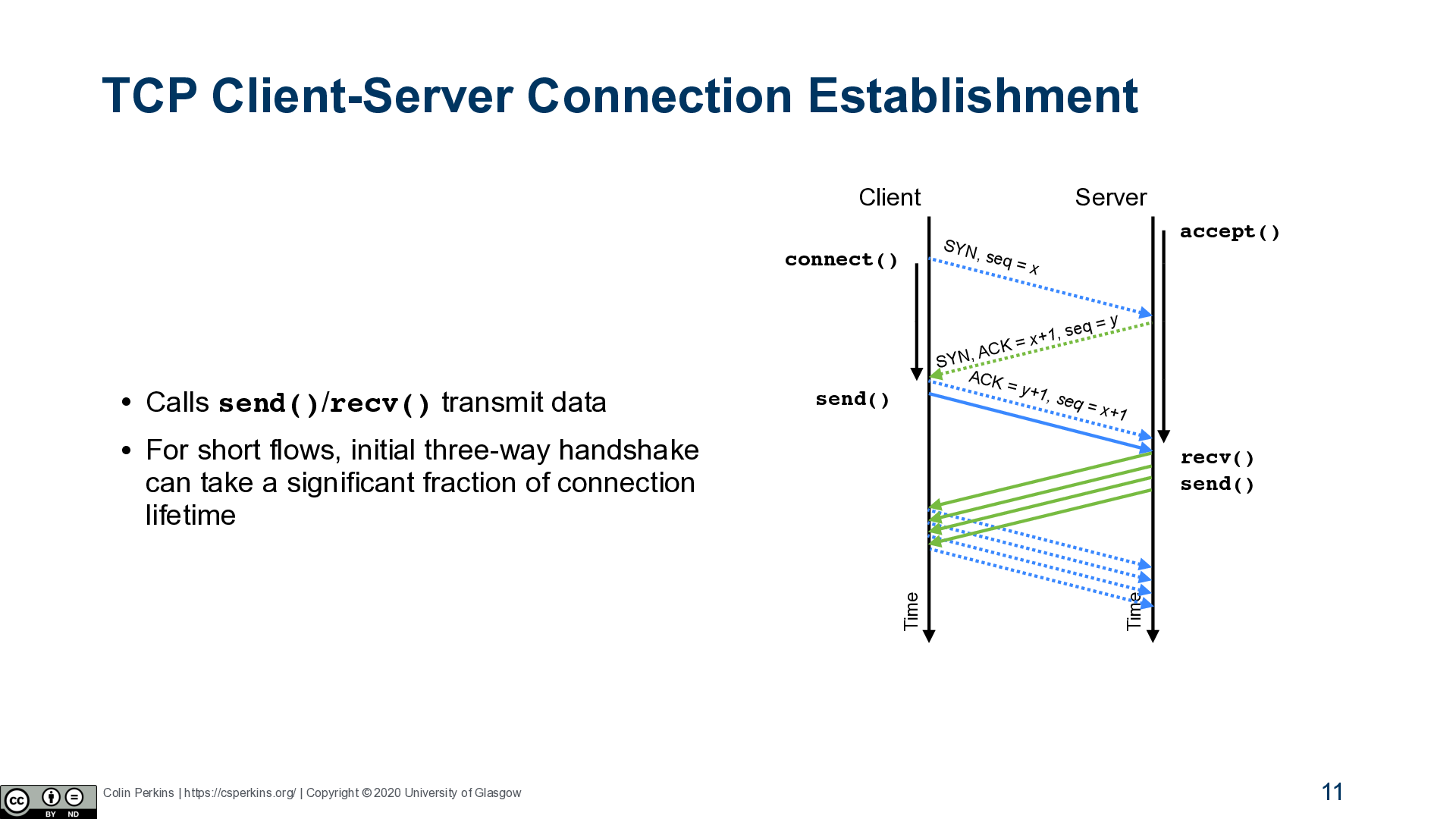
00:15:52.000
Once the three-way handshake has completed,
00:15:54.566
the client and server can send and
00:15:57.466
receive data over the connection.
00:15:59.500
The typical case is that the client
00:16:02.500
sends data to the server immediately after
00:16:05.366
it connects, and the server responds with
00:16:08.266
the requested data. There’s no requirement that
00:16:11.133
the client sends first, though, or that
00:16:14.033
client and server alternate in sending data.
00:16:17.000
The slide shows an example where the
00:16:19.200
client sends a request comprising a single
00:16:21.400
segment’s worth of data to the server.
00:16:23.600
The server then responds by sending a
00:16:25.800
larger response back, including the acknowledgement for
00:16:28.000
the request on the first segment of
00:16:30.200
the response. Finally, we see the client
00:16:32.400
acknowledge receipt of the segments that comprise
00:16:34.566
the response.
00:16:35.200
This is the typical pattern when a
00:16:37.500
browser fetches a web page from a
00:16:39.700
web server.
00:16:40.333
What’s interesting, is that if we look
00:16:42.633
at the time from when the client
00:16:44.833
calls connect(), until the time it receives
00:16:47.033
the last of data segment from the
00:16:49.233
server, a significant part of that time
00:16:51.433
is taken up by the connection setup
00:16:53.633
handshake.
00:16:54.700
It takes a certain amount of time,
00:16:57.000
known as the round trip time,
00:16:58.866
to send a minimal sized request to
00:17:01.066
the server and get a minimal sized
00:17:03.266
response. Larger requests and responses add to
00:17:05.466
this, based on the time to send
00:17:07.666
the additional data down the link,
00:17:09.533
known as the serialisation time for the
00:17:11.733
data. But, if the amount of data
00:17:13.933
being requested from the server is small,
00:17:16.133
it’s often the round trip time that dominates.
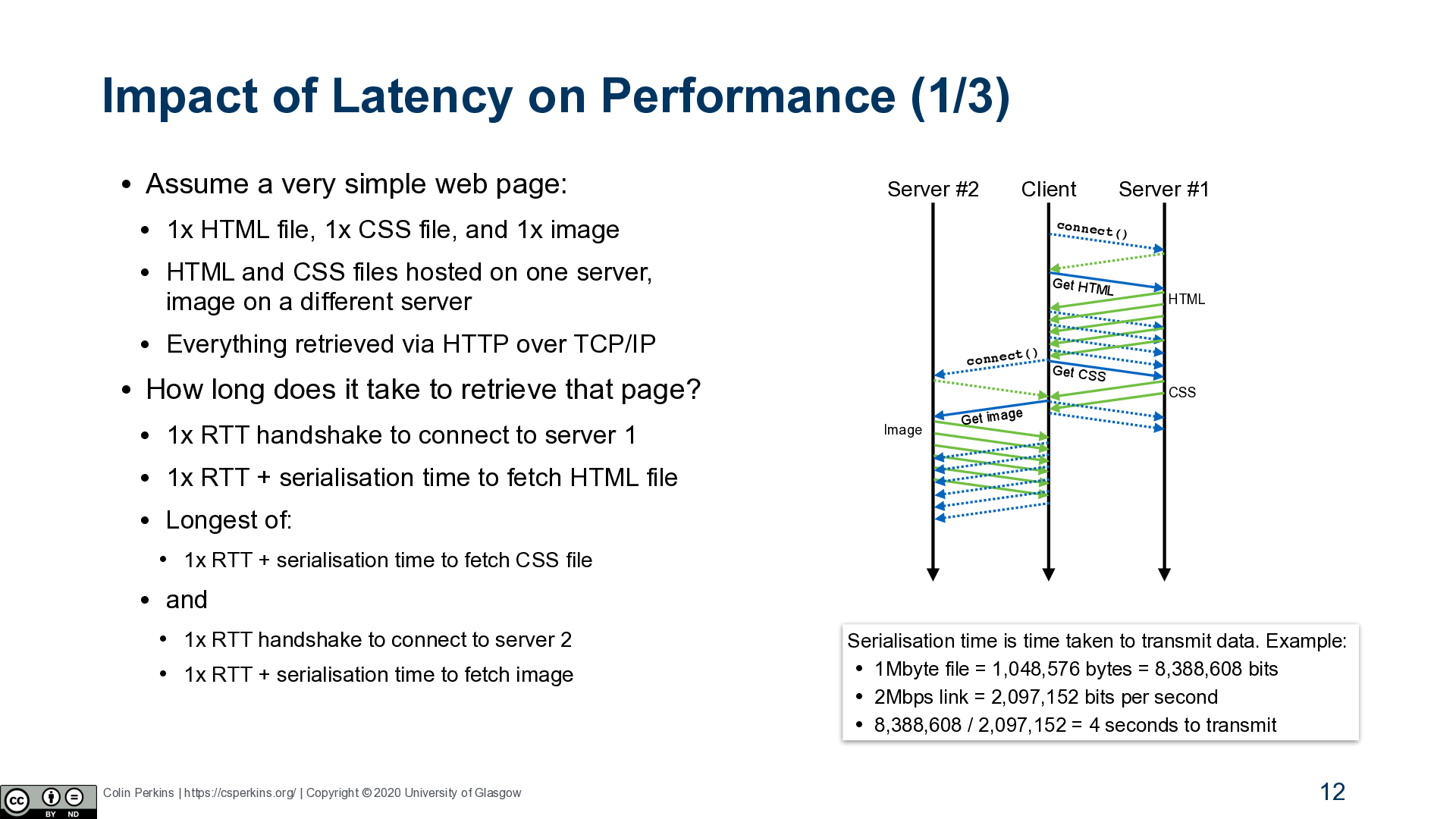
00:17:19.666
For example, let’s assume a browser is
00:17:22.066
requesting a simple web page from a
00:17:25.033
web server using HTTP running over TCP.
00:17:28.000
That web page comprises a single HTML
00:17:30.966
file, a CSS style sheet, and an
00:17:33.933
image. The HTML and CSS files are
00:17:36.900
on one server, while the image is
00:17:39.866
located on a different server.
00:17:42.000
How long does it take to retrieve
00:17:45.066
that page?
00:17:46.000
Well, the client initially connects to the
00:17:48.366
server where the HTML file is located.
00:17:50.766
This takes one round-trip time for the
00:17:53.133
SYN and SYN-ACK packets to be exchanged,
00:17:55.533
and for the connect() call to complete.
00:17:58.000
As soon as the connect() completes,
00:18:00.066
the client sends the request for the
00:18:02.500
HTML. It takes another round-trip for the
00:18:04.900
request to reach the server and the
00:18:07.333
first part of the response to come
00:18:09.766
back, followed by the serialisation time for
00:18:12.166
the rest of the response.
00:18:14.000
When it’s received the HTML, the client
00:18:16.433
knows that it needs to retrieve the
00:18:18.866
CSS file and the image.
00:18:20.600
It reuses the existing connection to the
00:18:23.133
first server to retrieve the CSS file.
00:18:25.566
This takes an additional round trip,
00:18:27.666
plus the serialisation time of the CSS
00:18:30.100
data.
00:18:31.200
In parallel to this, it opens a
00:18:33.733
TCP connection to the second server,
00:18:35.800
sends a request for the image,
00:18:37.900
and downloads the response. This takes two
00:18:40.333
round trips, plus the time to send
00:18:42.766
the image data.
00:18:43.800
Whichever of these takes the longest,
00:18:46.000
plus the amount of time to make
00:18:48.433
the initial connection and fetch the HTML,
00:18:50.866
determines the total time to download the page.
00:18:53.233
The round trip time depends on the
00:18:55.333
distance from the client to the server.
00:18:57.700
The serialisation time depends on the available
00:19:00.133
capacity of the network. For example,
00:19:02.166
if the image is 1 megabyte,
00:19:04.166
8 megabits, in size, and the available
00:19:06.500
bandwidth of the link is 2 megabits
00:19:08.866
per second, then the image will take
00:19:11.200
4 seconds to download, in addition to
00:19:13.566
the round trip time.
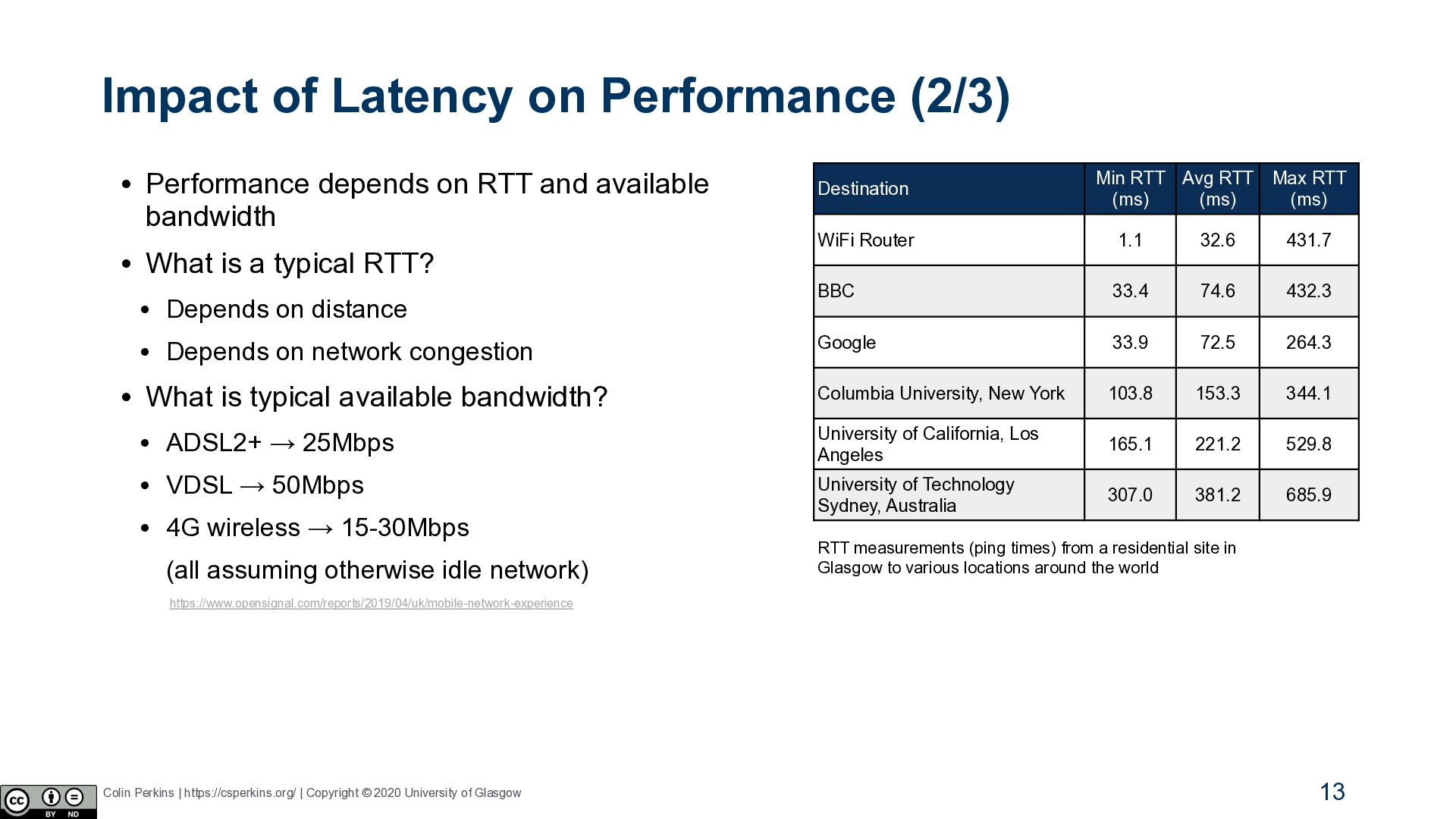
00:19:16.000
It can be seen that the total
00:19:18.666
download time depends on both the round
00:19:21.233
trip time, the available bandwidth, and the
00:19:23.800
size of the data being downloaded.
00:19:26.033
What’s a typical round trip time?
00:19:28.333
This depends on the distance between the
00:19:31.000
client and server, and on the amount
00:19:33.566
of network congestion. The table on the
00:19:36.133
right gives some typical values, measured from
00:19:38.700
a laptop on my home network to various destinations.
00:19:42.000
There’s a lot of variation. In the
00:19:44.666
best case, it takes around 33ms to
00:19:47.266
get a response from a server in
00:19:49.833
the UK, around 100ms to get a
00:19:52.400
response from a server on the East
00:19:54.966
coast of the US, around 165ms from
00:19:57.533
a server in California, and around 300ms
00:20:00.100
from Australia. Worst case, when there’s other
00:20:02.666
traffic on the network, is considerably higher.
00:20:05.266
This means that a request sent to
00:20:07.933
a server in New York takes at
00:20:10.500
least 1/10th of a second, irrespective of
00:20:13.066
how much data is requested.
00:20:15.000
What about available bandwidth?
00:20:16.566
Well, ADSL typically gets around 25 megabits
00:20:19.433
per second.
00:20:20.233
VDSL, often known as fibre to the
00:20:23.100
kerb, where the connection runs over your
00:20:25.866
home phone line to a cabinet in
00:20:28.633
your street, then over fibre to the
00:20:31.400
exchange and beyond, typically gets around 50
00:20:34.166
megabits per second.
00:20:35.333
And fibre to the premises, where the
00:20:38.200
optical fibre runs direct into your home,
00:20:40.966
can transmit several hundred megabits per second.
00:20:43.733
4G wireless is highly variable, depending on
00:20:46.600
the options enabled by your provider and
00:20:49.366
the reception quality, but somewhere in the
00:20:52.133
15-30 megabits per second range is typical.
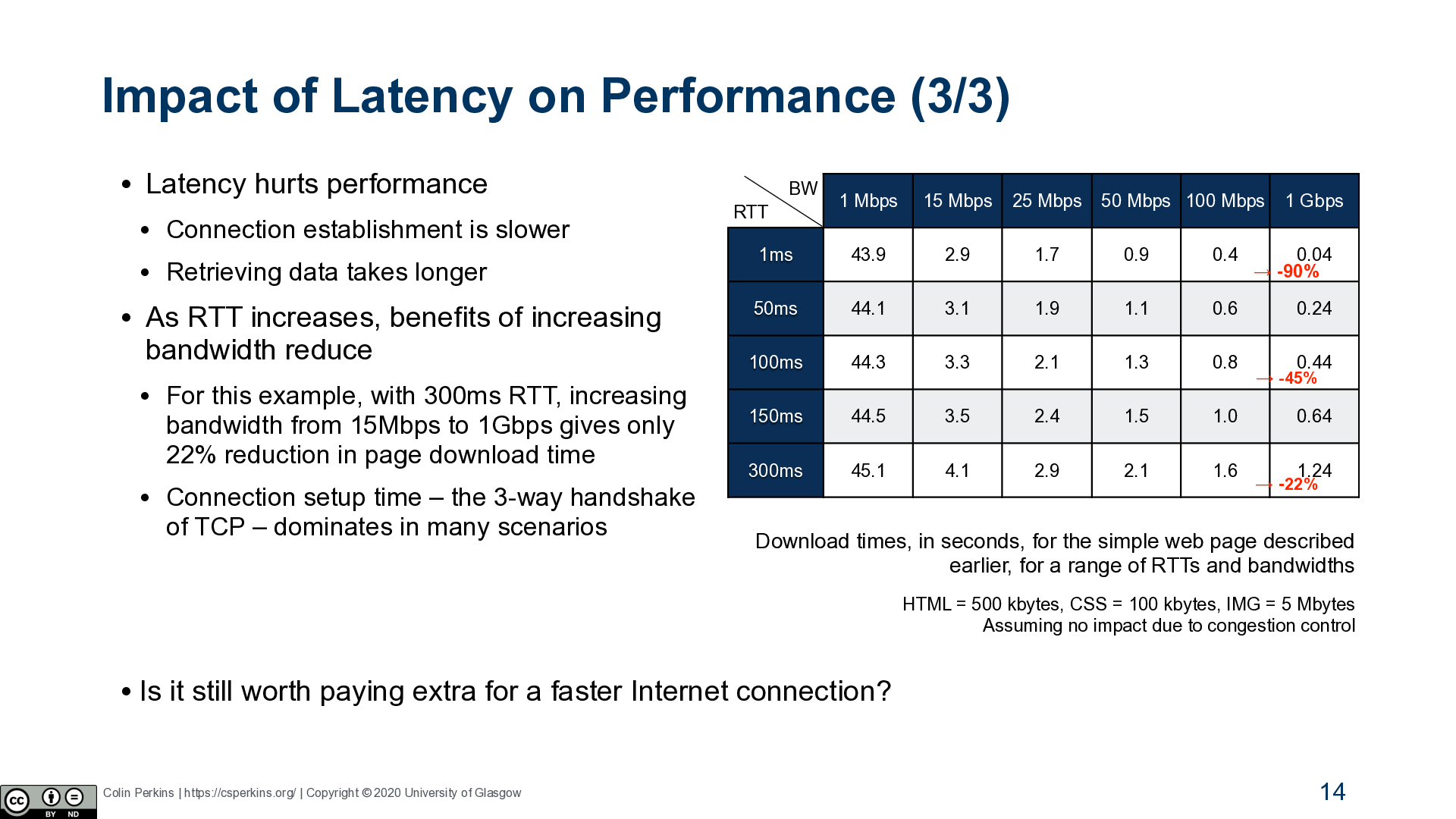
00:20:56.000
What does this mean in practice?
00:20:58.066
Let’s take the example of a single
00:21:00.500
web page we used before, comprising HTML,
00:21:02.800
a CSS style sheet, and a single
00:21:05.100
image, and plug in some typical numbers
00:21:07.400
for the file sizes, as shown on
00:21:09.733
the slide. Let’s also assume that the
00:21:12.033
round trip time is the same for
00:21:14.333
both servers, to make the numbers easier.
00:21:16.633
The table then plots the total time
00:21:19.033
it would take to download that simple
00:21:21.366
web page, given different values for bandwidth
00:21:23.666
and the round trip time to the
00:21:25.966
servers.
00:21:27.066
The slowest case is the bottom left
00:21:29.466
of the table, where it would take
00:21:31.766
45.1 seconds to download the page,
00:21:33.733
assuming a 1 megabit per second link
00:21:36.066
to a server with a 300ms round
00:21:38.366
trip time. This models a slow connection
00:21:40.666
to a server in Australia.
00:21:42.333
The fastest is the top right of
00:21:44.733
the table, where it takes 0.04 seconds
00:21:47.033
to download the page from a server
00:21:49.333
located 1ms away on a gigabit link.
00:21:51.466
What’s interesting is how the download time
00:21:53.833
varies as the link speed improves.
00:21:56.233
If we look at the top row,
00:21:59.166
with 1ms round trip time, we see
00:22:02.000
that if we increase the bandwidth by
00:22:04.833
a factor of ten, from 100Mbps to
00:22:07.666
1Gbps, the time taken to download the
00:22:10.466
page goes down by a factor of
00:22:13.300
ten, a 90% reduction. The link is
00:22:16.133
ten times faster, and the page downloads
00:22:18.966
ten time faster.
00:22:20.166
If we look instead at the bottom
00:22:23.100
row, with 300ms round trip time,
00:22:25.500
increasing the link speed from 100Mbps to
00:22:28.333
1Gbps gives only a 22% reduction in
00:22:31.166
download time.
00:22:31.966
Other links are somewhere in the middle.
00:22:35.000
Internet service providers like to advertise their
00:22:37.166
services based on the link speed.
00:22:39.033
They proudly announce that they can now
00:22:41.233
provide gigabit links, and that these are
00:22:43.400
now more than ten times faster than before!
00:22:46.066
And this is true.
00:22:47.600
But, in terms of actual download time,
00:22:50.466
unless you’re downloading very large files,
00:22:52.866
the round trip time is often the
00:22:55.666
limiting factor. The download time, for typical
00:22:58.433
pages, may only improve by a factor
00:23:01.233
of two if the link gets 10x
00:23:04.033
faster.
00:23:05.166
Is it still worth paying extra for
00:23:08.066
that faster Internet connection?
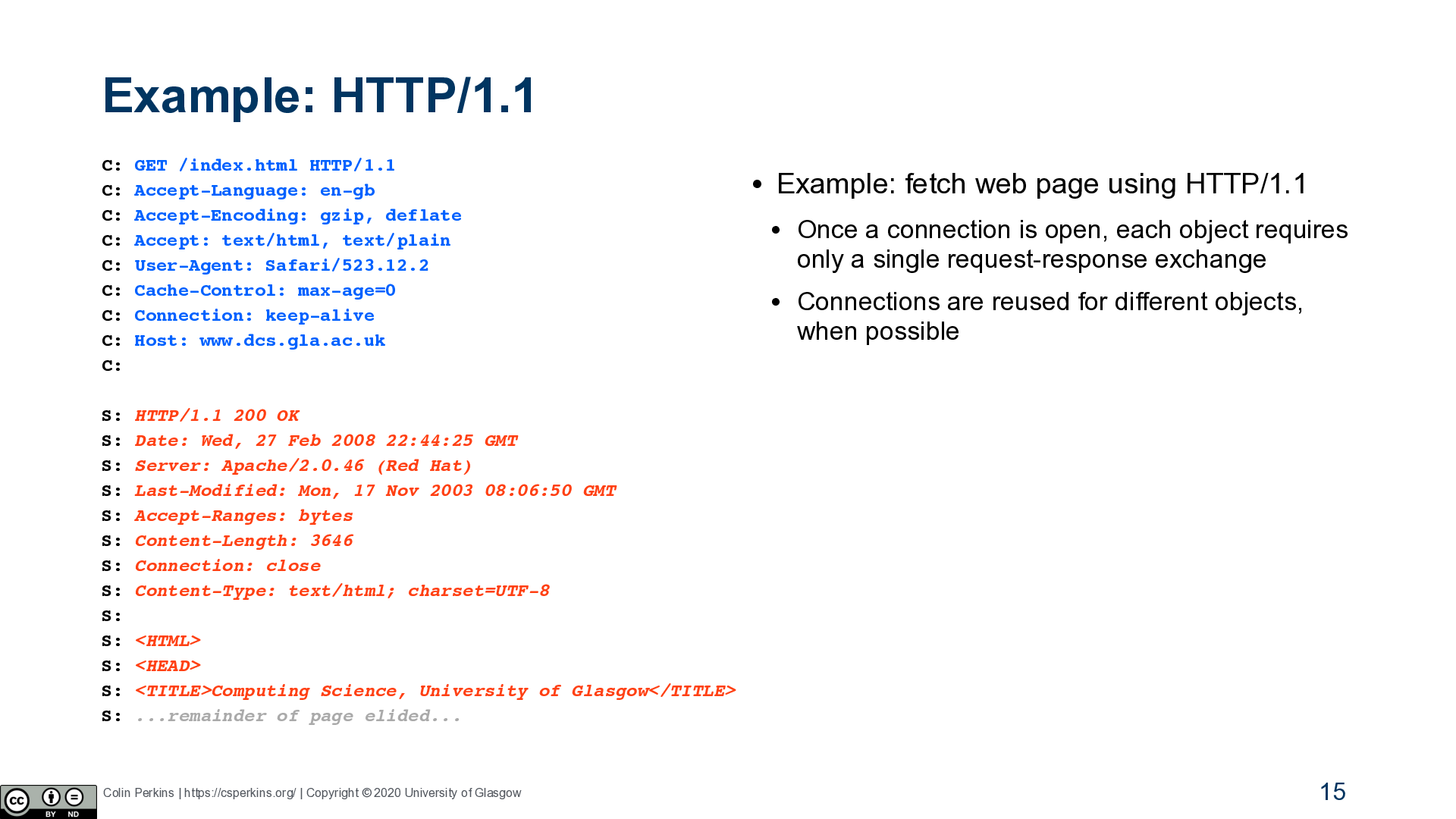
00:23:10.000
What does this mean for protocol design?
00:23:12.800
The example shows an HTTP/1.1 exchange.
00:23:15.200
Once the connection has been opened,
00:23:17.533
the client sends the data shown in
00:23:20.233
blue, prefixed with the letter “C:”,
00:23:22.533
to the server. The server then responds
00:23:25.233
with the data shown in red,
00:23:27.533
prefixed with the letter “S:”, comprising some
00:23:30.233
header information and the requested page.
00:23:32.566
Everything is completed in a single round
00:23:35.366
trip. Request. Then response.
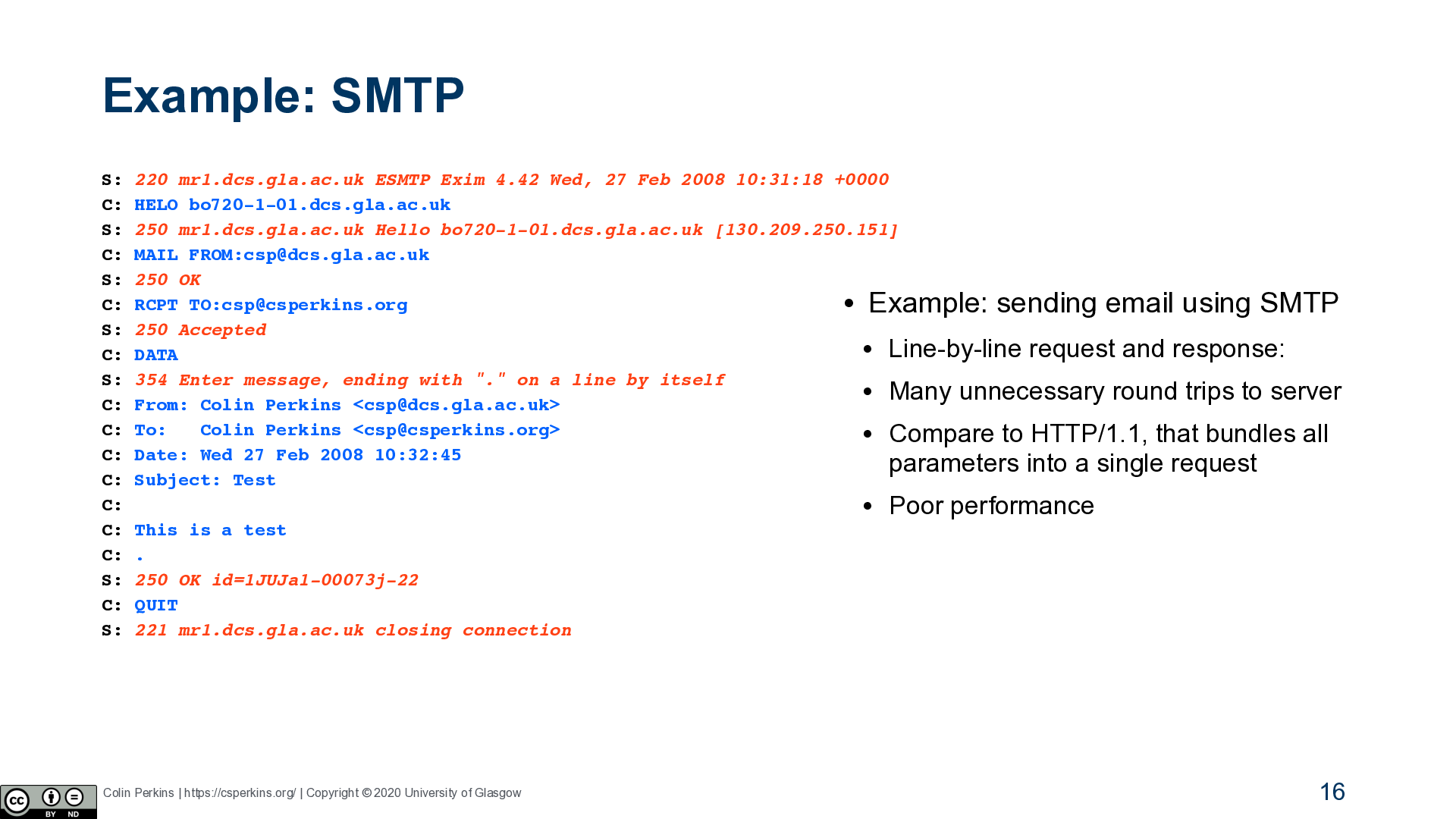
00:23:38.000
Compare that with this example, showing the
00:23:40.633
Simple Mail Transfer Protocol, SMTP, used to
00:23:43.200
send email.
00:23:43.933
As with the previous slide, data sent
00:23:46.566
from client to server is shown in
00:23:49.133
blue and prefixed with the letter “C:”,
00:23:51.666
and that sent from the server to
00:23:54.200
the client is in red, prefixed with
00:23:56.766
the letter “S:”.
00:23:57.866
We see that the protocol is very
00:24:00.500
chatty.
00:24:01.600
Once the connection is established, after the
00:24:04.266
SYN, SYN-ACK, and ACK, the server sends
00:24:06.800
an initial greeting. Establishing the connection and
00:24:09.366
sending this initial greeting takes two round trips.
00:24:12.800
The client then sends HELO, and waits
00:24:14.466
for the go ahead from the server.
00:24:16.700
This takes one more round trip.
00:24:19.166
The client then sends the from address,
00:24:21.466
and waits for the server. One more
00:24:23.966
round trip.
00:24:24.666
The client then send the recipients,
00:24:26.900
and waits for the server. One more
00:24:29.366
round trip.
00:24:30.066
The client then says it’d like to
00:24:32.666
send data now, and waits for the
00:24:35.133
server. One more round trip.
00:24:37.000
Then, finally the client gets to send
00:24:40.033
the data, and once it’s confirmed that
00:24:43.033
the data was received, sends QUIT,
00:24:45.633
waits, then closes the connection.
00:24:47.766
The whole exchange takes eight round trips.
00:24:51.000
Is this necessary or efficient?
00:24:52.866
No!
00:24:54.100
If the protocol were designed differently,
00:24:56.433
all the data could be sent at
00:24:59.066
once, as soon as the connection was
00:25:01.700
opened, and the server could respond with
00:25:04.300
an okay or an error. The eight
00:25:06.933
round trips could be reduced to two:
00:25:09.566
one to establish the connection, one to
00:25:12.166
send the message and get confirmation from
00:25:14.800
the server.
00:25:15.566
This is why email is slow to send.
00:25:19.066
TCP establishes connections using a three-way handshake.
00:25:22.166
SYN, SYN-ACK, ACK.
00:25:23.500
The time to establish a connection depends
00:25:26.766
on round trip time and the bandwidth.
00:25:30.000
Links are now fast enough that the
00:25:32.400
round trip time is generally the dominant
00:25:34.833
factor, even for relatively slow links.
00:25:37.000
The best way to improve application performance
00:25:39.366
is usually to reduce the number of
00:25:41.733
messages that need to be sent from
00:25:44.100
client to server. That is, to reduce
00:25:46.466
the number of round trips. Unless you’re
00:25:48.833
sending a lot of data, increasing the
00:25:51.200
bandwidth generally makes very little difference to
00:25:53.566
performance.
Part 2: Impact of TLS and IPv6 on Connection Establishment
The 2nd part of the lecture discusses the impact of TLS and IPv6 on
TCP connection establishment. It shows how the use of TLS, to secure
connections, increases the connection establishment latency. And it
discusses the "happy eyeballs" technique for connection racing, to
reduce connection establishment delays, in dual stack IPv4 and IPv6
networks.
00:00:00.000
In the previous part, I discussed TCP
00:00:03.366
connection establishment, and highlighted that the round-trip
00:00:05.700
time is often the limiting factor for
00:00:08.066
performance.
00:00:09.133
In the following, I want to discuss
00:00:11.600
the performance implications of adding transport layer
00:00:13.933
security to TCP connections, and how to
00:00:16.300
achieve good performance when the destination is
00:00:18.633
a dual-stack IPv4 and IPv6 host.
00:00:21.000
In the previous part, I showed how
00:00:23.566
the network round trip time can be
00:00:26.066
the limiting factor in performance. This is
00:00:28.533
because every TCP connection needs at least
00:00:31.033
two round trip times: one to establish
00:00:33.500
the connection, and one for the client
00:00:36.000
to send a request and receive a
00:00:38.466
response from the server.
00:00:39.900
I also showed how the protocol running
00:00:42.500
over TCP can make a significant difference
00:00:44.966
to performance, with the examples of HTTP,
00:00:47.466
which sends a request and receives a
00:00:49.933
response in a single round trip,
00:00:52.066
and SMTP, which makes multiple unnecessary round trips.
00:00:55.166
One of the important protocols that runs
00:00:58.133
over TCP is the transport layer security
00:01:01.266
protocol, TLS.
00:01:02.133
TLS provides security for a TCP connection.
00:01:05.366
That is, it allows the client and
00:01:08.500
server to agree encryption and authentication keys
00:01:11.633
to make sure that the data sent
00:01:14.766
over that TCP connection is confidential and
00:01:17.900
protected from modification in transit.
00:01:20.133
TLS is essential to Internet security.
00:01:23.000
When you retrieve a secure web page
00:01:25.700
using HTTPS, it first opens a TCP
00:01:28.366
connection to the server. Then, it runs
00:01:31.066
TLS to enable security for that connection.
00:01:33.766
Then, it asks to retrieve the web
00:01:36.433
page.
00:01:37.566
Depending on the version of TLS used,
00:01:40.366
this adds additional time to the connection.
00:01:43.033
With the latest version of TLS,
00:01:45.466
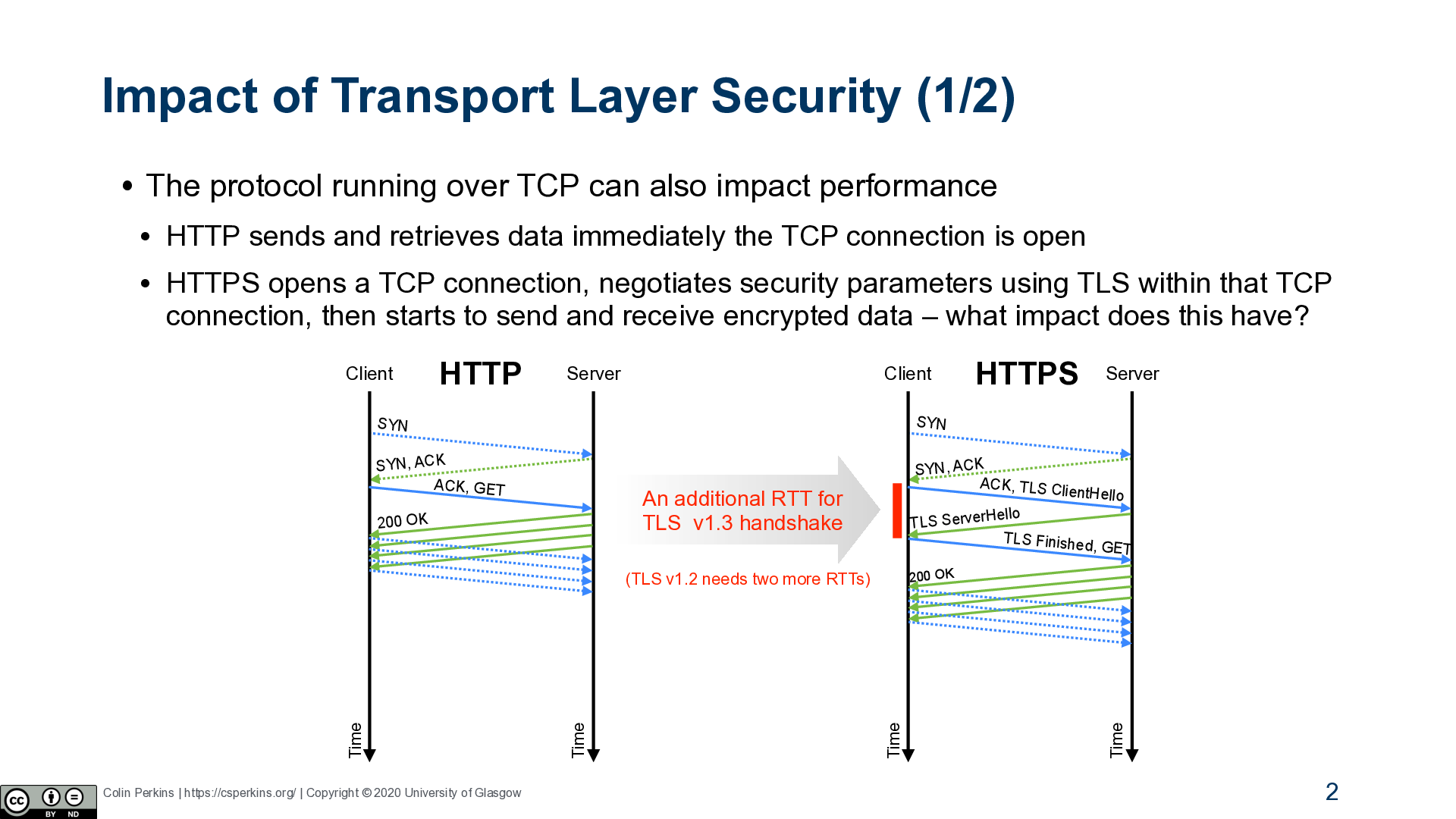
TLS v1.3, it takes one additional round
00:01:48.133
trip to agree the encryption and authentication
00:01:50.833
keys. That is, after the TCP connection
00:01:53.500
has been established, via the SYN -
00:01:56.200
SYN-ACK - ACK handshake, then the client
00:01:58.900
and server need an additional round trip
00:02:01.566
to enable TLS, before they can request data.
00:02:04.033
The TLS handshake is in three parts.
00:02:06.800
First, the client sends a TLS ClientHello
00:02:09.600
message to the server to propose security
00:02:12.400
parameters. Then, the server responds with a
00:02:15.200
TLS ServerHello, containing its keys and other
00:02:18.000
security parameters. Finally, assuming there’s a match,
00:02:20.800
the client responds with a TLS Finished
00:02:23.600
message to set the encryption parameters.
00:02:26.000
The client then immediately follows this by
00:02:28.800
sending the application data, such as an
00:02:31.600
HTTP GET request, without waiting for a
00:02:34.400
response.
00:02:35.566
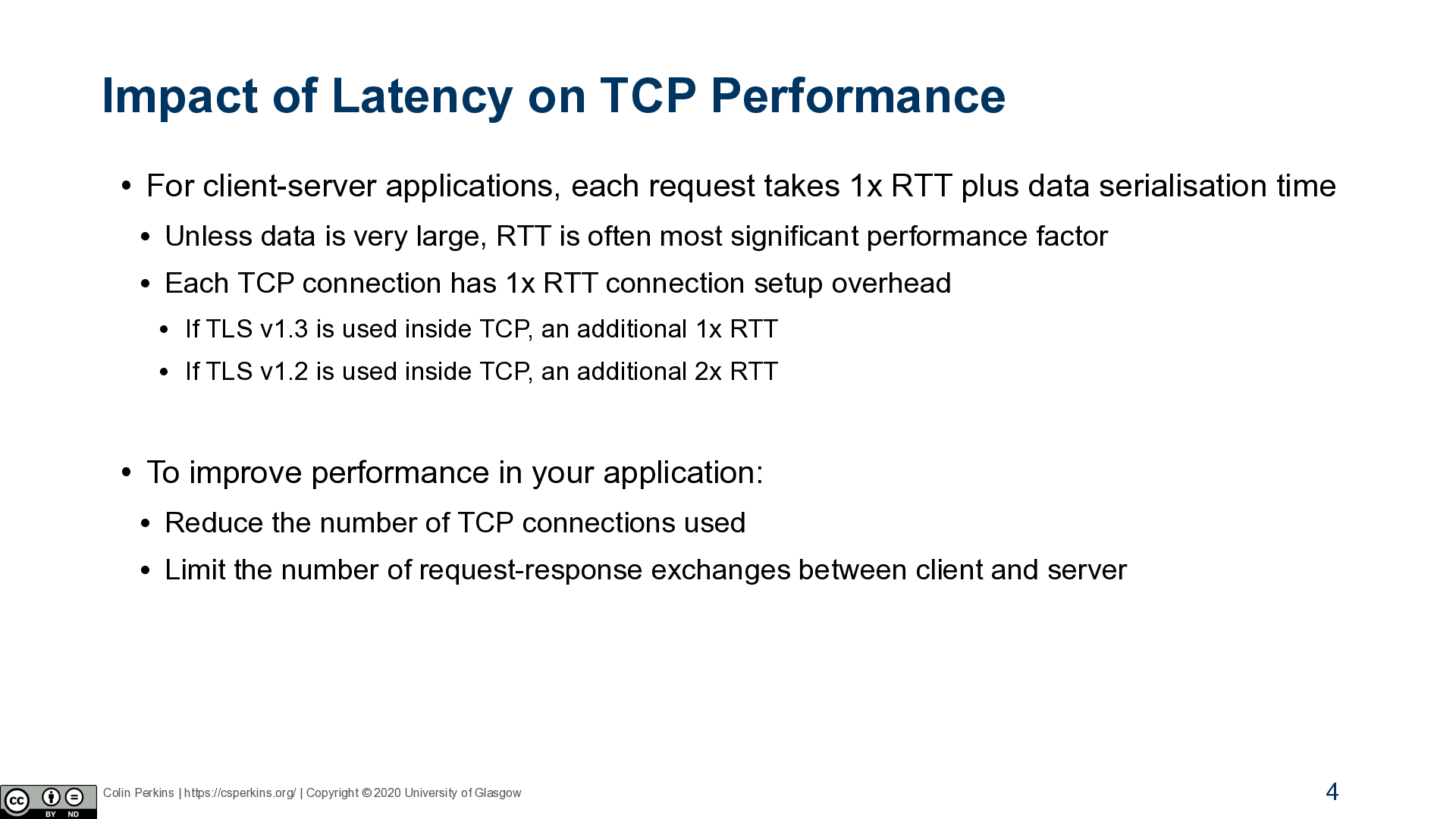
This adds one additional round trip time, in most cases.
00:02:39.100
Older versions of TLS take longer.
00:02:41.266
TLS v1.2, for example, takes at least
00:02:43.900
two round trips to negotiate a secure
00:02:46.533
connection.
00:02:48.000
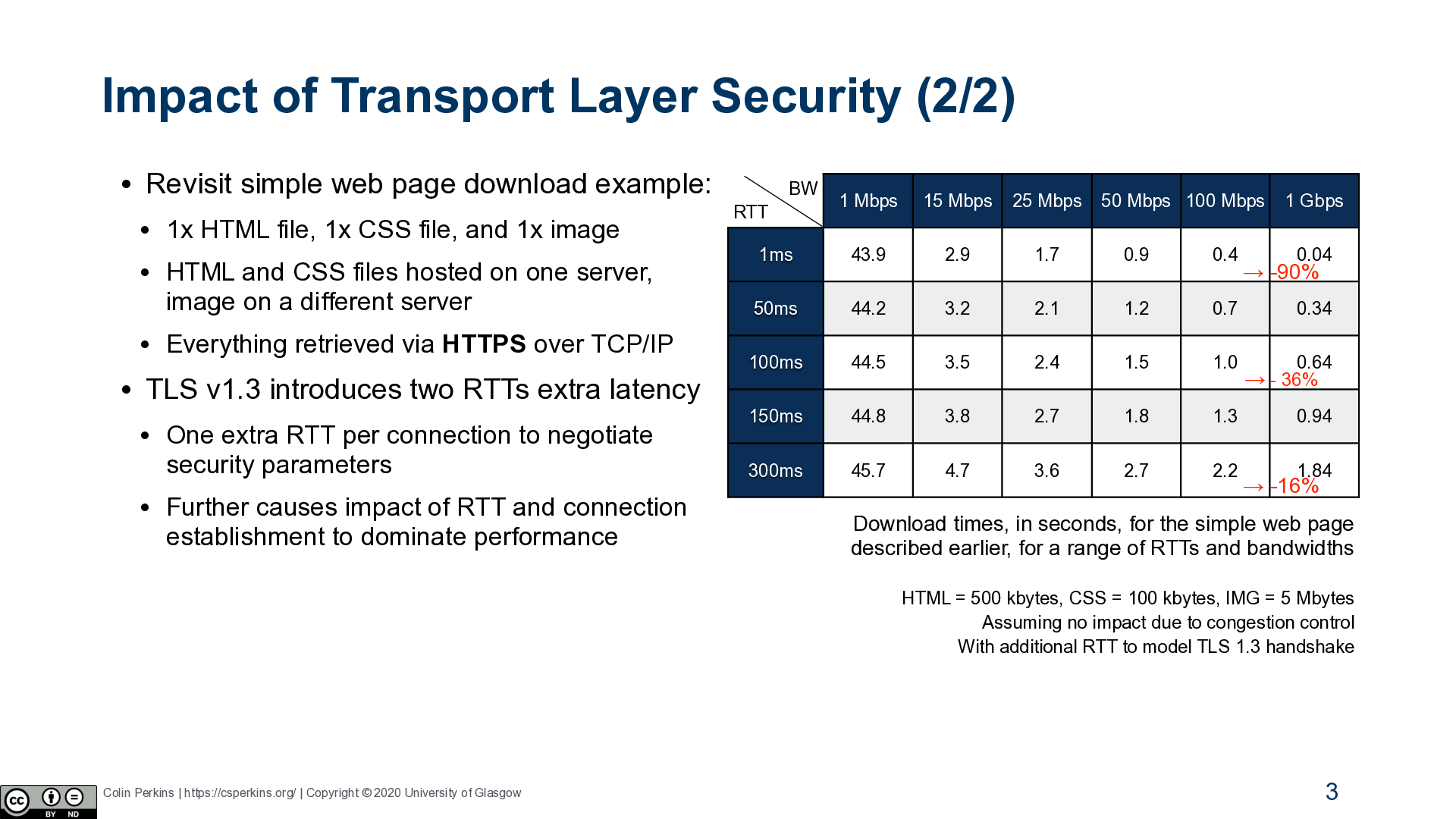
What impact does the additional round trip
00:02:50.833
due to TLS have on performance?
00:02:53.266
Well, let’s look again at the simple
00:02:56.200
web page download examples from the previous
00:02:59.033
part.
00:03:00.200
When the round-trip time is negligible,
00:03:02.733
as on the top row with 1ms
00:03:05.566
round trip time, performance is unchanged.
00:03:08.000
As we go down the table,
00:03:10.533
though, performance gets worse. With 100ms round
00:03:13.366
trip time, both the overall performance and
00:03:16.233
the benefit of increasing the link speed
00:03:19.066
go down. The download time for the
00:03:21.900
page on a gigabit link is increased
00:03:24.733
by 45%, from 0.44 to 0.64 seconds,
00:03:27.566
compared to a connection without TLS.
00:03:30.000
And the benefit of going from a
00:03:32.833
100 megabit link to a gigabit link
00:03:35.666
is only 36%, rather than 45% without
00:03:38.533
TLS.
00:03:39.666
With 300ms round trip time the behaviour
00:03:42.600
is even worse. Total download time increases
00:03:45.466
by 48% compared to the non-TLS case,
00:03:48.300
and there’s only a 22% reduction in
00:03:51.133
download time when going from a 100
00:03:53.966
megabit link to a gigabit link.
00:03:55.966
This is not to say that TLS
00:03:58.566
is bad! Far from it – security
00:04:01.133
is essential.
00:04:01.866
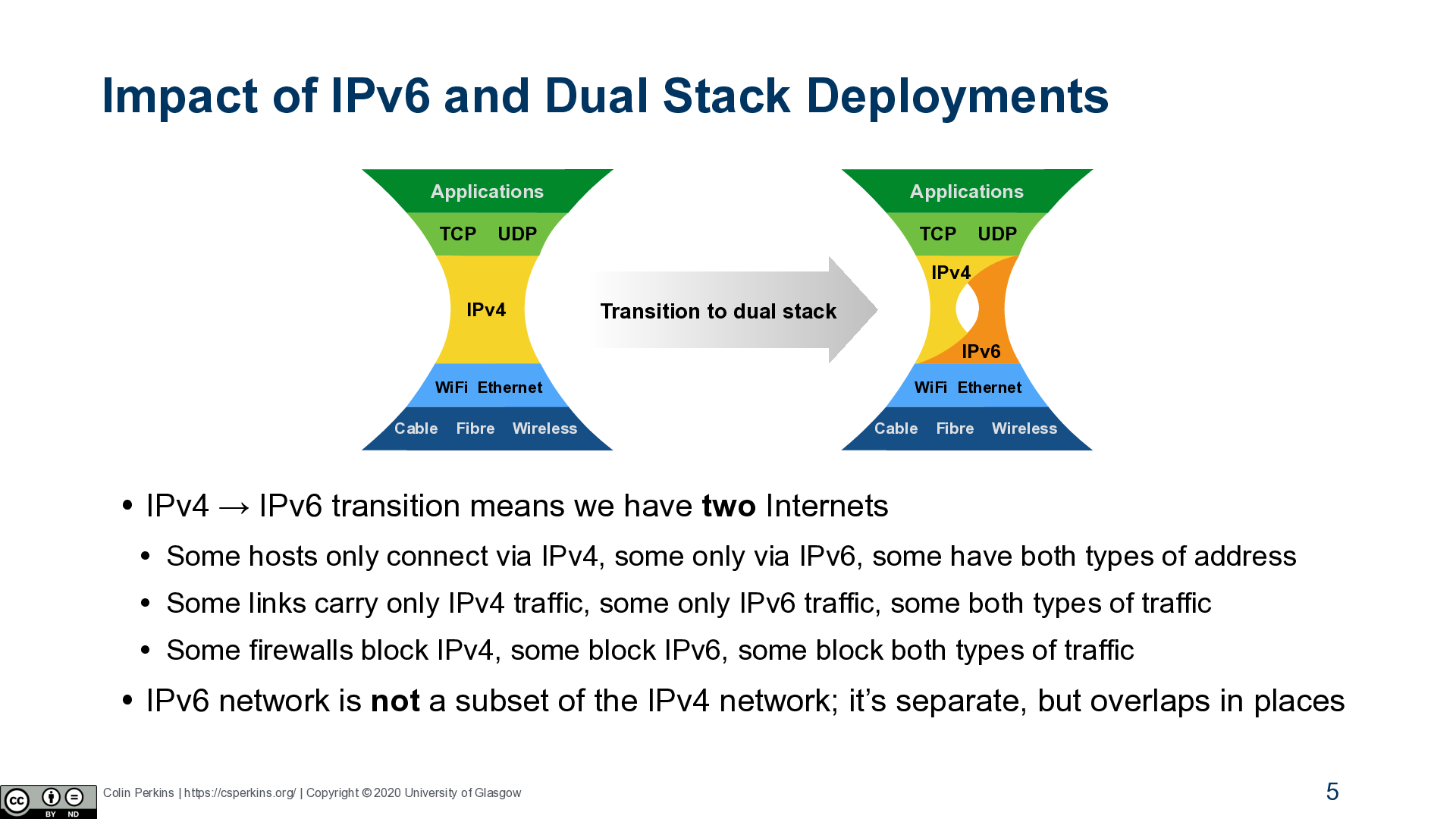
Rather, it further highlights that the number
00:04:04.533
of round trips that a connection must
00:04:07.133
perform, between client and server, is often
00:04:09.700
the limiting factor in performance.
00:04:11.533
Applications that have good performance will try
00:04:14.200
to reduce the number of TCP connections
00:04:16.766
that they establish, since each connection takes
00:04:19.333
time to establish. They also try to
00:04:21.900
limit the number of request-response exchanges,
00:04:24.100
each taking a round trip, they make
00:04:26.700
on each connection.
00:04:27.800
TLS v1.3, standardised in 2018, was a
00:04:30.466
big win here, because it reduces the
00:04:33.033
number of round trips needed to enable
00:04:35.600
security from two, down to one.
00:04:37.800
When used with TCP, this gives the
00:04:40.366
best possible performance: one round trip to
00:04:42.933
establish the TCP connection, and one to
00:04:45.500
negotiate the security, before the data can
00:04:48.100
be sent.
00:04:48.833
We’ll talk more about TLS and how
00:04:51.500
to improve the performance of secure connections
00:04:54.066
in lectures 3 and 4.
00:04:57.000
The other factor affecting TCP connection performance
00:05:00.266
is the ongoing transition to IPv6.
00:05:03.033
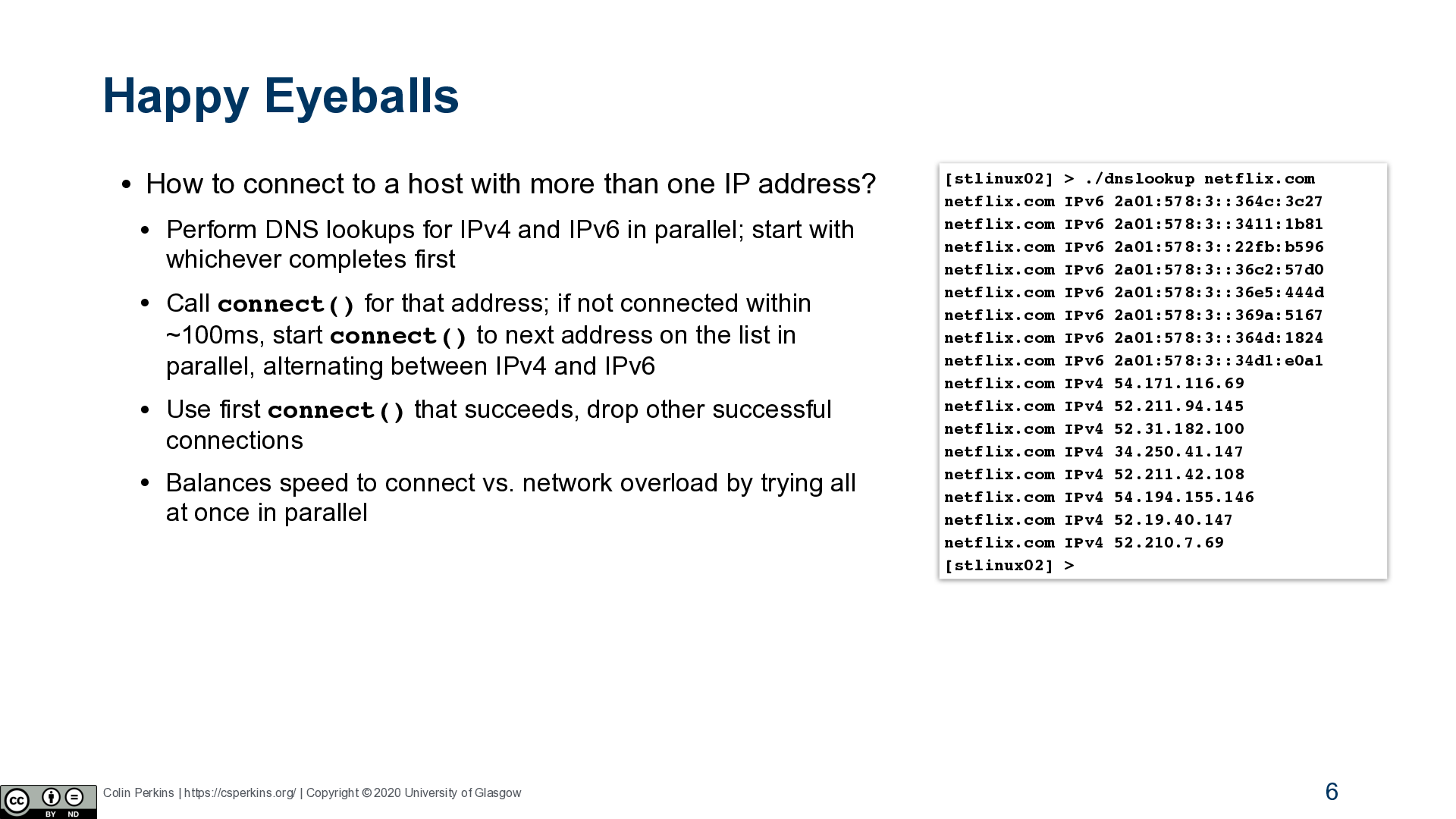
This transition means that we currently have
00:05:06.400
two Internets: the IPv4 Internet and the
00:05:09.633
IPv6 Internet.
00:05:10.566
Some hosts can only connect using IPv4.
00:05:13.933
Some hosts can only connect using IPv6.
00:05:17.166
And some hosts have both types of address.
00:05:21.066
Similarly, some network links can only carry
00:05:24.166
IPv4 traffic, some only IPv6, and some
00:05:27.333
links can carry both types of traffic.
00:05:30.500
And some firewalls, or other middleboxes,
00:05:33.333
block IPv4, some block IPv6, and some
00:05:36.500
block both types of traffic.
00:05:38.733
Importantly, the IPv6 network is not a
00:05:42.033
subset of the IPv4 network. It’s a
00:05:45.200
separate Internet, that overlaps in places.
00:05:49.000
Given that some hosts will be reachable
00:05:52.000
over IPv4 but not IPv6, and vice
00:05:54.866
versa, how do you establish connections during
00:05:57.766
the transition?
00:05:58.566
Well, given a hostname, you perform a
00:06:01.566
DNS lookup to find the IP addresses
00:06:04.433
for that host using the getaddinfo() call.
00:06:07.333
This returns a list of possible IP
00:06:10.200
addresses for the host, including both IPv4
00:06:13.100
and IPv6 addresses.
00:06:14.333
The simple approach is a loop,
00:06:16.900
trying each address in turn,
00:06:18.666
until one successfully connects.
00:06:20.733
This works, but can be very slow.
00:06:24.300
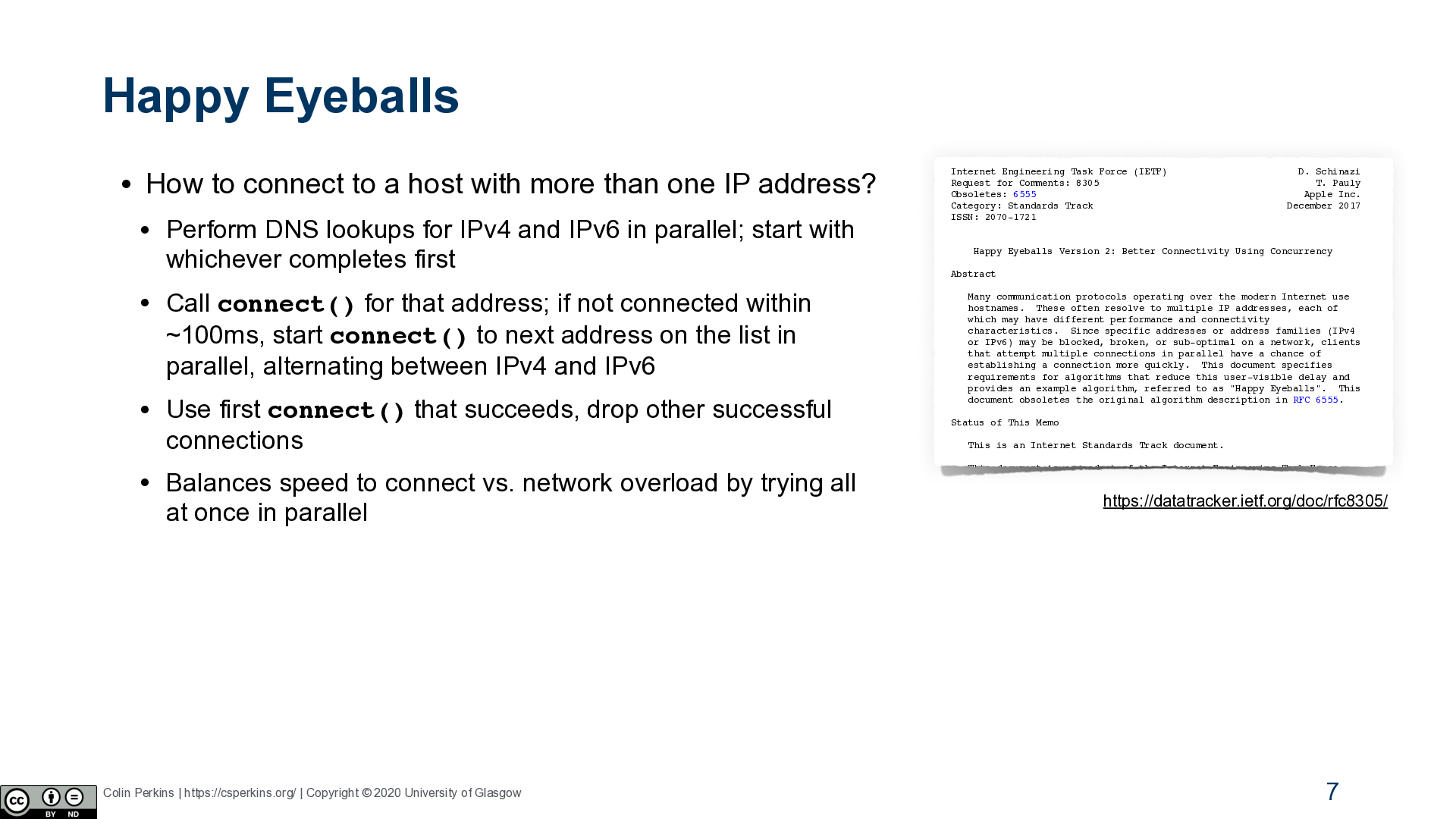
In the example on the slide,
00:06:26.066
Netflix has 16 possible IP addresses,
00:06:28.533
eight IPv6 and eight IPv4, and lists
00:06:31.433
the IPv6 addresses first in its DNS
00:06:34.300
response. If you have only IPv4 connectivity,
00:06:37.200
it may take a long time to
00:06:40.066
try, and fail, to connect to eight
00:06:42.966
different IPv6 addresses before you get to
00:06:45.833
an IPv4 address that works.
00:06:49.000
To get good performance, applications use a
00:06:52.233
technique known as “Happy Eyeballs”.
00:06:54.500
This involves making two separate DNS lookups,
00:06:57.733
in parallel, one asking for only IPv4
00:07:00.866
addresses and one for only IPv6 addresses.
00:07:04.033
Starting with whichever of these DNS lookups
00:07:07.266
completes first, the client makes a connection
00:07:10.433
to the first address returned by the
00:07:13.566
server. If that hasn’t succeeded within 100ms,
00:07:16.700
it starts another connection request to the
00:07:19.866
next possible address, alternating between IPv4 and
00:07:23.000
IPv6 addresses.
00:07:24.000
The different connection requests proceed in parallel,
00:07:27.366
until once eventually succeeds. That first successful
00:07:30.700
connection is used, whether over IPv4 or
00:07:34.066
IPv6, and the other connection requests are cancelled.
00:07:37.900
The happy eyeballs technique tries to balance
00:07:40.900
the time taken to connect vs.
00:07:43.366
the network overload of trying many possible
00:07:46.266
connections at once in parallel. It adds
00:07:49.166
complexity to the connection setup, to achieve
00:07:52.066
good performance.
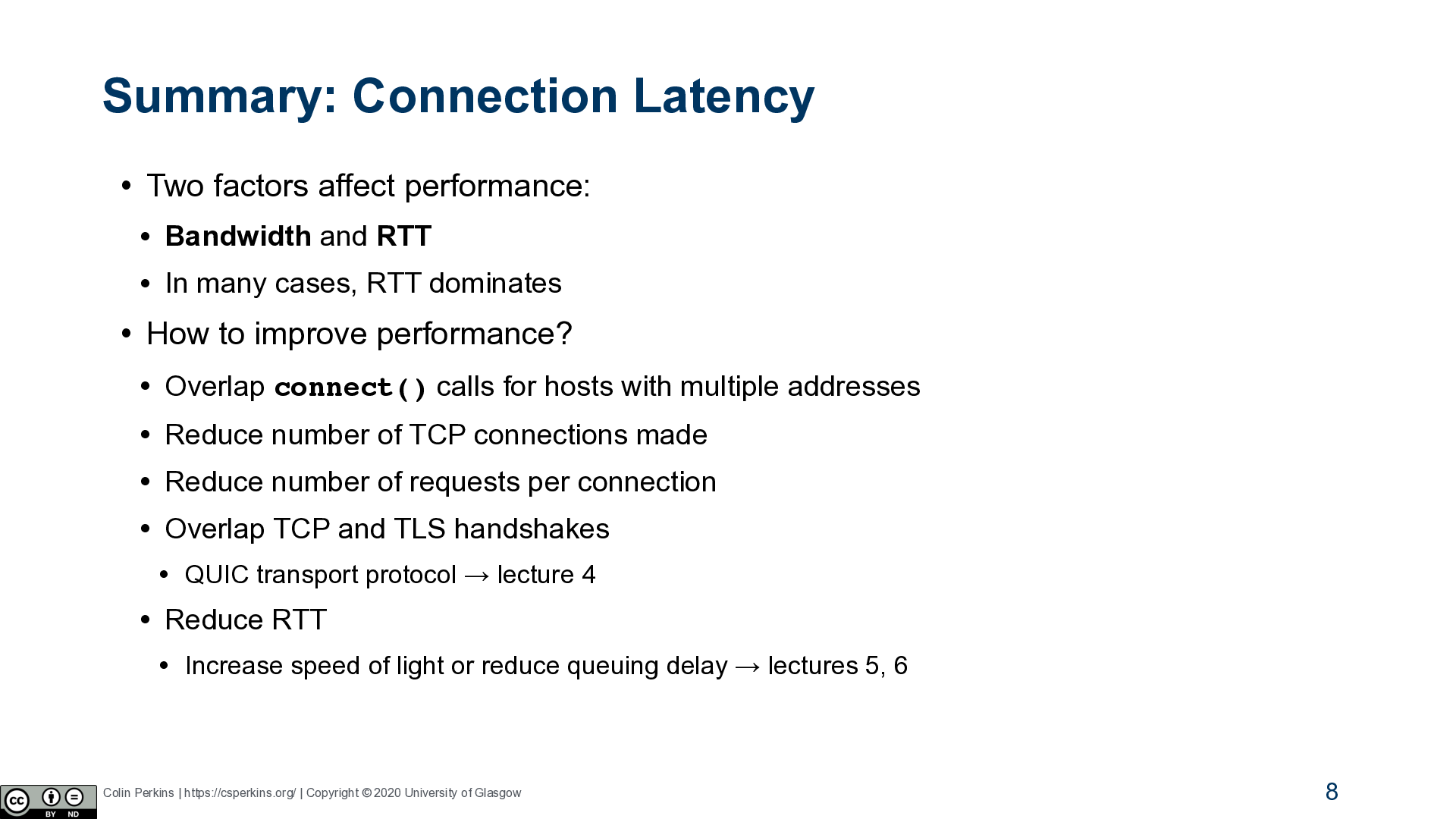
00:07:54.000
The two factors affecting TCP performance are
00:07:56.900
bandwidth and latency. In many cases,
00:07:59.300
the latency, the round trip time,
00:08:01.700
dominates.
00:08:02.866
The are five ways in which applications
00:08:05.766
using TCP improve their performance.
00:08:07.766
The first is that a client should
00:08:10.666
use something like happy eyeballs, overlapping connection
00:08:13.466
requests if the server, if the server
00:08:16.266
has more than one address. This is
00:08:18.466
more complicated to implement than trying to
00:08:20.966
connect to each different address in turn,
00:08:22.800
but connects a lot faster.
00:08:25.566
The second way to improve TCP performance
00:08:28.566
is to reduce the number of TCP
00:08:31.133
connections made. Each connection takes time to
00:08:33.700
establish. If you can make a single
00:08:36.300
TCP connection and reuse it for multiple
00:08:38.866
requests, that’s faster than making a new
00:08:41.433
connection for each request.
00:08:43.000
Third, if you reduce the number of
00:08:45.600
request-response exchanges made over each connection,
00:08:47.833
you reduce the impact of the round
00:08:50.433
trip latency.
00:08:51.166
All these are possible for any application,
00:08:53.866
by using TCP connections effectively.
00:08:55.733
There are also two more radical changes
00:08:58.400
that can be made.
00:09:00.000
The first is to overlap and TCP
00:09:02.533
and TLS connection setup handshakes, by sending
00:09:05.066
the security parameters along with the initial
00:09:07.633
connection request, so that both the connection
00:09:10.166
setup and security parameters can be negotiated
00:09:12.700
in a single round trip. This isn’t
00:09:15.233
possible with TCP, but the QUIC transport
00:09:17.766
protocol, that we’ll discuss in lecture 4,
00:09:20.333
does allow this.
00:09:21.400
Finally, one can always improve performance by
00:09:24.066
reducing the round trip latency. This latency
00:09:26.600
depends on two things: the speed at
00:09:29.133
which the signal propagates down the link,
00:09:31.666
and the amount of other traffic.
00:09:33.833
Since signals travel down electrical cables and
00:09:36.500
optical fibres at the speed of light,
00:09:39.033
there’s little that can be done to
00:09:41.566
increase the propagation speed, although low earth
00:09:44.100
orbit satellites can help, we’ll discuss in
00:09:46.633
lecture 6.
00:09:47.366
Reducing the amount of other traffic queued
00:09:50.000
up at intermediate links is a possibility
00:09:52.566
though, and this can be affected by
00:09:55.100
the choice of TCP congestion control algorithm.
00:09:57.633
We’ll talk about this in lectures 5
00:10:00.166
and 6.
00:10:02.000
To summarise, one of the limiting factors
00:10:04.900
with TCP performance is the round trip
00:10:07.666
latency.
00:10:08.833
The use of TLS is essential to
00:10:11.700
improve security, but comes at the expense
00:10:14.500
of an additional round trip that slows
00:10:17.266
down connection establishment. This is solved by
00:10:20.066
the upcoming QUIC transport protocol, that we’ll
00:10:22.833
discuss in lecture 4.
00:10:24.433
Similarly, the ongoing migration to IPv6 means
00:10:27.333
that servers often have both IPv4 and
00:10:30.100
IPv6 addresses, and it’s not clear which
00:10:32.900
of these are reachable. Clients must try
00:10:35.666
to establish multiple connections in parallel,
00:10:38.066
using the happy eyeballs technique, to get
00:10:40.866
good performance.
Part 3: Peer-to-peer Connections
The 3rd part starts to discuss peer-to-peer connections. It talks about
how the use of Network Address Translation (NAT) affects addressing and
connection establishment, and why it complicates creating peer-to-peer
applications.
00:00:00.000
In this part, I’ll start to talk
00:00:02.733
about peer-to-peer connections, network address translation,
00:00:05.666
and how these affect Internet addressing and
00:00:07.700
connection establishment.
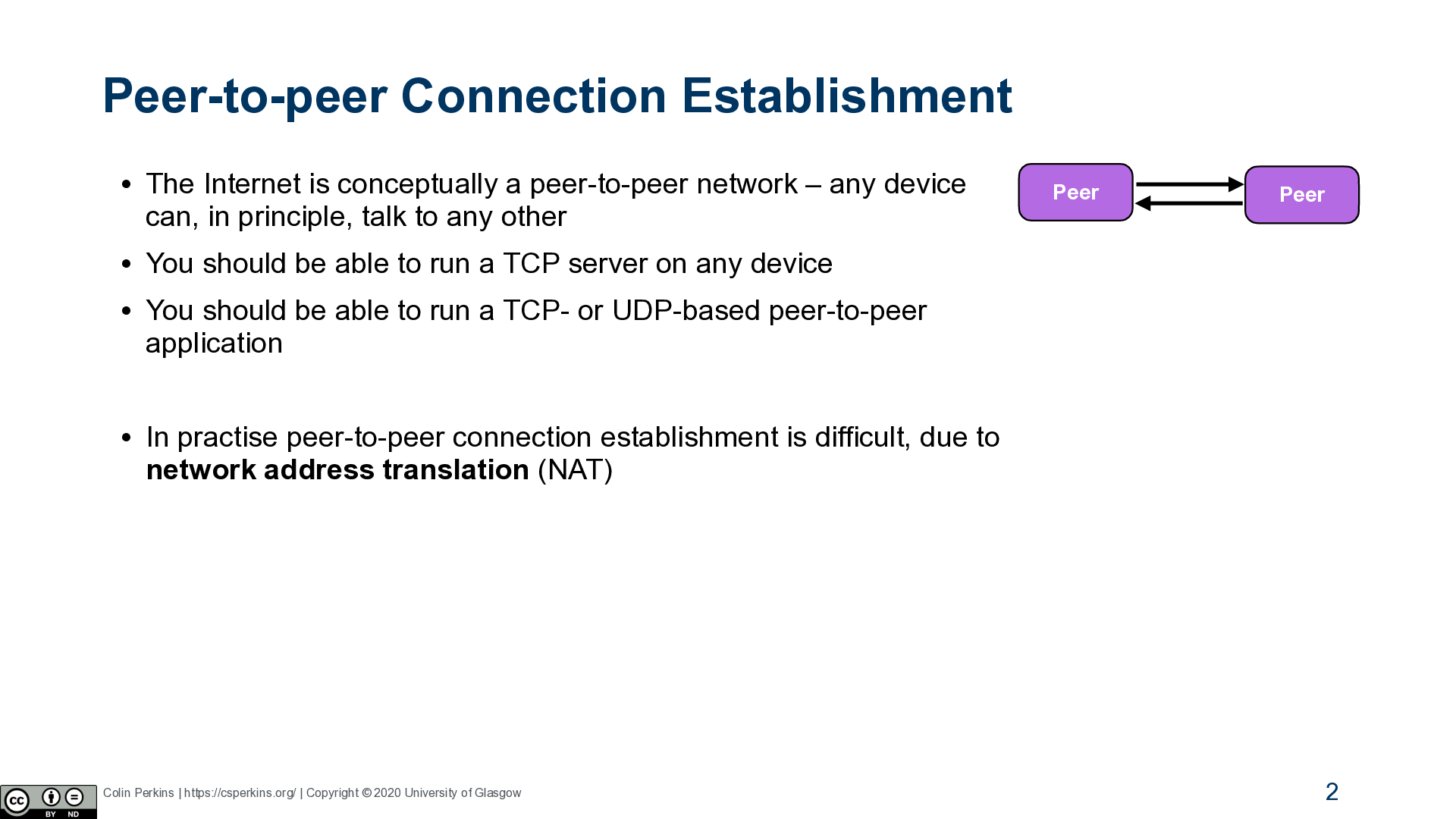
00:00:10.000
The Internet was designed as a peer-to-peer
00:00:12.366
network, and makes no distinction between clients
00:00:14.733
and servers at the IP layer.
00:00:16.733
In principle, it should be possible to
00:00:19.200
run a TCP server, or a UDP-
00:00:21.566
or TCP-based peer-to-peer application, on any host
00:00:23.933
on the network. As long as the
00:00:26.300
clients have some way of finding the
00:00:28.666
server’s IP address, and knowing what port
00:00:31.000
number it’s using, and as long as
00:00:33.366
any firewall pinholes are opened, then it
00:00:35.733
shouldn’t matter whether a server is located
00:00:38.100
in someone’s home or in a data
00:00:40.466
centre.
00:00:41.533
A server in a data centre is
00:00:44.000
likely to have better performance, of course,
00:00:46.366
because it’s probably got a faster connection
00:00:48.433
to the rest of the network.
00:00:49.933
It’s also likely to be more robust,
00:00:52.666
because the data centre will have redundant
00:00:55.333
power and network links, air conditioning,
00:00:57.600
and professional system administrators. But, at the
00:01:00.266
protocol level, there shouldn’t be a difference.
00:01:02.933
In practise, this is not the case.
00:01:05.700
It’s difficult to run a server on
00:01:08.366
a host connected to most residential broadband
00:01:11.033
connections, and it’s difficult to make peer-to-peer
00:01:13.700
connections work.
00:01:14.466
The reason for this is the widespread
00:01:17.233
use of network address translation – NAT.
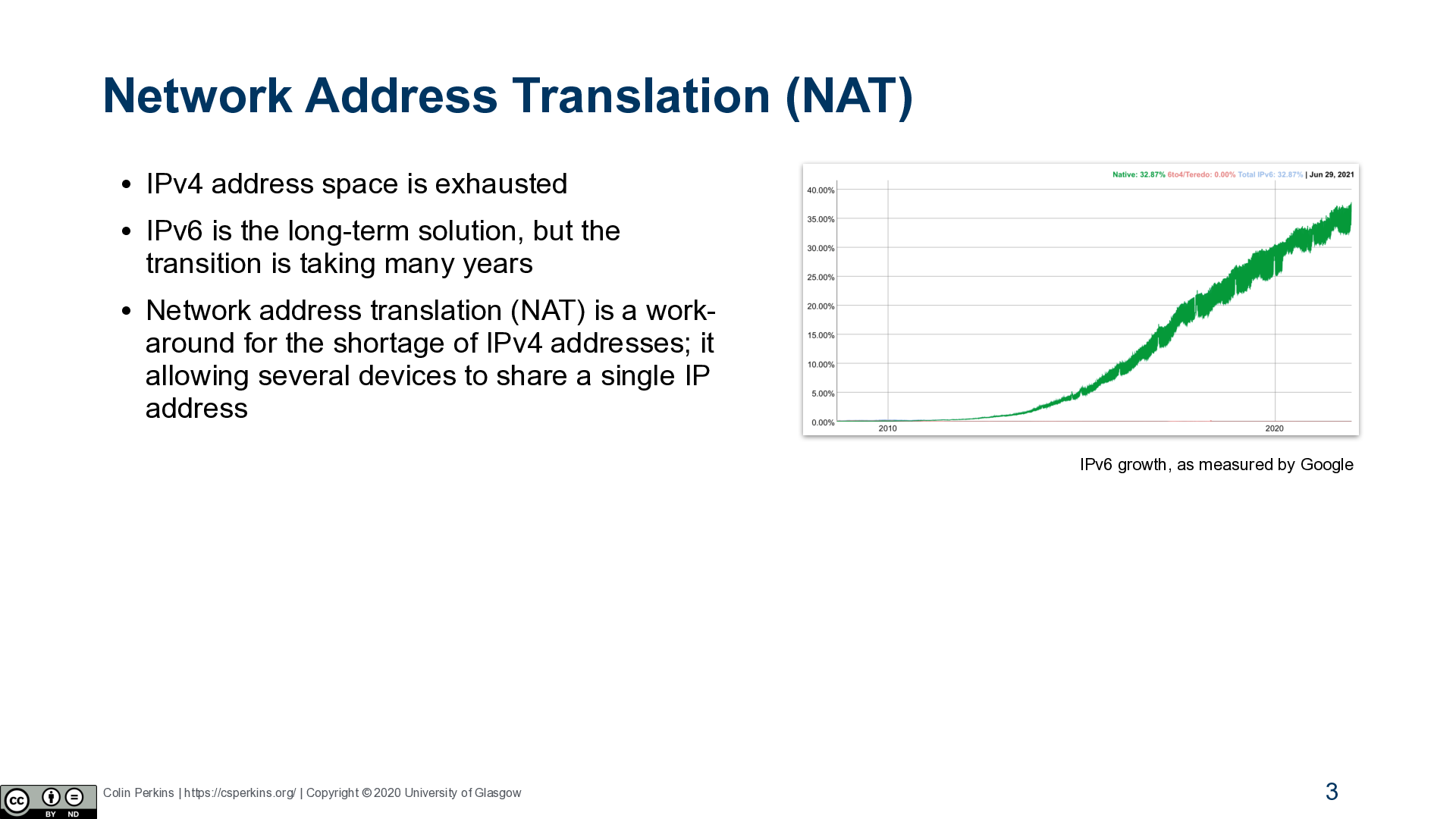
00:01:21.000
What is network address translation?
00:01:22.966
NAT is the process by which several
00:01:25.833
devices can share a single public IP
00:01:28.600
address. It allows several hosts to form
00:01:31.366
a private internal network, with IP addresses
00:01:34.133
assigned from a special-use range. One device
00:01:36.900
– the network address translator, the NAT
00:01:39.666
– is connected to both the private
00:01:42.466
network and to the Internet, and can
00:01:45.233
forward packets between the two networks.
00:01:47.600
As it does so, it rewrites,
00:01:49.966
translates, the IP addresses, and the TCP
00:01:52.733
and UDP port numbers, so all the
00:01:55.500
packets appear to come from the NAT’s
00:01:58.266
IP address.
00:01:59.066
Essentially, it hides an entire private network
00:02:01.933
behind a single IP address.
00:02:04.000
This is useful because there aren’t enough
00:02:06.400
IPv4 addresses for every device that wants
00:02:08.766
to connect to the network, and because
00:02:11.166
it’s taking a long time to deploy IPv6.
00:02:14.033
NAT is a work around, to let
00:02:17.166
you keep using IPv4 devices, with some
00:02:20.300
limitations, even though there aren’t enough IPv4
00:02:23.466
addresses.
00:02:25.000
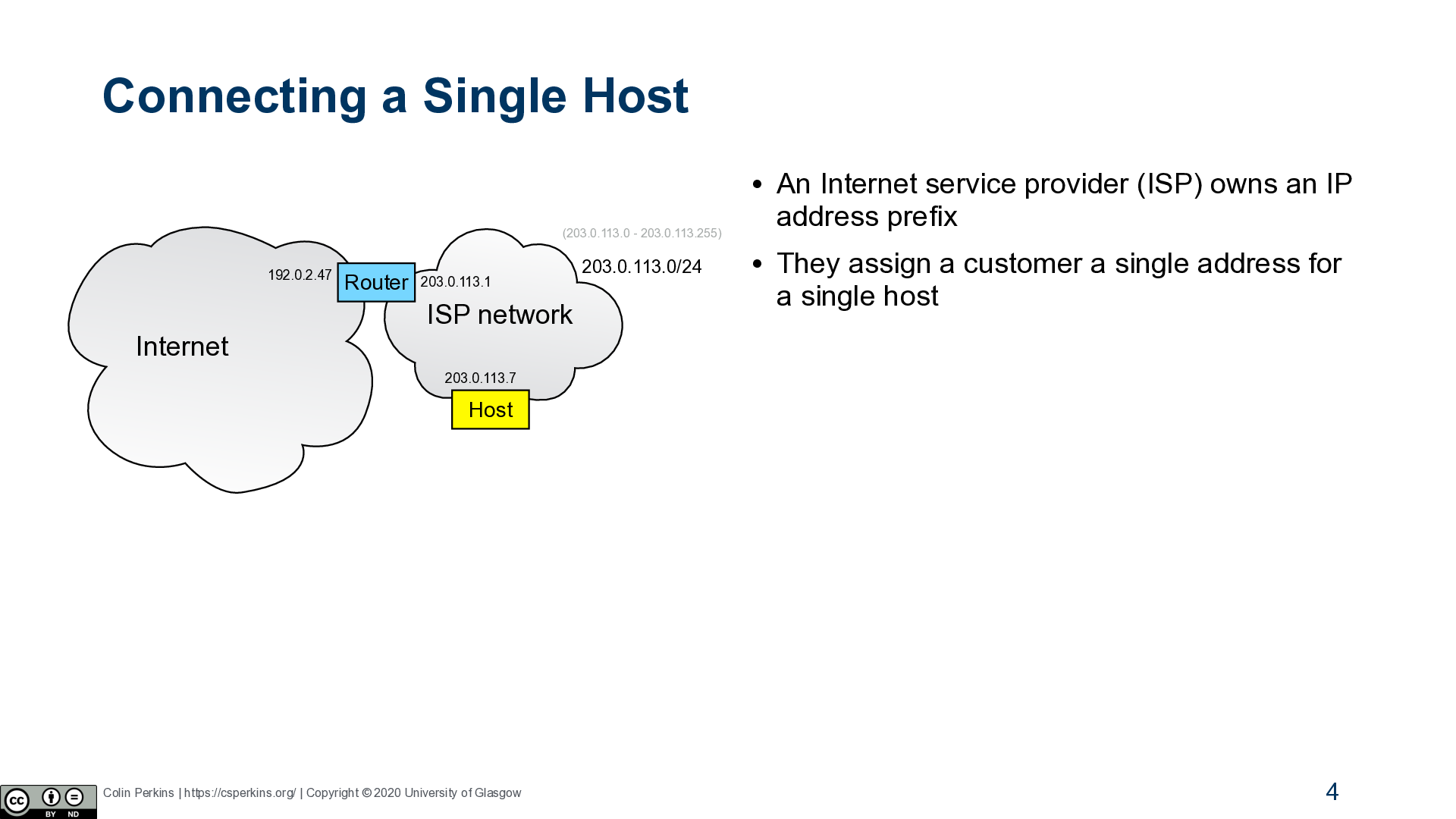
How does NAT work? Well, let’s first
00:02:27.766
step back, and think about how a
00:02:30.533
single host connects to the network.
00:02:33.000
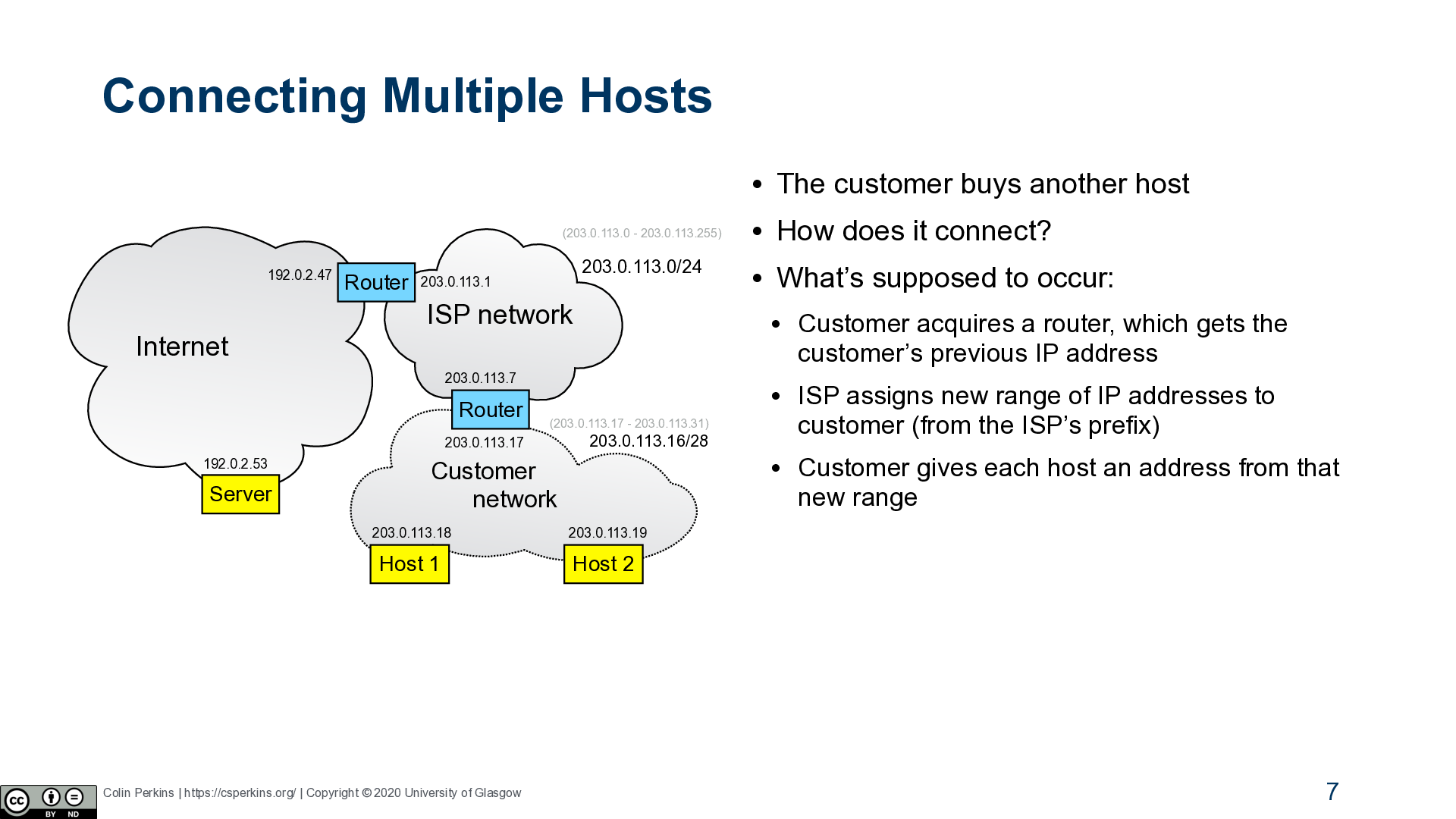
In the figure, a customer owns a
00:02:35.666
single host. That host connects to a
00:02:38.333
network run by an Internet service provider.
00:02:41.000
That ISP, in turn, connects to the
00:02:44.033
broader Internet.
00:02:45.000
The ISP owns a range of IP
00:02:47.333
addresses that it can assign to its customers.
00:02:50.066
In this example, it owns the IPv4
00:02:53.866
prefix 203.0.113.0/24. That is, the set of
00:02:57.733
IPv4 addresses where the first 24 bits,
00:03:01.600
known as the network part of the
00:03:05.466
address, match those of 203.0.113.0 are assigned
00:03:09.333
to the ISP.
00:03:11.000
These are the IPv4 addresses in the
00:03:17.933
range 203.0.113.0 to 203.0.113.255.
00:03:22.000
The address with the host part equal
00:03:24.533
to zero represents the network, and cannot
00:03:27.033
be assigned to a device. The ISP
00:03:29.566
assigns the first usable IP address in
00:03:32.100
the range, 203.0.113.1, to the internal network
00:03:34.600
interface of the router that connects it
00:03:37.133
to the rest of the network,
00:03:39.300
and assigns the rest of the addresses
00:03:41.833
to customer machines.
00:03:43.000
One particular customer is assigned IP address
00:03:46.100
203.0.113.7 for their device.
00:03:47.900
The external, Internet-facing, side of the router
00:03:51.100
that connects the ISP to the rest
00:03:54.233
of the network has an IP address
00:03:57.333
assigned by the network to which the
00:04:00.466
ISP connects. In this example, it gets
00:04:03.566
IP address 192.0.2.47.
00:04:06.000
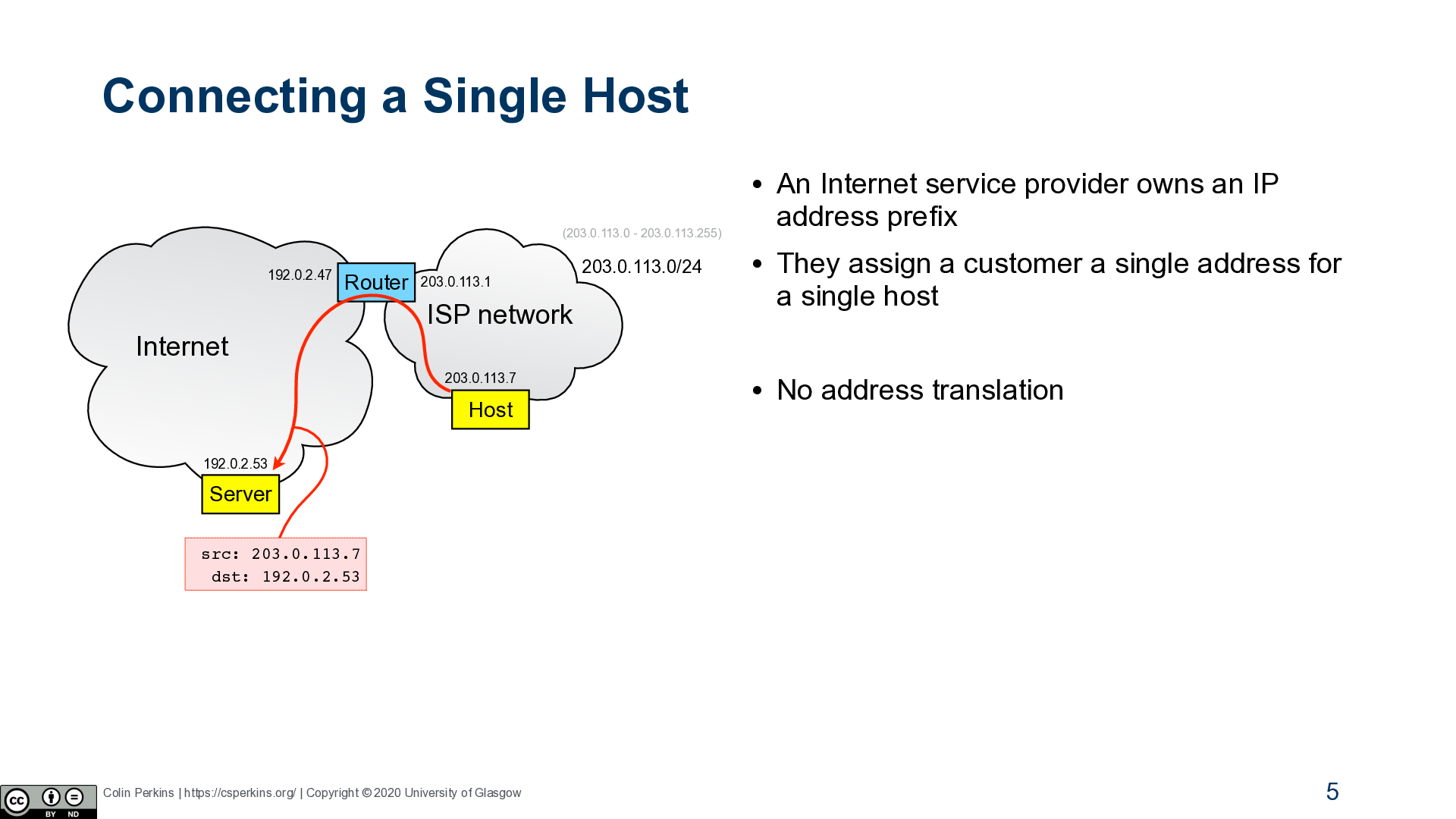
The customer’s host connects to a server
00:04:09.800
on the Internet. The server happens to
00:04:13.633
have IP address 192.0.2.53.
00:04:15.800
The customer’s host sends packets that have
00:04:19.733
their destination IP address equal to that
00:04:23.533
of the server, 192.0.2.53, and source IP
00:04:27.366
address equal to that of the customer’s
00:04:31.166
host, 203.0.113.7.
00:04:32.266
Those packets travel through the network without
00:04:36.166
change, and when they arrive that the
00:04:40.000
server, they still have destination IP address
00:04:43.800
192.0.2.53 and source IP address 203.0.113.7.
00:04:47.066
When it sends a reply, the server
00:04:51.000
will set the destination IP address to
00:04:54.800
that of the customer’s device, 203.0.113.7,
00:04:58.066
and use its own address, 192.0.2.53,
00:05:01.366
as the source IP address.
00:05:04.066
No address translation takes place.
00:05:08.000
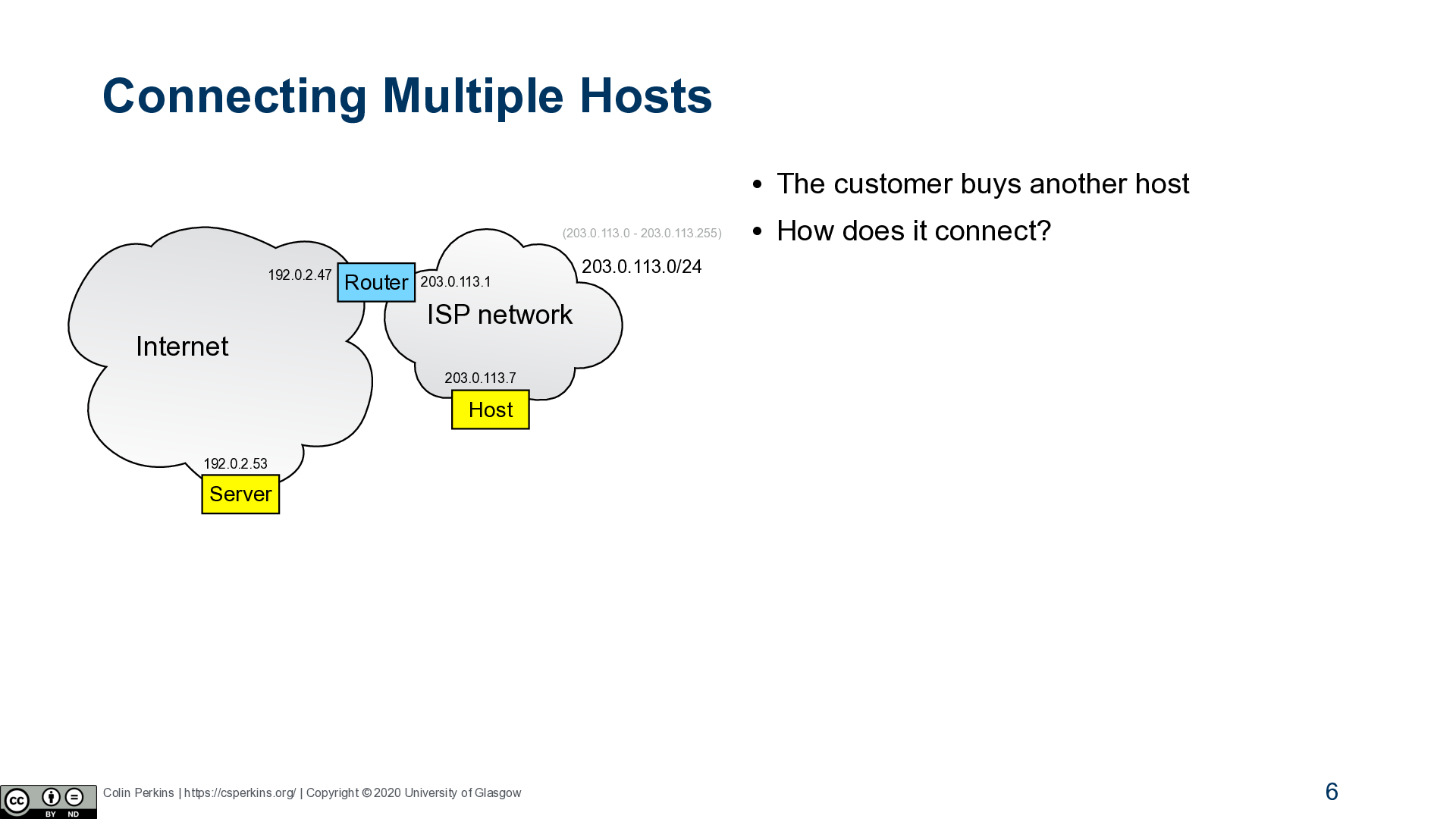
At some point later, the customer buys
00:05:11.033
another host. How does it connect to
00:05:14.033
the network?
00:05:15.000
What’s supposed to happen is as follows.
00:05:17.666
First, the customer buys an IP router,
00:05:20.433
or is given one by the ISP.
00:05:23.133
The router is used to create an
00:05:25.800
internal network for the customer, that connects
00:05:28.466
to the ISP’s network.
00:05:30.000
This could be an Ethernet, a WiFi
00:05:33.433
network, or whatever.
00:05:35.000
The external interface of that router,
00:05:38.266
that connects the customer to the ISP,
00:05:42.066
inherits the IP address that was previously
00:05:45.900
assigned to the customer’s single device,
00:05:49.133
in this case 203.0.113.7.
00:05:51.333
The ISP also assigns a new IP
00:05:55.233
address range to the customer. This will
00:05:59.033
be a subset of the IP address
00:06:02.866
range the ISP owns. In this example,
00:06:06.666
the customer is assigned the IP address
00:06:10.466
range 203.0.113.16/28. That is, IP addresses where
00:06:14.266
the first 28 bits match those of
00:06:18.100
203.0.113.16, namely the range 203.0.113.16 to 203.0.113.31.
00:06:22.000
The customer assigns the first usable address
00:06:25.933
in that range, 203.0.113.17, to the internal
00:06:29.866
network interface of the router, and assigns
00:06:33.800
other addresses to their two hosts.
00:06:37.166
In this example, the two hosts are
00:06:41.100
given addresses 203.0.113.18 and 203.0.113.19.
00:06:44.000
The end result is that the ISP
00:06:46.133
delegates some of the IP addresses they
00:06:48.266
own to their customer, and the customer
00:06:50.366
uses them in their network.
00:06:53.000
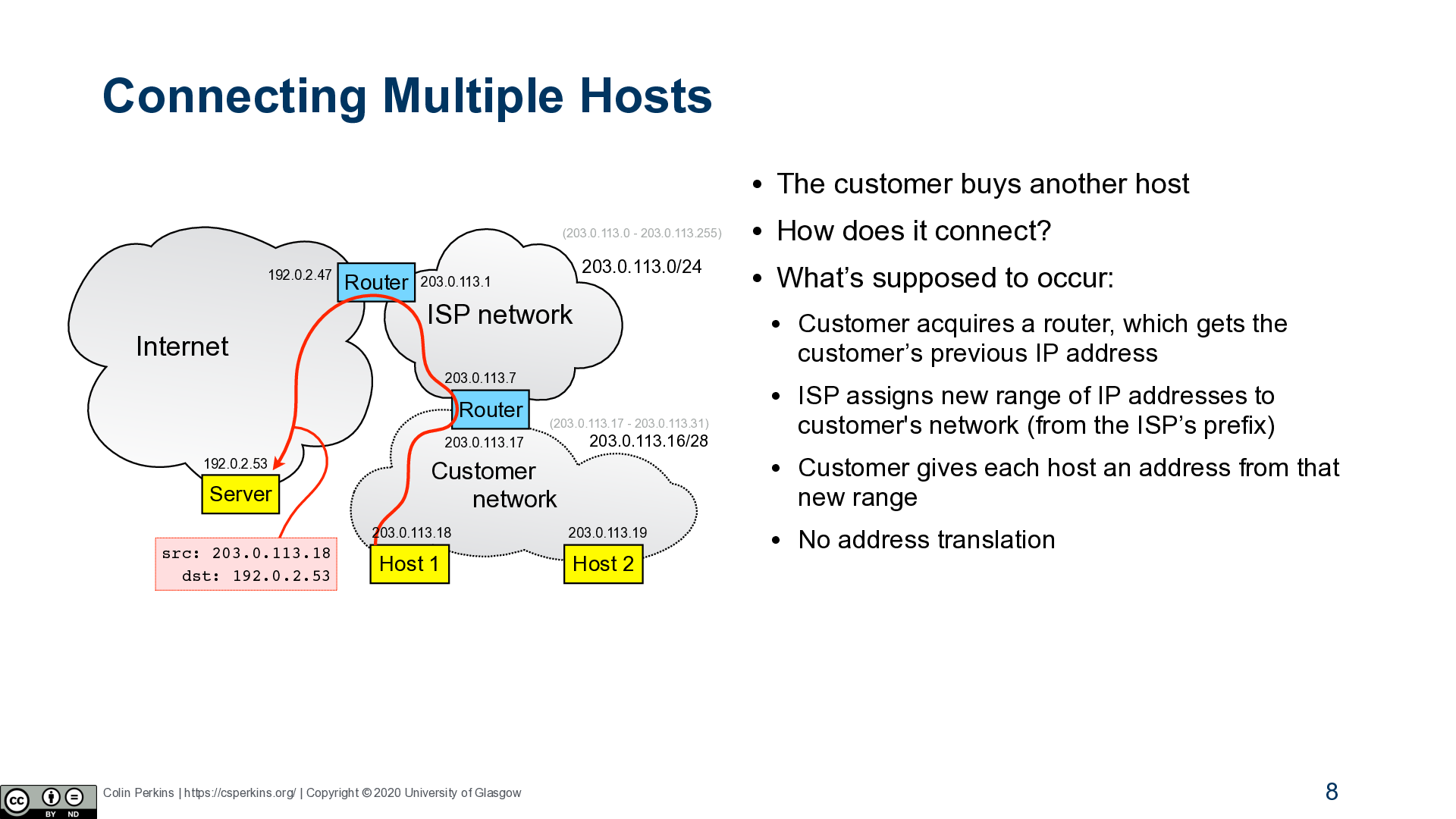
One of the customer’s hosts connects to
00:06:56.133
a server on the Internet.
00:06:58.366
As expected, to do so, that host
00:07:01.600
sends an IP packet with the source
00:07:04.733
IP address set to its IP address,
00:07:07.866
in this case 203.0.113.18, and the destination
00:07:11.000
address set to the IP address of
00:07:14.133
the server, 192.0.2.53.
00:07:15.466
That packet travels through the customer’s network
00:07:18.700
to its router, and is forwarded on
00:07:21.833
to the ISP’s network. It traverses the
00:07:24.966
ISP’s network to the router connecting the
00:07:28.100
ISP to the Internet, and is forwarded
00:07:31.233
on from there to the Internet.
00:07:33.933
Eventually, the packet arrives at the server.
00:07:37.066
When it arrives, it still has destination
00:07:40.200
address equal to that of the server,
00:07:43.333
192.0.2.53, and source address equal to that
00:07:46.466
of the host that sent it,
00:07:49.133
203.0.113.18.
00:07:50.333
When it sends a reply, the server
00:07:53.566
will set the destination IP address to
00:07:56.700
that of the customer’s device, 203.0.113.18 and
00:07:59.833
use its own address, 192.0.2.53, as the
00:08:02.966
source IP address.
00:08:04.300
No address translation takes place.
00:08:07.000
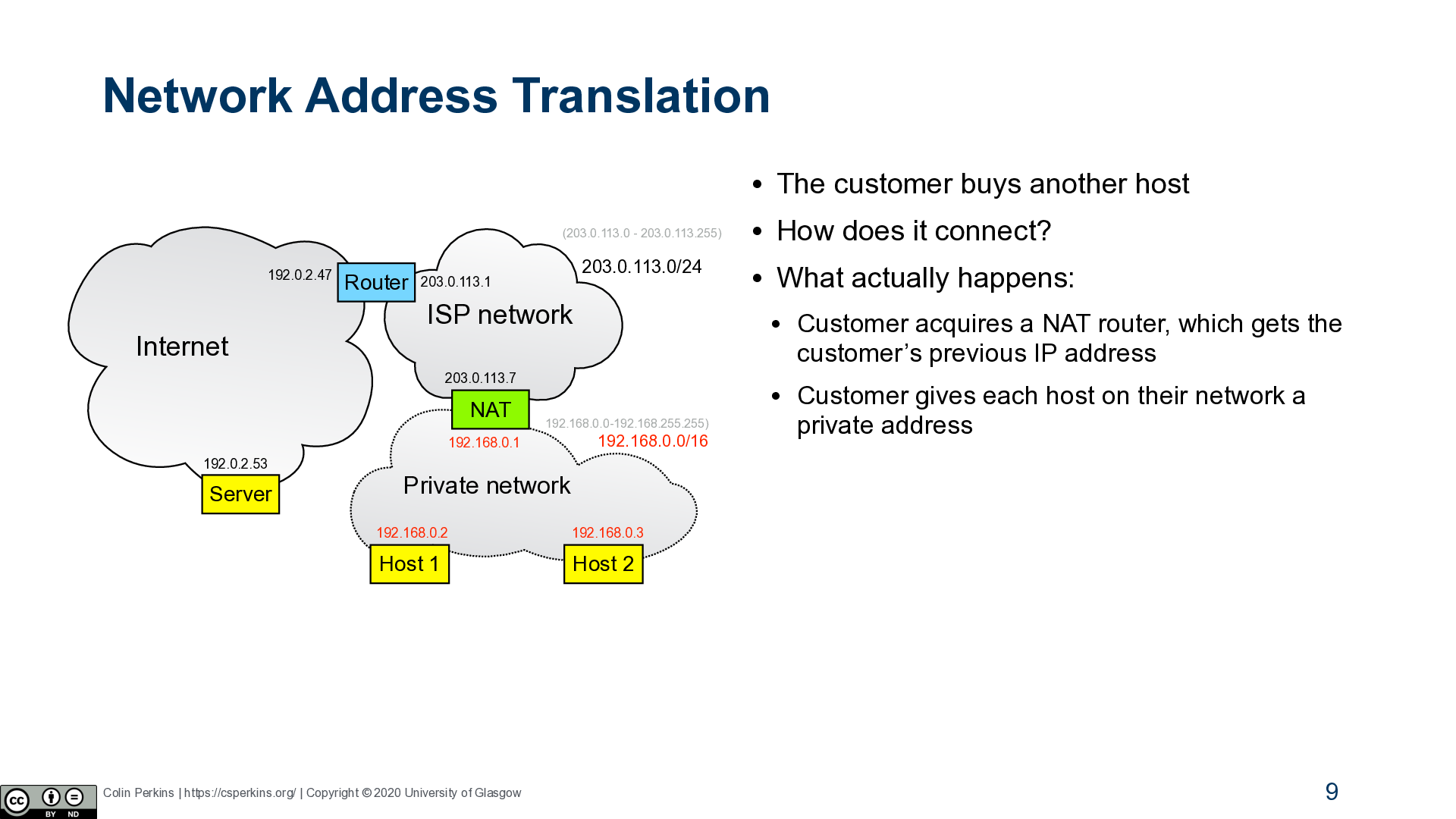
That’s what’s supposed to happen, but what
00:08:09.733
actually happens?
00:08:10.500
Well, most likely the ISP either doesn’t
00:08:13.300
have enough IPv4 addresses to delegate some
00:08:16.033
of them to their customer, or they
00:08:18.766
want to charge a lot extra to
00:08:21.466
do so.
00:08:22.266
Accordingly, the customer buys a network address
00:08:25.066
translator, and connects it to the ISP’s
00:08:27.800
network in place of their single original host.
00:08:31.100
The external interface of the NAT gets
00:08:34.533
the IP address assigned to the customer’s
00:08:38.066
original host, 203.0.113.7.
00:08:39.600
The customer sets up their internal network
00:08:43.233
as before, but instead of using IP
00:08:46.766
addresses assigned by their ISP, they use
00:08:50.300
one of the private IP address ranges.
00:08:53.833
@ 08:50 In this example, they use
00:08:57.366
addresses in the range 192.168.0.0 to 192.168.255.255.
00:09:01.000
The internal interface of the NAT is
00:09:05.500
given IP address 192.168.0.1, and the two
00:09:10.033
hosts get addresses 192.16.0.2 and 192.168.0.3.
00:09:15.000
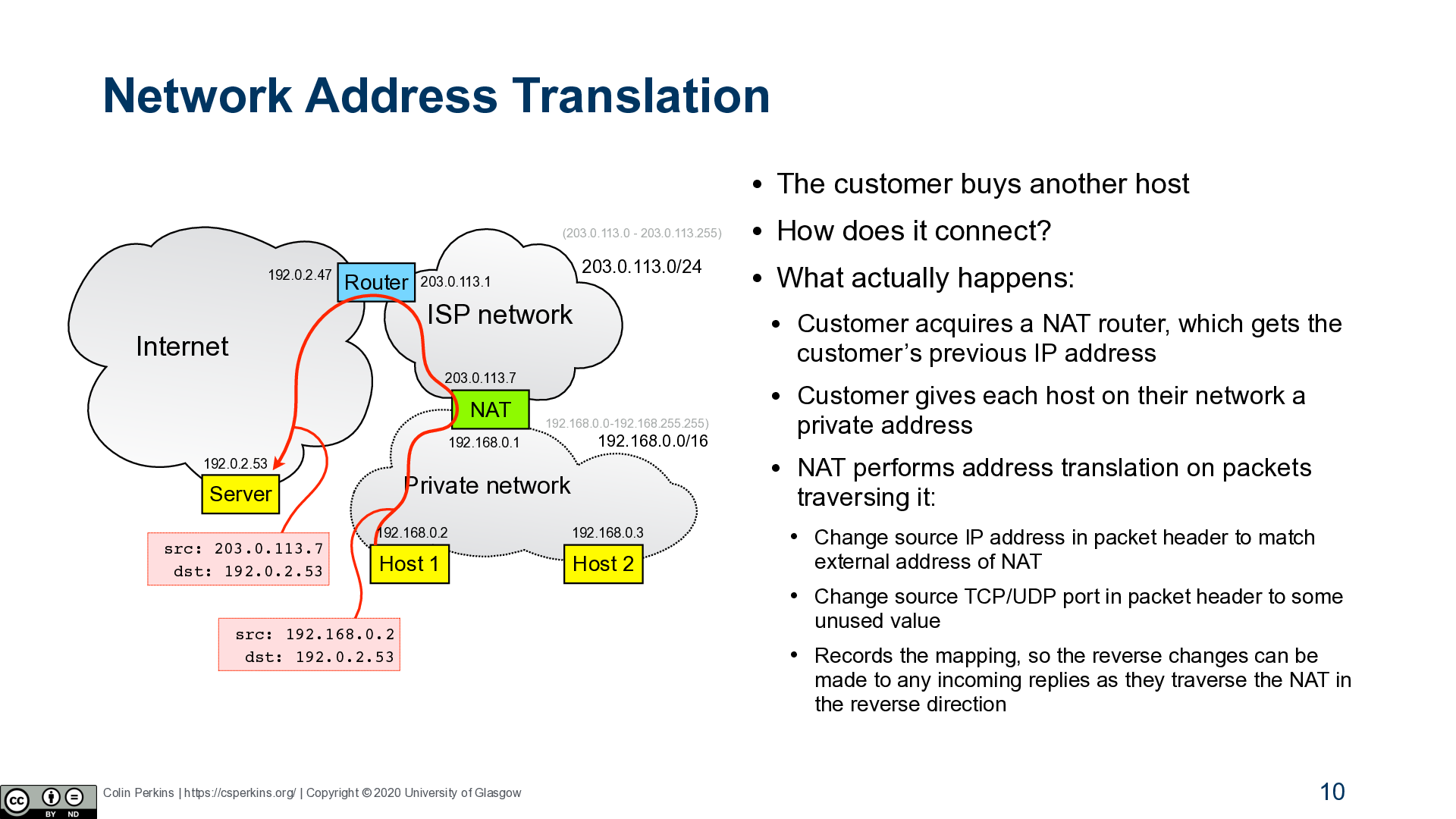
One of the customer’s hosts again connects
00:09:18.333
to a server on the Internet.
00:09:21.166
As expected, that host sends an IP
00:09:24.600
packet with the source IP address set
00:09:27.933
to its IP address, in this case
00:09:31.266
192.168.0.2, and the destination address set to
00:09:34.566
the IP address of the server, 192.0.2.53.
00:09:38.166
That packet travels through the customer’s network
00:09:40.666
to its NAT router. The NAT rewrites
00:09:43.333
the source address of the packet to
00:09:46.000
match the external address of the NAT,
00:09:48.700
in this case 203.0.113.7, and also rewrites
00:09:51.366
the TCP or UDP port number to
00:09:54.033
some new port number that’s unused on
00:09:56.700
the NAT, and forwards the packet on
00:09:59.366
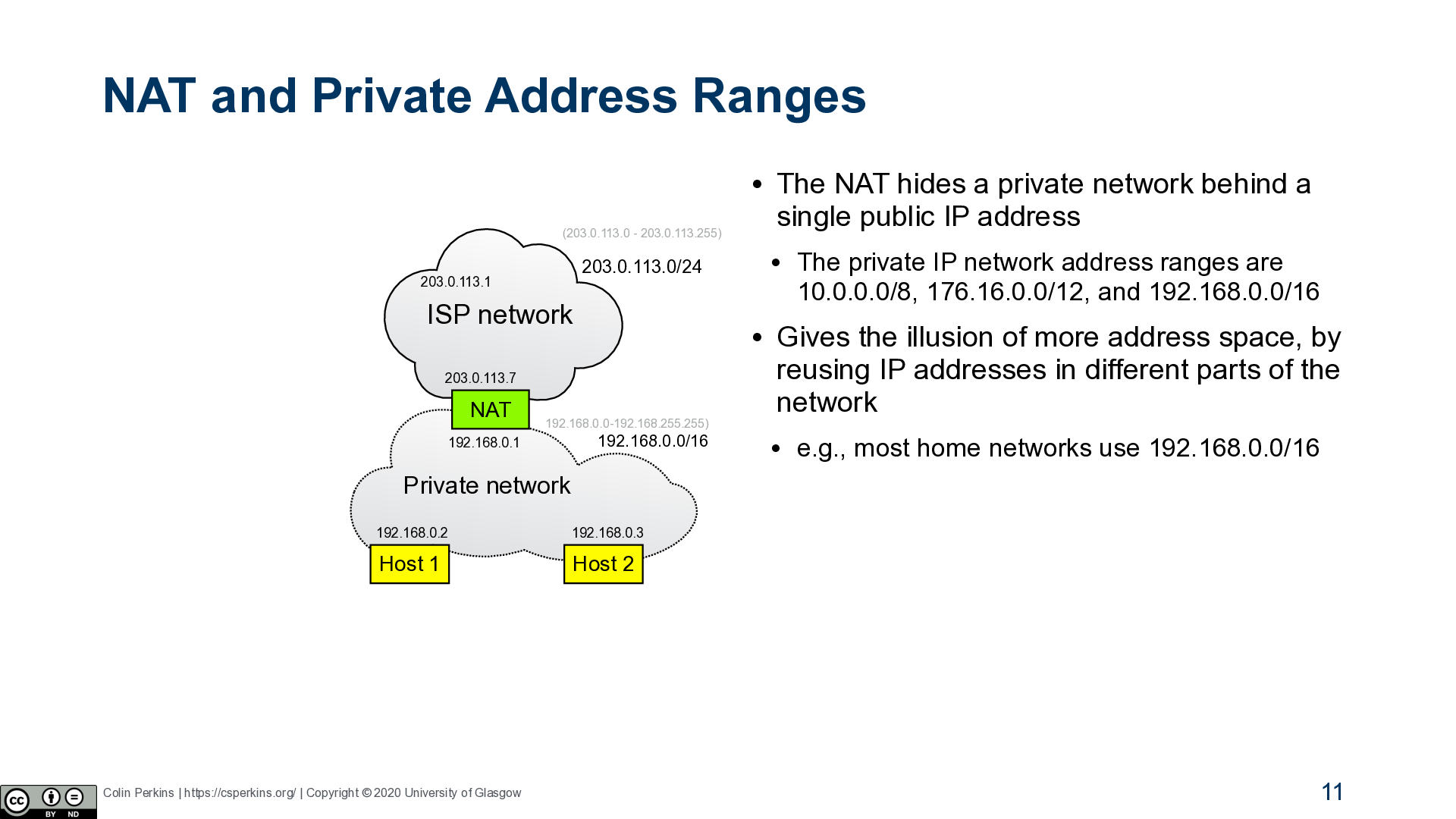
to the ISP’s network.
00:10:01.000
Internally, the NAT keeps a record on
00:10:04.200
the changes it made, associated with the
00:10:07.366
port.
00:10:08.566
The packet traverses the ISP’s network to
00:10:11.866
the router connecting the ISP to the
00:10:15.066
Internet, and is forwarded on from there
00:10:18.266
to the Internet. Eventually, the packet arrives
00:10:21.433
at the server. When it arrives,
00:10:24.166
it still has destination address equal to
00:10:27.366
that of the server, 192.0.2.53, but source
00:10:30.566
address will equal to that of the NAT, 203.0.113.7.
00:10:34.133
To the server, the packet appears to
00:10:37.066
have come from the NAT. When it
00:10:40.100
sends a reply, the server will set
00:10:43.166
the destination IP address to that of
00:10:46.233
the NAT, 203.0.113.7, and use its own
00:10:49.266
address, 192.0.2.53, as the source address.
00:10:52.000
The reply will traverse the network until
00:10:54.400
it reaches the NAT. The NAT looks
00:10:56.766
at the TCP or UDP port number
00:10:59.166
to which the packet is destined,
00:11:01.200
and uses this to retrieve its internal
00:11:03.566
record of the rewrites that were performed.
00:11:05.966
It then uses this to do the
00:11:08.333
inverse rewrite, changing the destination IP address
00:11:10.733
and port in the packet to those
00:11:13.100
of the host on the private network,
00:11:15.500
then forwards the packet onto the private
00:11:17.866
network for delivery.
00:11:20.000
Essentially, the NAT hides a private network
00:11:25.533
behind a single public IP address.
00:11:30.266
The private network can use one of
00:11:35.900
three private IPv4 address ranges: 10.0.0.0/8,
00:11:40.633
176.16.0.0/12, and 192.168.0.0/16.
00:11:43.000
Machines in a private network can directly
00:11:45.600
talk to each other using these private
00:11:48.200
IP addresses, provided that communications stays within
00:11:50.800
the private network.
00:11:52.000
When they communicate with the rest of
00:11:54.433
the network, the IP addresses are rewritten
00:11:56.833
so that, to the rest of the
00:11:59.266
network, the private network looks like a
00:12:01.700
single device, with one IP address matching
00:12:04.133
that of the external address of the
00:12:06.533
NAT. This gives the illusion that there
00:12:08.966
are more IPv4 addresses available, by allowing
00:12:11.400
the same private address ranges being re-used
00:12:13.833
in different parts of the network.
00:12:16.000
Your home network, for example, almost certainly
00:12:18.833
uses addresses in the 192.168.0.0/16 private address
00:12:21.633
range, and is connected to the rest
00:12:24.466
of the network via a NAT router
00:12:27.300
provided by your ISP.
00:12:30.000
This concludes our review of how NAT
00:12:32.400
routers allow multiple devices to share a
00:12:34.766
single IP address. In the next part,
00:12:37.666
I’ll explain some of the problems NATs cause.
Part 4: Problems due to Network Address Translation
The 4th part of the lecture continues the discussion of the problems
cause by NAT devices, and why they are used despite these problems.
It talks about the use of NAT as a work-around for the lack of IPv4
address space, as a possible translation mechanism between IPv4 and
IPv6, and to avoid renumbering. And it talks about the implications
of NAT for TCP connections and UDP flows.
00:00:00.133
In the previous part we discussed what
00:00:03.233
is network address translation, and walked through
00:00:05.466
some examples showing how NAT routers allow
00:00:07.700
several hosts on a private network to
00:00:09.933
share a single IP address.
00:00:11.533
In the following, I want to talk
00:00:13.866
about some of the problems caused by
00:00:16.100
NATs, and to discuss some of the
00:00:18.333
reasons why NATs are used despite these
00:00:20.566
problems.
00:00:22.000
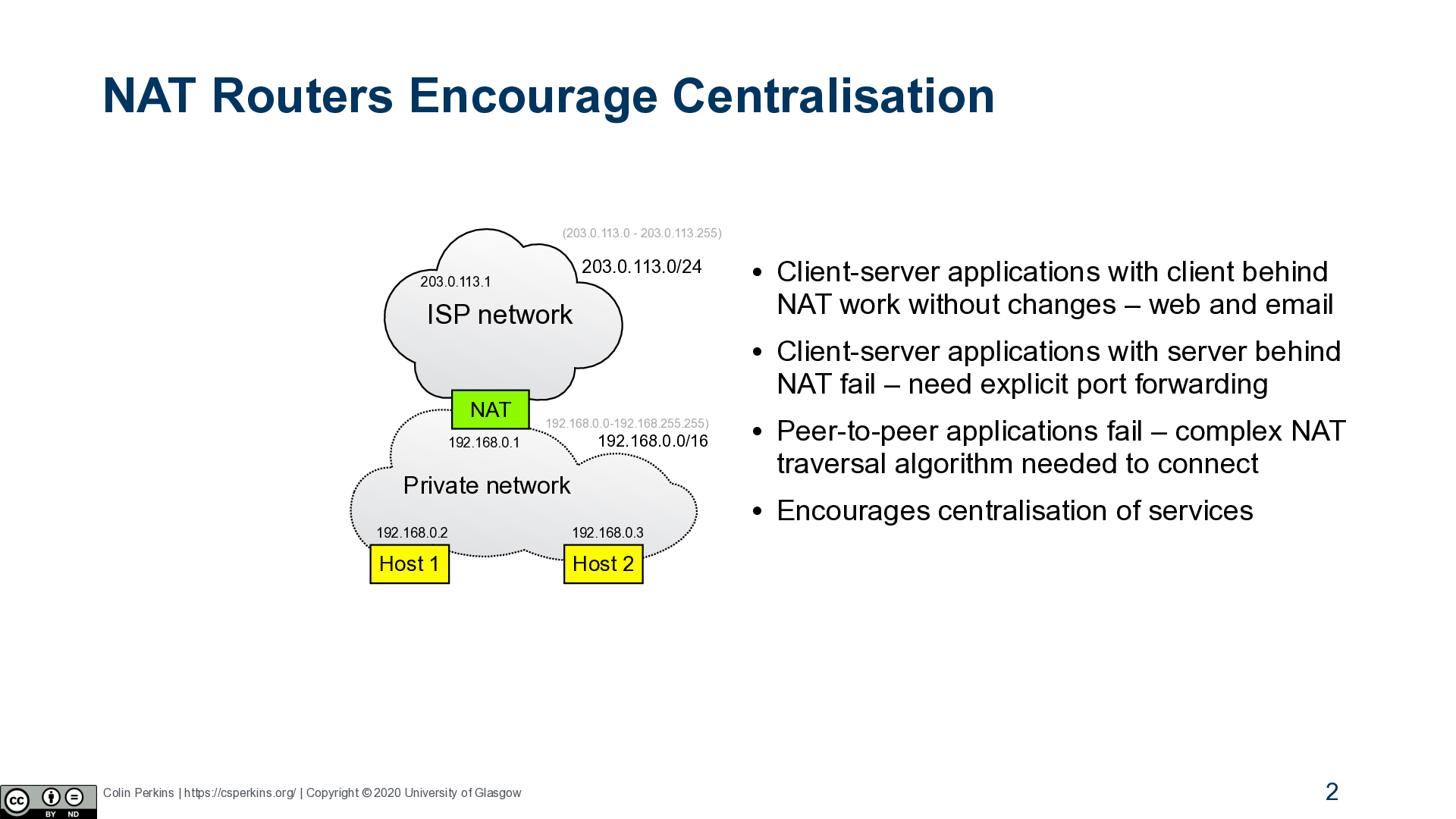
The first issue with NAT routers is
00:00:24.500
that they break certain classes of application,
00:00:26.800
and encourage centralisation.
00:00:28.400
NATs are designed to support client-server
00:00:30.133
applications, where the client is behind the NAT
00:00:33.133
and the server is a host on
00:00:35.633
the public Internet. Packets sent by a
00:00:38.133
host with a private IP address can
00:00:40.600
pass out through the NAT, and will
00:00:43.100
have their IP address and port translated
00:00:45.600
to use the public IP address of
00:00:47.433
the NAT before they’re forwarded to the
00:00:49.600
public Internet. The NAT will also retain
00:00:51.900
state, so that the reverse translation will
00:00:54.100
be applied to replies to those packets,
00:00:56.066
allowing them to pass back through the NAT.
00:00:59.066
This behaviour allows clients to connect to
00:01:01.933
servers, setting up NAT translation state in the process,
00:01:04.900
and to receive responses.
00:01:07.800
The reverse doesn’t work, though.
00:01:10.133
NAT routers rely on outgoing packets to
00:01:12.366
establish the mappings they need to translate
00:01:14.700
incoming packets. That is, when an incoming
00:01:17.066
TCP or UDP packet arrives at some
00:01:19.400
particular port on a NAT, the NAT
00:01:21.766
looks at its record of what it
00:01:24.100
previously sent from that port, and how
00:01:26.466
it was translated, to know what’s the
00:01:28.800
reverse translation to make. If there’s been
00:01:31.166
no outgoing packet on that port,
00:01:33.166
the NAT won’t know how to translate
00:01:35.500
the incoming packet. It won’t know which
00:01:37.866
of the private IP addresses to use
00:01:40.200
as the destination address for the translated packet.
00:01:43.133
This complicates running a server behind a
00:01:45.800
NAT, since the NAT won’t know how
00:01:48.600
to translate incoming requests for the server.
00:01:51.433
It’s possible to manually configure the NAT
00:01:54.233
to forward packets appropriately, of course,
00:01:56.633
and protools like UPnP can help with
00:01:59.433
this, but these approaches are complicated or
00:02:02.266
unreliable. It’s generally easier and more reliable
00:02:05.066
to pay a cloud computing provider to
00:02:07.866
host the server, which encourages centralisation onto
00:02:10.666
large hosting services.
00:02:11.866
NATs also make it hard to write
00:02:14.800
peer-to-peer applications. In part, this is because
00:02:17.600
NATs make incoming connections difficult. But it’s
00:02:20.400
also because hosts located behind a NAT
00:02:23.200
only know their private address, so can’t
00:02:26.033
give their peer a public address to
00:02:28.833
which it can connect. There are solutions
00:02:31.633
to this, that I’ll talk about in
00:02:34.433
the next part of this lecture,
00:02:36.866
but they’re complicated, slow, and wasteful.
00:02:39.266
Unless you really need the privacy and
00:02:42.066
latency benefits of a direct peer-to-peer connection,
00:02:44.866
it’s often easier to relay traffic via
00:02:47.666
a server hosted in a data centre
00:02:50.500
somewhere, with a public IP address,
00:02:52.900
again encouraging centralisation of services.
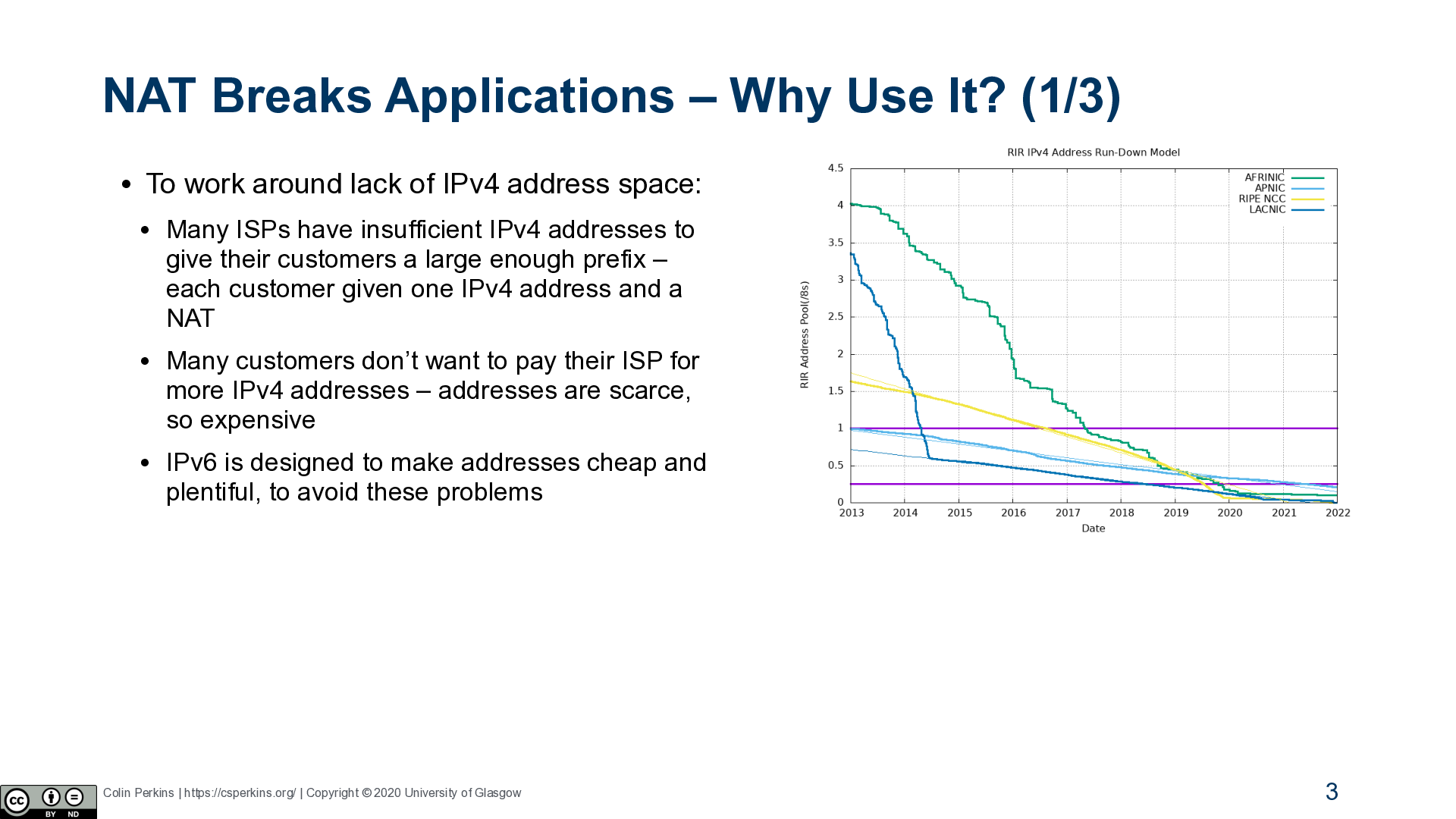
00:02:56.000
If NAT routers are so problematic,
00:02:58.400
why do people use them? There are
00:03:01.166
three reasons.
00:03:01.966
The first is to work around the
00:03:04.866
lack of IPv4 address space.
00:03:06.866
As shown in the figure on the
00:03:09.733
right, the Regional Internet Registries have run
00:03:12.533
out of IPv4 addresses. There are no
00:03:15.300
more IPv4 addresses available for ISPs and
00:03:18.100
companies that want to connect to the
00:03:20.900
Internet, and they can’t provide enough IPv4
00:03:23.666
addresses to fulfil demand.
00:03:25.266
The result is that IPv4 addresses are
00:03:28.166
scarce and expensive. ISPs either don’t have
00:03:30.933
enough addresses to meet their customers needs,
00:03:33.733
or the cost of those addresses is
00:03:36.500
prohibitive, and customers use a private network
00:03:39.300
with a NAT instead of using public
00:03:42.100
IPv4 addresses.
00:03:42.866
The transition to IPv6 will solve this
00:03:45.766
problem, since IPv6 makes addresses cheap and
00:03:48.566
plentiful. The smallest possible address allocation for
00:03:51.333
an IPv6 network is a factor of
00:03:54.133
four billion times larger than the entire
00:03:56.933
IPv4 Internet! Unfortunately, the transition to IPv6
00:03:59.700
has been slow.
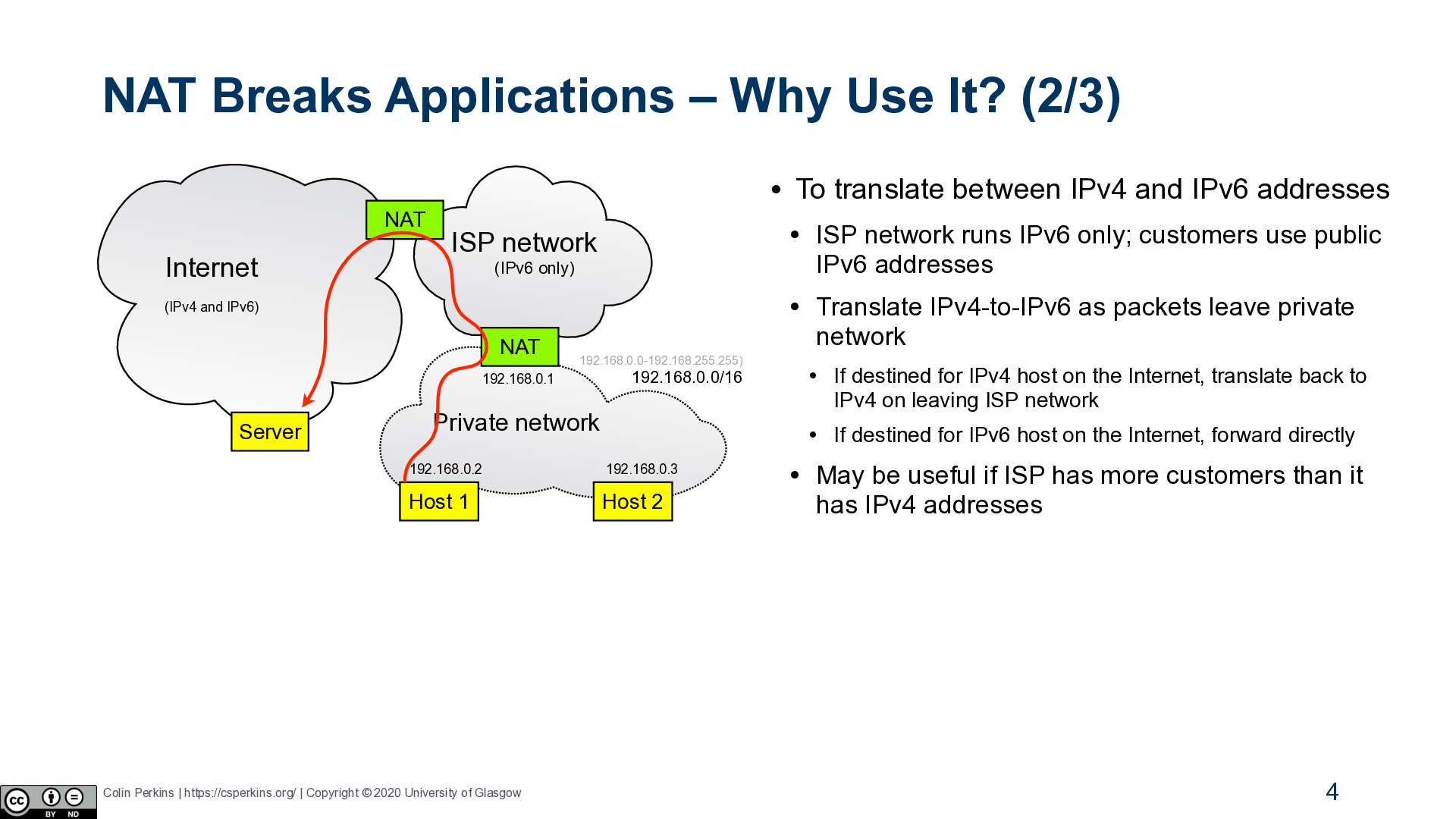
00:04:02.000
This suggests the second reason why NAT
00:04:05.066
is used: to translate between IPv4 and
00:04:08.100
IPv6 addresses.
00:04:08.966
In this model, an ISP, or other
00:04:12.133
network operator, runs IPv6 internally in their
00:04:15.200
network, and does not support IPv4.
00:04:17.800
This gives the ISP a clean,
00:04:20.433
modern, and future-proof network.
00:04:22.166
The ISP also runs two sets of
00:04:25.333
NATs.
00:04:26.500
For customers that want to use IPv4
00:04:29.666
internally, the customer uses a private IPv4
00:04:32.733
network, and the NAT translates the IPv4
00:04:35.766
packets into IPv6 packets when they leave
00:04:38.833
the customer’s network. The principle is the
00:04:41.900
same as the NAT routers we discussed
00:04:44.933
in the last part of this lecture,
00:04:48.000
except that rather than rewriting packets with
00:04:51.066
private IP addresses to have public IPv4
00:04:54.100
addresses, the NAT rewrites the entire IPv4
00:04:57.166
header and replaces it with an IPv6 header.
00:04:59.133
When packets get to the edge of
00:05:01.900
the ISPs network, where it connects to
00:05:05.700
the public Internet, they’re either forwarded as
00:05:08.566
native IPv6 if the destination is accessible
00:05:11.400
via IPv6, or translated to IPv4 by
00:05:14.266
another NAT.
00:05:15.100
The expectation in this approach to running
00:05:18.033
a network is that, over time,
00:05:20.500
the number of customers and destination networks
00:05:23.333
that need IPv4 will go down,
00:05:25.800
and more traffic will run IPv6 end-to-end.
00:05:28.633
NAT is used as a, hopefully temporary,
00:05:31.500
workaround.
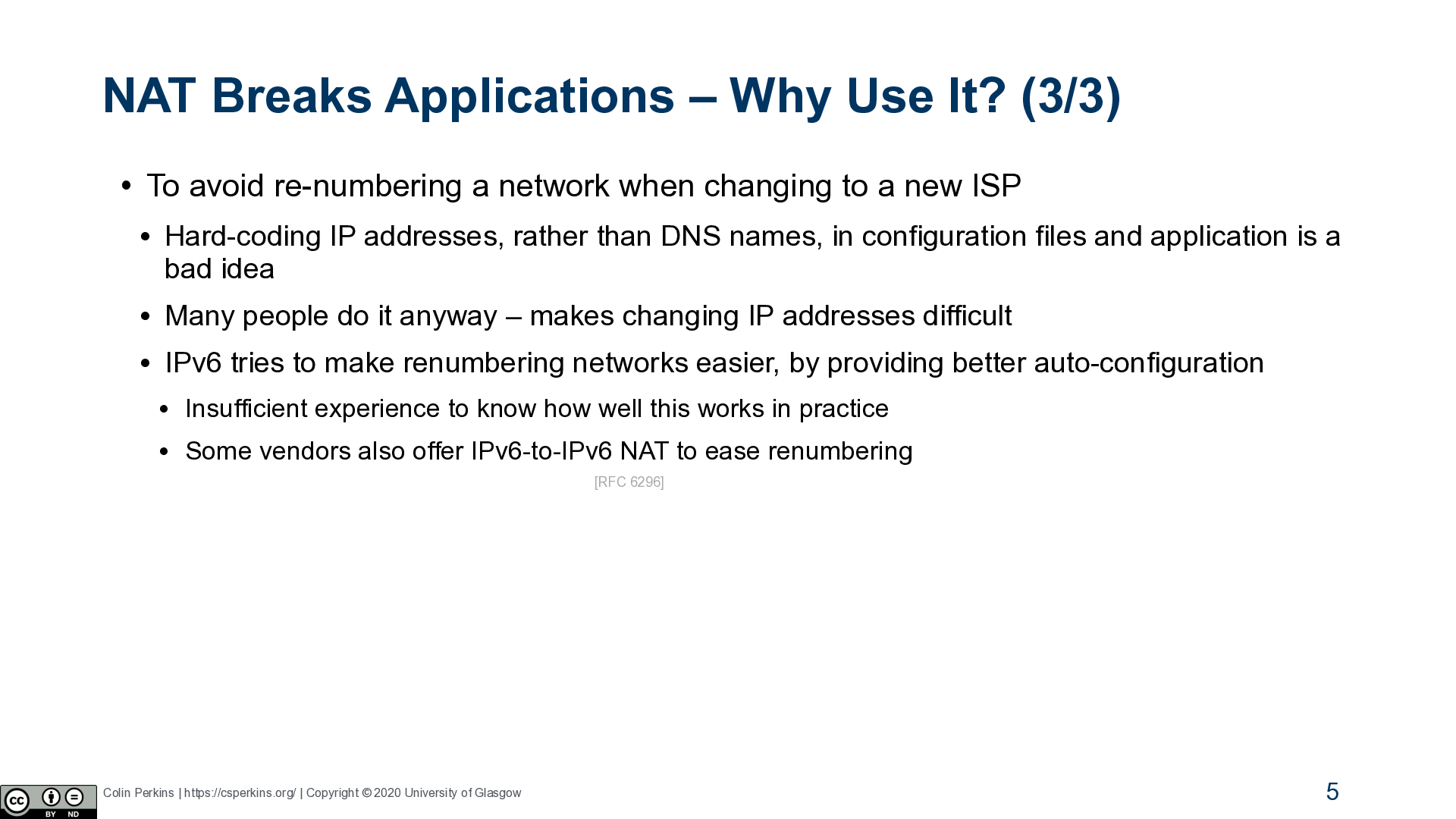
00:05:33.000
The third reason to use NAT is
00:05:35.666
to avoid renumbering.
00:05:36.833
Networks that have a public IP address
00:05:39.600
range tend, over time, to end up
00:05:42.266
hard coding IP addresses from that range
00:05:44.966
into configuration files, applications, and settings.
00:05:47.266
This is a mistake. Applications should always
00:05:49.933
use DNS names, to allow the IP
00:05:52.600
addresses to change, but people do it
00:05:55.300
anyway.
00:05:56.433
The result is that it’s difficult to
00:05:59.200
change the IP addresses used by machines
00:06:01.866
on a network. The longer a host
00:06:04.566
has used a particular IP address,
00:06:06.866
the more likely it is that something,
00:06:09.533
somewhere, on the network has that address
00:06:12.200
hard-coded, and will fail if the host’s address changes.
00:06:15.033
If a network has an IP address
00:06:17.633
range delegated to it from its ISP,
00:06:20.300
what’s known as a provider allocated IP
00:06:22.933
address range, and wants to change ISP,
00:06:25.600
then it will need to change the
00:06:28.233
IP address range it uses to one
00:06:30.900
delegated from its new provider. Many organisations
00:06:33.533
have found this sufficiently difficult that it’s
00:06:36.200
easier to keep the old IP addresses
00:06:38.833
internally, and use a NAT to translate
00:06:41.500
addresses to the range assigned by the
00:06:44.133
new ISP.
00:06:45.000
A similar problem can occur if one
00:06:47.900
company buys another, and has to integrate
00:06:50.800
the IT systems of the new company
00:06:53.700
into its existing network.
00:06:55.366
IPv6 has better auto-configuration support than IPv4,
00:06:58.366
and tries to make renumbering easier,
00:07:00.866
but it’s not clear how well this
00:07:03.766
works. As a result, some network equipment
00:07:06.666
vendors have started selling NATs that translate
00:07:09.566
between two different IPv6 prefixes, to ease renumbering.
00:07:12.833
In both cases, a better approach is
00:07:15.833
that an organisation gets what’s known as
00:07:18.666
provider independent IP addresses, directly from one
00:07:21.500
of the Regional Internet Registries, so it
00:07:24.333
owns the IP addresses it uses.
00:07:26.766
In this case, the organisation pays its
00:07:29.600
ISP to route traffic to the addresses
00:07:32.433
it owns, and can move to a
00:07:35.266
new ISP without renumbering.
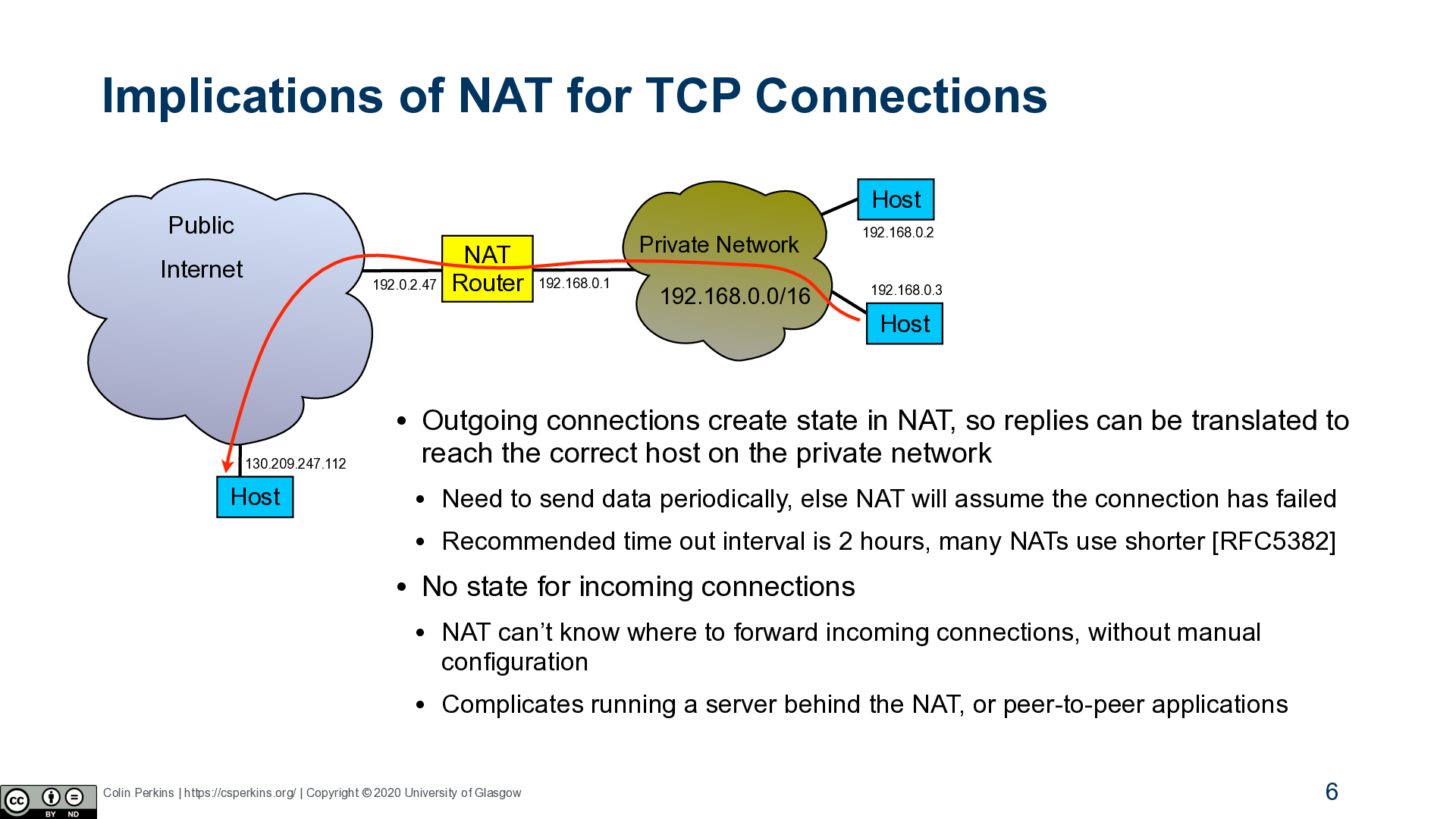
00:07:38.000
Given these reasons why NAT routers will
00:07:40.733
be used, despite their problems, what are
00:07:43.466
the implications for NAT routers on TCP
00:07:46.200
connections?
00:07:47.333
Well, as I’ve explained, outgoing connections create
00:07:50.166
state in the NAT, so replies can
00:07:52.900
be translated to reach the correct host
00:07:55.633
on the private network. The question is,
00:07:58.366
then, how does the NAT know what translation state to setup?
00:08:01.833
The way this works is that the
00:08:04.966
NAT router looks at TCP segments it’s
00:08:07.966
translating and forwarding, and watches for packets
00:08:10.933
representing a TCP connection establishment handshake.
00:08:13.466
If the NAT sees an outgoing SYN
00:08:16.466
packet, followed by an incoming SYN-ACK,
00:08:19.000
then an outgoing ACK, with matching sequence
00:08:21.966
and acknowledgment numbers, then it can infer
00:08:24.966
that this is the start of a
00:08:27.933
TCP connection, and setup the appropriate translation.
00:08:31.000
TCP connections have a similar exchange at
00:08:33.800
the end of the connection, with FIN,
00:08:36.633
FIN-ACK, and ACK packets. The NAT router
00:08:39.433
can watch for these exchanges, and infer
00:08:42.266
that the corresponding TCP connections have finished,
00:08:45.066
and that the translation state can be
00:08:47.900
removed.
00:08:49.033
Unfortunately, applications and hosts sometimes crash,
00:08:51.566
and connections disappear without sending the FIN,
00:08:54.366
FIN-ACK, and ACK packets. For this reason,
00:08:57.200
NAT routers also implement a timeout.
00:08:59.600
If a connection waits too long between
00:09:02.433
sending packets, the NAT will assume it’s
00:09:05.233
failed, and remove the translation state.
00:09:07.066
The recommendation from the IETF is that
00:09:09.433
NATs use a two hour timeout,
00:09:11.533
but measurements have shown that many NATs
00:09:13.966
ignore this and use a shorter timer.
00:09:16.400
The result is that long-lived TCP connections,
00:09:18.966
that would otherwise go idle, need to
00:09:21.400
send something, even if just an empty
00:09:23.833
TCP segment, every few minutes, to prevent
00:09:26.266
NATs on the path from timing out
00:09:28.700
and dropping the connection.
00:09:30.100
If you’ve ever used ssh to login
00:09:32.666
to a remote system, gone to do
00:09:35.100
something else, then come back after a
00:09:37.533
couple of hours and wondered why the
00:09:39.966
ssh connection has failed, this may well
00:09:42.400
be due to NAT timeout.
00:09:44.166
The other issue, as I mentioned at
00:09:46.700
the start of this part, is that
00:09:49.133
the NAT won’t have state for incoming
00:09:51.566
connections, unless manually configured to do so.
00:09:54.033
This makes it difficult to run a
00:09:56.466
server or peer-to-peer application behind the NAT.
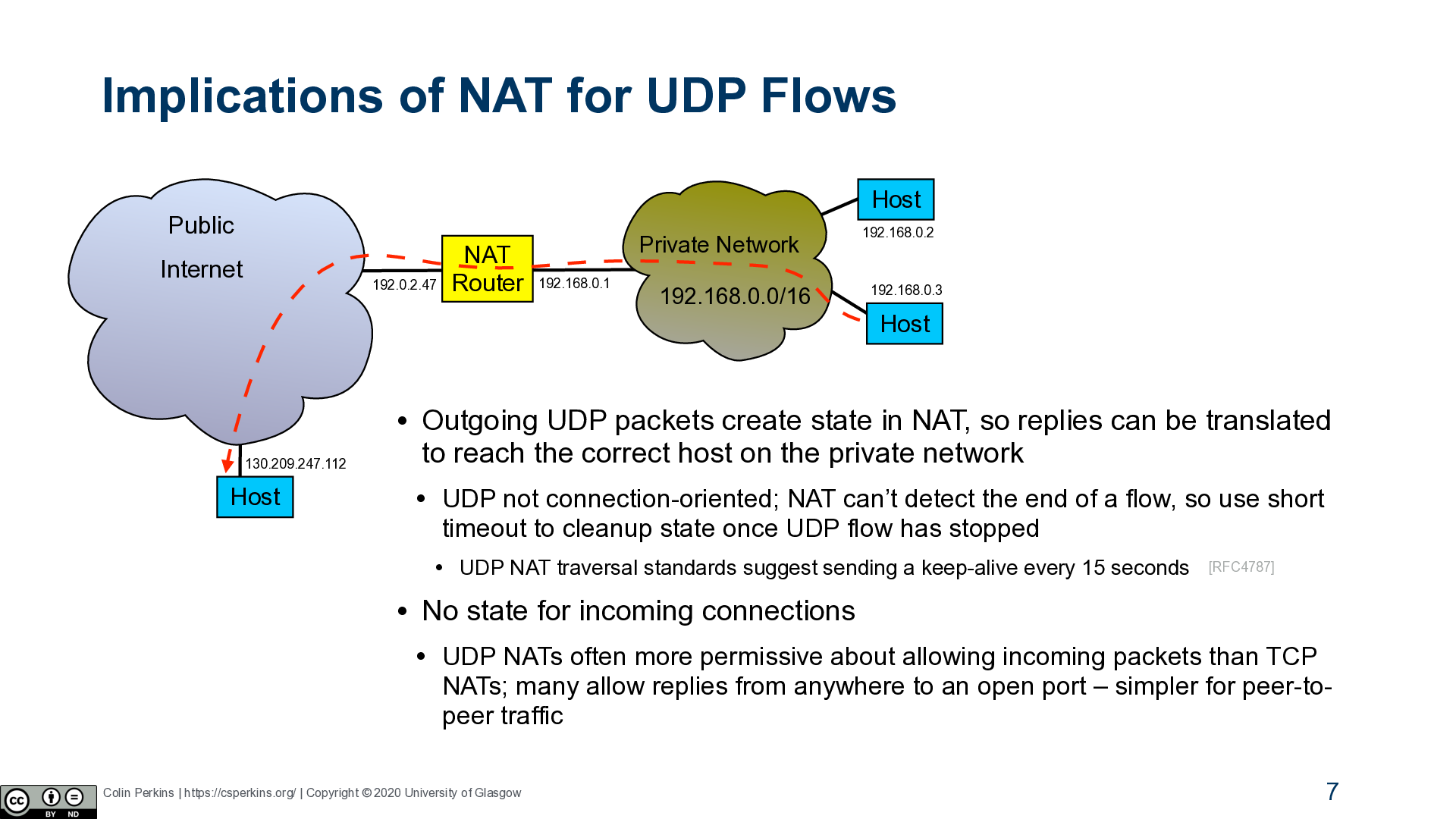
00:10:00.000
The implications of NAT for UDP flows
00:10:02.866
are similar to those for TCP,
00:10:05.366
except that the lack of connections with
00:10:08.233
UDP complicates things.
00:10:09.466
For TCP, a NAT can watch for
00:10:12.466
the connection establishment and teardown segments,
00:10:14.933
and know when the TCP connections start
00:10:17.800
and finish. TCP connections can fail without
00:10:20.700
sending the FIN, FIN-ACK, ACK exchange,
00:10:23.166
but this is rare, and NAT routers
00:10:26.033
generally rely on watching the TCP connection
00:10:28.933
setup and teardown messages to manage translation state.
00:10:32.966
UDP, on the other hand, has no
00:10:35.133
connection establishment,
00:10:36.900
since it has no concept of connections.
00:10:39.133
This is not a great problem when
00:10:41.400
it comes to establishing state in a
00:10:43.833
NAT. If the NAT sees any outgoing
00:10:46.233
UDP packet with a particular address and
00:10:48.633
port, it sets up the state in
00:10:51.066
the NAT to allow replies.
00:10:52.766
The problem comes with knowing when to
00:10:55.300
remove that translation state in the NAT.
00:10:57.700
Since UDP has no “end of connection”
00:11:00.100
message, the only way to do this
00:11:02.533
is with a timeout.
00:11:04.000
The most widely used UDP application,
00:11:06.200
historically, has been DNS. DNS clients tend
00:11:08.800
to contact a lot of different servers,
00:11:11.400
but exchange only a small amount of
00:11:13.966
data with each. As a result,
00:11:16.200
many NATs have very short timeouts -
00:11:18.766
on the order of tens of seconds
00:11:21.366
- for UDP translation state, to prevent
00:11:23.933
them accumulating state for too many UDP flows.
00:11:27.166
An unfortunate consequence of this, is that
00:11:30.166
applications that use UDP, such as video
00:11:33.300
conferencing and gaming, must send packets frequently,
00:11:36.466
in both directions, to make sure the
00:11:39.633
NAT bindings stay open. The IETF recommends
00:11:42.766
that such applications send and receive something
00:11:45.933
at least once every 15 seconds.
00:11:48.633
This can generate unnecessary traffic.
00:11:51.000
There is one benefit, though, that comes
00:11:53.733
from the lack of connection establishment signalling
00:11:56.500
in UDP. With TCP, the NAT can
00:11:59.233
see the SYN, SYN-ACK, ACK exchange,
00:12:01.600
and knows the exact addresses and ports
00:12:04.333
that the client and server are using.
00:12:07.066
This allows the NAT to create a
00:12:09.833
very specific binding, and reject traffic from
00:12:12.566
other addresses.
00:12:13.366
These very specific bindings are a security
00:12:16.200
benefit, but make peer-to-peer connections harder to
00:12:18.933
establish. UDP applications tend to be more
00:12:21.700
flexible in where they accept packets from,
00:12:24.433
so NATs generally establish bindings that allow
00:12:27.166
any UDP packets that arrive on the
00:12:29.933
correct port to be translated and forwarded
00:12:32.666
across the NAT. This makes peer to
00:12:35.400
peer connection establishment much easier for NAT,
00:12:38.166
as we’ll see in the next part.
00:12:42.000
NATs work around three real problems:
00:12:44.566
lack of IPv4 address space, IPv4 to
00:12:47.600
IPv6 transition, and renumbering. They work well
00:12:50.600
for client-server applications, where the client is
00:12:53.633
behind the NAT and the server is
00:12:56.633
on the public Internet, but make it
00:12:59.633
hard to run peer-to-peer applications and to
00:13:02.666
host servers on networks that use NATs.
00:13:04.733
This encourages centralisation
00:13:06.733
of the Internet infrastructure
00:13:08.200
onto cloud providers and, as we’ll see
00:13:11.700
in the next part, greatly complicates certain
00:13:13.566
classes of application.
Part 5: NAT Traversal and Peer-to-Peer Connection Establishment
The final part of the lecture, discusses NAT traversal and peer-to-peer
connection establishment. It outlines the binding discovery process,
by which a client can establish that it's behind a NAT and find the
external IP address of that NAT, and the ICE algorithm for candidate
exchange and peer-to-peer connection establishment.
00:00:00.133
In the final part of this lecture,
00:00:03.400
I’d like to discuss the problem of
00:00:05.766
NAT traversal. That is, how applications can
00:00:08.166
work around the presence of NAT routers
00:00:10.533
to establish peer-to-peer connections.
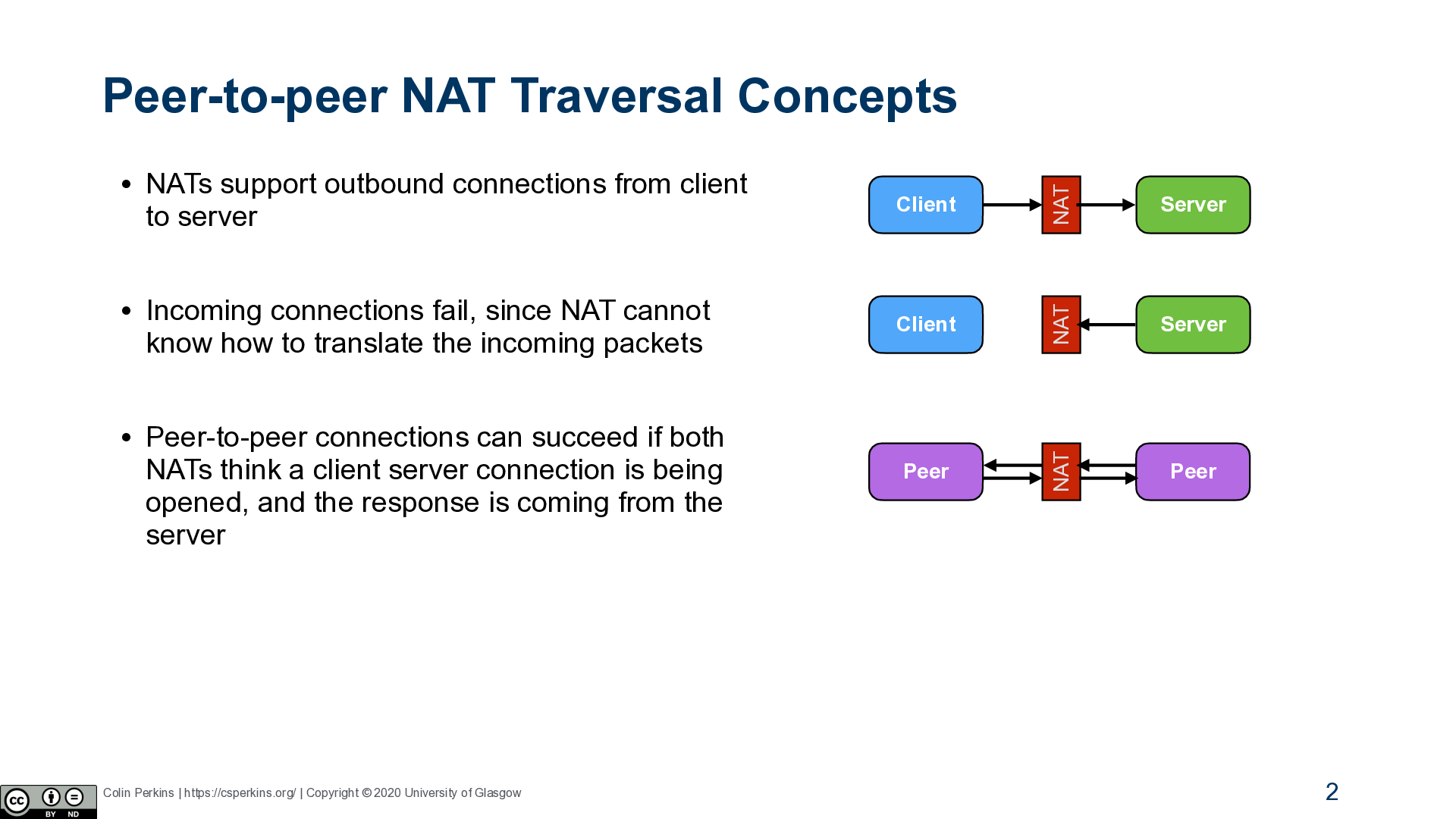
00:00:13.000
As I described in the previous part,
00:00:15.633
NATs are designed to support outbound connections
00:00:18.266
from a client in the private network
00:00:20.900
to a server on the public Internet,
00:00:23.533
and this use case works well.
00:00:25.766
Other scenarios are less successful.
00:00:27.766
Incoming connections, to a server located in
00:00:30.500
the private network, will fail. This happens
00:00:33.133
because the NAT can’t know how to
00:00:35.733
translate the incoming packets. There are work
00:00:38.366
arounds for this, that involve manually configuring
00:00:41.000
the NAT to forward incoming connections to
00:00:43.633
the correct device, but this is difficult
00:00:46.266
to do correctly.
00:00:47.400
Similarly, peer-to-peer connections through a NAT will
00:00:50.133
also fail, unless the packets are sent
00:00:52.766
in a way that makes the NAT,
00:00:55.400
or the NATs if there are several
00:00:58.033
peers all located in private networks,
00:01:00.266
think that a client-server connection is being
00:01:02.900
opened, and that the response is coming
00:01:05.533
from the server. In the following,
00:01:07.800
I’ll talk about how this can be
00:01:10.533
arranged.
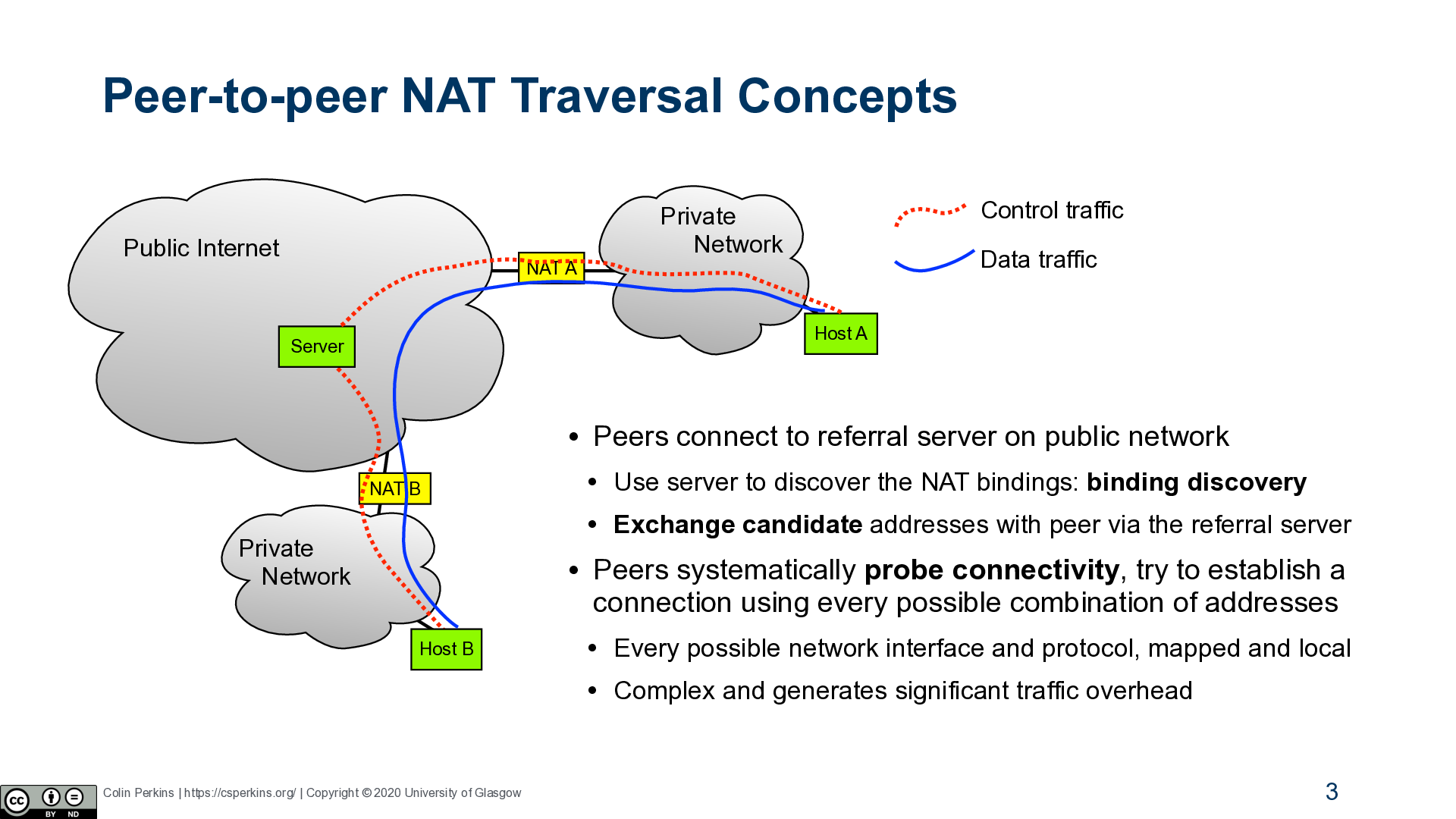
00:01:12.000
The figure shows an example where two
00:01:14.866
hosts, A and B, and trying to
00:01:17.733
establish a direct peer to peer connection.
00:01:20.600
For example, this could be two devices
00:01:23.466
in people’s homes that are trying to
00:01:26.366
setup a video call.
00:01:28.000
Each of these hosts is in a
00:01:30.966
private network, and is connected to the
00:01:33.833
public Internet via a NAT. It’s possible,
00:01:36.700
indeed likely, that if these are home
00:01:39.566
networks, then both of the private networks
00:01:42.433
will be using the IP address range
00:01:45.333
192.168.0.0./16, since that’s the default for most
00:01:48.200
home NAT routers. A consequence is that
00:01:51.066
Host A and Host B could both
00:01:53.933
be using the same private IP address,
00:01:56.800
for example both hosts could be using
00:01:59.666
IP address 192.168.0.2.
00:02:01.000
This isn’t a problem, since Host A
00:02:03.566
and Host B are on different private
00:02:06.100
networks, each hidden behind a different NAT.
00:02:08.666
The two NATs have different public IP
00:02:11.233
address on the external interface of the
00:02:13.800
router, and what’s used internally is not
00:02:16.333
visible to the rest of the network.
00:02:19.000
How do these two hosts go about
00:02:21.433
establishing a connection?
00:02:22.500
Well, Host A can’t send a packet
00:02:25.033
directly to Host B, because it has
00:02:27.466
the same IP address. If it tries,
00:02:29.900
the packet will come straight back to
00:02:32.366
itself!
00:02:33.466
Rather, in order to connect to Host
00:02:36.000
B, Host A will have to discover
00:02:38.433
the external address and port number that
00:02:40.866
NAT B is using for packets sent
00:02:43.333
by Host B. It can then send
00:02:45.766
its packets to NAT B, that will
00:02:48.200
translate and forward them to host B.
00:02:50.266
To do this, the two peers,
00:02:52.233
Host A and Host B, both make
00:02:54.866
connections to a referral server located somewhere
00:02:57.500
on the public Internet. This is shown
00:03:00.100
in the dashed red lines on the
00:03:02.733
slide. They ask that server where their
00:03:05.333
packets appear to be coming from.
00:03:07.600
This process is known as binding discovery,
00:03:10.200
and lets the hosts find out how
00:03:12.833
their NAT is translating packets. The result
00:03:15.466
is a candidate address for each host,
00:03:18.066
that it thinks is the external address
00:03:20.700
of the NAT that will translate incoming
00:03:23.300
packets and forward them to it.
00:03:25.566
The peers then exchange these candidate addresses
00:03:28.266
with each other, via the referral server.
00:03:31.000
Once they’ve received the candidate addresses from
00:03:33.466
their peer, the two hosts systematically send
00:03:35.933
probe packets, to check if any of
00:03:38.400
these candidates actually work to reach the
00:03:40.866
peer. That is, the hosts check if
00:03:43.366
the outgoing probe packets they send will
00:03:45.833
correctly setup translation state in the NAT,
00:03:48.300
so that incoming probes from the peer
00:03:50.766
will be translated and forwarded to them.
00:03:53.233
And they check that there are no
00:03:55.700
firewalls that are blocking the traffic.
00:03:57.833
If the probes are successfully received,
00:04:00.033
in both directions, then the two hosts
00:04:02.500
can switch to using the direct peer-to-peer
00:04:04.966
path, shown as the solid blue line
00:04:07.433
on the slide, and no longer need
00:04:09.933
the server.
00:04:10.633
If the probes fail, then a direct
00:04:13.200
peer-to-peer connection may not be possible,
00:04:15.300
and the hosts may have to relay
00:04:17.766
all traffic via the referral server.
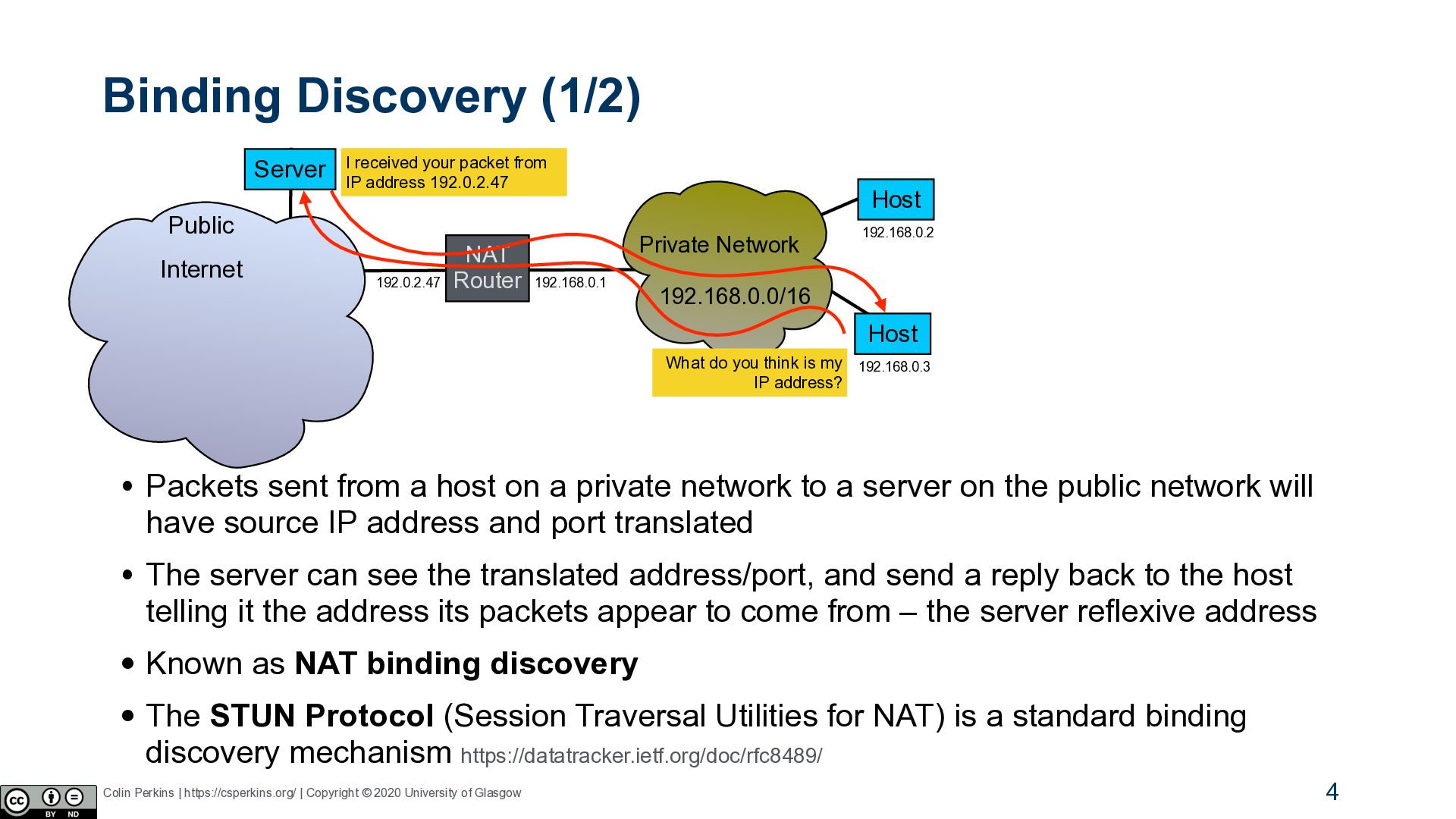
00:04:21.000
The process of finding out what translations
00:04:23.633
a NAT is performing is known as
00:04:26.233
NAT binding discovery.
00:04:27.366
The Session Traversal Utilities for NAT,
00:04:29.700
STUN, is a commonly used protocol that
00:04:32.333
performs NAT binding discovery in the Internet.
00:04:34.933
When a host on a private network
00:04:37.666
sends a packet to a host on
00:04:40.266
the public network, the NAT at the
00:04:42.900
edge of the private network will translate
00:04:45.533
the source IP address and port number
00:04:48.133
in the packet. The host on the
00:04:50.766
private network doesn’t know what translation has
00:04:53.366
been done, but the server that receives
00:04:56.000
the packet can inspect its source address
00:04:58.633
and port, to find out where it
00:05:01.233
came from.
00:05:02.000
For example, when using a UDP socket,
00:05:04.700
an application can use the recvfrom() system
00:05:07.333
call to retrieve both the contents of
00:05:09.933
a UDP packet and its source address.
00:05:12.566
Similarly, for TCP connections, the accept() system
00:05:15.266
call returns the address of the client.
00:05:18.000
The server then replies to the client,
00:05:20.333
telling it where the packet appeared to
00:05:22.633
come from. This is what’s known as
00:05:24.966
a server reflexive address. That is,
00:05:26.933
the address that a server thinks the
00:05:29.266
client has.
00:05:29.933
If there’s a NAT between the client
00:05:32.333
and the server, then the server reflexive
00:05:34.666
address will be different to the address
00:05:36.966
from which the client sent the packet.
00:05:39.300
If the client’s addresses and the server
00:05:41.600
reflexive address are the same, the client
00:05:43.933
knows there’s no NAT between it and
00:05:46.233
the server.
00:05:47.000
You might ask why a host that’s
00:05:49.300
in a private network doesn’t just ask
00:05:51.633
its NAT how it will translate the
00:05:53.933
packets? Two reasons.
00:05:54.933
The first is that by the time
00:05:57.333
we realised that binding discovery was needed,
00:05:59.633
there were already tens of millions of
00:06:01.966
NATs deployed, with no way to upgrade
00:06:04.266
them to add a way to ask
00:06:06.566
how they’ll translate packets.
00:06:07.900
The second is that a host might
00:06:10.300
not know that it’s behind a NAT,
00:06:12.633
or might be behind more than one
00:06:14.933
NAT, and so won’t know what NAT
00:06:17.233
to ask for the binding.
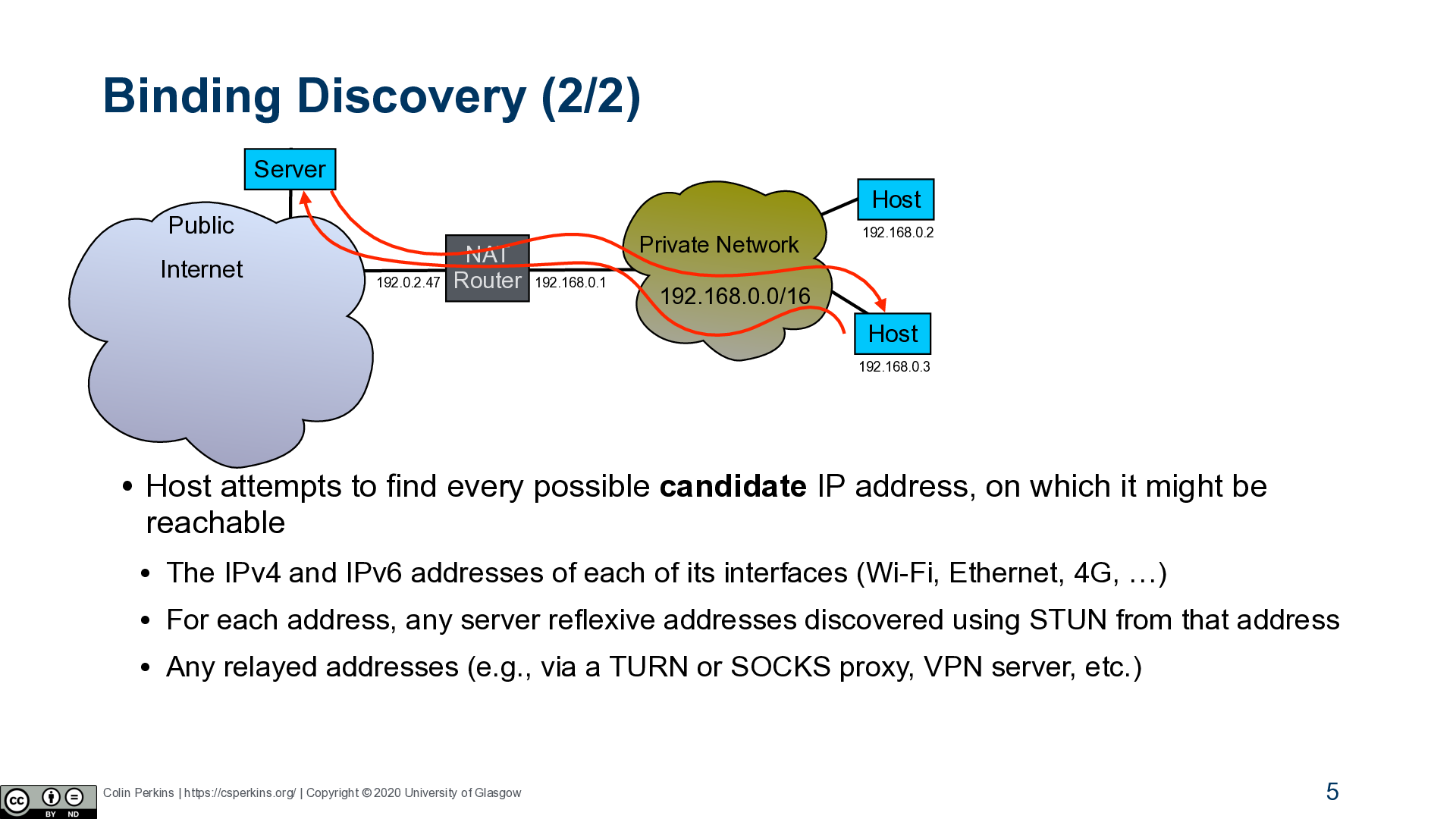
00:06:20.000
When performing binding discovery, it’s important that
00:06:22.633
a host discovers every possible candidate address
00:06:25.266
on which it might be reachable.
00:06:27.533
For example, think about a phone that
00:06:30.266
has both 4G and WiFi interfaces.
00:06:32.533
Each of these interfaces can have an
00:06:35.166
IPv4 address and an IPv6 address,
00:06:37.400
representing the point of attachment to networks
00:06:40.033
it directly connects to. This could be
00:06:42.666
a total of four possible IP addresses
00:06:45.300
for the phone.
00:06:46.433
The phone may be behind IPv4 NAT
00:06:49.166
routers on each of those interfaces,
00:06:51.433
and so each interface might also have
00:06:54.066
a server reflexive address on which it
00:06:56.700
can be reached, that the host can
00:06:59.333
discover using STUN. This can give another
00:07:01.966
two addresses, bringing the total to six.
00:07:04.600
It’s unlikely, but the phone could also
00:07:07.333
be connected via one or more IPv6
00:07:09.966
NATs. This potentially gives two more server
00:07:12.600
reflexive addresses on which it can be
00:07:15.233
reached.
00:07:16.366
In case these server reflexive addresses don’t
00:07:19.100
work, the phone may also be able
00:07:21.733
to use the referral server to relay
00:07:24.366
for it, using a protocol called TURN,
00:07:27.000
acting as a proxy to deliver traffic
00:07:29.633
if a direct connection isn’t possible.
00:07:31.900
This proxy endpoint might be accessible via IPv4 and IPv6.
00:07:35.133
The phone might also have a VPN
00:07:37.600
connection, and be able to send and
00:07:40.233
receive traffic via the VPN, as well
00:07:42.833
as directly. That VPN endpoint could be
00:07:45.433
accessible over IPv4 or IPv6, and might
00:07:48.066
itself be behind a NAT, so it’s
00:07:50.666
necessary to check for server reflexive addresses
00:07:53.266
on the VPN interface.
00:07:54.766
Not all of these will exist for
00:07:57.500
every device, of course, but the point
00:08:00.100
is that a modern networked device is
00:08:02.700
often reachable in many different ways.
00:08:04.933
If it’s to successfully connect to another
00:08:07.566
device, in a peer-to-peer manner, it needs
00:08:10.166
to find as many of these candidate
00:08:12.766
addresses as possible.
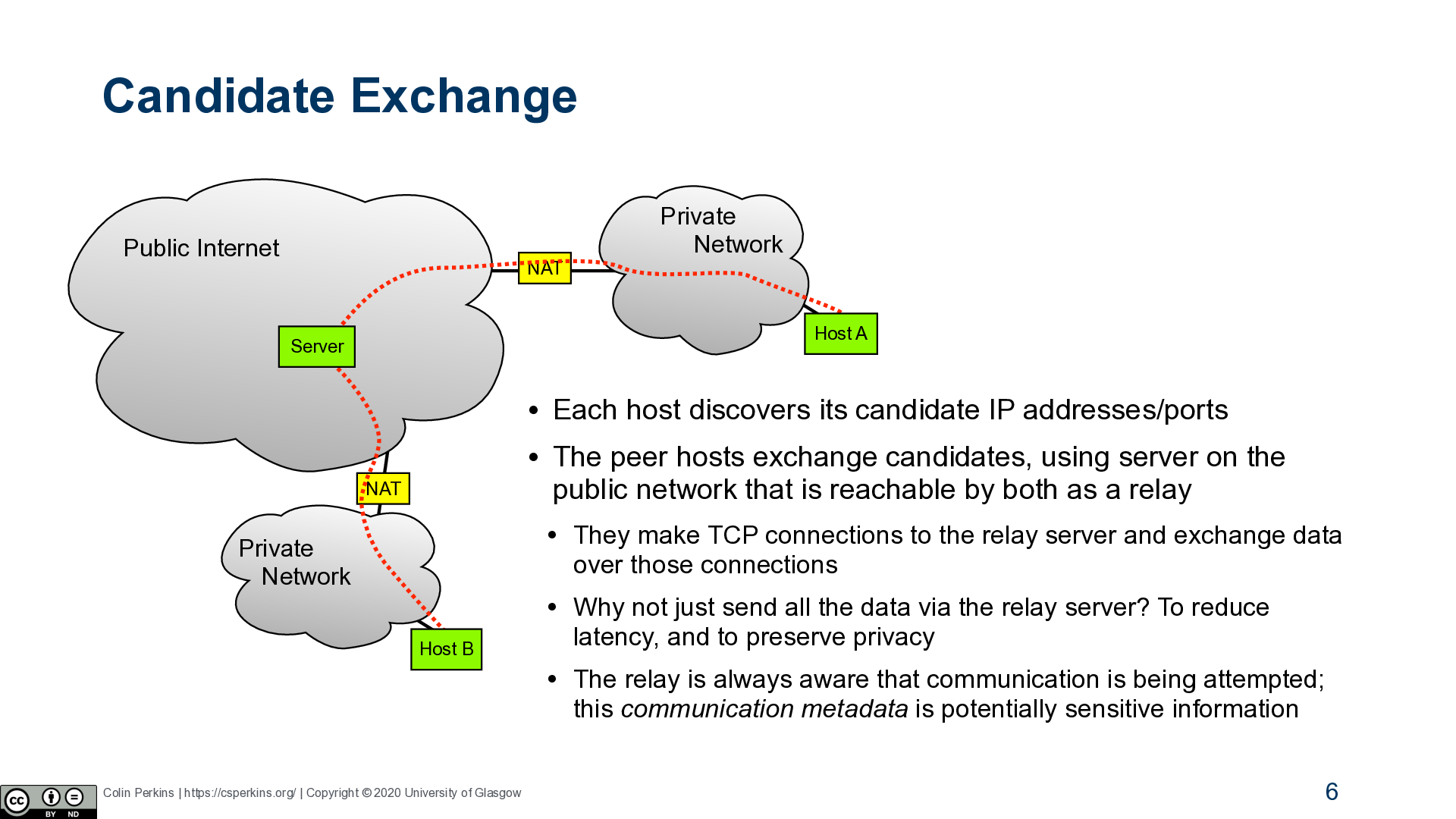
00:08:15.000
Having run a binding discovery protocol to
00:08:17.533
find all its possible candidates, a host
00:08:20.066
sends the list of candidates to the
00:08:22.566
referral server, and the referral server sends
00:08:25.100
them on to its peer. Its peer
00:08:27.633
does the same, and the host receives
00:08:30.166
the peer’s candidates via the referral server.
00:08:32.666
At this point, the two hosts know
00:08:35.200
each others candidate addresses, and are ready
00:08:37.733
to check which of the addresses work.
00:08:40.266
Given that the two peers can communicate
00:08:42.866
via the referral server, you might ask
00:08:45.400
why the peers bother to establish a
00:08:47.933
peer-to-peer connection, and don’t instead just keep
00:08:50.466
communicating via the relay?
00:08:52.000
The primary reason is because a direct
00:08:54.700
peer-to-peer connection is usually lower latency than
00:08:57.366
a connection via a relay, and for
00:09:00.066
peer-to-peer applications like video calls, latency matters.
00:09:02.766
The second is that the relay server
00:09:05.533
can eavesdrop on connections that it’s relaying,
00:09:08.233
but not on direct peer-to-peer connections.
00:09:10.533
This is perhaps less of a concern
00:09:13.233
than you might think, since the traffic
00:09:15.933
can be encrypted so it can’t be
00:09:18.600
read by the server. Also, the server
00:09:21.300
knows that the call is happening anyway,
00:09:24.000
and sometimes knowledge that two people are
00:09:26.666
talking is almost as sensitive as knowing
00:09:29.366
what they’re talking about.
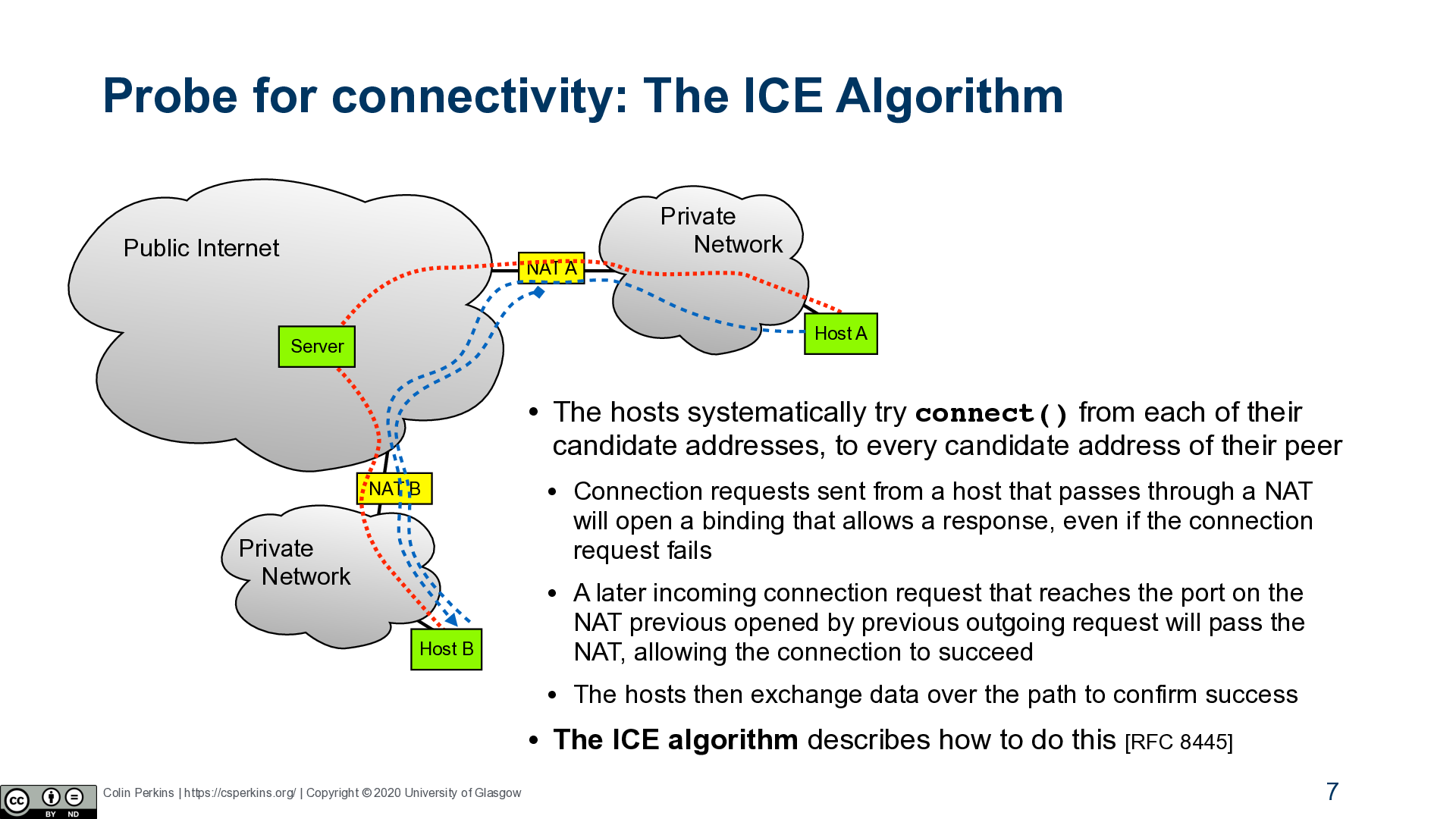
00:09:32.000
Once they’ve exchanged candidates, the two hosts
00:09:34.633
systematically send probe packets from every one
00:09:37.266
of their candidate addresses to every one
00:09:39.900
of the peer’s candidate addresses in turn,
00:09:42.533
to see if the can establish a
00:09:45.133
direct connection.
00:09:46.000
The idea is that a probe packet
00:09:48.533
sent, for example, from Host A to
00:09:51.100
a server reflexive address of Host B,
00:09:53.633
will open a binding in NAT A,
00:09:56.166
even if it fails to reach host
00:09:58.733
B. This open binding will allow a
00:10:01.266
later probe from Host B to the
00:10:03.800
server reflexive address of Host A to
00:10:06.366
reach Host A. This will, in turn,
00:10:08.900
trigger Host A to probe again in
00:10:11.466
response, and this time the probe from
00:10:14.000
Host A to the server reflexive address
00:10:16.533
of Host B will succeed because the
00:10:19.100
probe from Host B opened the necessary
00:10:21.633
binding on NAT B. The two hosts
00:10:24.166
then start sending traffic and keep-alive messages
00:10:26.733
on that path to keep the bindings
00:10:29.266
active, while the probing continues on all
00:10:31.800
the other candidates.
00:10:33.000
The probing can take a long time,
00:10:35.466
so candidate addresses are assigned a priority
00:10:37.966
based on how likely the host thinks
00:10:40.433
it is to be reachable on that
00:10:42.900
address, and on its expectation of how
00:10:45.400
well that address will perform. The checks
00:10:47.866
take place in priority order, to quickly
00:10:50.333
try to find a pair of candidates
00:10:52.833
that works.
00:10:53.533
If more than one pair of candidate
00:10:56.100
addresses successfully succeeds, the hosts choose the
00:10:58.600
best path, for example the path with
00:11:01.066
the lowest latency, and drop the other connections.
00:11:03.900
The Interactive Connectivity Establishment algorithm, ICE,
00:11:06.733
described by the IETF in RFC 8445
00:11:09.933
describes this probing process is detail.
00:11:12.666
When making a peer-to-peer phone or video
00:11:15.966
call, the ICE algorithm and the probing
00:11:19.133
usually happens while the phone is ringing,
00:11:22.333
so the connection is ready when the
00:11:25.533
call is answered.
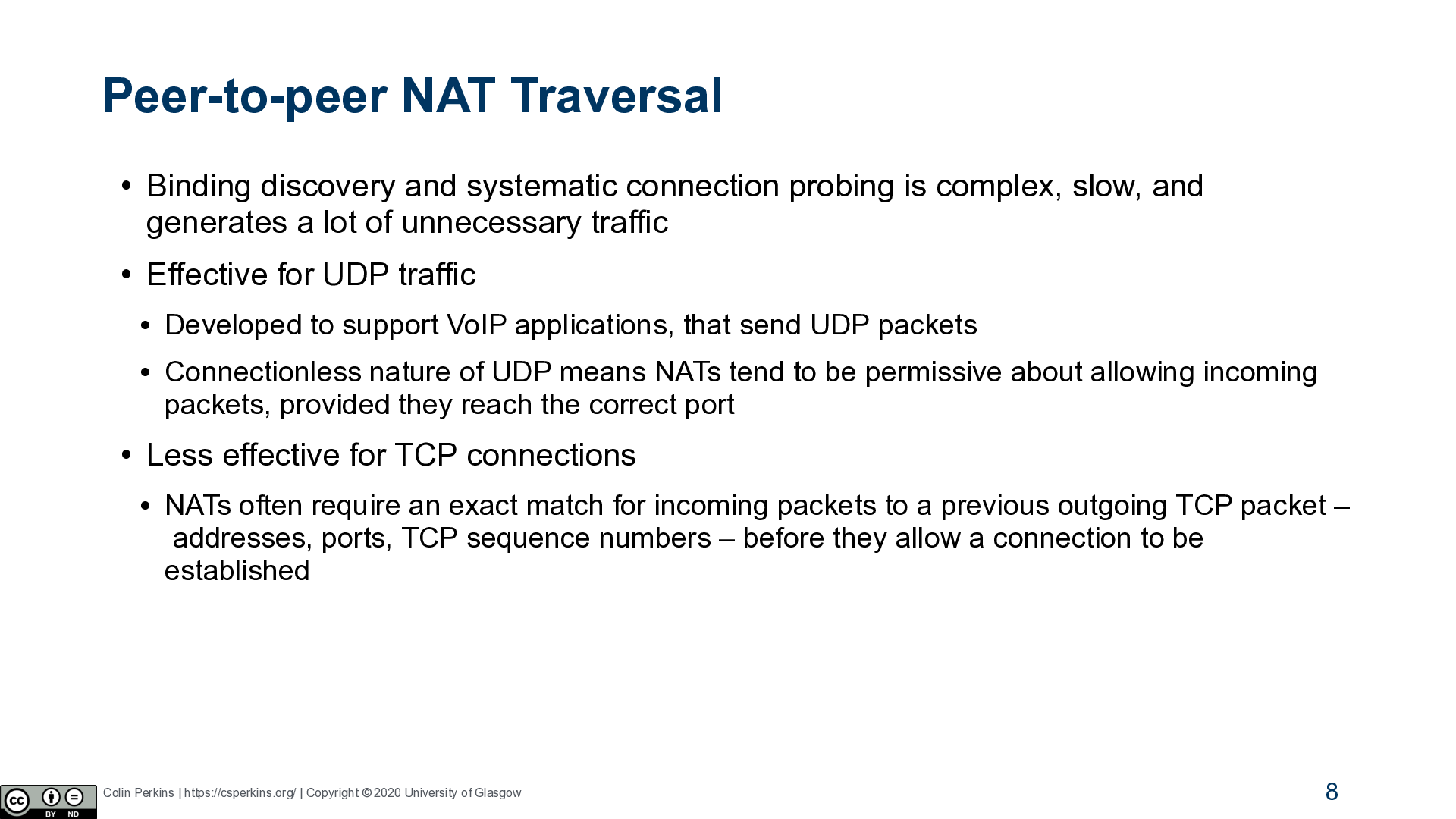
00:11:28.000
What should be clear by now is
00:11:31.166
that NAT binding discovery, and the systematic
00:11:34.333
connection probing needed for NAT traversal,
00:11:37.033
is complex, slow, and generates a lot
00:11:40.200
of traffic. The RFCs that describe how
00:11:43.366
the process works are almost 200 pages
00:11:46.533
long, and are not easy to implement
00:11:49.700
correctly.
00:11:50.900
The result is reasonably effective for UDP
00:11:54.166
traffic.
00:11:55.366
The STUN protocol, and the ICE algorithm,
00:11:58.633
were developed to support voice-over-IP applications,
00:12:01.333
that run over UDP, and the result works well.
00:12:03.766
It’s less effective for peer-to-peer TCP connections.
00:12:07.233
NATs tend to be quite permissive for
00:12:10.433
UDP, translating any incoming UDP packet that
00:12:13.666
reaches the correct address and port,
00:12:16.400
but are often stricter for TCP connections,
00:12:19.633
and check for matching TCP sequence numbers,
00:12:22.833
etc., This makes peer-to-peer TCP connections less
00:12:26.066
likely to be successful.
00:12:29.000
In this lecture, I’ve outlined how client-server
00:12:32.166
connection establishment works, and how the use
00:12:35.333
of TLS and IPv6 can affect connection
00:12:38.500
establishment, and can require connection racing using
00:12:41.666
the “happy eyeballs” technique. I also showed
00:12:44.833
that connection establishment latency is often a
00:12:47.966
critical factor limiting the performance of TCP connections.
00:12:50.866
In the later parts, I outlined how
00:12:53.200
and why NAT routers are used,
00:12:56.433
their advantages and disadvantages, and how NAT
00:12:59.633
traversal techniques work to establish
00:13:01.666
peer-to-peer connections.
00:13:04.066
Establishing a connection used to be a
00:13:06.600
simple task. What I hope to have
00:13:09.200
shown you is that it’s no longer
00:13:11.800
simple, not in the client-server case,
00:13:14.033
and especially not when peer-to-peer connections are needed.
Discussion
Lecture 2 discussed connection establishment in a fragmented network.
It started with a review of the TCP service model, and how it
establishes a client-server connection. Then, it showed some of the
factors that affect connection establishment performance.
One of the key factors affecting performance was latency, and the
number of round trips between the client and server needed to establish
the connection. With the aid of a simple example, I tried to show that
latency is often the main limitation, rather than bandwidth.
Think whether the example look reasonable to you? Did the results
surprise you? Given this behaviour, would you be willing to pay your
ISP for a higher bandwidth Internet connection?
We then discussed dual-stack connection establishment for networks that
have both IPv4 and IPv6 hosts. I highlighted that the IPv4 and IPv6
networks are separate, and showed that parallel connection establishment
is needed.
Consider how does the complexity of parallel connection establishment
compare to the sequential DNS look-up code shown in lab 1? How would
you implement this parallel connection establishment and racing? Do
you think the complexity is worth the effort to speed-up connection
establishment?
Finally, the lecture discussed network address translation and NAT
traversal, allowing several hosts to share an IP address. It showed
how NAT devices work, and discussed some of the problems they cause.
Review when does NAT work well and when is it problematic? Think
about what types of application do NATs break? Given this, why do
people use NAT devices?
NAT traversal uses binding discovery and the ICE algorithm to establish
peer-to-peer connections, using a referral server to exchange addresses
then probing to check is candidate addresses work.
Review this algorithm to determine whether the approach makes sense.
How effectively do you think this approach to NAT traversal works?
How easy do you think it would be to implement?