Lecture 5: Resource Ownership and Memory Management
This lecture begins to discuss the various options available for
resource ownership and memory management in modern programming
languages. It discusses how running programs are arranged in memory,
and outlines the need for automatic memory management. It then
discusses two approaches to memory management: reference counting and
region-based memory management, considering their various costs and
benefits. The region-based approach used in Rust is shown to have
several important benefits, in terms of efficient and deterministic
memory management, but at the cost of making certain classes of program
more complex to express.
Part 1: Memory
The first part of this lecture reviews of a process is stored in
memory, and what different types of memory exist within a running
process, as a prelude to the discussion of automatic memory
management. It also discusses how memory-unsafe behaviour can lead to
security vulnerabilities through buffer overflows attacks.
00:00:00.200
In this week’s lecture, I want to
00:00:02.200
talk about resource ownership and memory management.
00:00:06.000
In this first part, I’ll talk about
00:00:07.866
how a process is stored in memory,
00:00:10.100
and what memory has to be managed.
00:00:12.400
Then, in the following parts,
00:00:14.300
I’ll start our discussion of different
00:00:16.166
approaches to memory management,
00:00:18.166
starting with reference counting and region-based
00:00:20.766
memory management, and how these interact with
00:00:23.366
resource management.
00:00:26.600
Let’s start by talking about memory.
00:00:30.600
To understand memory management, you must first
00:00:33.400
understand what memory needs to be managed.
00:00:35.800
In all modern operating systems, every process
00:00:38.300
is given a virtual address space in
00:00:40.700
which it executes. Each process thinks it’s
00:00:43.066
the only one running on the machine,
00:00:45.466
and has access to the full range
00:00:47.033
of memory addresses.
00:00:49.000
The underlying hardware translates these virtual addresses
00:00:52.000
into physical addresses that represent particular locations
00:00:55.000
in real memory, and makes sure that
00:00:57.966
the different processes are isolated from each other.
00:01:01.300
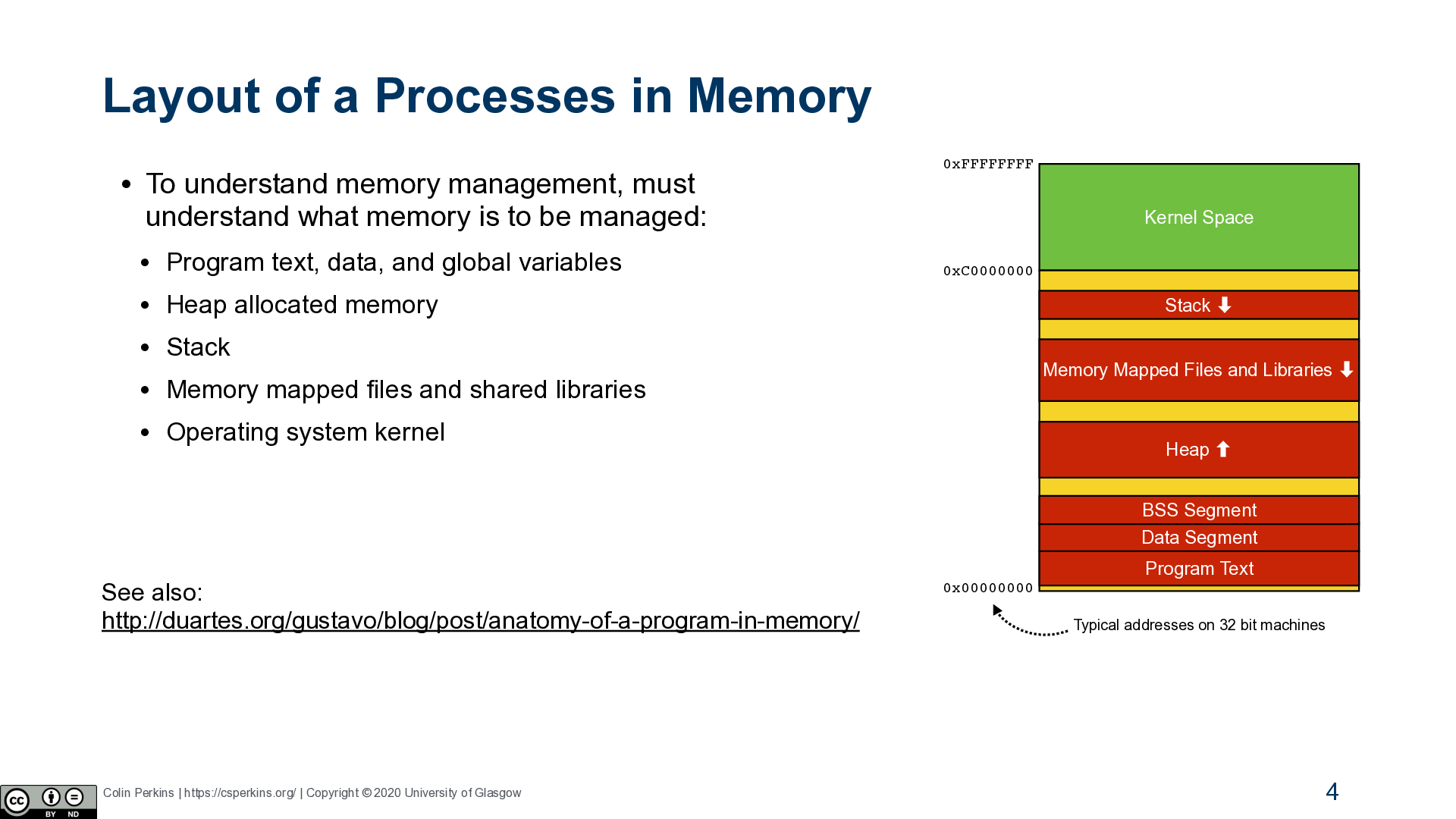
The virtual address space that a process
00:01:03.566
sees is divided into several different parts.
00:01:06.933
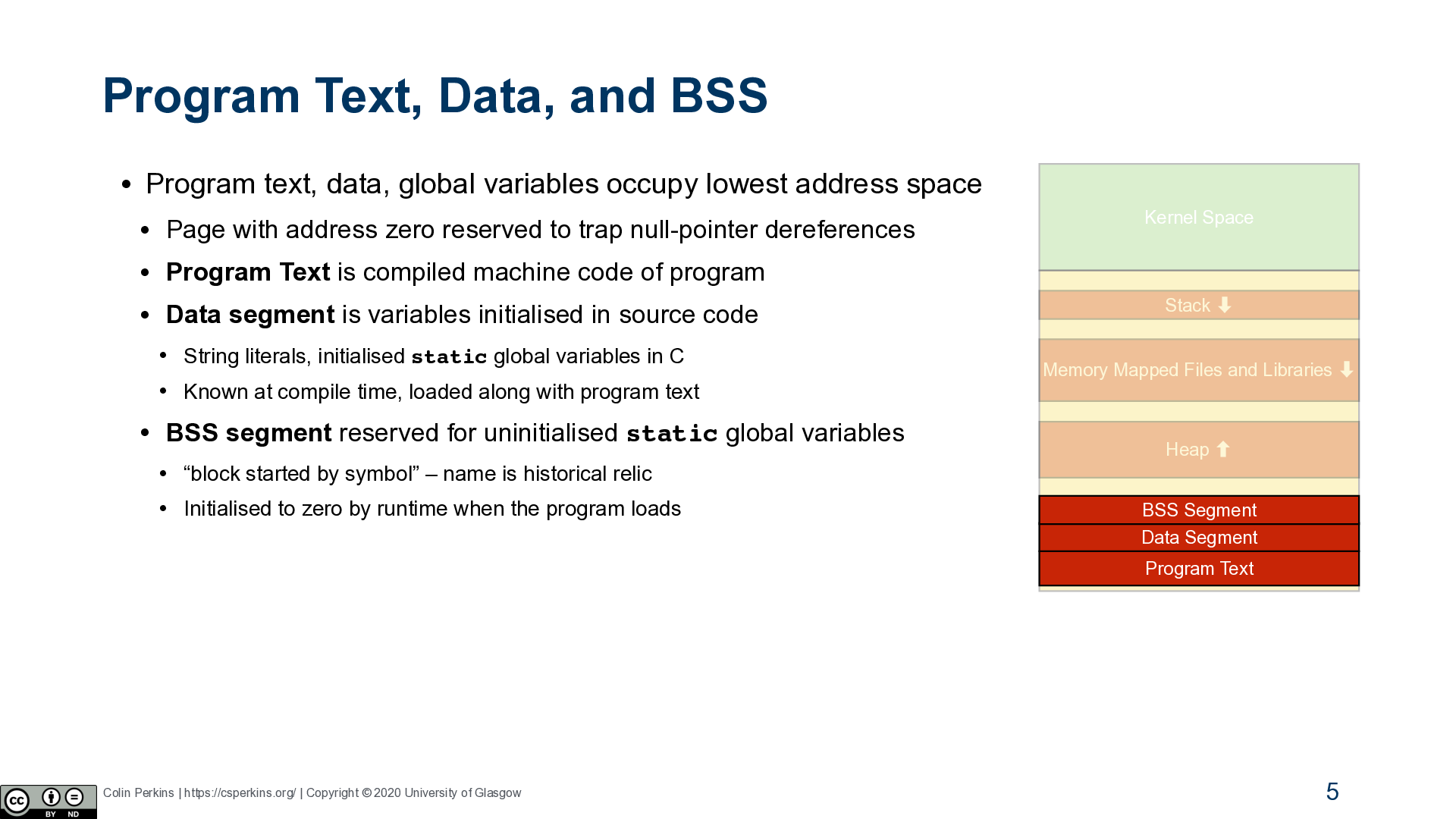
At the bottom of memory, starting with
00:01:09.000
the lowest numbered address sits the program
00:01:11.033
text itself: the machine runs that represents
00:01:14.466
the running program. That’s immediately followed by
00:01:17.800
the static data and space for any
00:01:19.900
global variables.
00:01:22.000
Following this in memory is the heap:
00:01:24.100
memory allocated using malloc(), or similar mechanisms.
00:01:27.900
Following that is the memory used to
00:01:30.200
hold shared libraries and memory mapped files.
00:01:33.000
Then the stack space, growing down from
00:01:35.100
the top of user accessible memory.
00:01:37.533
Then, finally, the operating system kernel itself
00:01:40.566
occupies the top part of the address space.
00:01:43.433
How much memory is allocated to each
00:01:45.600
of these, and what virtual addresses each
00:01:47.900
sits between, depend on whether you have
00:01:50.900
a 32-bit or a 64-bit machine,
00:01:53.433
and on what operating system you’re running.
00:01:55.900
But all the systems follow the same basic approach.
00:02:01.566
The program text, data, and global variables
00:02:04.966
occupy the lowest part of the address space.
00:02:08.100
There are four parts to this.
00:02:10.966
The very lowest page of memory,
00:02:12.800
usually the first 4096 bytes starting at
00:02:16.133
address zero, is reserved. In languages like
00:02:20.166
C, a null pointer is represented by
00:02:22.400
address zero, so the hardware virtual memory
00:02:25.000
controller is programmed to prohibit access to
00:02:27.766
that address, and to adjacent addresses,
00:02:30.366
as a way of trapping null-pointer dereferences.
00:02:33.800
Trying to access this memory will trap
00:02:36.133
into the operating system, which will kill
00:02:38.100
the process with a segmentation violation error.
00:02:42.000
Following this reserved page, sits the compiled
00:02:44.700
program text. That is, the machine code
00:02:47.966
representing the program. This occupies the lowest
00:02:51.266
part of the address space, starting just above address zero.
00:02:55.800
Next comes the data segment.
00:02:58.233
This comprises string literals and static global variables.
00:03:02.266
Data and global variables where the value
00:03:04.233
is known at compile time.
00:03:06.500
These are stored in the compiled binary,
00:03:08.866
along with the executable machine code,
00:03:11.266
and loaded into memory following the program text.
00:03:15.000
Then, space is allocated for the BSS segment.
00:03:18.966
This provides reserved space for uninitialised
00:03:21.933
global variables defined in the program.
00:03:24.600
The name BSS stands for “block started
00:03:27.400
by symbol”, and is a historical relic.
00:03:30.833
The program text and data segments are
00:03:33.333
fixed. They comprise the compiled program code
00:03:36.033
and data known at compile time.
00:03:38.666
Similarly, the size of the BSS segment
00:03:41.133
is known at compile time.
00:03:43.500
In older operating systems,
00:03:45.533
the program and data always start at a fixed
00:03:48.000
location at the start of the memory.
00:03:50.500
In modern systems,
00:03:52.033
they’re still loaded near the start of the memory,
00:03:54.766
but the actual starting address is randomised
00:03:56.833
each time the program runs.
00:03:59.000
Why is it randomised?
00:04:01.066
It’s a security measure.
00:04:02.800
It makes it harder for code executed as part of
00:04:05.366
a buffer overflow attack to call into
00:04:07.800
other parts of the program, since it
00:04:09.966
can’t know where they’ll be located in memory.
00:04:14.633
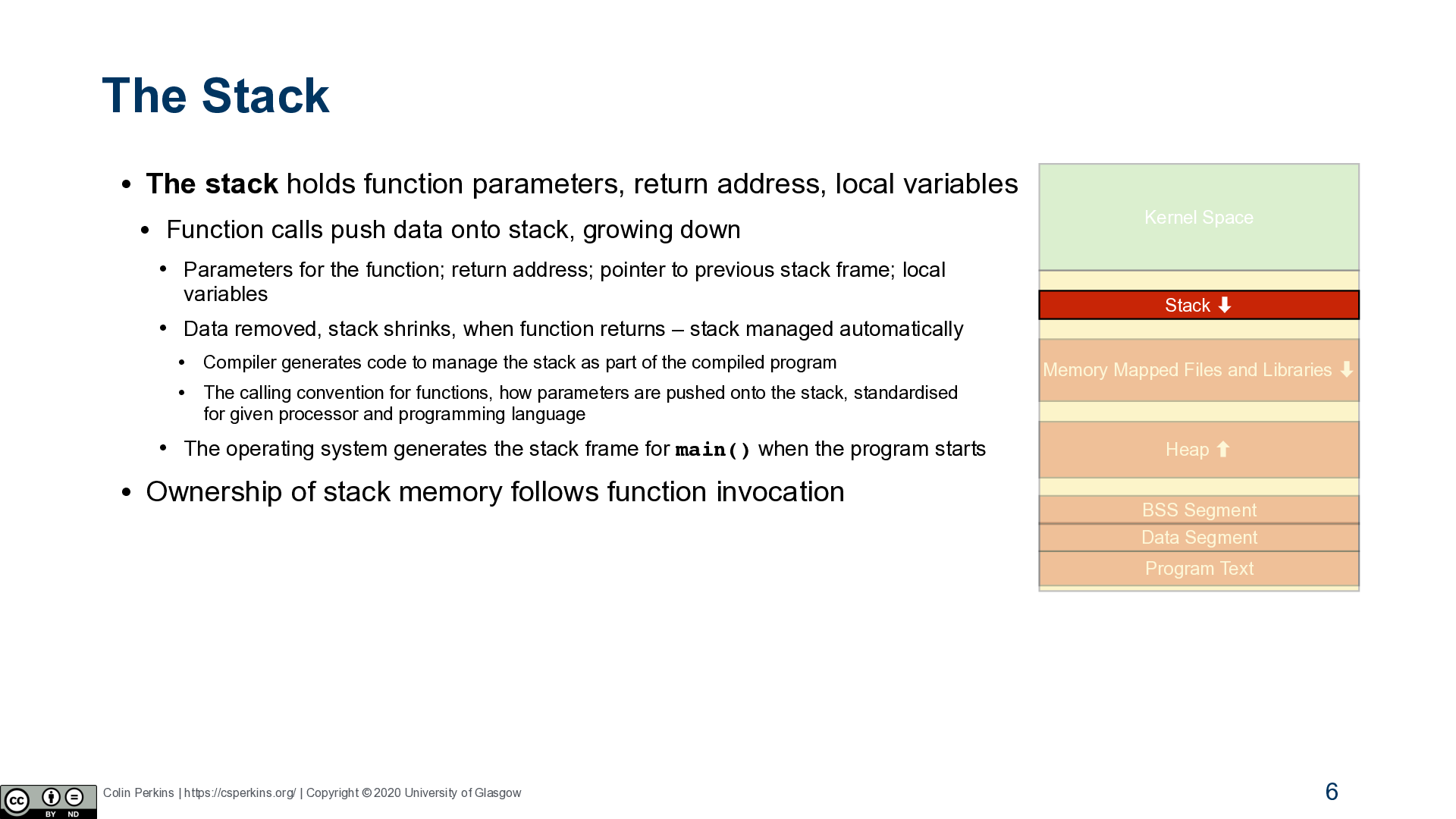
As a program executes, it needs space
00:04:17.333
to hold the function parameters, return addresses,
00:04:19.800
and local variables.
00:04:21.833
These are stored on the stack.
00:04:24.900
The stack occupies the top of user
00:04:27.000
accessible memory, starting at a random address
00:04:30.000
for security, and grows downwards.
00:04:33.566
Each time a function is called,
00:04:35.366
starting with main(), the parameters to that
00:04:38.133
function, the return address, and a pointer
00:04:40.766
to the previous stack frame are pushed
00:04:42.566
onto the stack. The occupy the next
00:04:45.466
addresses below the previous top of the stack.
00:04:48.866
And when the function starts to execute,
00:04:51.200
space for its local variables is similarly
00:04:53.433
allocated on the stack.
00:04:56.033
If that function calls other functions,
00:04:58.166
the stack grows, as the new stack frames are created.
00:05:02.000
And when a function returns, the stack
00:05:04.500
shrinks and the memory it used on
00:05:06.233
the stack is automatically reclaimed.
00:05:08.866
The compiler generates the code to manage
00:05:11.333
the stack, as part of the code
00:05:13.133
it generates for each function.
00:05:15.333
It knows how the return address, parameters, and stack
00:05:18.500
pointer are represented, and how to grow
00:05:21.000
and shrink the stack.
00:05:23.000
And the operating system generates the stack
00:05:25.033
frame for main() when the program starts,
00:05:27.900
with a return address pointing to the process cleanup code.
00:05:32.000
To the programmer, the stack is managed automatically.
00:05:35.600
Ownership of the stack memory follows function invocation.
00:05:41.500
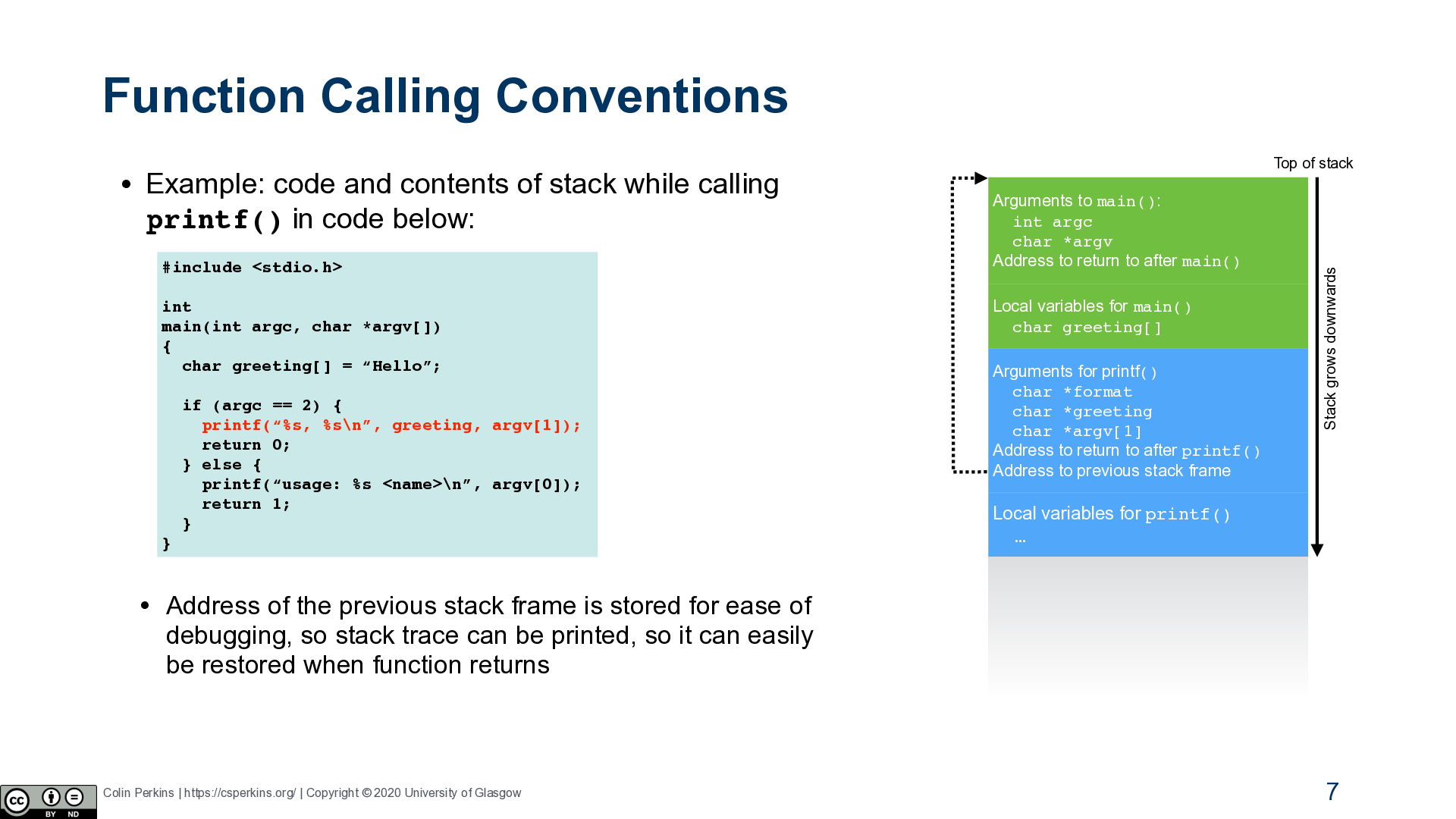
This slide shows an example of a simple C program.
00:05:45.100
It comprises a main() function that inspects
00:05:47.566
the values given as command line arguments,
00:05:49.966
and either prints a greeting or a usage message.
00:05:53.833
When this program starts to execute,
00:05:56.366
and main() is called, the stack contents
00:05:59.000
are as shown in the green region
00:06:01.033
on the right of the slide.
00:06:03.466
The stack contains the arguments to main(),
00:06:06.300
argc and argv, the address to return
00:06:10.066
to once main() completes, and the local variables for main.
00:06:14.833
When execution reaches the printf() line,
00:06:17.966
shown in red, and the function is
00:06:20.233
called, a new stack frame is created.
00:06:24.266
This new stack frame holds the arguments
00:06:26.533
for printf(), the address to return to
00:06:29.466
once the printf() call finishes, and a
00:06:31.733
pointer to the previous stack frame.
00:06:34.633
The address of the previous stack frame
00:06:36.533
is stored for ease of debugging,
00:06:38.266
so stack traces can be printed and
00:06:40.500
so debuggers can trace program execution.
00:06:44.200
As printf() starts to execute, space is
00:06:46.733
allocated on the stack for any local variables it uses.
00:06:50.566
And, if printf() itself calls any functions,
00:06:53.266
the stack will continue to grow as needed.
00:06:57.333
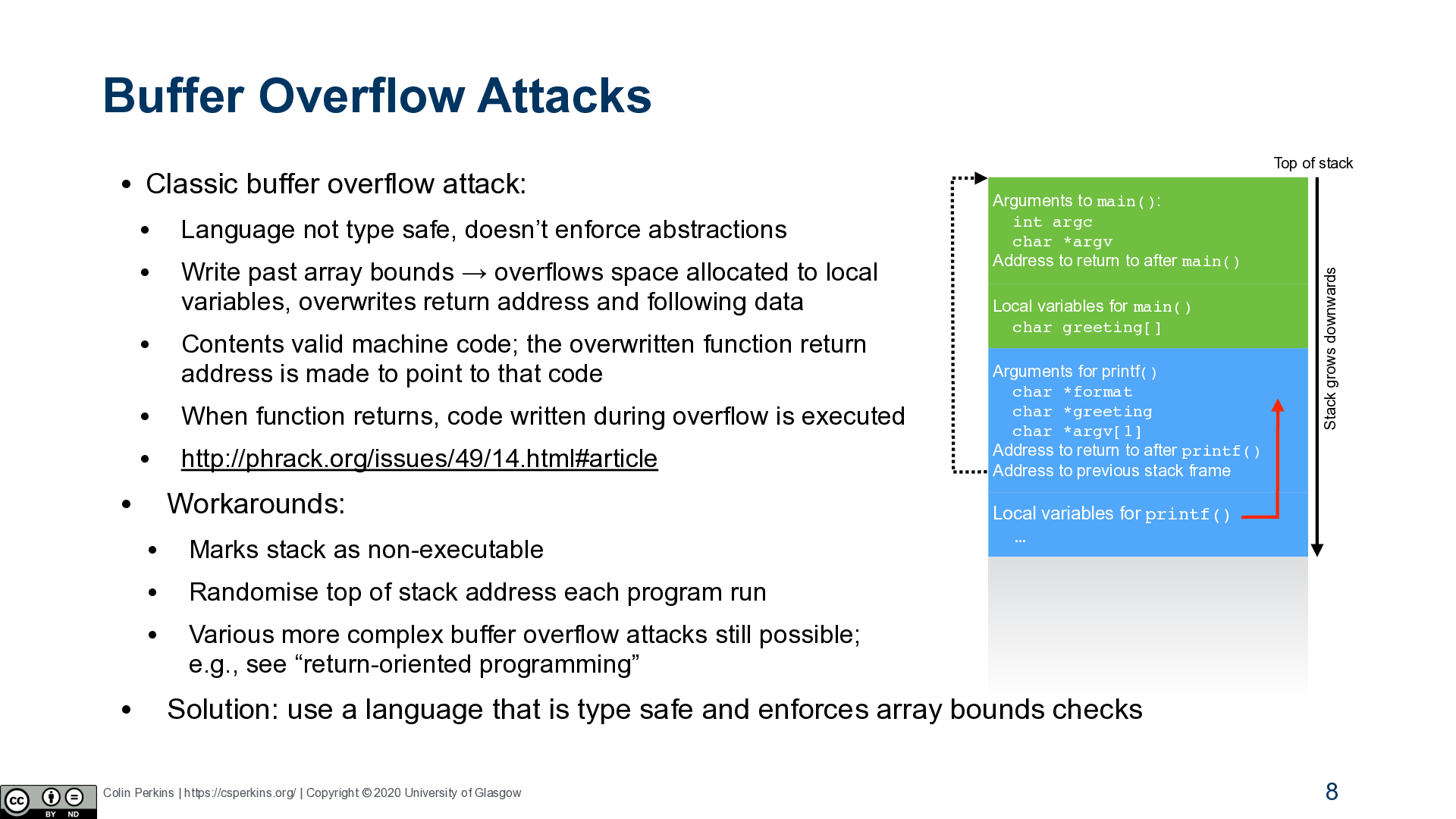
This suggests the classic buffer overflow attack.
00:07:01.333
If the language is not type safe,
00:07:03.566
and doesn’t check array bounds,
00:07:05.600
then the call to printf() can be arranged
00:07:07.700
so that it writes past the bounds of a local
00:07:09.600
variable stored on the stack.
00:07:12.000
When this happens, it overwrites whatever is
00:07:14.633
stored in the next higher addresses on the stack.
00:07:18.366
What would that be?
00:07:20.166
Well, maybe some other local variables,
00:07:23.200
but also the pointer to the previous stack frame,
00:07:26.000
then the return address of the function.
00:07:29.000
The goal is to overwrite the return address,
00:07:31.700
and some of the following memory.
00:07:33.933
The attacker tries to fill the memory
00:07:36.066
following the return address with the code
00:07:37.866
they want to execute. And to overwrite
00:07:40.500
the return address so that it points to that code.
00:07:44.266
When the function then returns, rather than
00:07:47.233
return to the correct place, it returns
00:07:49.733
instead to the return address written during
00:07:51.766
the overflows, and executes the attacker’s code.
00:07:55.533
It’s a technique known as stack smashing.
00:07:59.033
The link to the Phrack article on
00:08:01.233
the slide is the classic explanation of this technique.
00:08:05.766
Modern systems have workarounds, of course.
00:08:09.900
They randomise the location of the stack
00:08:11.833
each time a program runs, to make
00:08:13.833
it harder to known what value to
00:08:15.300
overwrite the return address with.
00:08:18.000
And they arrange for the virtual memory hardware to mark
00:08:20.566
the stack memory as non-executable,
00:08:22.800
so the system will refuse to execute the code
00:08:25.466
if the return address is successfully overwritten.
00:08:29.000
These techniques help.
00:08:30.933
The classic stack smashing attack I’ve described
00:08:34.000
won’t work on a modern system.
00:08:36.933
But they don’t entirely solve the problem.
00:08:39.666
Newer attacks, such as return oriented programming,
00:08:43.100
can defeat the protections in some cases.
00:08:46.000
The real solution, of course, is to
00:08:48.533
use a language that checks array bounds,
00:08:51.333
and prevents buffer overflows in the first place.
00:08:56.000
Back to memory management.
00:08:58.400
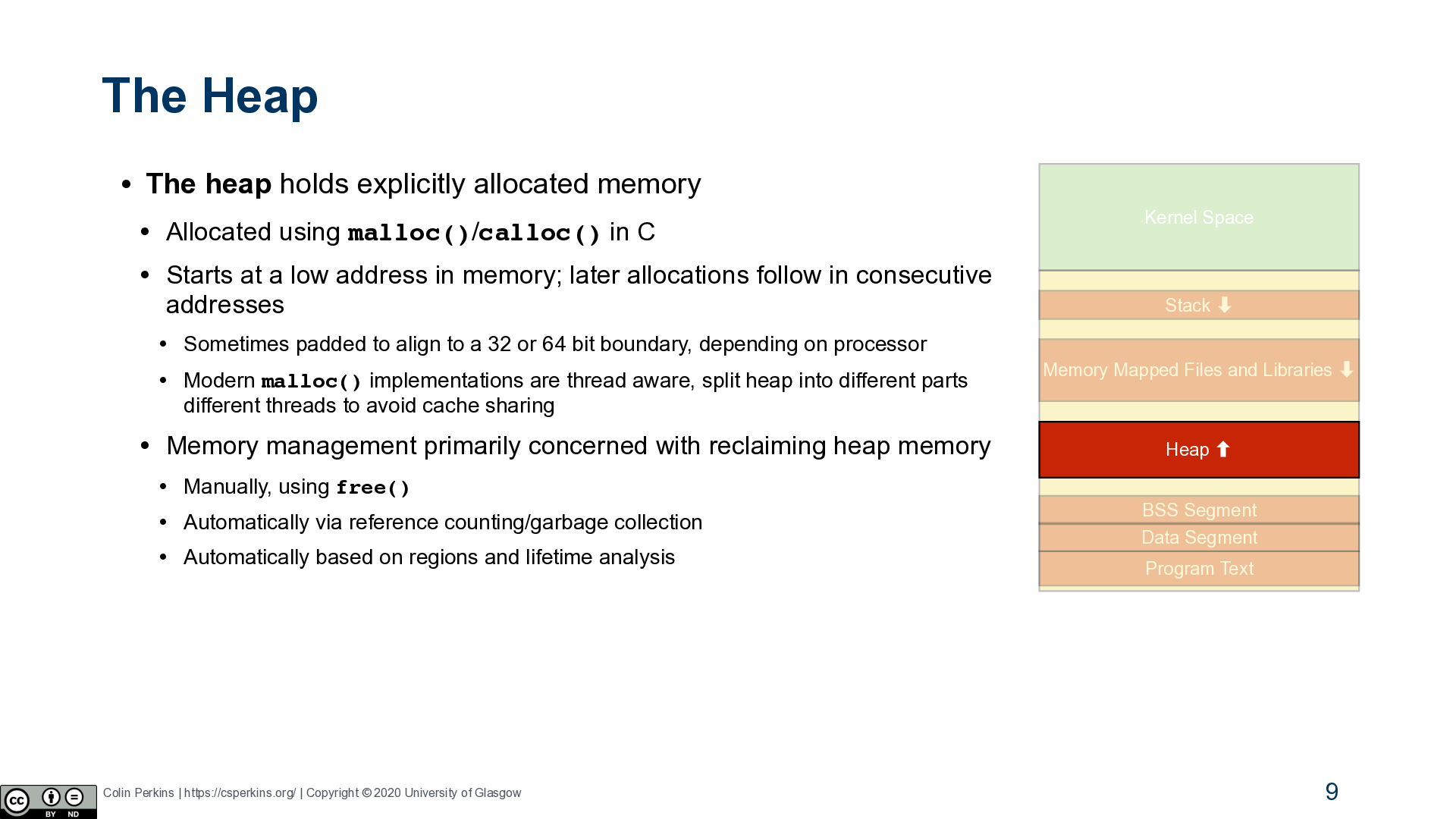
In addition to the program code and the stack,
00:09:01.333
the heap holds explicitly allocated memory.
00:09:06.733
This is memory allocated by calls to
00:09:08.666
functions such as malloc() and calloc() in C;
00:09:11.966
boxed memory in Rust;
00:09:13.800
and objects allocated using new() in Java.
00:09:17.500
The heap starts at a low address in memory,
00:09:20.500
following the BSS segment,
00:09:22.266
and grows upwards towards the stack.
00:09:25.100
As you might expect by now,
00:09:26.733
the exact starting address for heap allocations
00:09:28.933
is randomised for security.
00:09:31.733
In general, successive heap allocations will occupy
00:09:34.733
consecutive blocks in memory,
00:09:36.633
although multi-threaded systems will partition the heap
00:09:39.800
so that each thread that its own
00:09:41.433
space in which to make allocations,
00:09:43.300
without needed to coordinate with other threads.
00:09:46.433
And, depending on the processor, small allocations
00:09:49.900
may be rounded up in size to
00:09:51.533
align on a 32 bit or a 64 bit boundary.
00:09:56.500
While the stack is managed automatically as
00:09:58.800
functions are called, the challenge of memory
00:10:01.233
management is primarily about how to manage
00:10:03.333
and reclaim the heap memory.
00:10:06.000
This can be done manually, by calling the free() function.
00:10:10.000
It can be done automatically via reference
00:10:12.533
counting or garbage collection, as we’ll discuss
00:10:15.200
in the next lecture.
00:10:17.000
Or it can be done automatically,
00:10:18.966
based on regions and lifetime analysis,
00:10:21.233
as I’ll discuss in later part of this lecture.
00:10:26.000
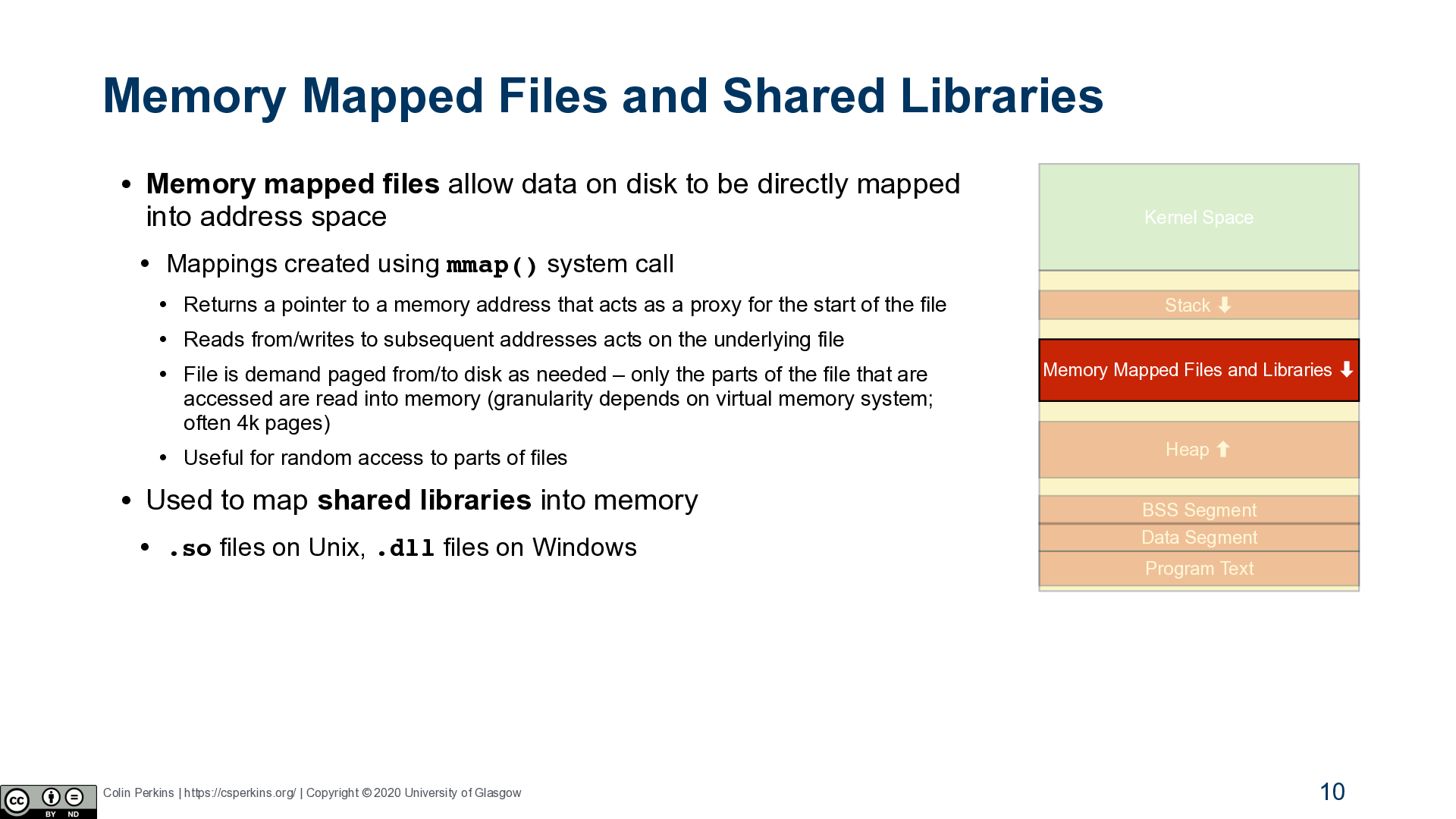
In addition to allocating heap memory,
00:10:28.733
most operating systems allow memory mapped files,
00:10:31.900
allowing data on disk to be directly
00:10:34.100
mapped into the address space.
00:10:37.000
On Unix-like systems, such mappings are created
00:10:39.866
using the mmap() system call.
00:10:43.000
The mmap() call returns a pointer to
00:10:45.133
a block of memory that acts as
00:10:46.633
a proxy for the file. Reading from
00:10:49.800
that memory will page into the relevant
00:10:51.533
part of the file into memory, and return its contents.
00:10:54.933
And writes to that block of memory will eventually be
00:10:57.400
paged back out to disk by the operating system.
00:11:01.266
The file is paged in and out
00:11:03.066
of memory as needed, with only the
00:11:05.333
parts of the file being accessed being
00:11:07.200
loaded. It’s an effective way of providing
00:11:10.066
random access to parts of a file.
00:11:13.433
Such memory mapped files generally occupy the
00:11:16.200
space between the heap and the stack.
00:11:19.000
Shared libraries are usually implemented using memory
00:11:21.666
mapped files, and are mapped into this memory space too.
00:11:27.333
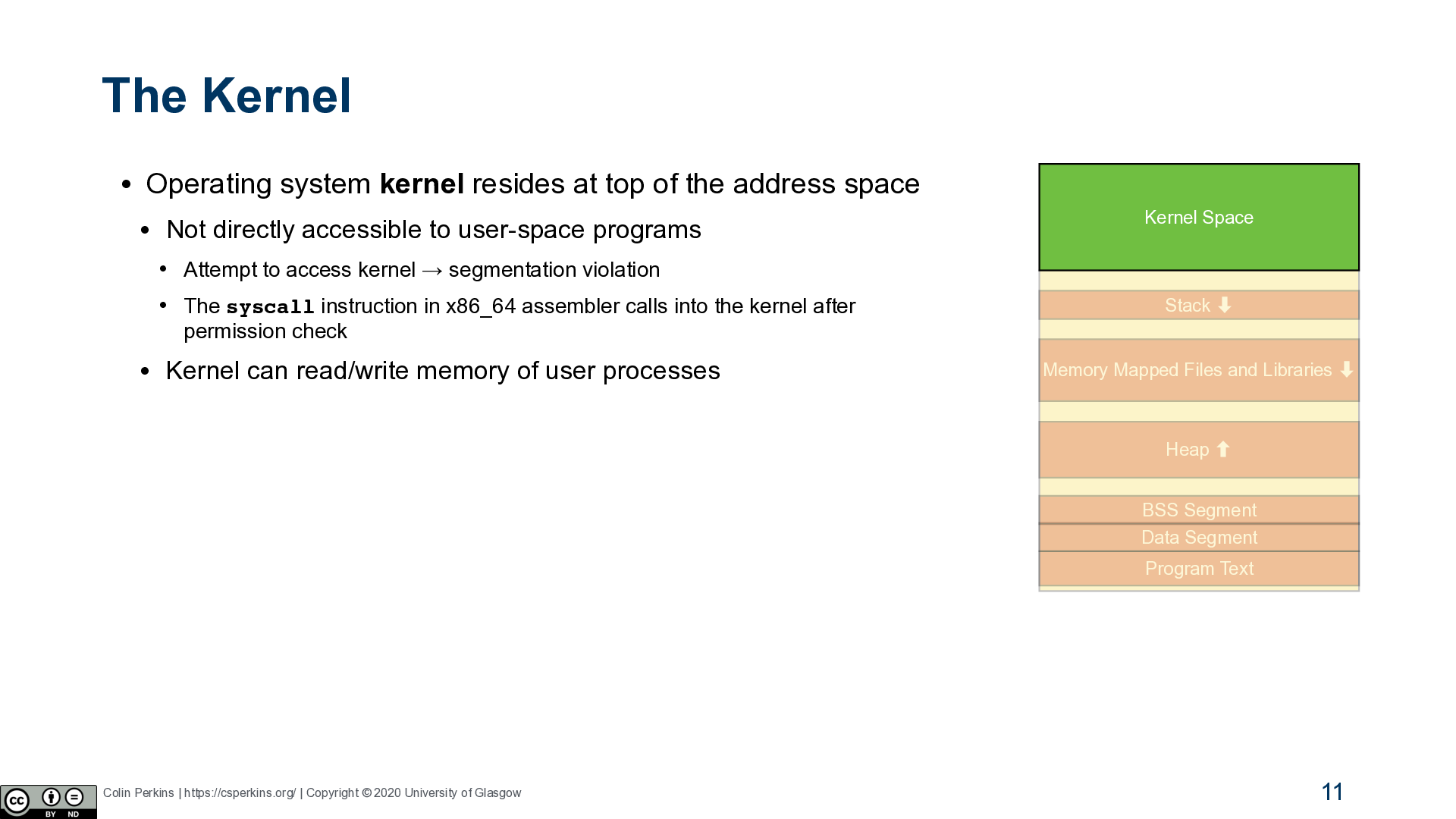
Finally, the operating system kernel resides at
00:11:30.033
the top of the address space.
00:11:32.566
Kernel memory isn’t directly accessible to user
00:11:34.900
programs, and attempts to access that memory
00:11:37.566
will result in a segmentation violation.
00:11:41.000
The hardware provides a special machine code
00:11:43.100
instruction, known as syscall on 64-bit Intel
00:11:46.733
processors, that switches the system to kernel
00:11:49.700
mode and executes a particular function in
00:11:52.100
kernel memory, after performing some permission checks.
00:11:56.000
The kernel itself can read and write
00:11:58.566
to the entire address space. The hardware
00:12:01.166
protects the operating system kernel from the
00:12:03.200
user processes, but the operating system has
00:12:05.600
to be able to control those processes
00:12:09.600
That concludes our discussion of how
00:12:11.533
programs are stored in memory.
00:12:13.700
In the next part, I’ll start to
00:12:15.333
talk about memory management, and the use
00:12:17.666
of reference counting as a memory management technique.
Part 2: Automatic Memory Management: Reference Counting
The second part of the lecture introduces the concepts of automatic
memory management and its use in systems programs. Then it discusses
one of the simplest automatic memory management schemes: reference
counting. It outlines how reference counting works, and describes
its limitations, costs, and benefits.
00:00:00.400
In this part, I’ll talk about the goals
00:00:02.633
of automatic memory management.
00:00:04.566
And I’ll discuss one of the simplest automatic memory
00:00:06.866
management schemes, reference counting.
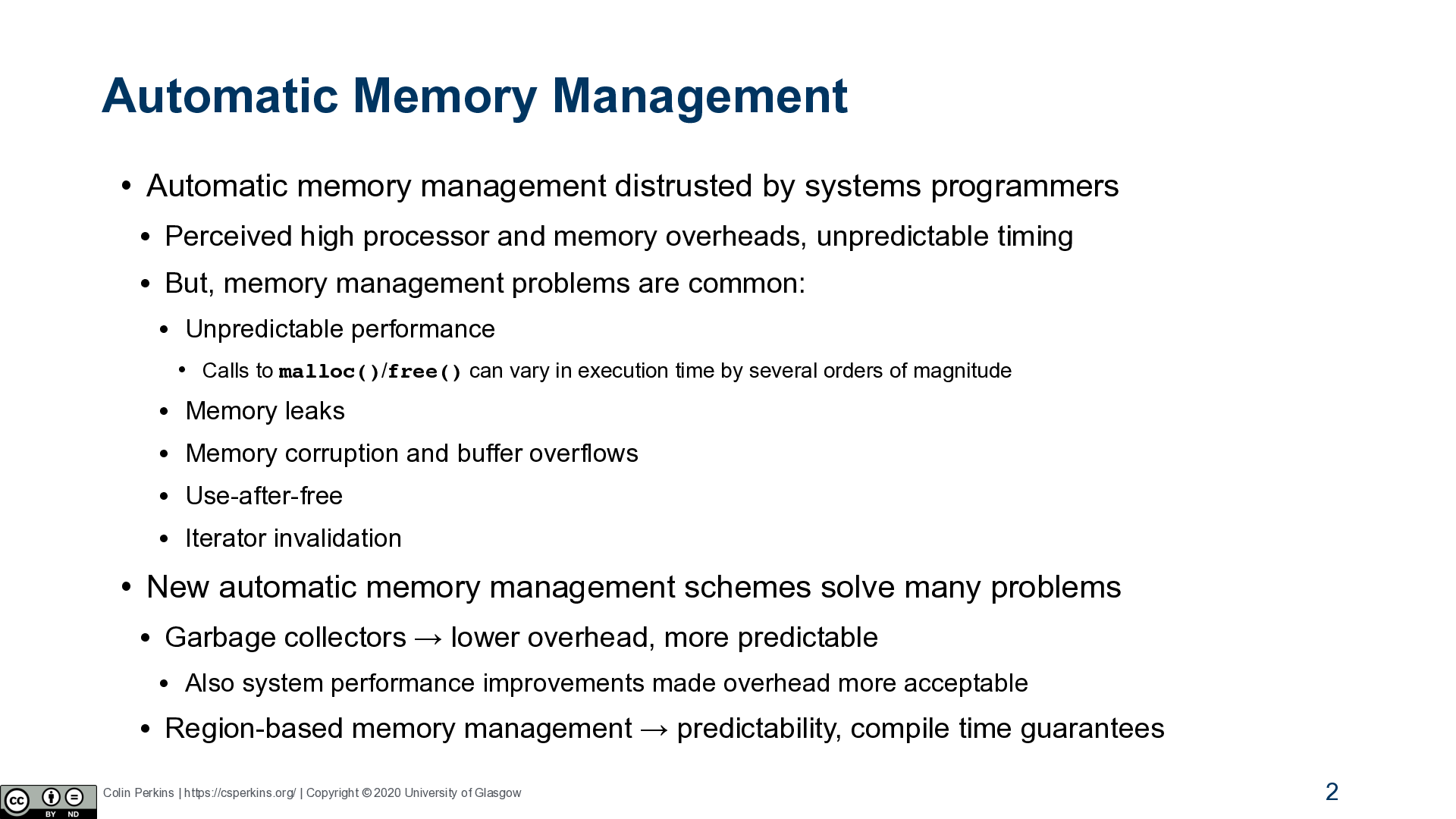
00:00:11.000
Automatic memory management
00:00:12.900
is frequently distrusted by systems programmers.
00:00:15.633
There’s a general belief that it has high overheads.
00:00:19.166
That it’s slow, CPU hungry, and wastes memory.
00:00:22.900
And that the use of automatic memory management
00:00:25.466
introduces unpredictability into the timing
00:00:28.200
of time sensitive operations.
00:00:31.000
And to some extent this belief is true.
00:00:34.066
There are many different types of automatic
00:00:36.100
memory management. And some of them do
00:00:38.600
have high CPU costs. Some of them
00:00:41.000
do waste memory. And some do introduce
00:00:43.866
unpredictability into timing.
00:00:46.733
Equally, though, there are very real problems
00:00:49.266
due to manual memory management.
00:00:52.000
Managing memory manually has unpredictable overheads.
00:00:56.066
As a programmer you known when you
00:00:58.266
call malloc() and free(), but you have
00:01:00.466
no idea how long those calls will
00:01:01.933
take to execute. And they can be
00:01:04.166
quite processor intensive, and can take unpredictable
00:01:06.666
amounts of time, in some cases.
00:01:10.000
And there are the numerous, and well
00:01:11.966
known, problems due to memory leaks,
00:01:13.900
memory corruption, buffer overflows, use-after-free bugs,
00:01:16.933
and iterator invalidation, all of which are
00:01:19.833
due to manual memory management.
00:01:23.000
Systems programmers have focussed on the problems
00:01:25.333
of moving to automatic memory management,
00:01:27.466
discounting the problems of the status quo.
00:01:31.166
Furthermore, we’re starting to see automatic memory
00:01:33.966
management techniques that solve some of the
00:01:35.800
problems with older approaches. New garbage collection
00:01:39.566
algorithms have lower overheads and are more
00:01:41.466
predictable. And systems have gotten faster,
00:01:44.633
making the overheads of existing algorithms more acceptable.
00:01:48.300
And different approaches, such as region-based memory
00:01:51.133
management, are starting to see widespread use,
00:01:54.766
and offer more predictability and stronger compile-time
00:01:58.266
behaviour guarantees.
00:02:00.700
For many systems programs, it may be
00:02:02.900
time to reconsider the cost-benefit tradeoff for
00:02:05.266
automatic memory management, to see if the
00:02:07.866
balance has shifted.
00:02:11.500
Systems programs traditionally used a mix of
00:02:13.900
manual and automatic memory management.
00:02:17.600
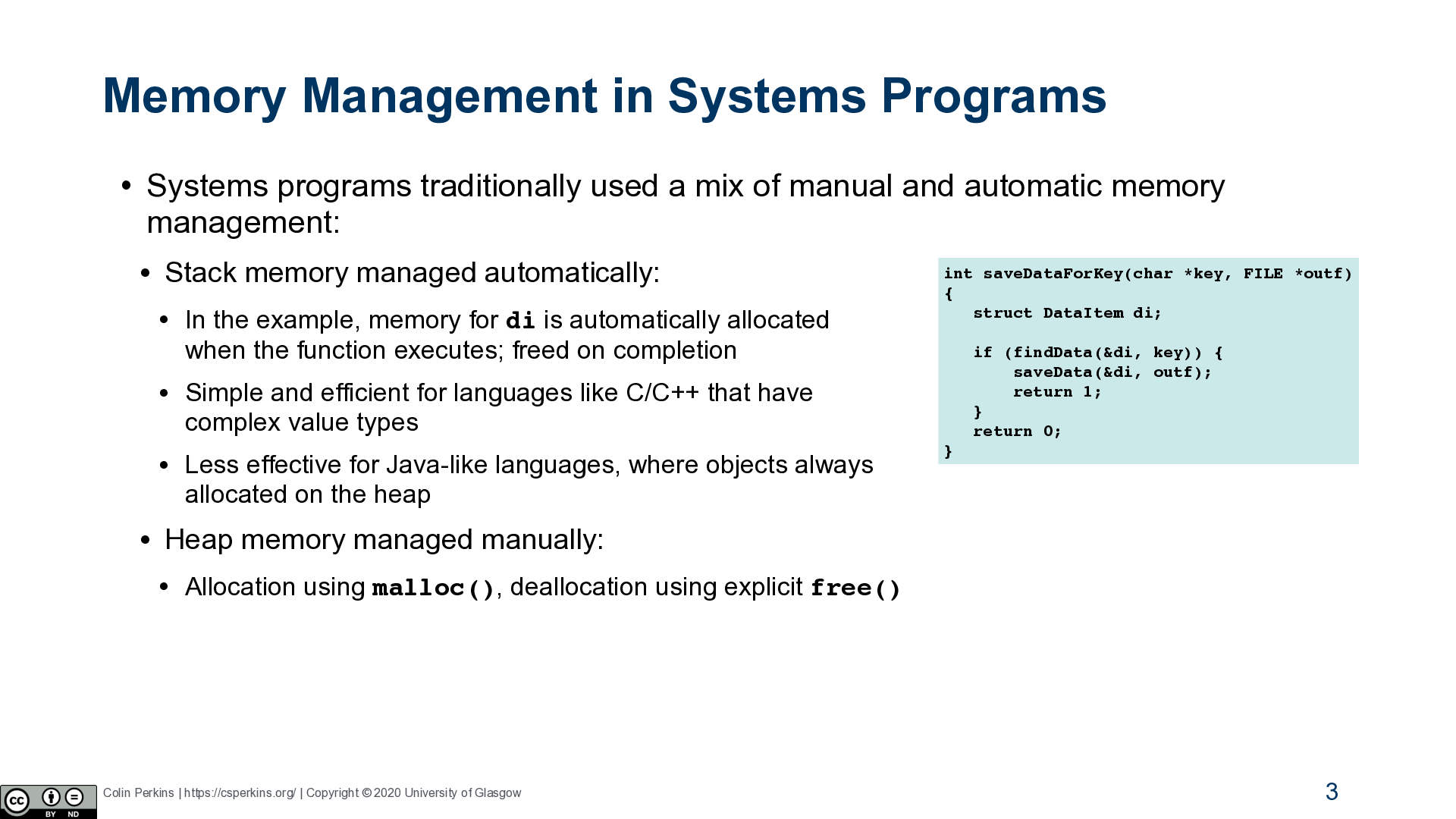
The memory used for the stack is managed automatically.
00:02:21.666
In the sample code on the slide,
00:02:23.600
for example, the memory for the local
00:02:25.833
variable, di, in the saveDataForKey() function is
00:02:29.266
automatically allocated when the function is called,
00:02:32.900
and automatically freed when the function returns.
00:02:37.000
This is so common that we don’t even think about it.
00:02:40.166
Stack-based memory management, in this form,
00:02:43.466
works extremely well for languages like C
00:02:46.366
and C++ that support complex value types.
00:02:49.400
That is, for languages that can put
00:02:51.666
structs on the stack and pass them by value.
00:02:55.800
It works less well for languages like
00:02:57.600
Java, where objects are heap allocated.
00:03:00.666
In Java, the variable, di, would be
00:03:03.166
a reference to a heap allocated object,
00:03:05.400
which would need to be garbage collected.
00:03:07.833
Only the reference to that object would
00:03:10.066
be stored on the stack. While,
00:03:12.600
in C and C++, the entire object
00:03:14.966
can be efficiently managed on the stack.
00:03:17.566
The stack in C and C++ is
00:03:20.000
an example of successful automatic memory management.
00:03:24.000
The heap, on the other hand,
00:03:25.900
is generally managed manually. Allocation is by
00:03:28.866
a call to malloc(). Deallocation, if the
00:03:31.266
programmer remembers to do so, is by
00:03:33.833
an explicit call to free().
00:03:37.900
It would be good to have an
00:03:39.266
effective and automatic way of managing the
00:03:41.033
heap. Something that’s as simple, efficient,
00:03:44.300
and effective as managing the stack.
00:03:47.266
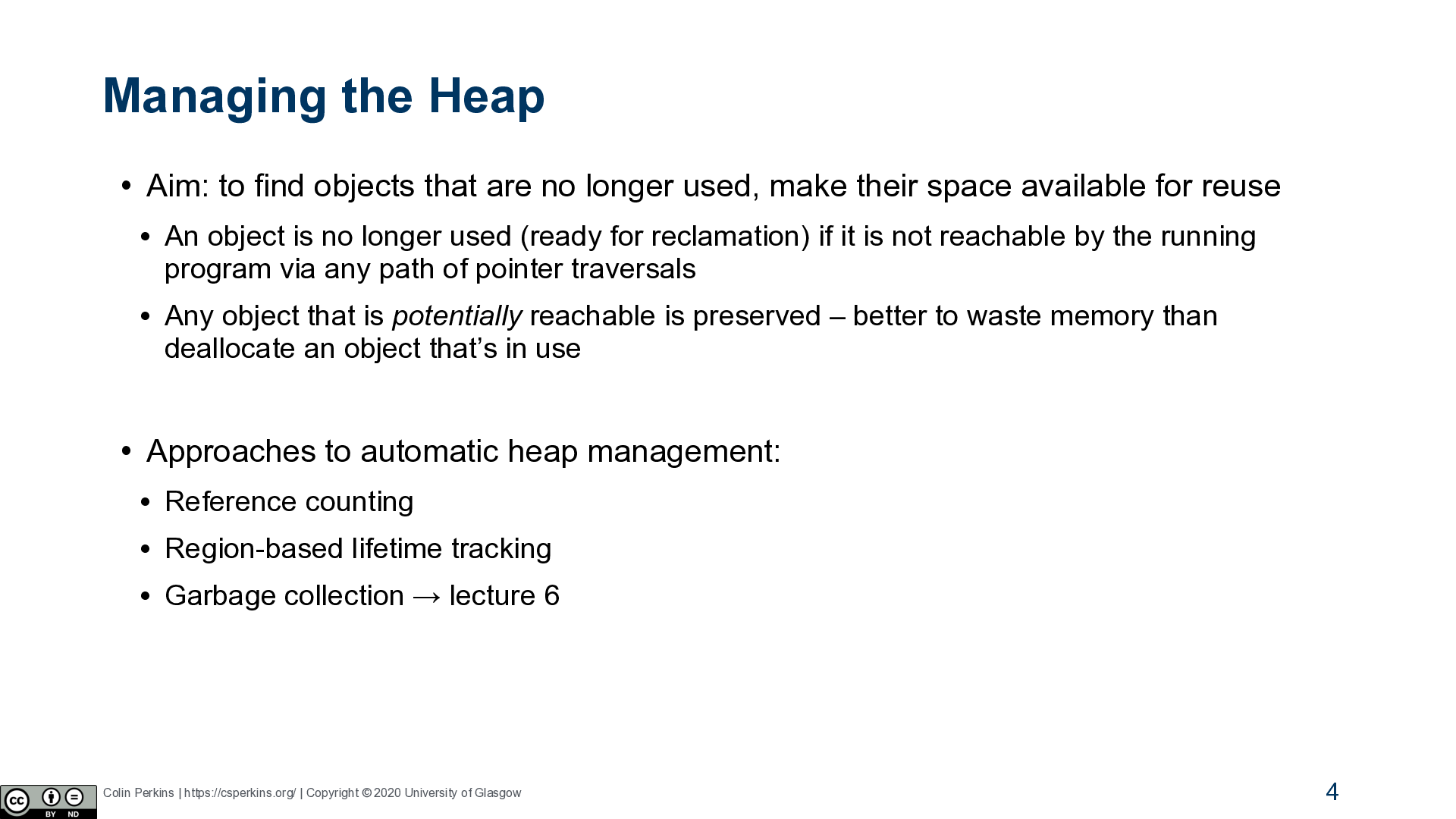
The goal of automatic memory management is
00:03:49.366
to manage the heap. To find memory
00:03:51.966
that’s no longer in use, and make
00:03:53.900
that space available for reuse. To look
00:03:56.033
for objects that are no longer referenced
00:03:58.166
by the running program, and to free their memory.
00:04:01.000
And to do so efficiently and automatically.
00:04:05.000
And to do so safely.
00:04:06.966
It’s better to waste memory, and to keep an
00:04:09.033
object alive when it shouldn’t be,
00:04:11.200
than to deallocate the memory used by
00:04:13.766
an object that’s potentially still in use.
00:04:16.500
There are three approaches to automatically
00:04:18.800
managing the heap.
00:04:21.000
The first is reference counting, that I’ll
00:04:22.933
discuss in a minute.
00:04:25.000
The second is region-based lifetime tracking,
00:04:27.700
that I’ll discuss in the next part of this lecture.
00:04:31.000
And the third is to use garbage
00:04:32.933
collection, that I’ll discuss in lecture 6.
00:04:37.500
The first of the automatic memory management
00:04:40.100
techniques is reference counting.
00:04:43.500
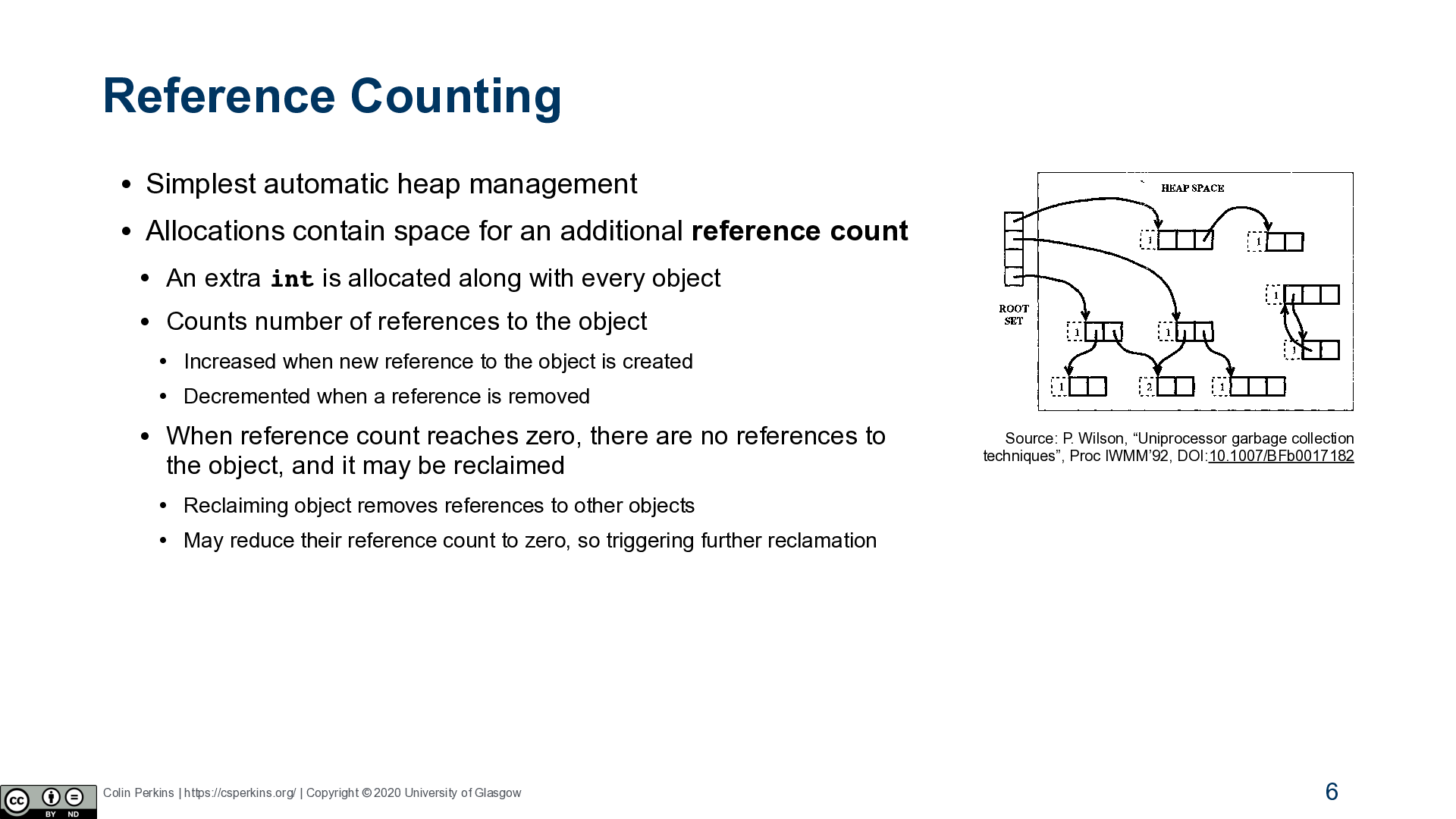
Reference counting is simple and easy to understand.
00:04:47.166
When allocating memory for an object,
00:04:49.433
the allocation contains additional space for a
00:04:51.500
reference count that’s stored along with the object.
00:04:54.900
That is, every object has a hidden
00:04:57.566
extra field, large enough to hold an
00:04:59.866
integer value, that’s stored alongside the object
00:05:03.100
and managed by the runtime system,
00:05:04.966
invisibly to the programmer.
00:05:07.333
This extra field contains a reference count.
00:05:10.400
It counts how many other objects have
00:05:12.833
a pointer, a reference, to this object.
00:05:15.333
When a heap allocated object is created,
00:05:18.033
the reference count is set to one,
00:05:20.133
and a reference to the object is returned.
00:05:22.866
When a new reference, a new pointer,
00:05:25.366
to the object is made, then the
00:05:28.066
reference count is increased by one.
00:05:30.233
When a reference is removed or changed,
00:05:32.766
so that it no longer points to
00:05:34.866
the object, then the reference count is decreased by one.
00:05:38.300
If the reference count reaches zero,
00:05:40.866
then there are no references left that
00:05:43.466
point to the object, and it may
00:05:44.966
be reclaimed, and it’s memory deallocated.
00:05:48.000
If an object that contains references to
00:05:50.300
other objects is reclaimed, this removes a
00:05:52.966
reference to those objects. Doing so potentially
00:05:56.233
causes their reference counts to go to
00:05:58.433
zero, triggering further reclamation.
00:06:01.066
The reference counts are maintained automatically.
00:06:04.100
In a compiled language with reference counting,
00:06:07.133
such as the Objective C runtime used
00:06:09.766
in iPhones, then the compiler generates the
00:06:12.500
code to manage references and reclaim objects
00:06:14.966
when pointers are manipulated. In an interpreted
00:06:18.533
language with reference counting, such as Python
00:06:21.400
or Ruby, the interpreter updates the references
00:06:24.533
and reclaims the objects.
00:06:28.500
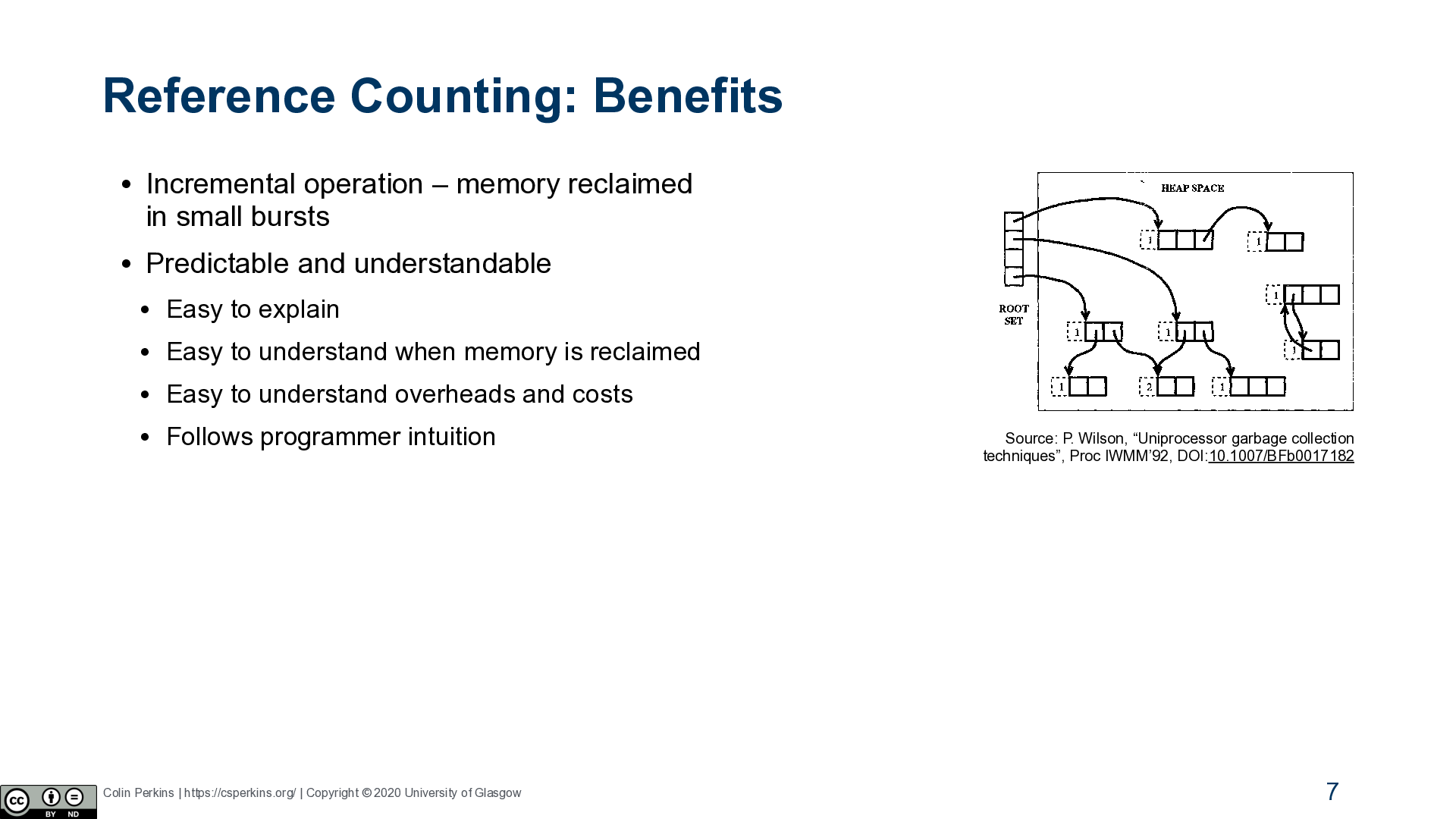
The key benefit of reference counting is
00:06:31.066
that it’s predictable and understandable.
00:06:34.000
It’s easy to explain how reference counting works.
00:06:37.533
It’s easy to understand when memory is
00:06:39.866
reclaimed, and what actions in a program
00:06:42.333
might trigger memory to be reclaimed.
00:06:45.000
It’s easy to understand what is the
00:06:46.766
overhead and what is the cost.
00:06:49.233
It’s one additional integer per object;
00:06:51.166
an increment of a reference count when
00:06:53.466
taking a pointer to an object;
00:06:55.200
and a decrement of a reference count,
00:06:57.033
an if statement, and a potential call
00:06:58.900
to free() when removing a reference.
00:07:01.933
The behaviour is intuitive to programmers –
00:07:04.233
and that counts for a lot.
00:07:06.466
Reference counting is also incremental.
00:07:09.266
Memory is reclaimed in small bursts, and the costs
00:07:12.133
that occur are an occasional small overhead
00:07:14.666
on pointer operations. There are few long
00:07:17.233
bursts of memory management activity, and it’s
00:07:19.800
clear what might trigger such bursts.
00:07:24.000
Reference counting also has some costs.
00:07:27.600
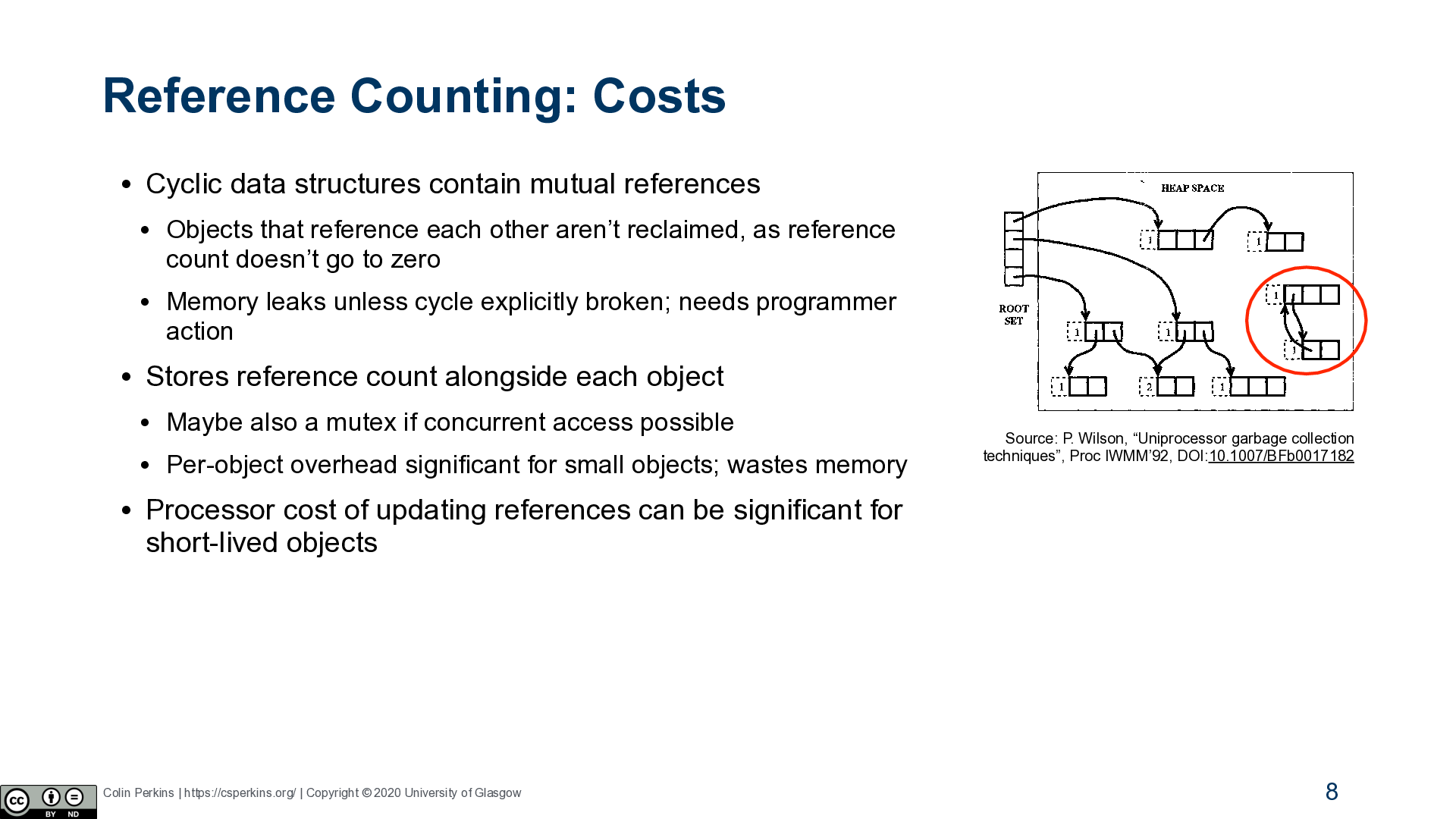
Cyclic data structures can be produced that
00:07:30.100
contain mutual references. That is, a set
00:07:33.100
of objects can reference each other in
00:07:35.233
a loop, such that the objects are
00:07:37.666
all reachable from some other object,
00:07:39.166
so the reference count never reaches zero,
00:07:41.733
but not from the rest of the program.
00:07:44.566
This can lead to a disconnected set
00:07:46.466
of objects, unreachable from the rest of
00:07:48.400
the code, that aren’t reclaimed because they
00:07:50.833
have non-zero reference counts.
00:07:53.000
That is, it can leak memory.
00:07:56.400
The programmer needs to notice, and explicitly
00:07:59.066
set one of the references to null,
00:08:00.933
to break the cycle before removing the
00:08:03.066
last other pointer to the objects.
00:08:05.000
Only then will the objects be reclaimed.
00:08:08.266
Reference counting stores a reference count alongside
00:08:11.100
each object, as an additional hidden field.
00:08:14.100
If the objects can be accessed concurrently,
00:08:16.633
it may also need a mutex for each object.
00:08:19.666
This uses additional memory. And can be
00:08:22.566
quite a high overhead if the objects are small.
00:08:25.733
And the processor cost of updating the
00:08:27.633
references can be moderately high, if the
00:08:30.133
program manipulates pointers a lot, of if
00:08:32.000
the objects don’t live long.
00:08:35.233
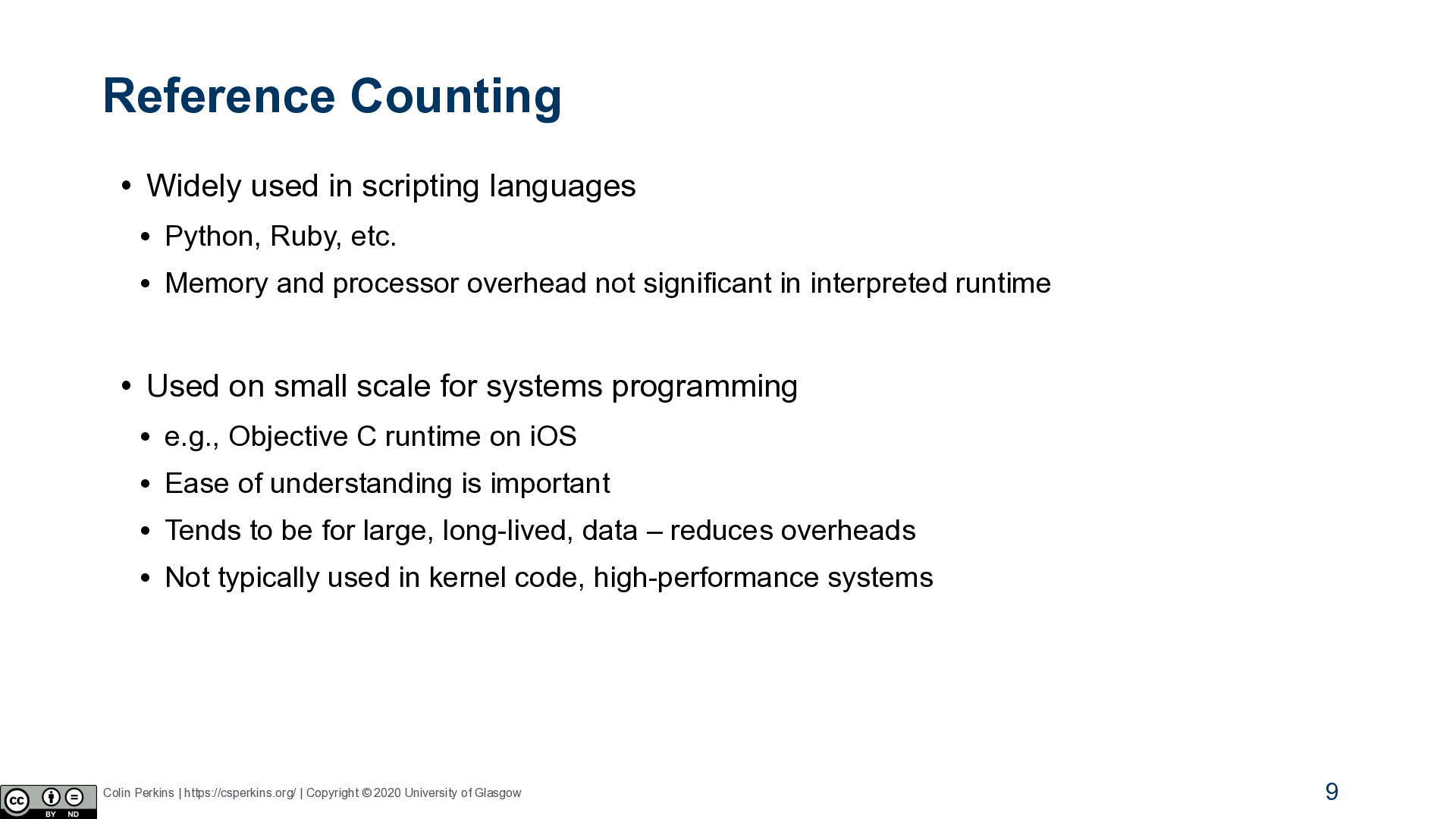
Despite these limitations,
00:08:36.900
reference counting is widely used.
00:08:39.800
It’s common in scripting languages, such as
00:08:42.500
Python or Ruby, where the overhead of
00:08:44.866
using an interpreted language far outweighs the
00:08:47.133
overhead of using reference counting.
00:08:50.000
It’s also used for some aspects of systems programming.
00:08:54.166
Applications for the iPhone and Mac are
00:08:56.700
typically written in the Objective C language.
00:08:59.700
This is an object oriented extension to
00:09:02.100
C that uses reference counting to manage
00:09:03.966
the memory allocated to objects. And it’s
00:09:06.966
actually highly optimised and reasonably high performance.
00:09:09.966
Reference counting has always been fast enough
00:09:12.333
for user interface code and much application
00:09:14.766
logic. It’s not used for low-level,
00:09:17.933
in-kernel, code, where performance is critical, though.
00:09:22.766
That concludes our discussion of reference counting.
00:09:25.766
It’s a simple, and reasonably effective automatic
00:09:28.400
memory management scheme, that’s quite widely used.
00:09:31.600
In the next part, I’ll move on to discuss
00:09:34.300
an alternative known as region-based memory management.
Part 3: Region-based Memory Management
The third part of the lecture introduces the concept of region-based
memory management. It describes the concepts and rationale behind
this approach, and how it builds on the way the stack is managed.
And it describes the benefits and limitations of region-based
approaches to memory management, such as that employed by Rust.
The concept of ownership tracking is introduced.
00:00:00.066
In this part, I want to introduce
00:00:02.033
region-based memory management, and discuss how it’s
00:00:04.833
used to manage memory in Rust.
00:00:08.000
Region-based memory management is a new way
00:00:10.366
of managing memory that grew out of
00:00:12.266
frustrations with the alternatives.
00:00:15.000
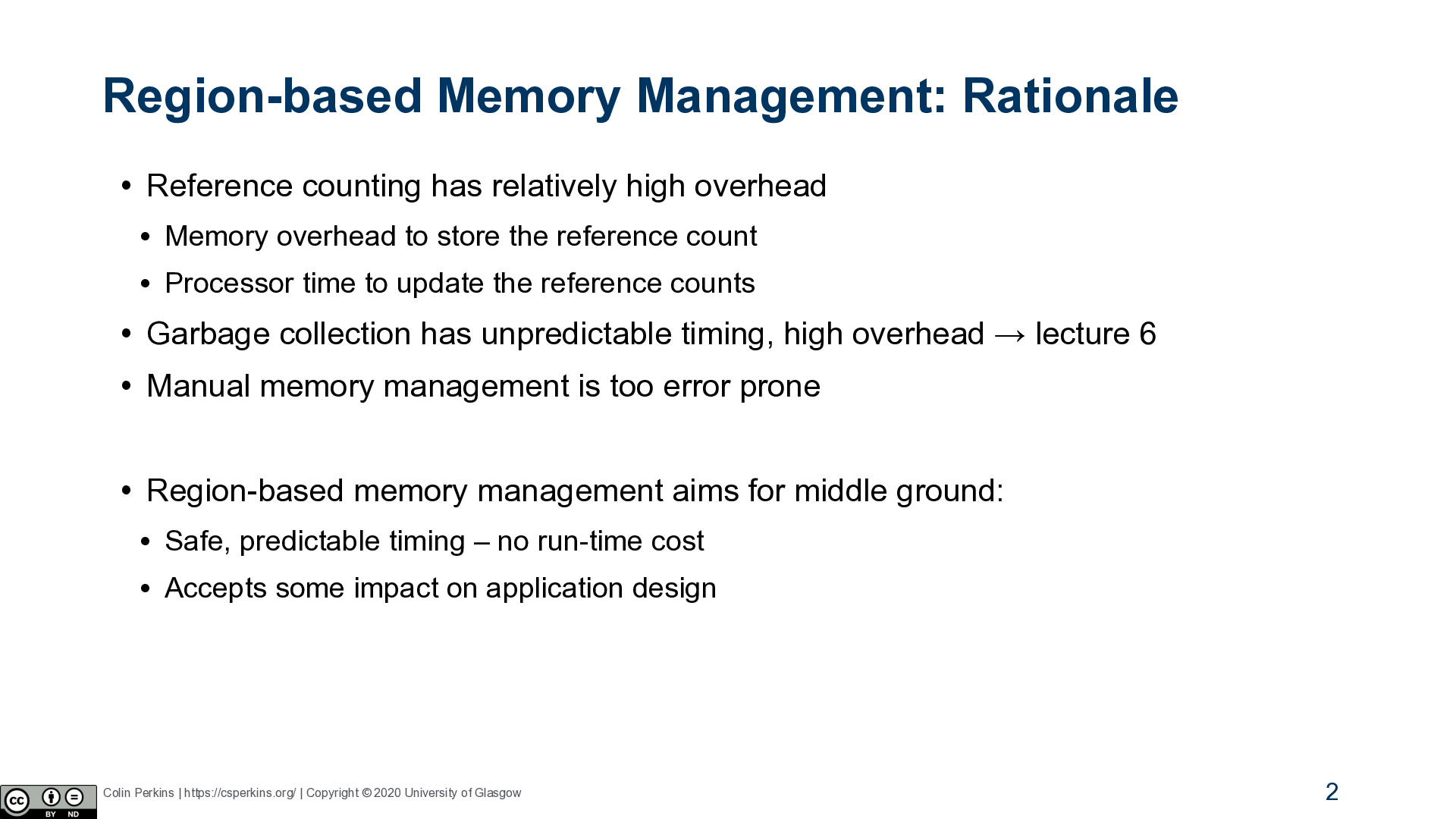
Reference counting, as we saw in the
00:00:16.933
last part, is simple and easy to
00:00:19.466
understand, but has relatively high overhead.
00:00:23.133
It takes space to store the reference
00:00:25.100
counts, and time to update them.
00:00:27.600
And while this overhead is okay for
00:00:29.733
most applications, it’s too much for performance-critical
00:00:32.566
systems code.
00:00:35.000
Garbage collection, which I’ll talk about in
00:00:37.933
detail in the next lecture, has unpredictable
00:00:40.200
timing and high memory overheads.
00:00:42.433
And manual memory management is too error prone.
00:00:46.066
Region-based memory management aims for the middle
00:00:48.366
ground between these.
00:00:50.333
It aims to be safe and offer
00:00:52.666
predictable timing. And it has no run-time
00:00:55.133
cost, compared to manual memory management.
00:00:57.800
But, to achieve this, it forces some
00:01:00.733
changes in the way code is written.
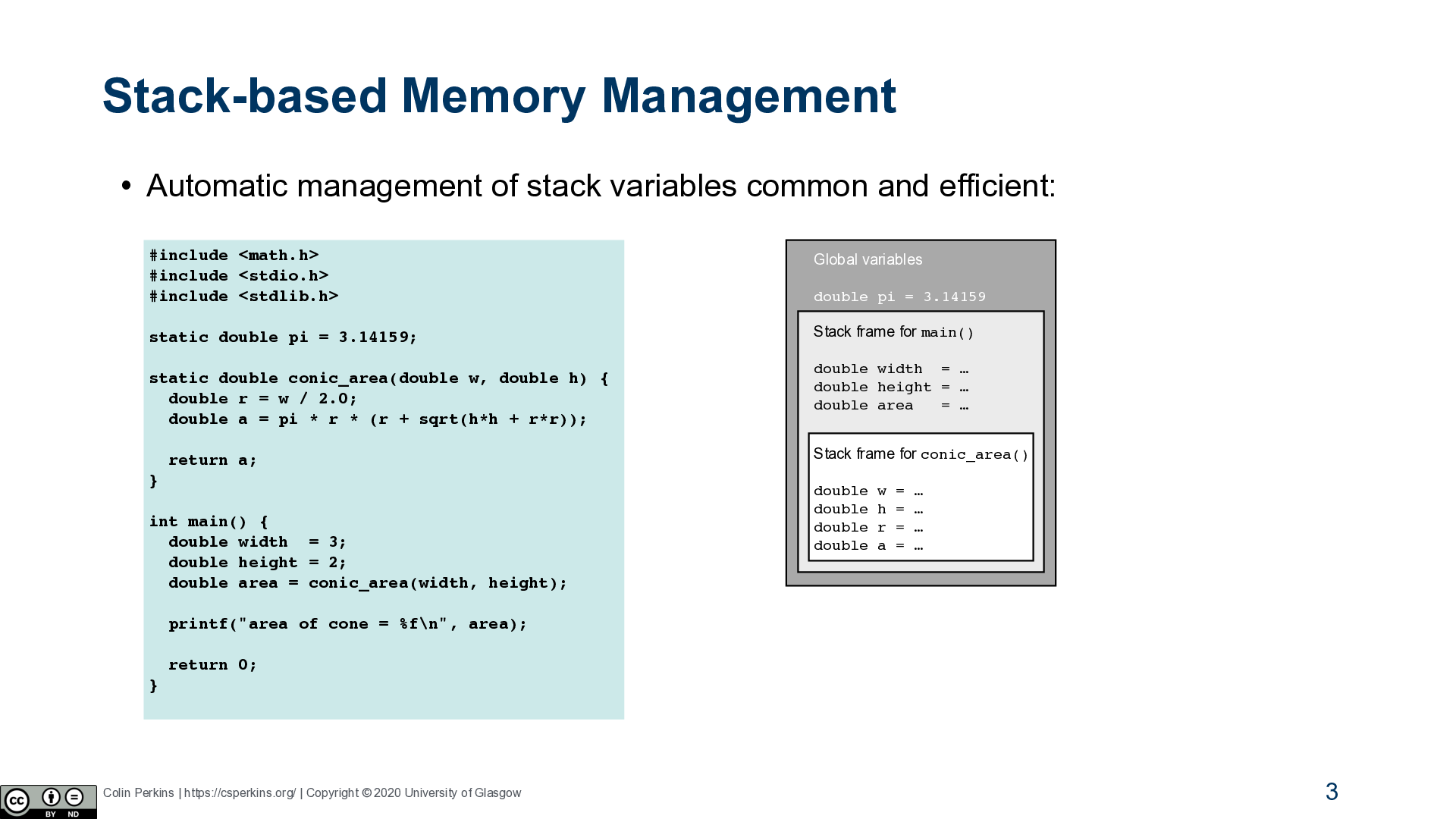
00:01:05.000
So what is region-based memory management?
00:01:07.800
Well, to understand that, let’s first recap
00:01:11.366
the way memory is managed on the stack.
00:01:14.566
The slide shows a simple C program.
00:01:17.900
This comprises two functions: main() and conic_area(),
00:01:21.766
where the conic_area() function implements a mathematical
00:01:25.000
formula to calculate the surface area
00:01:27.133
of a right circular cone.
00:01:30.000
There’s one global static variable,
00:01:32.066
holding the value of Pi.
00:01:34.500
The main() function takes no parameters,
00:01:37.066
and hold local variables width, height, and area.
00:01:40.700
And the conic_area() function takes two parameters,
00:01:43.433
w and h, and hold the local
00:01:45.833
variables r and a.
00:01:49.000
The diagram on the right shows the
00:01:50.900
memory regions owned by the program,
00:01:52.933
while the conic_area() function is executing.
00:01:56.433
We see there’s a region holding the
00:01:58.133
global variables, and sub-regions for the stack
00:02:01.066
frame for main() and for the conic_area()
00:02:03.700
functions. These nest, one within the other,
00:02:06.433
with the global region lasting for the
00:02:09.966
entire duration of the program, and the
00:02:12.666
other regions nesting within, and lasting for
00:02:15.200
part of the time.
00:02:17.000
The lifetime of the local variables and
00:02:19.066
function parameters matches that of the stack
00:02:21.733
frames of the functions holding them.
00:02:24.600
Memory is allocated and deallocated automatically,
00:02:27.866
efficiently, and seamlessly.
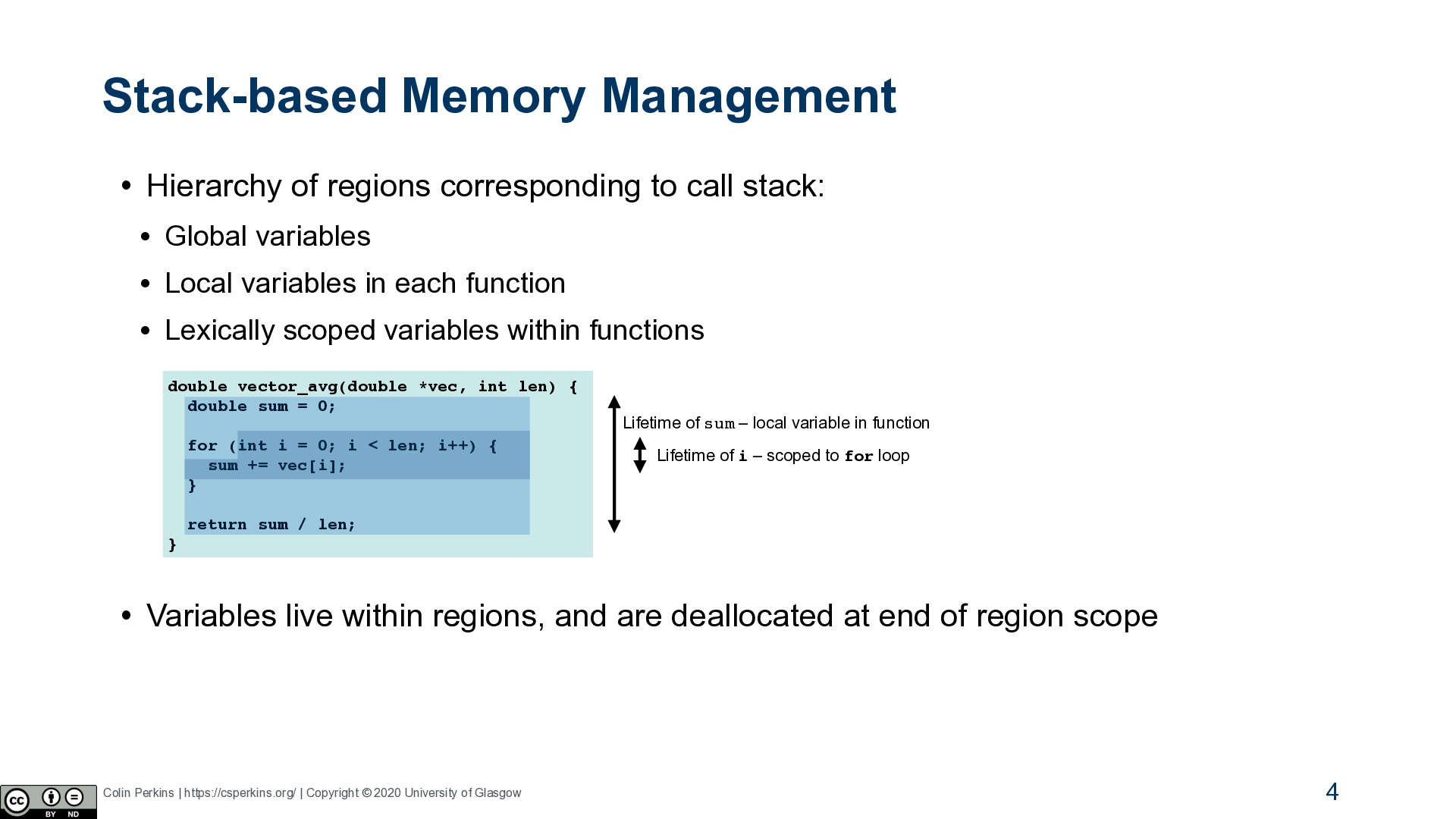
00:02:32.000
Essentially, there’s a hierarchy of regions corresponding
00:02:34.500
to the call stack of the program.
00:02:37.166
The lifetime of the global variables is
00:02:39.566
that of the entire program, and the
00:02:42.066
lifetime of the local variables matches the
00:02:44.366
execution time of the functions they live within.
00:02:47.400
And, within each function, we see there
00:02:49.933
may be lexically scoped variables that have
00:02:51.933
a lifetime less than that of the enclosing function.
00:02:55.533
In the code on the slide,
00:02:57.366
for example, we see that the variable
00:02:59.666
i, the index variable in the for
00:03:01.700
loop, lives only for the duration of that for loop.
00:03:06.000
Each of these variables lives within a
00:03:08.566
region, scoped by the program code,
00:03:10.766
and is automatically allocated when entering that
00:03:13.166
region, and deallocated when the program leaves the region.
00:03:16.466
This works seamlessly.
00:03:19.100
So much so that we take it for granted when writing code.
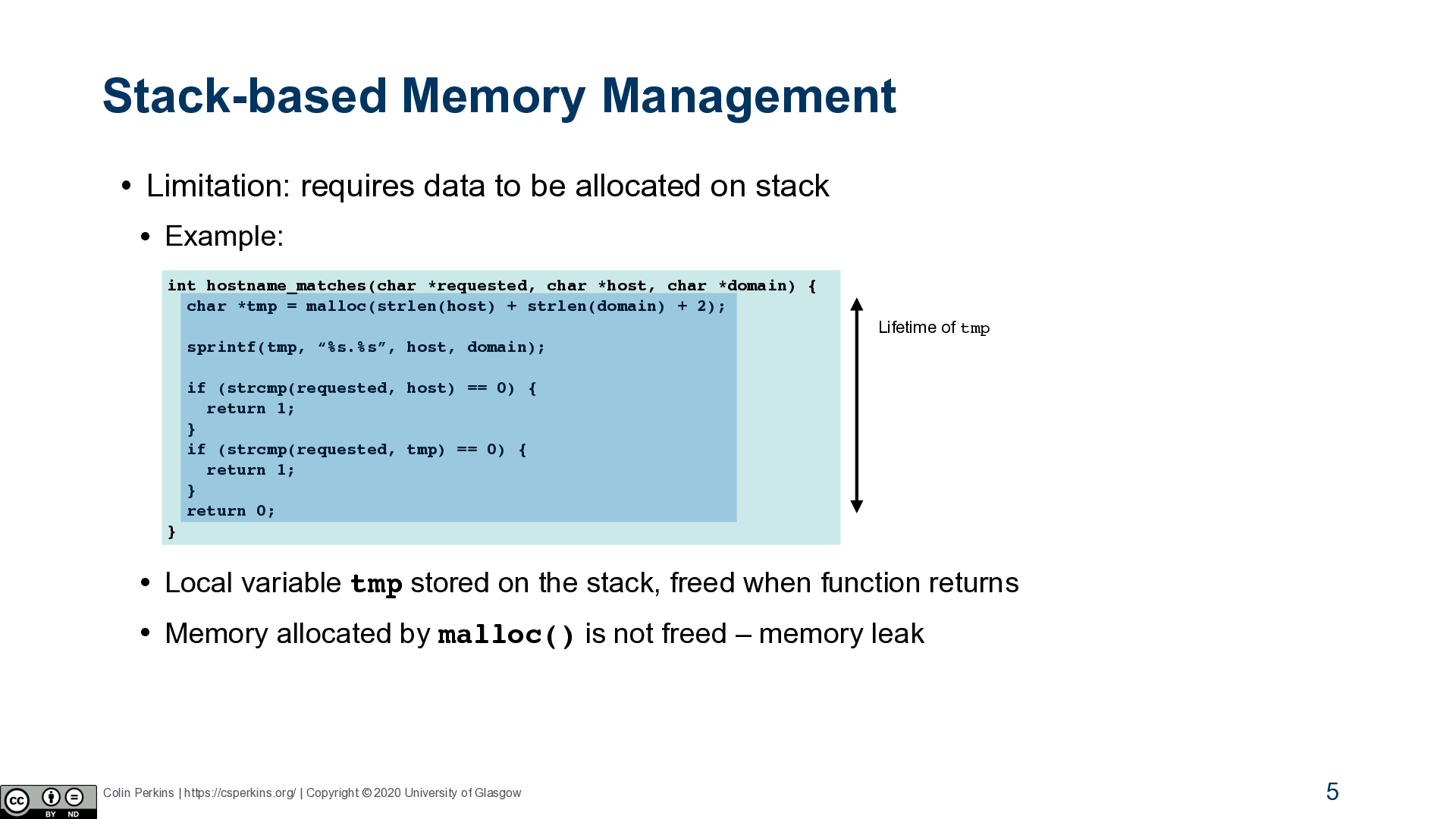
00:03:24.433
There’s one limitation of this stack-based approach
00:03:27.166
to memory management.
00:03:29.100
It requires data to be allocated on the stack.
00:03:33.000
In the example on this slide,
00:03:35.333
the variable tmp lives on the stack
00:03:37.466
frame for the hostname_matches() function. Space for
00:03:41.166
the variable is created when the function
00:03:43.033
starts to execute, and freed when the function concludes.
00:03:47.533
But that’s only the memory that holds tmp.
00:03:50.633
That is, the memory for the local
00:03:52.666
variable holding the pointer is managed automatically.
00:03:56.666
The heap allocated memory, the memory allocated
00:03:59.700
by the call to malloc(), is not freed automatically.
00:04:04.000
When tmp goes out of scope,
00:04:06.233
the space holding the pointer is freed,
00:04:08.433
but the value it points to is not.
00:04:11.766
The program doesn’t call free() to deallocate
00:04:14.066
that memory, and it doesn’t return the
00:04:16.333
pointer so some other function can do so.
00:04:19.966
It leaks memory. The pointer is gone,
00:04:23.533
so there’s no remaining reference to the
00:04:25.466
allocated memory, so no way to free that memory.
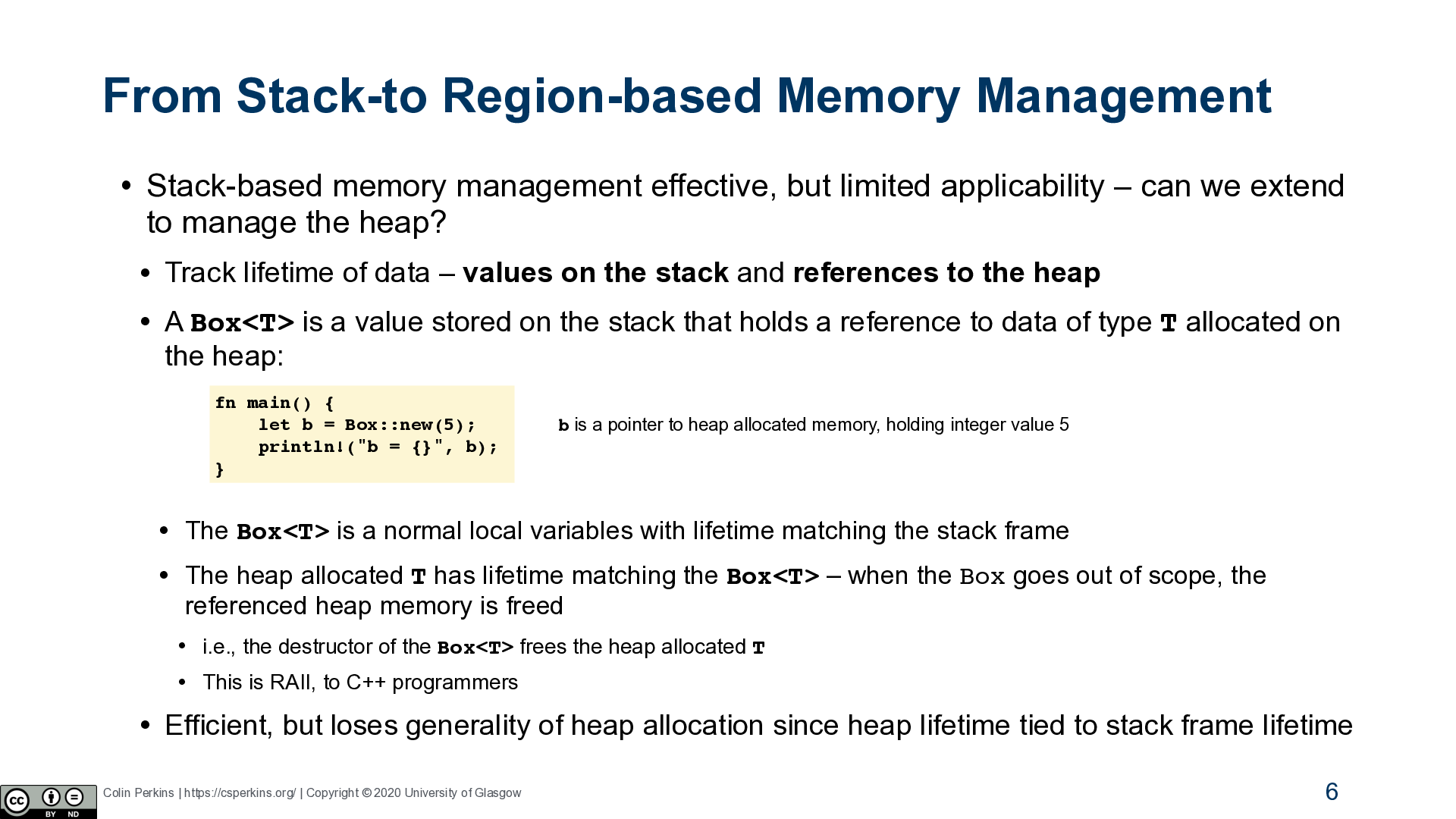
00:04:30.566
Stack-based memory management is clearly effective,
00:04:33.533
but has limited applicability.
00:04:35.933
Can we extend it to manage the heap?
00:04:39.033
Yes. We can arrange for the compiler
00:04:41.866
to track the lifetime of data,
00:04:44.000
and in the same way that it
00:04:45.733
inserts code to manage the stack,
00:04:47.466
it can insert code to manage heap
00:04:48.933
memory based on object lifetimes.
00:04:51.833
If we arrange the code so that
00:04:53.700
there’s a single clear owner of every
00:04:55.500
data value, then we can arrange it
00:04:57.833
so that if a pointer goes out
00:04:59.100
of scope, then the value it points
00:05:01.133
to is also freed.
00:05:03.666
This requires us to track ownership of
00:05:05.533
all data objects, but as we saw
00:05:07.833
in the last lecture, Rust does this.
00:05:11.333
The idea then it to define the
00:05:13.533
Box-of-T type, which is a value that’s
00:05:16.366
stored on the stack that holds a
00:05:18.033
reference to data of type T that’s
00:05:21.433
allocated on the heap.
00:05:23.800
Calling Box::new() allocates and populates heap memory,
00:05:28.400
and returns a pointer to that memory
00:05:30.600
that’s stored in a local variable on
00:05:32.066
the stack. The resulting local variable is
00:05:35.666
a normal variable, with lifetime matching that
00:05:38.166
of the stack frame in which it resides.
00:05:41.366
And the heap allocated object has lifetime
00:05:43.633
matching that of the Box too.
00:05:46.566
When the local variable holding the Box
00:05:48.466
goes out of scope, its destructor is
00:05:50.800
automatically called by the compiler. The destructor
00:05:54.433
frees the heap allocated memory. This is
00:05:57.766
the basis for region based memory management in Rust.
00:06:01.400
It’s highly efficient. And it safety manages
00:06:05.033
heap memory. But it loses generality,
00:06:08.266
since it ties the lifetime of heap
00:06:10.333
allocation to that of stack frames.
00:06:13.833
If you’ve programmed C++, this approach will
00:06:16.766
be familiar as the RAII – Resource
00:06:19.866
Acquisition Is Initialization – design pattern.
00:06:23.566
Python also does something similar in its “with” clauses.
00:06:30.133
Rust takes the pattern further though.
00:06:33.766
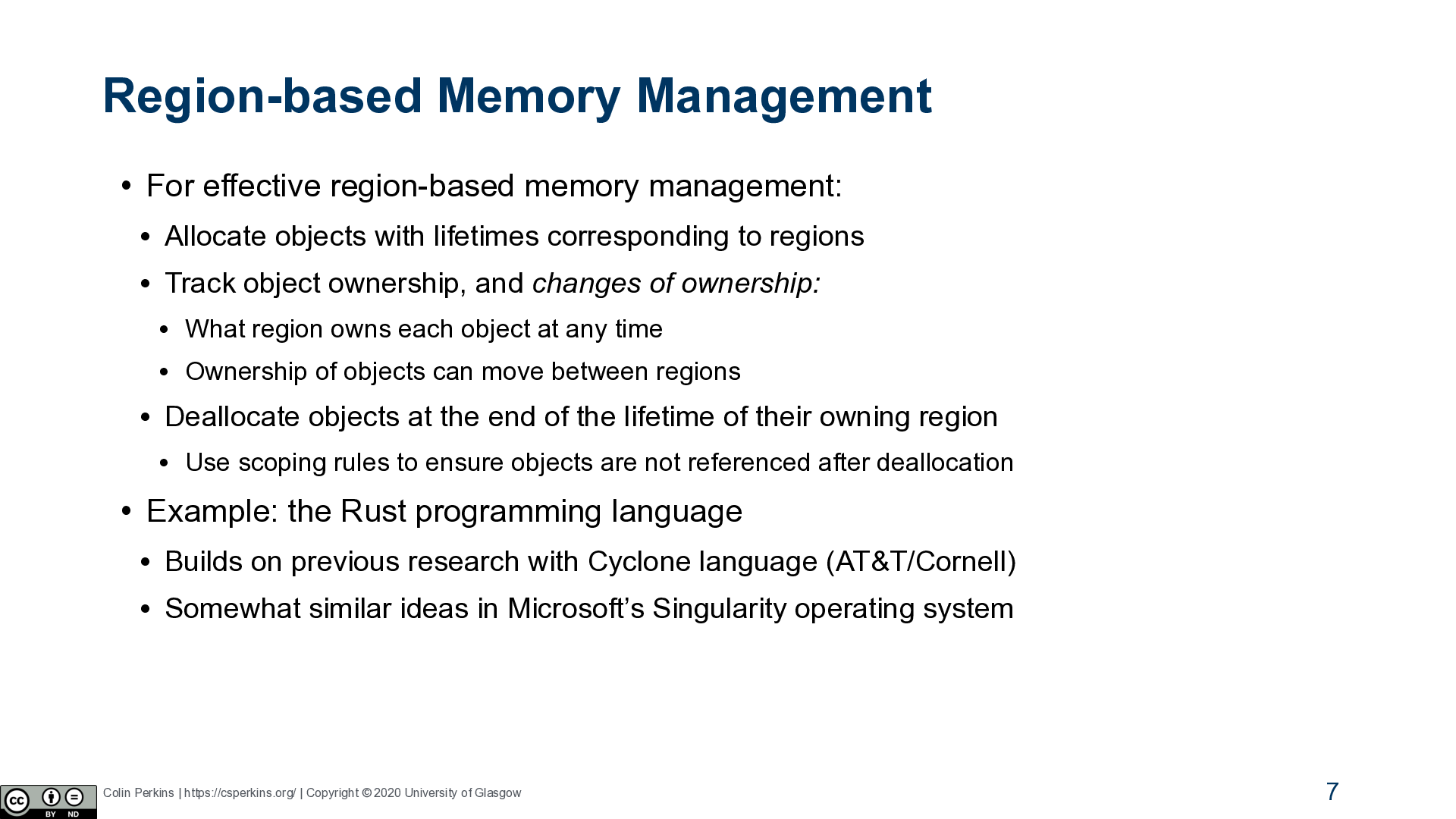
To be effective, region-based memory management has
00:06:36.666
to not just tie object lifetimes to
00:06:39.033
stack frames, but also to track how
00:06:42.033
objects are passed between stack frames.
00:06:45.133
And do so in a way that
00:06:46.733
maintains the single owner invariant for every object.
00:06:49.700
At every point, the compiler must know
00:06:52.666
what region of code owns each piece
00:06:54.800
of data. And as data is passed
00:06:57.266
between functions, as ownership of the data
00:07:00.266
is passed between functions, the compiler must
00:07:02.666
track that data ownership.
00:07:05.300
And, when the data item finally goes
00:07:07.866
out of scope, after its ownership
00:07:10.500
has been passed between various functions,
00:07:12.433
only then should it deallocate the heap memory.
00:07:17.166
As we saw in the last lecture,
00:07:19.066
Rust tracks ownership of data items as
00:07:21.366
they’re passed between functions.
00:07:24.066
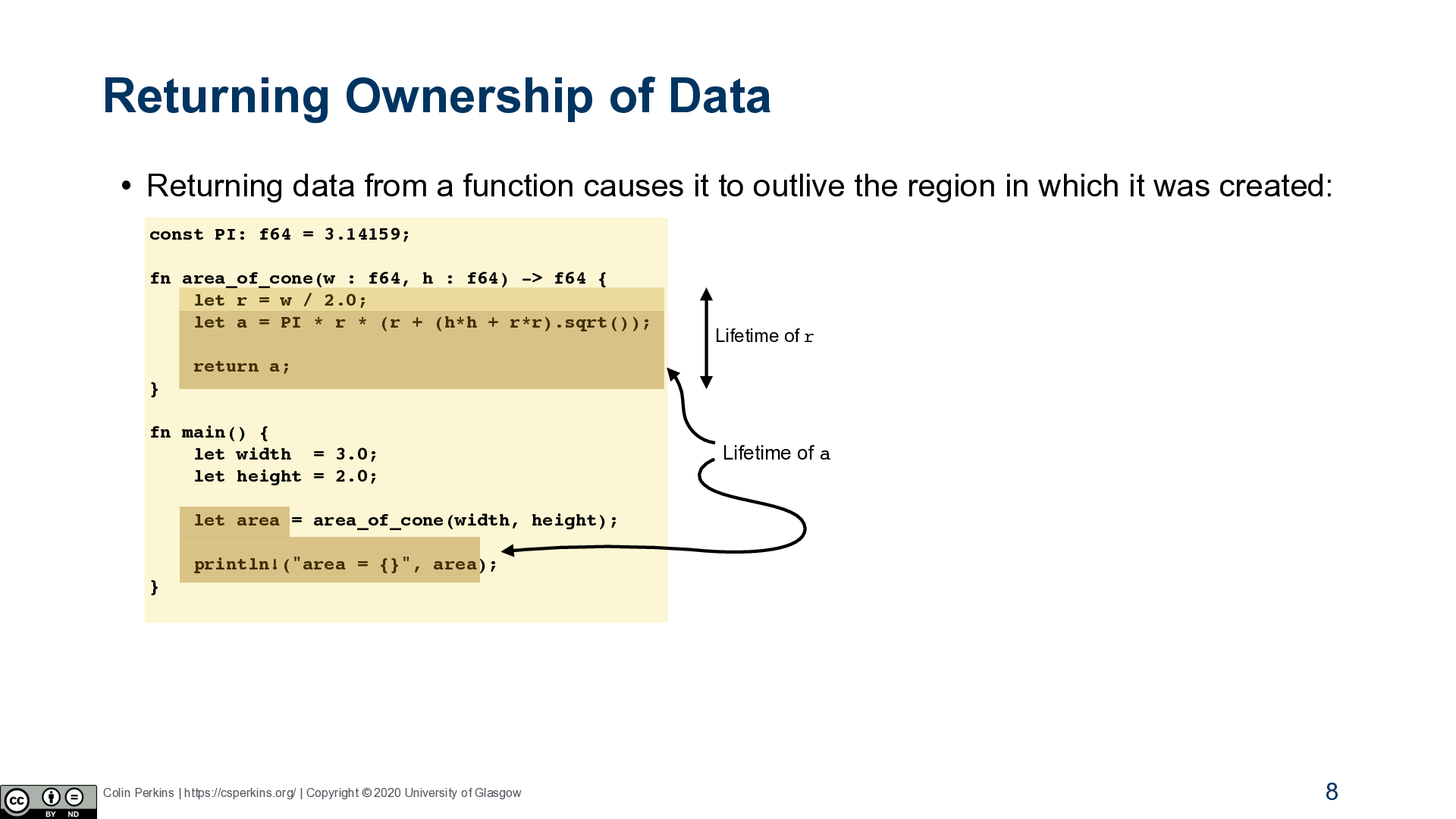
The code on the slide is the
00:07:25.966
Rust equivalent of the C program we
00:07:27.933
saw earlier, to calculate the conic area.
00:07:31.300
If we look at the lifetimes of
00:07:32.900
the variables in the function area_of_cone(),
00:07:35.566
we see that the variable, r,
00:07:37.466
has lifetime matching that of the function’s
00:07:39.566
stack frame. It’s allocated when the function
00:07:42.666
starts to execute, and goes out of
00:07:45.000
scope and is freed when the function finishes.
00:07:48.533
The variable, a, though is created within
00:07:51.400
the area_of_cone() but then returned from that
00:07:54.566
function. Ownership of the value is passed
00:07:57.666
from that function to its caller,
00:07:59.800
the main() function. And from there,
00:08:02.200
it’s passed as an argument to the
00:08:04.633
println!() macro, that consumes the value.
00:08:07.500
The key point is that the lifetime
00:08:09.466
of the value initially stored in the
00:08:11.166
local variable, a, in the area_of_cone() function,
00:08:14.566
outlives that function.
00:08:17.133
And the compiler tracks this lifetime.
00:08:19.733
It knows that the ownership has changed.
00:08:22.466
That the value has been passed out
00:08:24.533
of the function into main(), and is
00:08:26.333
later consumed by the println!() call.
00:08:30.100
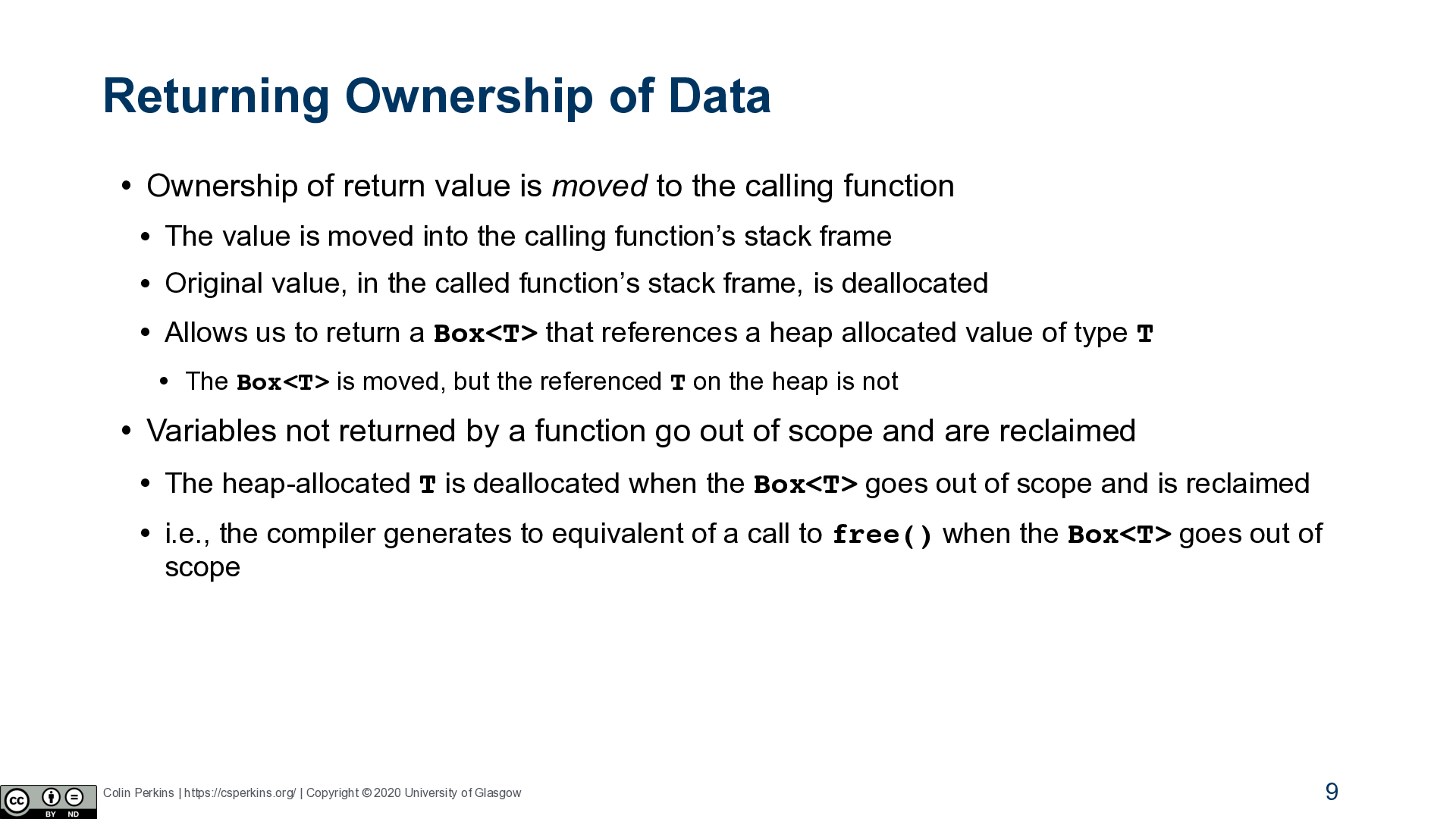
We see that ownership of the return
00:08:32.233
value is moved to the calling function.
00:08:35.333
The value is moved into the stack
00:08:37.066
frame of the calling function, and assigned
00:08:39.466
to a local variable. And the original
00:08:42.066
value, in the called function’s stack frame,
00:08:44.666
is destroyed when that function returns.
00:08:48.000
If the value being moved is a
00:08:49.500
Box, what’s moved is the Box itself.
00:08:52.433
That is, the smart pointer to the
00:08:54.333
heap allocated memory is moved into the
00:08:56.400
stack frame of the caller. The value
00:08:59.200
on the heap that it references is unchanged.
00:09:02.766
Similarly, if a reference is returned,
00:09:05.100
it’s the reference that’s moved. The referenced
00:09:08.100
value is unchanged.
00:09:11.500
Any variable not returned by a function
00:09:13.966
goes out of scope and is destroyed
00:09:15.800
when the function returns.
00:09:18.466
What does this mean? The destructor for
00:09:21.466
the type, the drop() method, is called.
00:09:24.566
Then the memory holding the object is deallocated.
00:09:28.100
If the value going out of scope
00:09:29.966
is a Box, the destructor for the
00:09:32.133
box calls the destructor for the heap
00:09:34.666
allocated object, then frees the heap memory.
00:09:37.300
Since every object goes out of scope
00:09:39.233
eventually, when it reaches the end of
00:09:40.933
its lifetime, since ensures that all heap memory is freed.
00:09:47.266
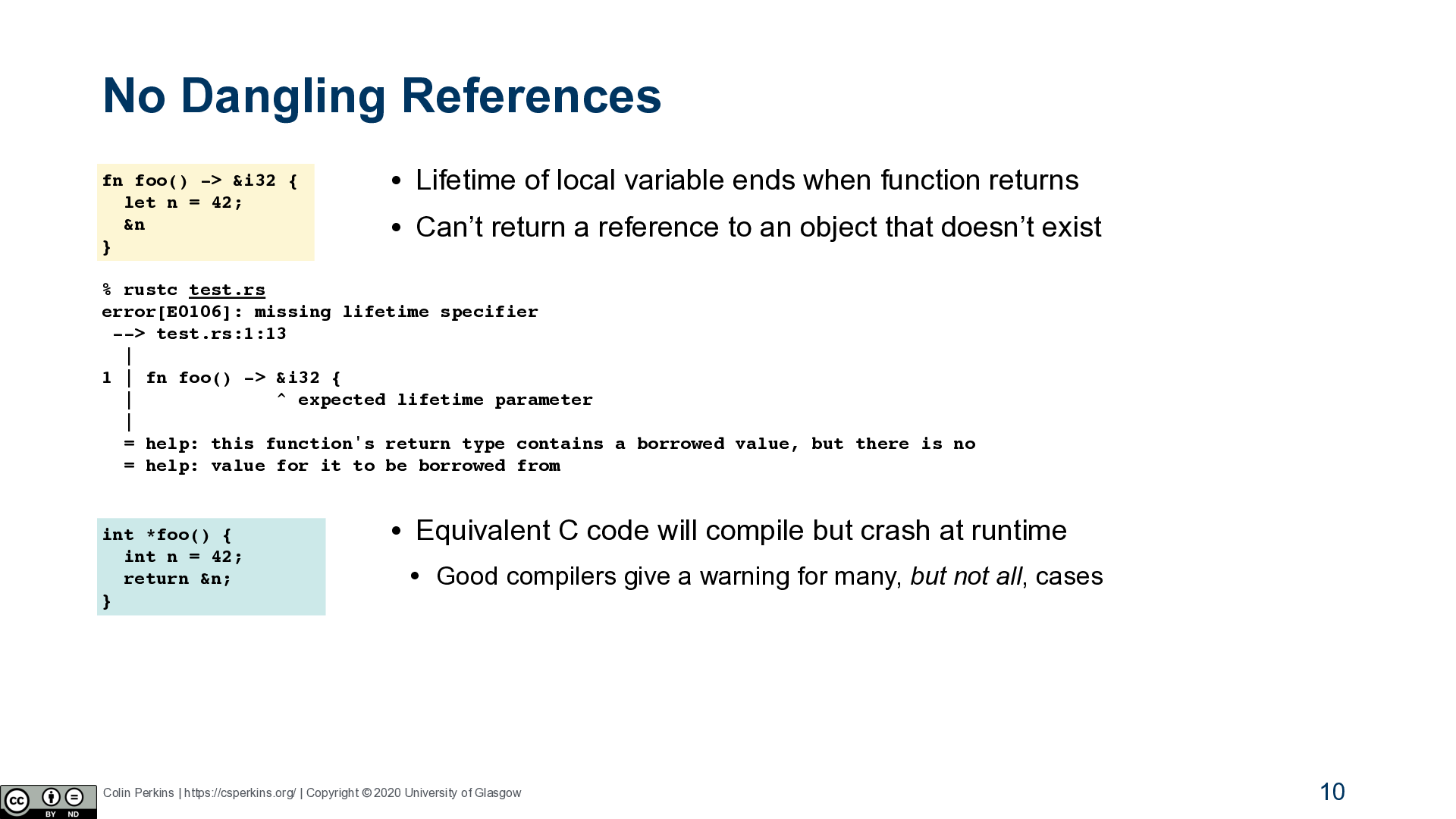
Since the Rust compiler tracks the lifetime
00:09:49.933
of every object, it can prevent common
00:09:52.000
lifetime-related errors.
00:09:54.466
For example, the Rust program shown on
00:09:56.900
the top of this slide is a
00:09:58.700
function that tries to return a reference
00:10:00.433
to a local variable. This isn’t possible,
00:10:03.533
since the local variable ceases to exist
00:10:05.166
once the function returns.
00:10:08.000
The compiler notices this, and as we
00:10:10.900
see, the code doesn’t compile. You can’t
00:10:14.333
return a reference to, that is,
00:10:16.800
borrow, a value that doesn’t exist any more.
00:10:19.733
The equivalent C program, shown on the
00:10:22.766
bottom of the slide, will compile just
00:10:24.733
fine, but crash at runtime when the
00:10:26.833
returned pointer is used.
00:10:29.800
Good C compilers warn about this,
00:10:32.000
in simple cases like this example,
00:10:34.433
but will compile more complex variants of
00:10:36.866
the code without warnings.
00:10:40.500
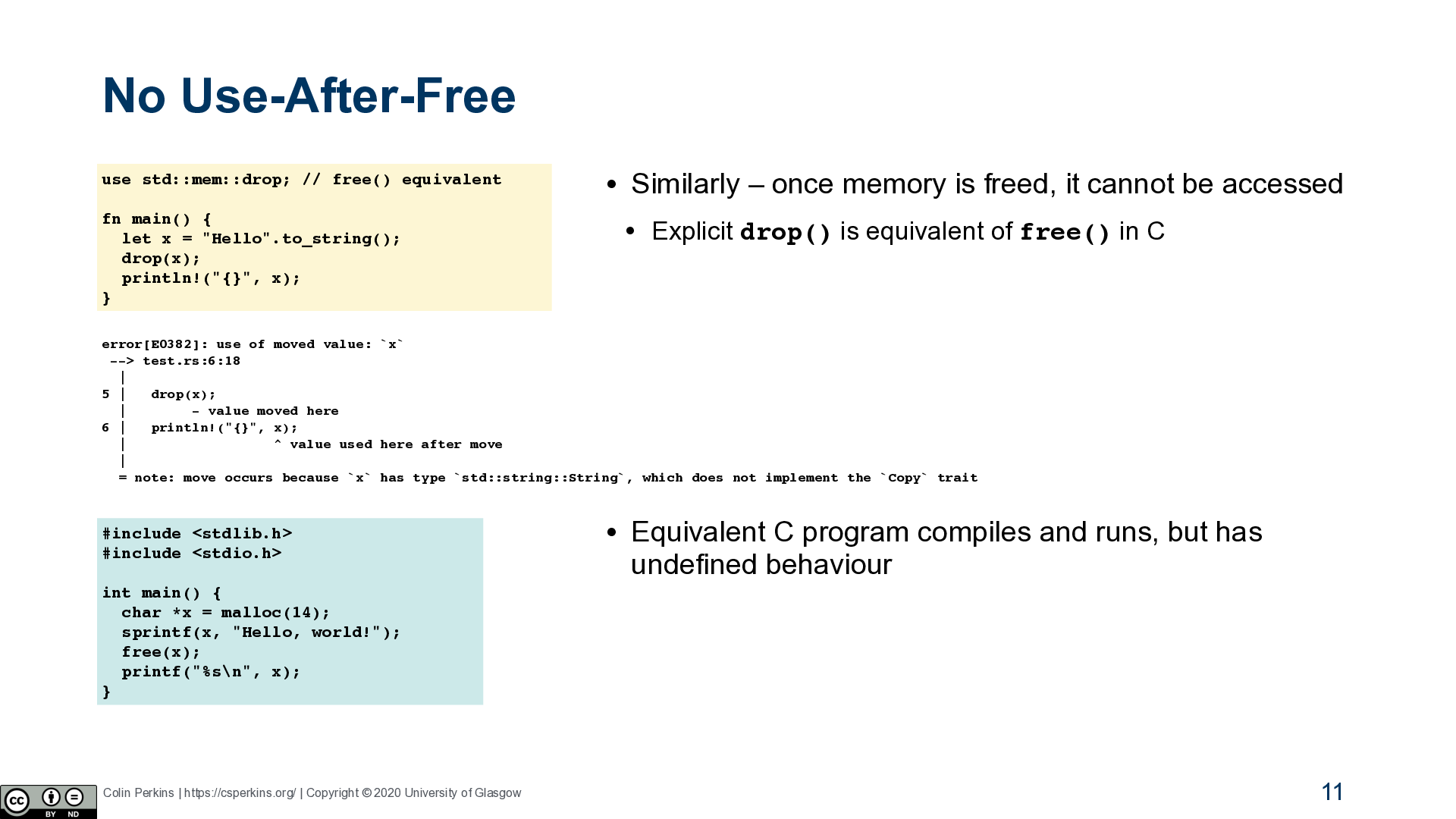
Similarly, because the Rust compiler tracks object
00:10:43.400
lifetimes, it can prevent you from accessing
00:10:45.800
memory once it’s been freed.
00:10:48.766
The Rust code shown at the top
00:10:50.800
of the slide shows an example.
00:10:53.066
It imports and explicitly calls the drop()
00:10:55.300
function, to force the local variable,
00:10:57.900
x, to be deallocated.
00:11:01.000
Calling drop() manually is never explicitly needed
00:11:03.666
in Rust, but is possible, and has
00:11:06.666
the same effect as calling free() to
00:11:08.433
deallocate memory in a C program.
00:11:12.000
The Rust code on the slide,
00:11:13.866
that deallocates memory then tries to print
00:11:16.266
out the contents of the just-deallocated memory,
00:11:19.133
fails to compile. The compiler knows that
00:11:22.633
the drop() call consumes the object and
00:11:25.033
that its lifetime ends. It knows that
00:11:27.266
the value cannot then be accessed.
00:11:30.200
The equivalent C program, shown at the
00:11:32.733
bottom, will compile without warnings, but has
00:11:36.066
undefined behaviour at runtime since it accesses
00:11:39.166
previously freed memory.
00:11:43.366
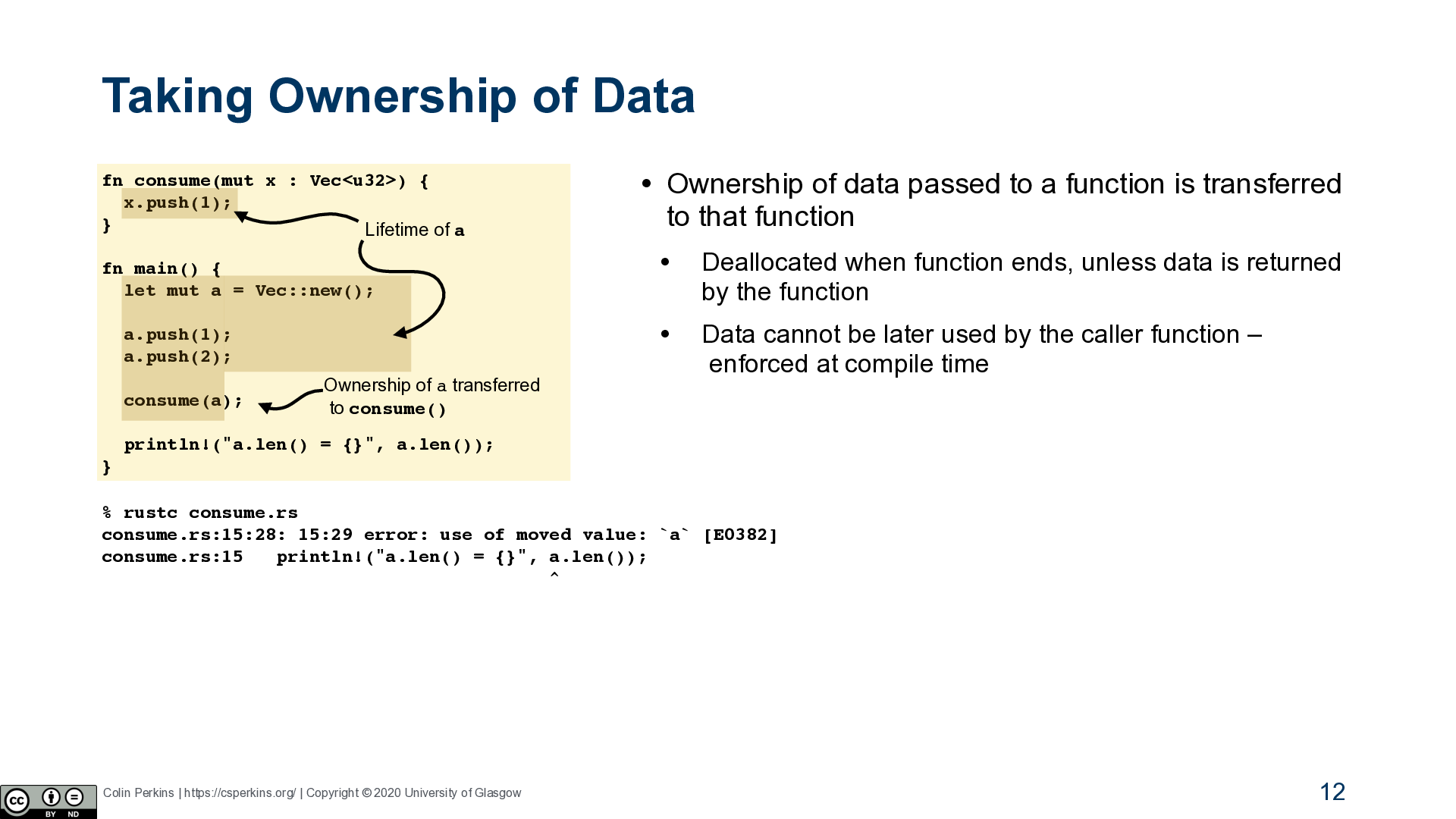
In addition to returning ownership of data,
00:11:46.533
functions can take ownership of a value.
00:11:49.366
When a value is passed to a
00:11:51.400
function, that function takes ownership of that
00:11:53.966
value. We see this in the code
00:11:56.233
on the slide, where the consume() function
00:11:58.633
takes ownership of the local variable, a,
00:12:00.800
from the main() function, in the
00:12:02.633
form of its parameter, x.
00:12:05.233
And, as usual, once the consume() function
00:12:07.700
ends, the values of any data it
00:12:09.633
owns that are not returned, as destroyed.
00:12:13.000
We see this when we try to
00:12:14.500
compile the code. The main() function can’t
00:12:17.500
access the local variable, a, to print
00:12:19.766
its length, since it doesn’t own the
00:12:21.500
value anymore. It gave ownership to the
00:12:25.100
consume() function, and that function destroyed the
00:12:27.233
value and didn’t pass it back.
00:12:29.733
Accordingly, it’s no longer accessible in main()
00:12:32.500
and the code won’t compile.
00:12:36.566
That concludes this introduction to region-based
00:12:39.066
memory management.
00:12:40.900
The key insight is that if every
00:12:43.200
value has a unique owner, and the
00:12:45.666
compiler tracks ownership and the lifetime of
00:12:48.233
those values, then every value can be
00:12:50.700
automatically freed at the end of its lifetime.
00:12:54.066
This is the key difference between Rust
00:12:56.400
and other programming languages. The Rust compiler
00:12:59.533
knows when a value has been consumed,
00:13:01.966
when it’s reached the end of its
00:13:04.100
lifetime, and will enforce this at compile time.
00:13:07.000
Other languages either don’t track lifetimes,
00:13:09.700
like C, and potentially allow use after
00:13:12.533
free bugs, dangling references, and so on.
00:13:15.900
Or they use some form of garbage
00:13:18.166
collection, to track liveness of data at
00:13:20.200
run time. They’re either unsafe, or have
00:13:23.533
run time overhead.
00:13:26.000
Rust is both safe, and avoids the
00:13:28.433
run-time overheads.
00:13:30.000
But to achieve this, Rust restricts the
00:13:32.300
set of programs that can be expressed,
00:13:34.600
as we’ll see in the next part of this lecture.
Part 4: Resource Management
The final part of the lecture discusses how region-based memory
management can be extended to include resource management. It
further expands on the concept of ownership tracking, introduced
in the previous part of the lecture, and shows how Rust supports
borrowing of data to make region-based memory management feasible.
It outlines the limitations of region-based memory management and
how it limits the classes of program that can be written, and
discusses the trade-off this imposes. And it reviews how
region-based management can be used to enforce deterministic
resource clean-up.
00:00:00.366
In this final part of the lecture,
00:00:02.600
I’ll talk about how Rust extends ownership
00:00:05.166
with the idea of borrowing, and how
00:00:07.333
this can apply to management of resources
00:00:09.233
other than memory.
00:00:12.000
We saw in the previous part that
00:00:14.000
functions can pass ownership of data between
00:00:16.433
them. We saw how functions take ownership
00:00:19.533
of data they’re passed, and how they
00:00:22.033
can return ownership of data to their caller.
00:00:24.600
We discussed how this relates to memory
00:00:26.533
management, with memory being freed when an
00:00:28.666
object goes out of scope at the
00:00:30.133
end of a function. And, we showed
00:00:32.166
how, with the aid of the single
00:00:33.633
ownership rules, Rust can leverage this to
00:00:36.433
provide an automatic region-based memory management scheme.
00:00:40.833
This can work, but repeatedly passing and
00:00:43.700
returning ownership of data to and from
00:00:46.233
functions is inconvenient. To make this easier,
00:00:49.966
Rust augments the ownership rules with the
00:00:52.166
idea of borrowed data.
00:00:55.666
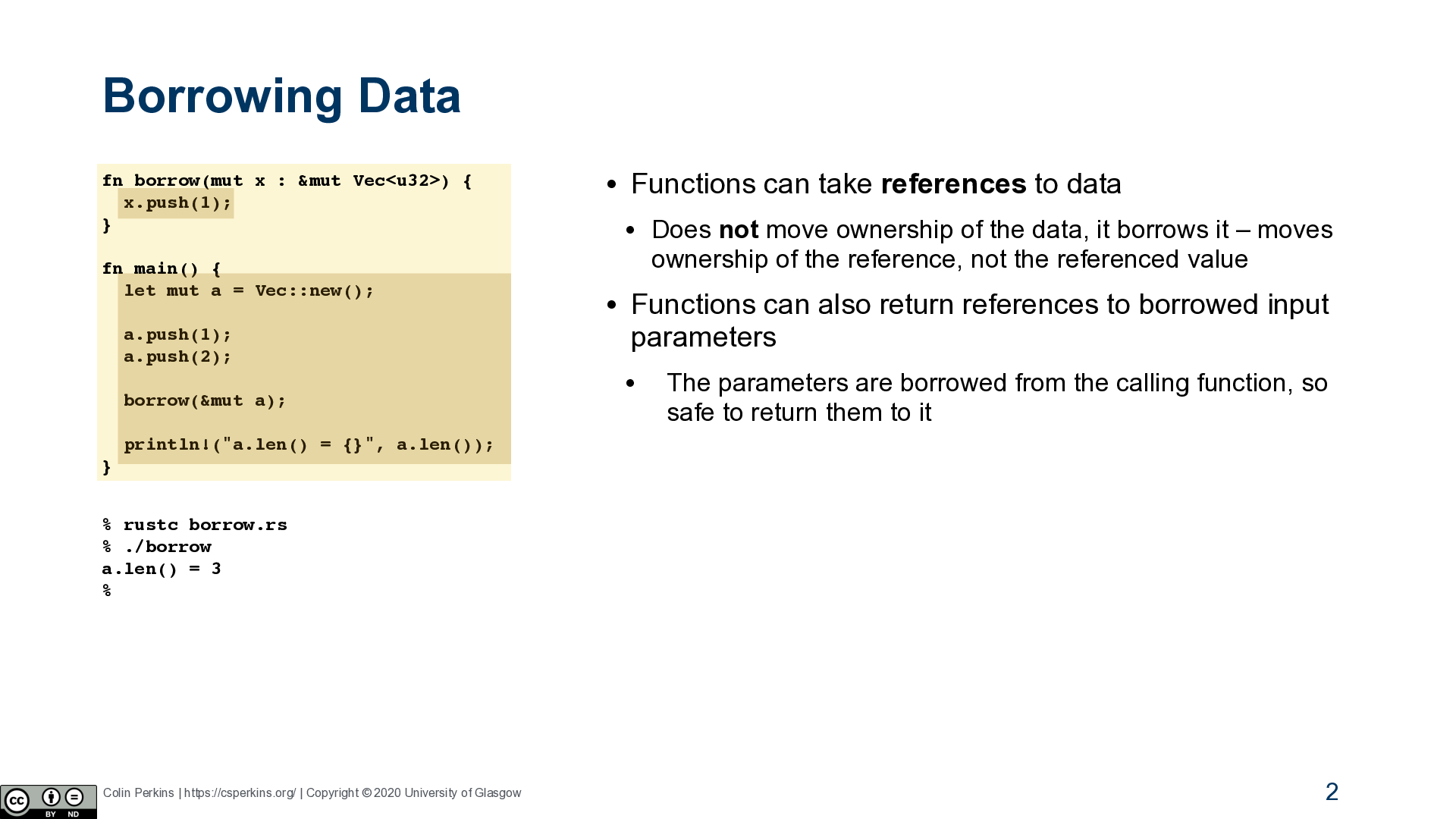
Functions in Rust can take references to
00:00:58.133
data as parameters. For example, in the
00:01:01.700
slide we see the function borrow() that
00:01:04.100
takes a mutable reference to a vector,
00:01:06.700
x, as its parameter, and modifies the
00:01:09.766
vector, by pushing a new element onto the end.
00:01:13.700
In the main() function, we create a
00:01:15.866
vector, add some data to it,
00:01:18.033
call the borrow() function, and print the
00:01:19.900
length of the vector.
00:01:22.433
Unlike the case we saw in the
00:01:24.166
last part, where the function consumed the
00:01:26.366
vector, in this case the vector is
00:01:28.633
still accessible after the call to borrow().
00:01:31.966
Why is this?
00:01:34.000
Well, because borrow() is passed data by reference.
00:01:38.166
The borrow() function is passed, takes ownership
00:01:41.766
of, a reference to the vector.
00:01:44.066
It doesn’t take ownership of the vector.
00:01:46.933
When the borrow() function returns, the lifetime
00:01:50.200
of the parameter x ends, and it
00:01:52.466
is reclaimed in the usual way.
00:01:55.300
The function has taken ownership of that
00:01:57.033
parameter, and hasn’t returned ownership to the
00:01:59.200
caller, so the data is freed.
00:02:02.233
But, what it took ownership of was
00:02:04.266
a reference to the vector, not the
00:02:06.233
vector itself. So what is freed is
00:02:09.066
the reference, not the vector. Ownership of
00:02:12.666
the vector remains with the main() function at all times.
00:02:16.433
This is known as borrowing a reference.
00:02:20.533
It’s not shown on the slide,
00:02:22.233
but a function that takes a reference
00:02:23.800
as a parameter can return that reference
00:02:25.800
to the caller. This is safe,
00:02:28.566
because the reference has to be accessible
00:02:30.500
to the caller – otherwise, how could
00:02:32.200
it pass it to the function –
00:02:33.700
so the returned reference will also be accessible.
00:02:38.700
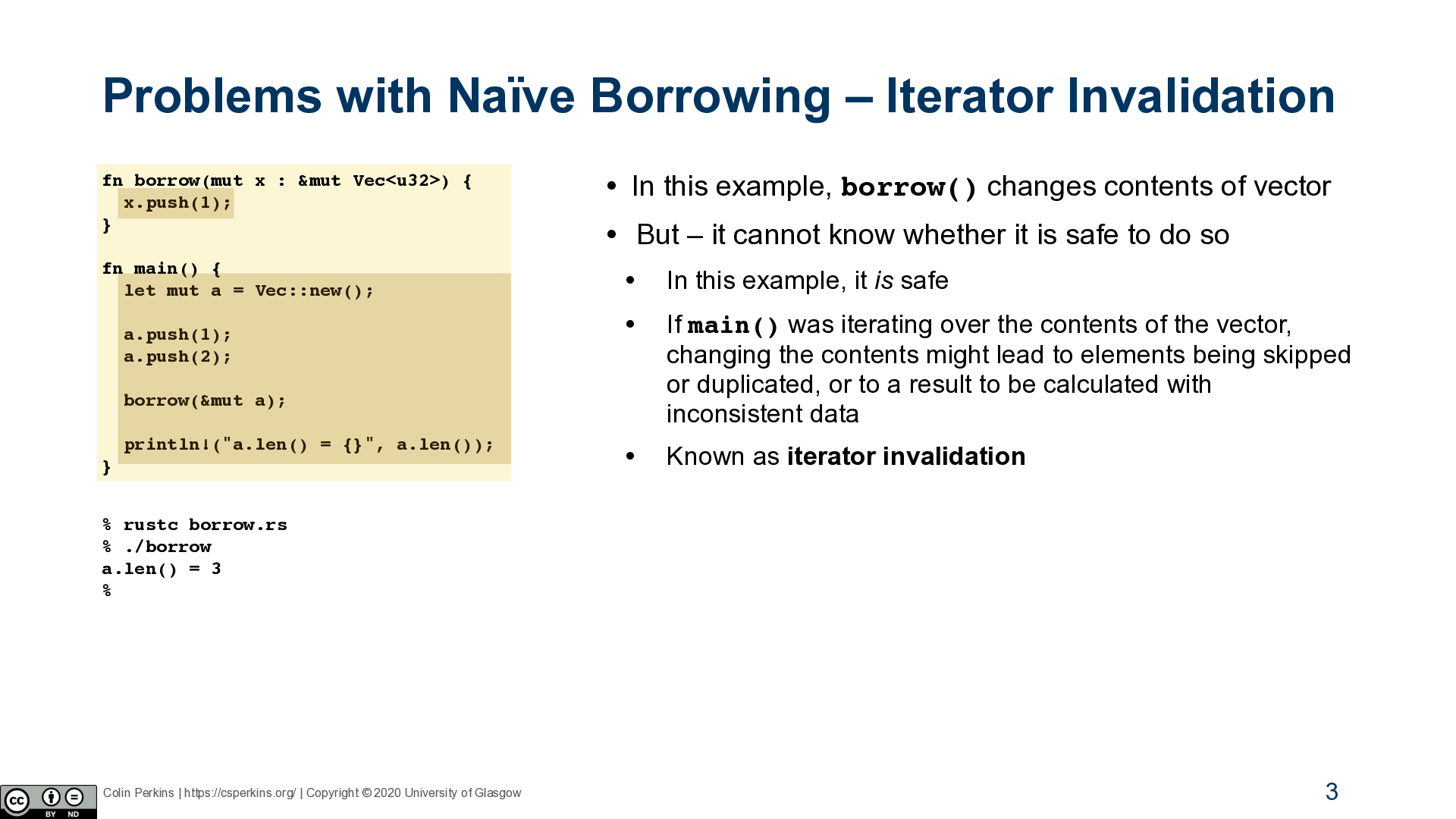
In this example, the borrow() function changes
00:02:41.466
the contents of the vector. It pushes
00:02:44.433
a new element onto the end of the vector.
00:02:47.466
And in this case, it’s safe for it to do so.
00:02:51.000
But this is not always safe.
00:02:54.000
For example, if main() was iterating over
00:02:56.533
the contents of the vector, and passed
00:02:59.033
a mutable reference to that vector to
00:03:01.100
a function that modified it, while that
00:03:03.866
iteration was in progress, this might lead
00:03:06.466
to elements being skipped or duplicated,
00:03:09.000
or to a result to be calculated
00:03:11.066
with inconsistent data.
00:03:13.866
This is a problem known as iterator invalidation.
00:03:18.800
To avoid iterator invalidation, and other problems,
00:03:22.166
references in Rust come in two different
00:03:24.333
types, and have restrictions on how they can be used.
00:03:29.066
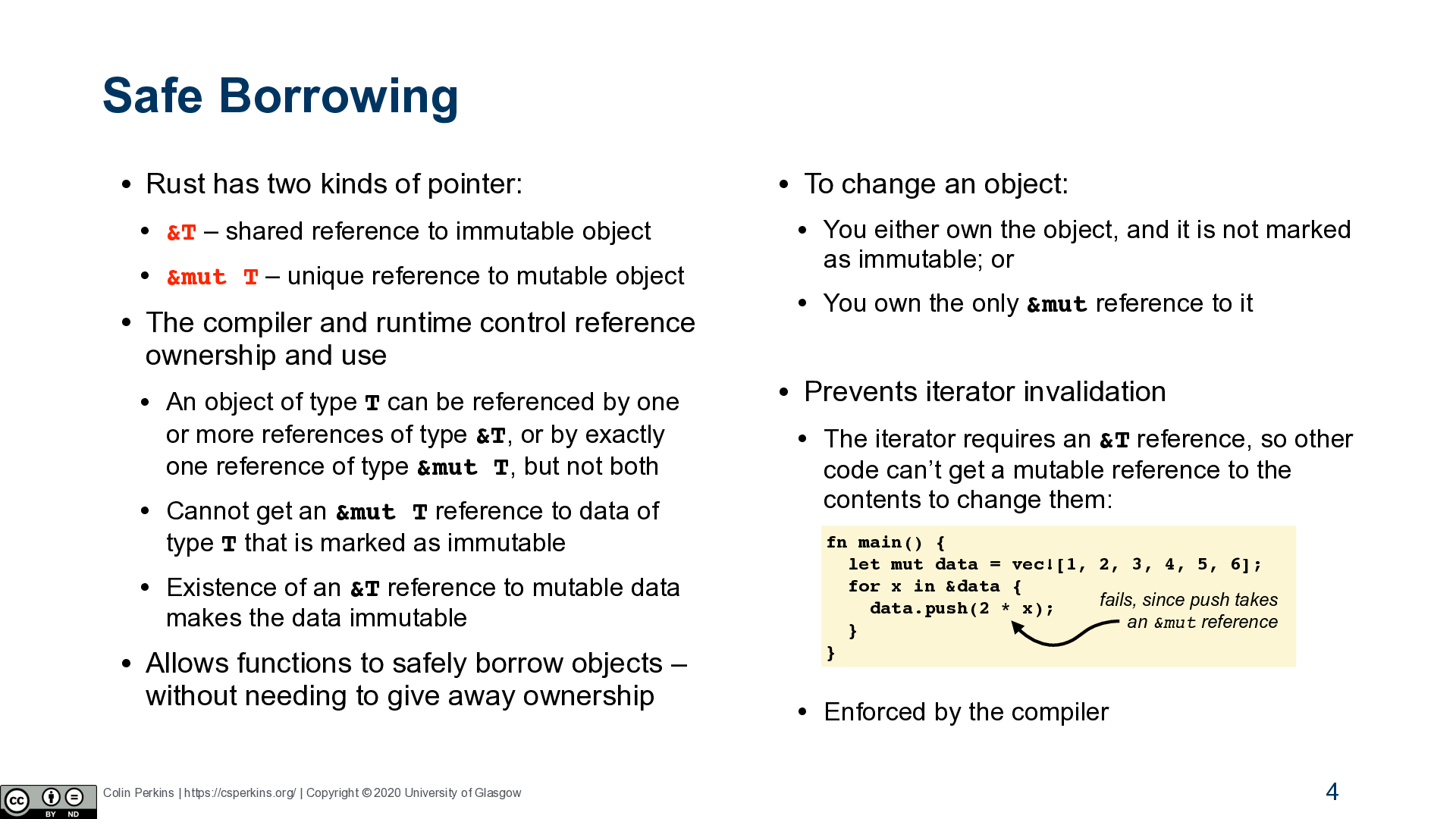
Rust has two different types of pointer;
00:03:31.333
two different types of reference.
00:03:34.100
The first is written &T, and is
00:03:37.366
a shared reference to an immutable object
00:03:39.833
of type T.
00:03:42.133
The second is written &mut T,
00:03:45.633
and is a unique reference to a
00:03:47.833
mutable object of type T.
00:03:50.866
The Rust compiler and runtime system work
00:03:53.366
together to control how references can be
00:03:55.166
used, and to track ownership of references
00:03:58.000
and the referenced values.
00:04:01.000
There are three fundamental rules.
00:04:04.566
An object of type T can be
00:04:07.000
referenced by one or more references of
00:04:09.800
type &T. Or it can be referenced
00:04:13.333
by exactly one reference of type &mut T.
00:04:16.533
But it’s not possible to have
00:04:18.333
both mutable and immutable references to the
00:04:20.766
same object.
00:04:23.000
If an object is defined to be
00:04:24.966
immutable, it’s not possible to take a
00:04:27.466
mutable reference to it.
00:04:30.000
And it an object is defined to
00:04:31.800
be mutable, then taking an immutable reference
00:04:34.666
to that object makes it immutable for
00:04:36.700
the duration of the immutable reference.
00:04:41.066
These restrictions complicate how pointers work in
00:04:43.800
Rust. And they limits the set of
00:04:46.333
programs it’s possible to write.
00:04:49.000
But they allow functions to safely borrow
00:04:51.500
objects, without needing to give away ownership.
00:04:55.933
In a Rust program, to be able
00:04:58.300
to change an object, you must either
00:05:00.600
own the object, and it not be
00:05:02.333
marked as immutable.
00:05:04.000
Or you must own the only &mut
00:05:06.433
reference to it.
00:05:09.000
These rules prevent iterator invalidation.
00:05:12.966
Iterators in Rust are designed to take
00:05:15.066
an immutable reference to the object over
00:05:17.266
which they iterate. This guarantees that the
00:05:20.266
object can’t change, and that no mutable
00:05:22.733
references to the object can exist.
00:05:25.966
If the object being iterated over cannot
00:05:27.933
change, the iterator cannot be invalidated.
00:05:31.666
The compiler checks and enforces these rules.
00:05:37.000
By tracking ownership, and controlling how pointers
00:05:40.633
are used, Rust turns various issues that
00:05:43.466
are run-time bugs in other languages into
00:05:46.233
compile-time errors.
00:05:49.000
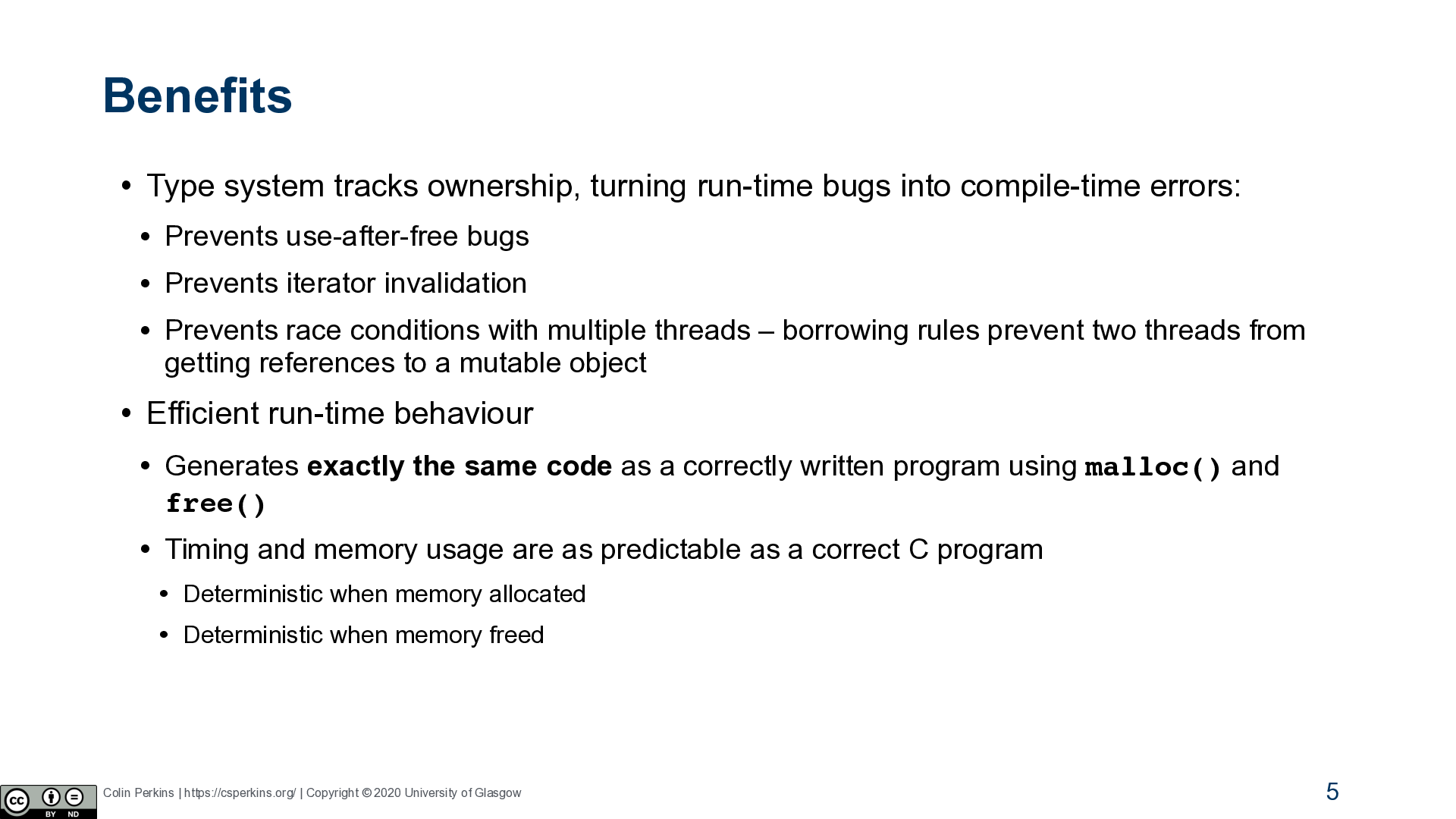
Rust prevents use-after-free bugs by making it
00:05:52.433
impossible to return references to data to
00:05:55.266
outlive the data being referenced.
00:05:58.000
Rust prevents iterator invalidation, by making it
00:06:01.100
impossible to change the object being iterated
00:06:03.500
over whilst the iterator exists.
00:06:06.500
And Rust prevents race conditions between multiple
00:06:09.000
threads, because the rules about pointers make
00:06:11.366
it impossible for two threads to each
00:06:13.533
have a mutable reference to the same object.
00:06:16.900
All these behaviours are checked at compile time.
00:06:21.466
And Rust has efficient run-time behaviour.
00:06:25.000
The Rust compiler generates exactly the same
00:06:27.533
code to allocate and free memory as
00:06:29.766
would a correctly written C program using
00:06:31.866
malloc() and free(). The difference is that
00:06:35.166
the compiler ensures the malloc() and free()
00:06:37.733
calls are in the correct places.
00:06:40.000
As a result the timing and memory
00:06:43.100
usage of Rust code is a predictable
00:06:45.833
as a correctly written C program.
00:06:48.866
Rust is deterministic in when memory is
00:06:51.100
both allocated and freed.
00:06:55.766
The region-based approach to memory management used
00:06:58.233
by Rust has some limitations though.
00:07:02.000
Primarily, Rust ensures correctness by limiting the
00:07:05.266
types of program it’s possible to write.
00:07:08.666
The rules about ownership and borrowing
00:07:10.800
make it impossible to express certain
00:07:12.833
data structures in safe Rust.
00:07:15.600
For example, it’s not possible to write
00:07:18.366
code that uses data structures that contain
00:07:20.500
reference cycles.
00:07:23.000
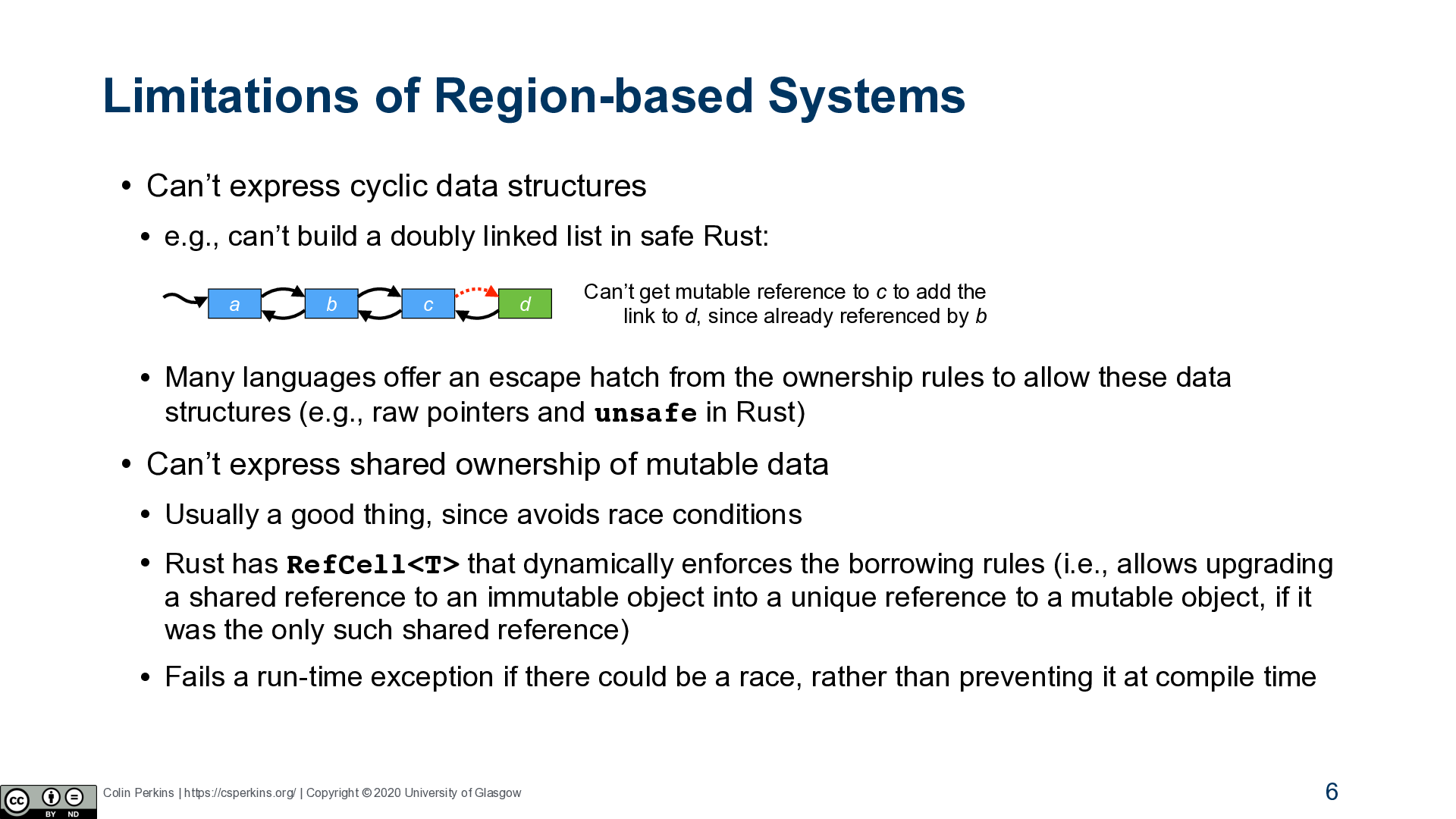
The canonical example of this, is that
00:07:25.300
it’s not possible to write a doubly
00:07:26.933
linked list in safe Rust. If you
00:07:30.100
look at the example of the slide,
00:07:32.166
where you have a list containing elements
00:07:33.833
a, b, and c, you’ll see that
00:07:36.366
it’s not possible to add an element,
00:07:37.933
d, to the end.
00:07:40.266
You can take an immutable reference to
00:07:42.133
element c, and add it to element
00:07:44.333
d. This works, since Rust allows two
00:07:47.533
immutable references to C to exist –
00:07:50.266
one from element b and one from element d.
00:07:54.000
What you can’t do, though, is take
00:07:56.500
a mutable reference to element c,
00:07:58.200
in order to modify it to add
00:07:59.900
a reference to element d. This is
00:08:03.000
because there’s already an immutable reference to
00:08:05.266
element c, held by element b,
00:08:07.966
and you can’t have both mutable and
00:08:09.733
immutable references to the same object.
00:08:13.133
The restrictions on references that prevent race
00:08:15.833
conditions, iterator invalidation, and so on,
00:08:19.000
also prevent cyclic data structures.
00:08:22.000
And it’s not just doubly linked lists.
00:08:25.000
They prevent any data structure that contains
00:08:27.266
a loop of pointers.
00:08:29.533
It’s a fundamental limitation of the way
00:08:31.466
references work in Rust. It trades expressive
00:08:34.933
power for safety.
00:08:38.000
The designers of Rust recognised this,
00:08:40.100
and added an escape hatch.
00:08:43.000
Rust also has a third type of
00:08:45.133
reference, known as the raw pointer.
00:08:48.700
Raw pointers work just like pointers in
00:08:50.900
C. They allow you to circumvent the
00:08:53.533
restrictions that Rust imposes on mutable and
00:08:56.066
immutable references, and make it possible to
00:08:59.366
write cyclic data structures in exactly the
00:09:01.666
same way you would do so in C.
00:09:04.333
Of course, by allowing you to circumvent
00:09:06.666
these restrictions, you lose the safety guarantees
00:09:09.400
of Rust. A Rust program that uses
00:09:12.733
raw pointers is as likely to suffer
00:09:14.766
from memory safety issues, such as use
00:09:17.200
after free bugs, iterator invalidation, and race
00:09:20.000
conditions, as is a C program.
00:09:24.000
To make this clear, Rust requires use
00:09:27.033
of raw pointers to be explicitly labelled
00:09:29.200
as unsafe in the code. It warns
00:09:32.366
the programmer, and makes it easy to find such uses.
00:09:36.633
There’s a second limitation of safe Rust,
00:09:39.366
which is that it can’t express shared
00:09:41.266
ownership of mutable data.
00:09:44.000
Shared ownership of immutable data is straight-forward.
00:09:48.200
It’s okay for many different references to
00:09:50.600
point to an object that cannot change.
00:09:53.466
Shared ownership of mutable data is problematic,
00:09:56.466
though, because it potentially open up race
00:09:59.066
conditions. This is why Rust only allows
00:10:02.300
a single mutable reference to a value
00:10:04.200
to exist at once.
00:10:06.866
But, occasionally, rarely, you need shared mutable state.
00:10:12.066
If you do, Rust has a RefCell-of-T
00:10:15.133
type. This wraps some value of type
00:10:18.400
T, and dynamically enforces the borrowing rules.
00:10:22.100
That is, it allows callers to borrow,
00:10:24.800
or mutably borrow, the wrapped value,
00:10:27.600
and enforces at run time that there
00:10:29.833
can only be immutable borrows, or a
00:10:32.366
single mutable borrow, but not both.
00:10:35.666
The RefCell type provides essentially the same
00:10:38.700
guarantees as the regular Rust borrowing rules,
00:10:41.366
but enforced at run time rather than
00:10:43.633
at compile time. This means that attempts
00:10:46.533
to take, for example, several mutable references
00:10:49.366
to the wrapped object, will cause a
00:10:51.366
panic when the code executes, rather than
00:10:53.666
failing to compile.
00:10:56.000
The RefCell is safe,
00:10:57.633
in that it never causes undefined behaviour,
00:11:00.433
but it can cause a run time failure.
00:11:05.266
Possibly the biggest issue with region-based memory
00:11:08.200
management, though, is that it forces the
00:11:10.866
programmer to consider object ownership explicitly,
00:11:13.966
and early in the design.
00:11:17.000
To what extent this is a problem
00:11:19.233
depends, I think, on your background.
00:11:22.500
If you’re experienced at programming in C,
00:11:24.866
this tends to be a non-issue.
00:11:27.500
Writing correct C programs also requires careful
00:11:30.633
consideration of data ownership, to know what
00:11:33.366
functions malloc() data and what functions free()
00:11:35.966
that data. Rust essentially codifies and enforces
00:11:39.433
the rules that well-written C programs tend
00:11:42.100
to adopt anyway.
00:11:44.700
If you’re experience is rather with a
00:11:46.500
language like Python or Java, where the
00:11:49.366
use of a garbage collector or reference
00:11:51.266
counting hides a lot of the complexity
00:11:53.166
of memory management, then needing to start
00:11:55.833
thinking about ownership is more of a
00:11:57.666
burden. In this case, programming effectively in
00:12:01.400
Rust may require a shift in your thinking.
00:12:06.733
That concludes our introduction to region-based
00:12:09.100
memory management.
00:12:10.666
This is one of the more unusual features of Rust.
00:12:14.566
It provides an efficient
00:12:16.166
and predictable way of managing memory,
00:12:18.266
and offers strong correctness guarantees that can
00:12:20.566
prevent many common bugs.
00:12:23.300
But it does so by constraining the
00:12:25.333
types of program that can be written,
00:12:27.000
and by making the programmer explicitly consider
00:12:29.300
data ownership.
00:12:31.233
It’s a trade-off that works well for
00:12:33.233
some types of problem, but less well for others.
00:12:39.300
The ownership rules of Rust can also
00:12:41.766
be useful for resource management.
00:12:46.000
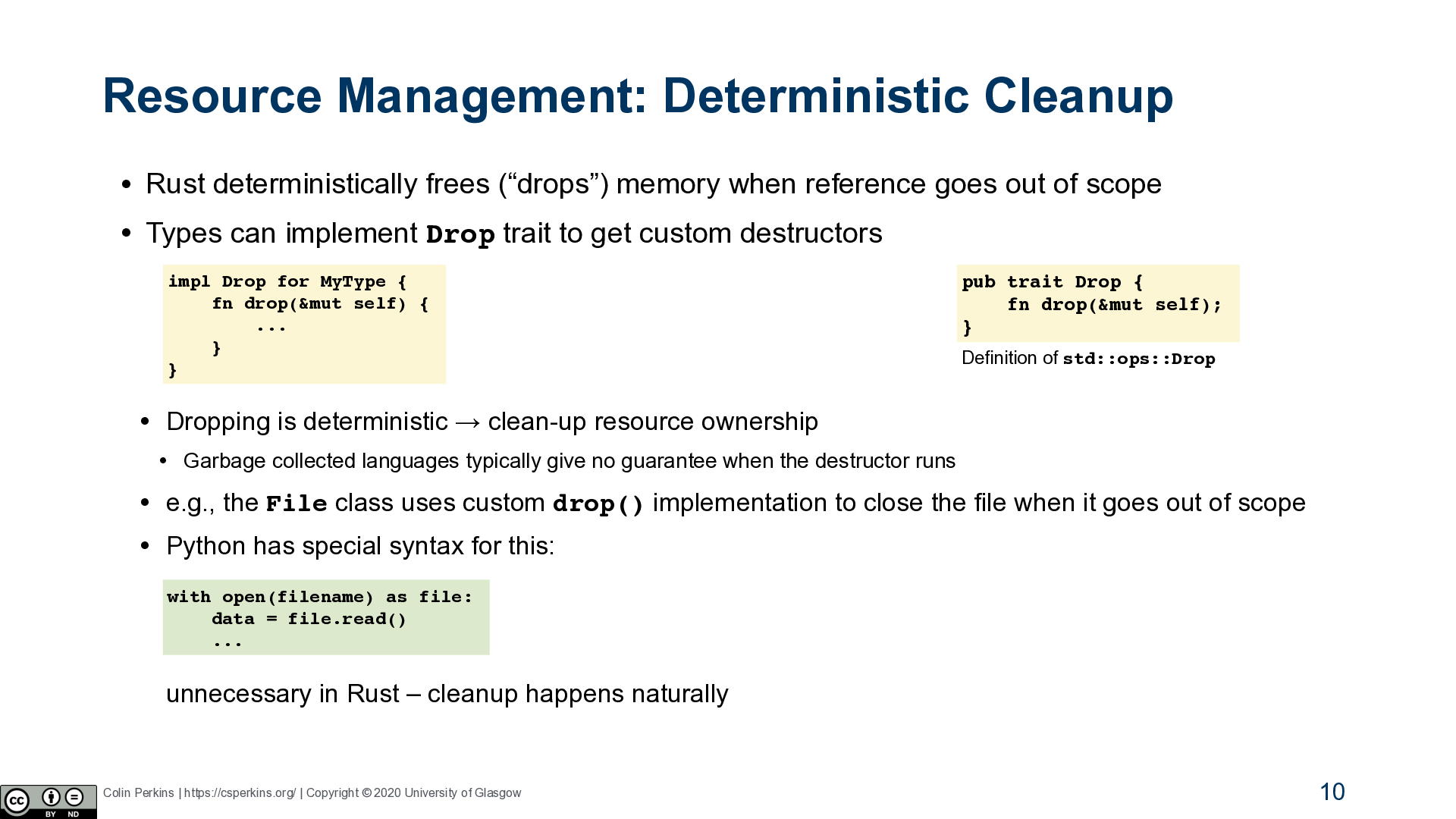
As we’ve seen, Rust tracks data ownership,
00:12:49.166
and deterministically frees heap allocated memory when
00:12:52.300
references to that memory go out of scope.
00:12:55.533
Particular types can use this ownership tracking
00:12:58.166
to implement custom destructors that provide deterministic
00:13:01.366
clean-up of resources they own.
00:13:04.433
If a type implements the Drop trait,
00:13:06.766
then the runtime will call the drop()
00:13:08.800
method on instances of that type at
00:13:10.966
the end of their lifetime, when they
00:13:12.700
go out of scope. This allows those
00:13:15.900
instances to clean-up after themselves.
00:13:19.000
For example, the File class implements the
00:13:21.866
Drop trait to close the underlying file
00:13:24.366
when file objects go out of scope.
00:13:28.000
Python has special syntax for this,
00:13:30.200
as shown on the slide. In Rust,
00:13:33.466
much like in C++, the cleanup happens
00:13:36.700
naturally when the object goes out of
00:13:38.300
scope, without the explicit syntax.
00:13:43.000
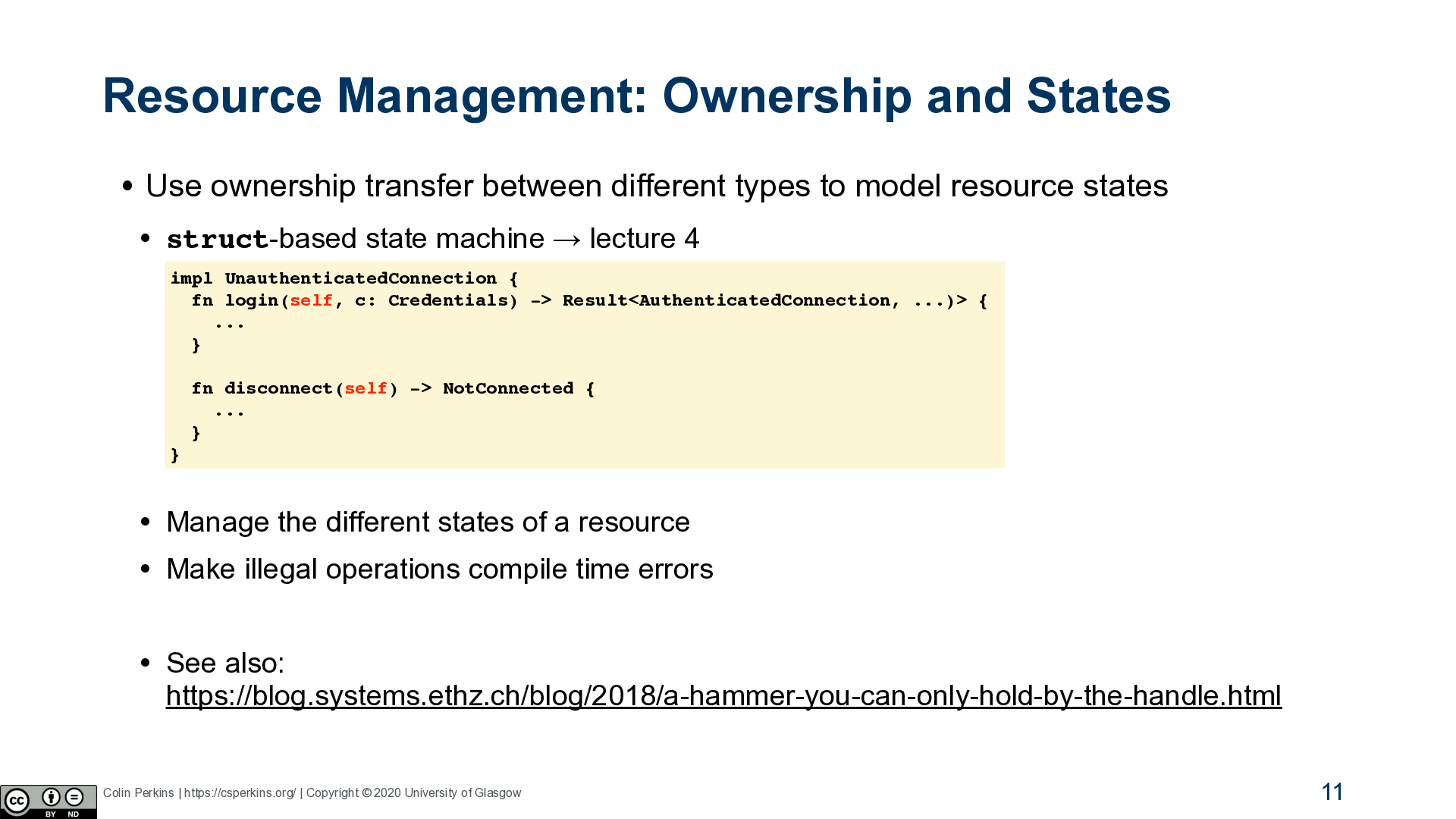
Finally, as we saw in the discussion
00:13:45.666
of struct-based state machines in Lecture 4,
00:13:48.866
ownership tracking allows state transitions to be enforced.
00:13:53.500
A state machine can be defined using
00:13:55.666
structs to represent the state, and to
00:13:58.333
hold any needed state variables. And state
00:14:01.433
transitions can be implemented by defining functions
00:14:04.033
on those structs that consume self,
00:14:06.166
and return a new state.
00:14:08.966
The slide shows an example, where methods
00:14:11.966
login() and disconnect() are implemented on an
00:14:15.066
UnauthenticatedConnection struct.
00:14:18.366
Note that both of these take self
00:14:20.866
as their first parameter, not &self.
00:14:24.066
That is, they take ownership of the
00:14:26.400
struct on which they’re implemented, rather than
00:14:28.600
borrow that struct.
00:14:31.300
This means they consume self. They destroy
00:14:34.333
the object on which they’re called.
00:14:37.300
That is, they force the object representing
00:14:39.600
the state to be destroyed. And they
00:14:42.266
return ownership of a new object,
00:14:44.333
representing the new state of the system.
00:14:47.566
This forces the cleanup of any data
00:14:49.600
held by that state that’s not explicitly
00:14:51.700
copied to the new state. It enforces
00:14:54.500
a clean state transition.
00:14:57.600
The blog post linked talks about these
00:14:59.666
issues further, and I encourage you to read it.
00:15:04.766
That concludes the first part of our
00:15:06.466
discussion of memory and resource management.
00:15:09.866
We’ve looked at how processes are stored in memory.
00:15:12.466
How reference counting works,
00:15:14.333
and what are its strengths and weaknesses.
00:15:17.033
And how region based memory management is
00:15:19.133
used in Rust as an alternative.
00:15:22.333
In the next lecture,
00:15:23.566
we’ll move on to discuss garbage collection.
Discussion
Lecture 5 focussed on resource ownership and memory management. It
started by discussing how a process is laid out in memory, and what
memory needs to be managed. Then, it moved on to discuss the problem of,
and need for, automatic memory management in general terms, highlighting
that systems programmers tend to distrust automatic memory management,
yet suffer from the problems due to manual memory management.
The lecture then discussed reference counting. This is widely used in
both scripting languages, such as Python or Ruby, and in the Objective-C
runtime used on Apple's iPhone and Mac operating systems. It noted that
reference counting is relatively easy to understand, incremental, and
predictable, but suffers from relatively high overhead with small or
short-lived objects, and cannot collect cyclic data structures.
The lecture then focussed on the region-based memory management scheme
used by Rust. It noted that the language tracks ownership of data as it
moves between functions, and deterministically cleans up heap allocated
memory when the lifetime of an object ends. Region based memory
management achieves good, predictable, performance, and provides a number
of nice guarantees around absence of race conditions, use-after-free
bugs, iterator invalidation, and so on. But it comes at the cost of
making the type system considerably more complex, and in limiting the
types of programs that can be expressed.
Discussion will focus, primarily, on how the region based memory
management scheme works, and on its advantages and disadvantages.
The goal is to understand whether you think the benefits
outweigh the complexity introduced.