Digital Amphitheatre
An important motivation in the design of the Digital Amphitheatre was
providing a feeling of presence, so that all participants believe
they are in the same location i.e, an amphitheatre, a classroom or a
beachside resort. This necessitates removing differing
backgrounds from each participant, and substituting them with a common
background of choice.
Background Substitution
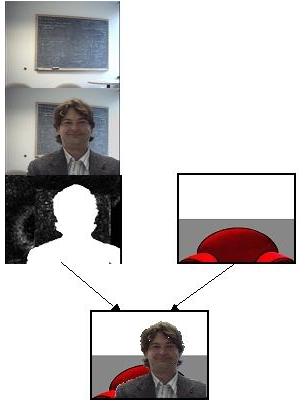
The background substitution process requires an initial background
image to use as a baseline for comparison. Once the camera has been
positioned and adjusted for use during the meeting, the participant
moves out of the field of view of the camera for a few seconds to
allow the software to collect several frames of the background. These
images are averaged together to provide a low-noise estimate of the
background.
After this brief training period, the participant returns to his seat.
The region of the current video image that has changed significantly
from the background is then segmented from the rest of the image,
allowing the background to be substituted, using a textbook background
segmentation algorithm.
A direct comparison between the current and background frames is made
difficult by features common to many commodity video cameras including
lighting changes, automated exposure, dynamic white balance, and
increased noise. For this reason, there is a scaling step in our
algorithm: we compare pixels primarily on their color, but allow the
apparent intensity to vary in order to compensate for changes in
brightness. The resulting distances are thresholded to produce a binary
mask labeling the pixels as foreground or background.
It is also possible that natural backgrounds, such as an office, contain
small regions that are difficult to distinguish from the foreground. We
apply morphological operators to the mask to compensate for small regions
of anomalous color match: the mask is eroded by a radius of two pixels
to remove most of the isolated regions caused by noise in the current
frame; the mask is then dilated by roughly twice the erosion radius to
fill in voids (an additional erosion step may be performed, depending
on the amount of noise in the image); the mask is finally eroded once
more such that the total number of erodes and dilates balance to zero
to restore the outer boundary of the foreground
We a low-complexity algorithm, with acceptable performance. Performance
suffers when the background is subject to large changes in lighting: a
more dynamic approach to updating the stored background image would
improve performance. The system also has to be retrained if the
background image changes, although fortunately training is a simple
process.